Bioluminescent fungi make their own light. It’s a steady green glow at roughly 520 to 530 nanometers, and every known glowing species belongs to a single order of mushrooms, the Agaricales. The most recent count, from a 2024 review in the Journal of Fungi, is 132 species. Plenty of websites still repeat figures between 64 and 80, which were right a decade or two ago and aren’t now.
This post covers how the light is made, which species are worth knowing (with an identification table), which ones can make you sick, why fungi evolved the trick at all, and how to go see it yourself.
Contents
- What counts as a glowing mushroom
- How bioluminescent fungi make light
- Six species worth knowing
- Toxicity: don’t eat what you find in the dark
- Why do mushrooms glow?
- From foxfire to glowing plants
- Where and when to see glowing mushrooms
- How to photograph them
- Summary
What counts as a glowing mushroom
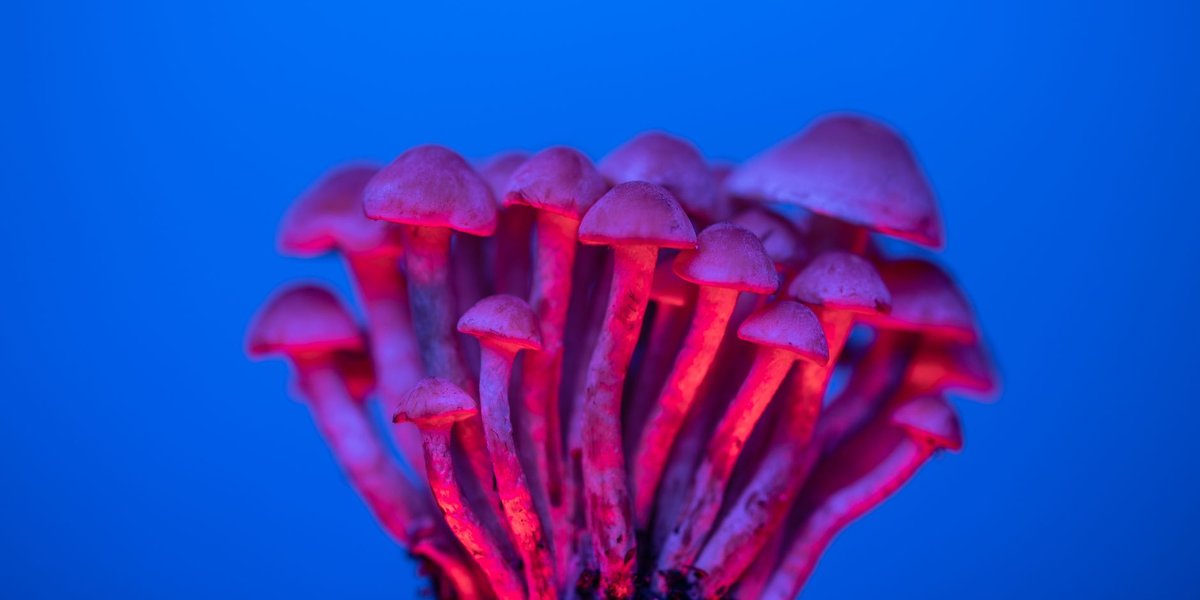
Two things get confused here. Bioluminescence is light produced by a chemical reaction inside the organism. Biofluorescence is light absorbed and re-emitted at a different color. Shine a UV torch on a forest floor and many fungi light up in blue, green, or orange. Turn the torch off and they go dark. That’s fluorescence, and it isn’t what this post is about.
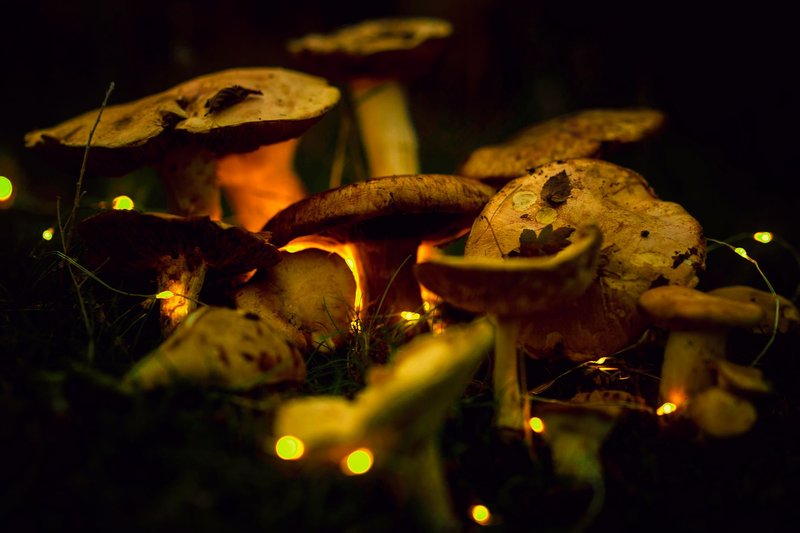
A bioluminescent fungus needs no outside light source. It glows in complete darkness, and the glow is faint. Dark-adapted eyes pick it up as a pale green smudge on a log. A phone camera set to auto sees nothing.
The 132 known species fall into four evolutionary lineages, all inside the Agaricales: the Armillaria (honey fungus) lineage, the Omphalotus lineage (jack-o’-lanterns), the Mycena and relatives lineage, and a smaller one called the Lucentipes clade. The Mycena group holds the most species by far, and most of them are tiny.
Which part glows depends on the species. In some, the cap and gills shine. In others, only the stalk. In honey fungus, the mushrooms mostly stay dark and the glow comes from the mycelium, the thread-like body that runs through rotting wood.
How bioluminescent fungi make light
The chemistry runs on a loop called the caffeic acid cycle, and it’s simpler than it sounds. It uses four enzymes and a compound most plants and fungi already make.
- Caffeic acid is the starting material.
- An enzyme called hispidin synthase converts it into hispidin.
- A second enzyme adds a hydroxyl group to make 3-hydroxyhispidin. This is the luciferin, the molecule that actually produces light.
- A luciferase enzyme reacts 3-hydroxyhispidin with oxygen. The reaction releases a photon of green light and leaves behind a spent product, caffeylpyruvate.
- A fourth enzyme converts caffeylpyruvate back into caffeic acid, and the cycle restarts.
The loop matters because it recycles its own fuel. The fungus doesn’t need to build a new luciferin every time. It reuses the same raw material continuously, which is part of why the glow can last for days in a log. It also needs oxygen, so the reaction is tied to the fungus’s metabolism, and a cold or dried-out specimen dims.
Compare this with fireflies, which use a completely different luciferin. Fungal bioluminescence evolved on its own, from a pathway built on common plant-type metabolites. That’s also why researchers could move the whole pathway into other organisms, which comes up below.
Six species worth knowing
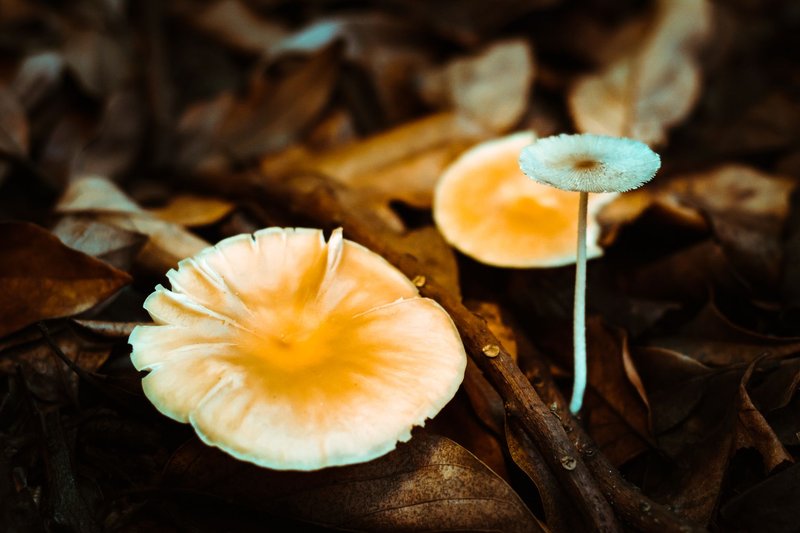
You won’t meet all 132. These six cover the range, from the one you can find in a North American woodlot to the one the Brazilian palm forests are known for.
| Species | Where | What glows | How to recognize it | Edible? |
|---|---|---|---|---|
| Omphalotus illudens (eastern jack-o’-lantern) | Eastern North America; relatives in Europe (O. olearius) and Australia (O. nidiformis, ghost fungus) | Gills, faintly | Orange, clustered at the base of stumps or on buried roots, gills run down the stalk | No, poisonous |
| Armillaria (honey fungus, several species) | Temperate forests worldwide | Mycelium in rotting wood; mushrooms rarely | Honey-colored caps with a ring on the stalk, in clumps on wood | Cooked only; dangerous look-alike |
| Panellus stipticus (bitter oysterling) | Eastern North America, parts of Europe and Asia | Whole fruiting body | Small tan fans, 1 to 3 cm wide, stacked on dead hardwood | No, bitter |
| Neonothopanus gardneri | Brazilian palm forests | Whole mushroom | Wide, funnel-shaped, yellowish; grows at the base of palms | Not recommended |
| Mycena chlorophos | Asia and Australasia | Cap and stalk, brightly | Tiny, 1 to 2 cm, pale cap on rotting wood and leaf litter | No |
| Other Mycena species | Every continent except Antarctica | Varies by species | Slender, bell-capped “bonnets” on logs and leaf litter | No |
A few notes on the ones that need more than a table cell.
Jack-o’-lanterns are the showpiece for a reason. Fresh Omphalotus clusters in the eastern United States stand out in daylight, and the glow in the gills is visible in a dark room if you give your eyes 20 minutes. They look enough like chanterelles that people eat them by mistake. More on that below.
Honey fungus is mostly known for what it does to trees. Armillaria is a root pathogen that spreads through soil as black, bootlace-like strands. The wood it infects can glow, and that glowing wood is what people historically called foxfire.
Panellus stipticus is easy to find and easy to overlook. The glow varies by population. The eastern North American strains are the reliable glowers, while many western populations barely produce light.
Neonothopanus gardneri gets the most attention from researchers because its glow follows a circadian rhythm. It brightens at night and fades by day, even when kept in constant conditions in a lab. That’s the clearest sign that the light isn’t a leak. Something is regulating it.
Mycena chlorophos is among the brightest glowing mushrooms. A cluster of them on a damp log in the tropics is the picture most people have in mind when they search for “glowing mushrooms.”
Toxicity: don’t eat what you find in the dark
Glowing doesn’t make a mushroom poisonous or safe. The light is unrelated to toxicity. But two of the best-known glowers carry warnings.
- Jack-o’-lantern mushrooms (Omphalotus) contain illudins, compounds that cause severe vomiting, cramps, and diarrhea. They’re commonly mistaken for chanterelles. The difference: chanterelles have blunt, forking ridges instead of true gills and usually grow singly from soil, while jack-o’-lanterns have sharp, thin gills and grow in tight clusters on wood.
- Honey fungus is eaten in many countries, but only after thorough cooking, and some people react badly even then. It also grows alongside Galerina marginata, a small brown wood-rotting mushroom with a similar look that contains amatoxins, the same class of poison found in death caps.
Other species, such as most Mycena and Panellus, are too small or too bitter to tempt anyone, but none are recommended as food. Treat every glowing mushroom as a look-but-don’t-eat find.
Why do mushrooms glow?
Nobody has a settled answer, and the main hypotheses aren’t mutually exclusive.
Insect attraction. The strongest experimental evidence supports this one. In a 2015 study on Neonothopanus gardneri, researchers placed green LED-lit fungus replicas and unlit replicas in a Brazilian forest. The glowing ones trapped more insects, including beetles, flies, wasps, and ants. A fungus that glows at night can recruit animals that carry spores away on their bodies, the way a bright fruit recruits birds.
Oxidative stress. Another hypothesis treats the light as a side effect of detoxifying reactive oxygen species. Fungal tissues make plenty of them, and the luciferase reaction consumes oxygen. If the pathway helps mop up damaging molecules, the light is a visible by-product of cellular housekeeping.
Accidental by-product. The simplest idea is that the glow does nothing. It could be an incidental result of enzymes doing other work. The problem with that view is the circadian control in N. gardneri. Evolution rarely bothers to put an accident on a clock.
Insect attraction has the best data, but it can’t explain every case. Many species glow only in the mycelium, buried in wood, where no insect will see it. The answer may differ by lineage, since bioluminescence appears to have arisen once in fungi and then been kept or lost across the family tree.
From foxfire to glowing plants
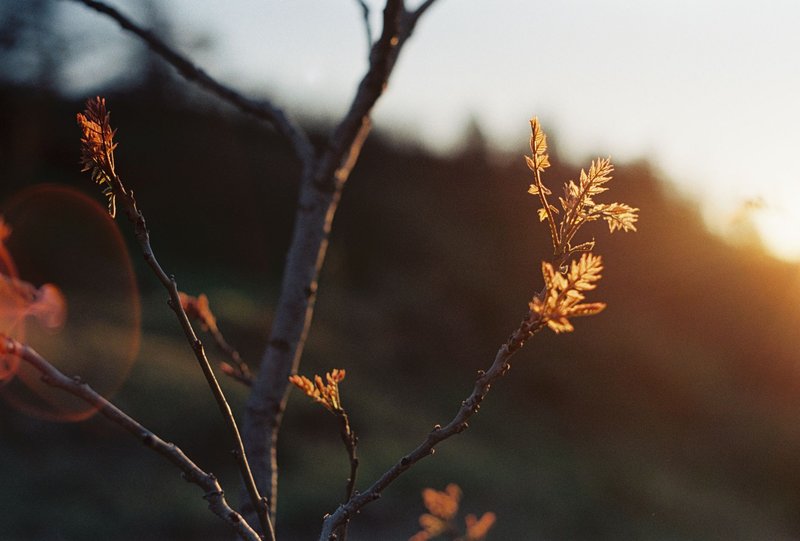
People noticed glowing wood long before they knew fungi were responsible. Aristotle and Pliny the Elder both wrote about the cold light given off by rotting timber. Later, foxfire was something villagers avoided, sailors and miners used as a faint light source, and soldiers reportedly stuck on their gear to avoid losing sight of each other in the dark.
The modern turn came in 2018, when a Russian-led team identified the genes behind the caffeic acid cycle and published the result in PNAS. Because the pathway starts from a molecule plants already make, the team could insert the genes into tobacco and make the plants glow without feeding them any added chemicals. Animal-origin systems, such as firefly luciferase, need an external supply of luciferin.
Applications followed:
- Research reporters. A self-contained light source lets scientists watch gene activity and plant health in living tissue without adding substrate.
- Glowing houseplants. A US company began selling a bioluminescent petunia in 2024 built on this fungal pathway.
- Biosensors. The same genes can in principle be wired to report stress, infection, or contamination as visible light.
None of that would exist without someone asking why a mushroom on a log was glowing.
Where and when to see glowing mushrooms
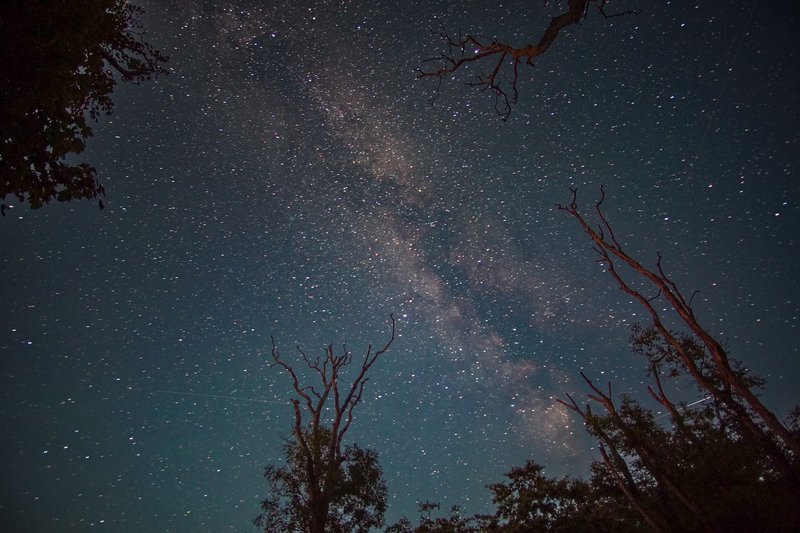
Glowing fungi aren’t rare, but you have to know the conditions.
When. Late summer through autumn gives you the best odds in temperate regions, a few days after steady rain. Fungi fruit when wood is damp and air is warm and humid. In the tropics, the wet season is the one to target. Go on a moonless or near-moonless night.
Where.
- Eastern North America. Dead oak and other hardwood logs in damp woodlots host Panellus stipticus and jack-o’-lanterns. Appalachian forests are reliable.
- Southeastern Australia and Tasmania. The ghost fungus, Omphalotus nidiformis, grows on dead wood in wet eucalypt forests, and its glow is easy to see in the dark.
- Japan, Taiwan, and Southeast Asia. Mycena chlorophos is the best-known glower, and several Mycena species grow in warm, humid forests.
- Brazil. The Atlantic forest and the palm-rich forests of the northeast hold Neonothopanus and Mycena species.
- Anywhere with old, rotting hardwood. Check logs and stumps for honey fungus. If the wood is soft and stringy, the glow might be in there.
How to look.
- Walk in with a headlamp, then turn it off. Better, switch it to red. White light resets your night vision.
- Wait 20 to 30 minutes. Dark adaptation takes that long, and the glow will appear gradually.
- Look at logs, stumps, and the base of trees. Scan sideways rather than straight on. Peripheral vision picks up dim light better.
- Go with someone and keep to marked trails. A forest at night is easy to get lost in.
Don’t collect specimens. Mushrooms on a log are the fruit of a larger organism, and picking them takes away your next visit’s glow.
How to photograph them
Your eyes are better at this than any camera, but a long exposure shows the green that your eyes only hint at.
- Tripod, no exceptions. Exposures run from 30 seconds to several minutes.
- Manual mode. Start at f/2.8 or wider, ISO 1600 to 3200, and 30 seconds. Adjust from there.
- Focus first. Autofocus fails in the dark. Pre-focus with a flashlight in daylight or at dusk, then switch to manual focus and leave it.
- Use the 2-second timer or a remote so pressing the shutter doesn’t shake the camera.
- Shoot RAW. The green is easier to adjust and noise is easier to handle.
- Add context with a brief flash of light. A quick pass with a dim torch during the exposure lights the log and surroundings without drowning the glow.
- Keep the torch away from the mushrooms. Strong light bleaches the glow temporarily.
Summary
Bioluminescent fungi are a small and very specific group: 132 known species, all in the Agaricales, all running the same caffeic acid cycle that turns 3-hydroxyhispidin and oxygen into green light. A handful are worth learning to identify, and two of them, jack-o’-lanterns and honey fungus, need caution if you’re tempted to cook what you find. Why they glow is still debated. Insect attraction has the strongest experimental support, and the circadian rhythm in some species shows the glow is regulated, not accidental. The best way to settle your own opinion is to go to a damp wood in late summer, switch off your torch, and wait for your eyes to adjust.