TLDR
Intrusive igneous rocks form when magma cools and hardens slowly underground. The slow cooling gives crystals time to grow large enough to see, so the rock looks speckled and coarse. Granite, diorite, gabbro, and peridotite are the main types. Rock from lava that cools at the surface (extrusive) is fine-grained or glassy instead.
Table of Contents
- What are intrusive igneous rocks?
- Why cooling speed controls crystal size
- Intrusive vs extrusive igneous rocks
- The common types of intrusive igneous rocks
- How to identify them in the field
- Intrusion shapes: batholiths, dikes, sills and more
- Famous examples of intrusive igneous rocks
- What we use them for
- FAQ
What are intrusive igneous rocks?
Intrusive igneous rocks are rocks that crystallize from magma beneath Earth’s surface. The magma pushes into existing rock, stalls, and cools over thousands to millions of years. Geologists also call them plutonic rocks, after Pluto, the Roman god of the underworld.
The signature feature is a coarse, interlocking crystal texture called phaneritic. In a phaneritic rock, the crystals are big enough to see without a magnifier, usually over 1 millimeter across. Look at a granite countertop and you’re looking at it: pink, white, and black grains locked together like a three-dimensional jigsaw.
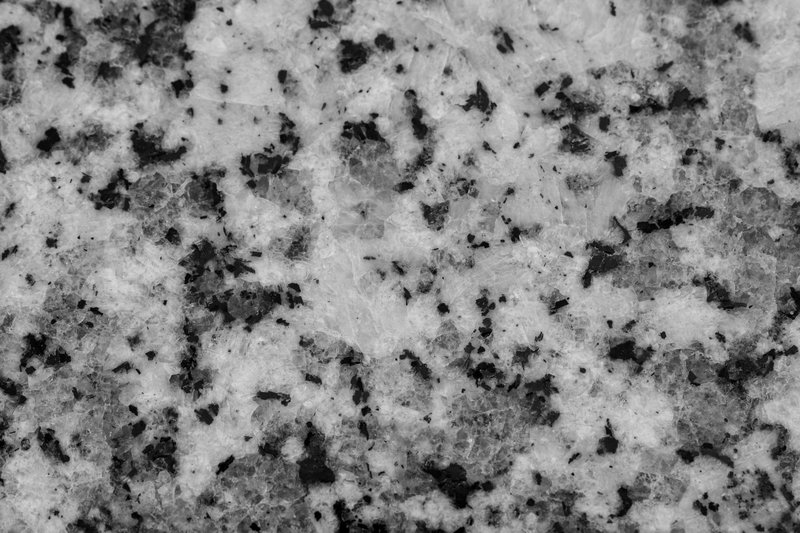
A body of intrusive rock is called a pluton. Plutons only show up at the surface after uplift and erosion strip away the rock that once covered them, which can take tens of millions of years. Every granite mountain you’ve ever seen was once buried several kilometers deep.
Why cooling speed controls crystal size
Crystals grow as atoms in the melt attach to a growing mineral grain. That takes time. Deep in the crust, surrounding rock acts as insulation, and a large magma body can take hundreds of thousands to millions of years to solidify. Each crystal gets room and time to grow, and the grains end up in the millimeter to centimeter range.
Small bodies cool faster. A thin dike, only a meter or so wide, can freeze in a matter of years, and its edges, which touch cold country rock, freeze almost at once. Geologists call those edges chilled margins. They show finer grains than the center of the same dike, which is a neat natural proof that cooling rate sets crystal size.
Some magmas start cooling deep, grow a few large crystals, then get pushed upward and finish cooling fast. The result is a porphyry: big crystals (phenocrysts) floating in a fine-grained matrix. It’s an in-between texture and a useful clue that the rock had a two-stage history.
Intrusive vs extrusive igneous rocks
The two families differ mainly in where the magma cooled. The chemistry can be identical. Granite and rhyolite have the same bulk composition, and so do gabbro and basalt. The cooling history that separates them is part of the wider story of how igneous rocks form and why they matter.
| Feature | Intrusive | Extrusive |
|---|---|---|
| Where it cools | Underground | At or near the surface |
| Cooling time | Thousands to millions of years | Seconds to months |
| Crystal size | Coarse, visible (phaneritic) | Fine or glassy (aphanitic or glassy) |
| Examples | Granite, diorite, gabbro | Rhyolite, andesite, basalt, obsidian |
| Typical landforms | Domes, cliffs, ridges after erosion | Lava flows, volcanic cones |
A quick test: if you can name the individual minerals with your naked eye, it’s almost certainly intrusive. If the rock looks like a uniform gray or black mass, or full of tiny bubbles, it’s extrusive.
The common types of intrusive igneous rocks
Geologists sort these rocks by silica content. Felsic rocks are rich in silica and light in color. Mafic rocks have less silica and more iron and magnesium, so they’re darker and denser. Ultramafic rocks sit at the far end, with very little silica.
| Rock | Composition | Color | Main minerals | Typical use |
|---|---|---|---|---|
| Granite | Felsic | Pink, gray, white with dark flecks | Quartz, potassium feldspar, mica | Countertops, monuments, building stone |
| Granodiorite | Felsic to intermediate | Light gray | Quartz, plagioclase, hornblende, biotite | Building stone, crushed aggregate |
| Diorite | Intermediate | “Salt and pepper” gray | Plagioclase, hornblende | Decorative stone, paving |
| Gabbro | Mafic | Dark gray to black | Plagioclase, pyroxene | Sold as “black granite,” road base |
| Peridotite | Ultramafic | Olive green | Olivine, pyroxene | Source of olivine and chromite ore |
| Pegmatite | Usually felsic | Varies, huge crystals | Quartz, feldspar, mica, plus rare minerals | Gems, lithium, mica, feldspar |
Pegmatite is the odd one out. It forms from the last watery, mineral-rich fluid left in a cooling magma, and that fluid lets crystals grow to extreme sizes. Individual crystals can reach several meters. Many gem minerals, including tourmaline and beryl, come from pegmatites.
Peridotite is rarely seen at the surface as a pure intrusion. Earth’s upper mantle is mostly peridotite, and slices of it get pushed up into mountain belts.
How to identify them in the field
Start with color, then look at the grains.
- Light-colored with visible quartz? Quartz looks glassy and gray, with no flat cleavage faces. Pink or white blocky grains next to it are feldspar. That’s granite.
- Medium gray, evenly speckled black and white, with no quartz? That’s diorite. Granodiorite looks similar but includes quartz.
- Dark gray to black and heavy? Check for pale plagioclase grains and dark pyroxene. That’s gabbro.
- Green and sugary, with a high density for its size? Peridotite, and the green mineral is olivine.
- Grains the size of your thumb or larger? Pegmatite, whatever the composition.
Density helps too. Granite has a density of about 2.7 g/cm³, while gabbro is closer to 3.0. Pick up two similar-sized samples and the gabbro feels noticeably heavier.
One trap: “black granite” in stone showrooms is typically gabbro or a similar dark rock. Commercial stone dealers lump anything hard and polishable under “granite.” Geologists don’t.
Intrusion shapes: batholiths, dikes, sills and more
Intrusive bodies come in several shapes. The name depends on size and on how the body cuts through the surrounding rock (called country rock).
- Batholith: A huge mass covering more than 100 square kilometers, usually made of many smaller pulses of magma merged together. These form the cores of mountain ranges.
- Stock: The same idea, smaller than 100 square kilometers.
- Dike: A sheet-like intrusion that cuts across the layering of the country rock. Think of a vertical wall of dark rock cutting through pale cliffs.
- Sill: A sheet that squeezes between layers and runs parallel to them. Look at the layers: if the intrusion follows them, it’s a sill.
- Laccolith: A lens or mushroom-shaped body that pushes the layers above it into a dome. The Henry Mountains in Utah are the classic example.
- Pipe: A roughly cylindrical, vertical conduit. Some of the world’s diamond mines are cut into kimberlite pipes.
Pieces of country rock that fall into a magma and don’t melt are called xenoliths (“foreign rocks”). Spotting dark xenoliths inside pale granite tells you the magma was moving through older rock when it solidified.
For a diagram-heavy, textbook-level explanation of pluton shapes, see the Physical Geology chapter on intrusive igneous rocks.
Famous examples of intrusive igneous rocks
Half Dome, Yosemite National Park, California. Mostly granodiorite, often loosely called granite. It’s part of the Sierra Nevada Batholith, and glaciers and exfoliation carved the sheer face you see today.
Sierra Nevada Batholith, California. One of the largest exposed batholiths in North America, running roughly 640 kilometers (400 miles) along the range. It’s a composite of hundreds of plutons that formed mostly during the Mesozoic Era.
Stone Mountain, Georgia. A bald dome of quartz monzonite, a granite relative, rising about 250 meters (825 feet) above the surrounding land. Its bare surface is what’s left after erosion stripped away everything above and around it.
Mount Rushmore, South Dakota. The four presidents are carved into granite, chosen partly because it erodes slowly, so details last.
The Palisades Sill, New York and New Jersey. A thick sheet of dark diabase, a fine-to-medium-grained relative of gabbro, forms the cliffs along the Hudson River. It’s a textbook sill.
Shiprock, New Mexico. The towering peak is the eroded remains of a volcanic neck, with radiating dikes extending outward across the desert.
What we use them for
Granite is the star. It’s hard, takes a polish, and resists weathering, so it ends up as countertops, curbs, floor tiles, bridge piers, and gravestones. Gabbro and diorite go into polished facing stone and crushed aggregate for roads.
Intrusions also carry ore. When a magma body cools, hot fluids release metals into surrounding rock. Porphyry copper deposits, which supply much of the world’s copper, form this way. Tin, tungsten, and gold deposits are often linked to granites. Pegmatites supply lithium minerals, feldspar for ceramics and glass, and mica. Peridotite hosts chromite, the only ore of chromium.
The University of Oregon’s igneous rock reference has a good classification chart if you want to place a specific sample.

FAQ
What is the main difference between intrusive and extrusive igneous rocks? Where the magma cools. Intrusive rocks cool underground and form large visible crystals. Extrusive rocks cool at the surface and have small crystals or glass.
Is granite the only intrusive igneous rock? No. Granite is the most familiar, but diorite, gabbro, peridotite, granodiorite, and pegmatite are all intrusive too.
Is granite the same as gabbro? No. Granite is light, rich in quartz and feldspar. Gabbro is dark, denser, and has no quartz. Both have visible crystals because both cool slowly underground.
What does phaneritic mean? A texture where crystals are large enough to see without magnification. All common intrusive igneous rocks have it.
Can intrusive rocks end up at the surface? Yes. Uplift and erosion strip off the covering rock, and the intrusive body becomes exposed. That’s how Half Dome and Stone Mountain got there.
What is a pluton? Any body of igneous rock that crystallized underground. Batholiths, stocks, sills, dikes, and laccoliths are all types of plutons.
Why do intrusive igneous rocks matter? They make up much of the continental crust, supply building stone, and host many metal ores.