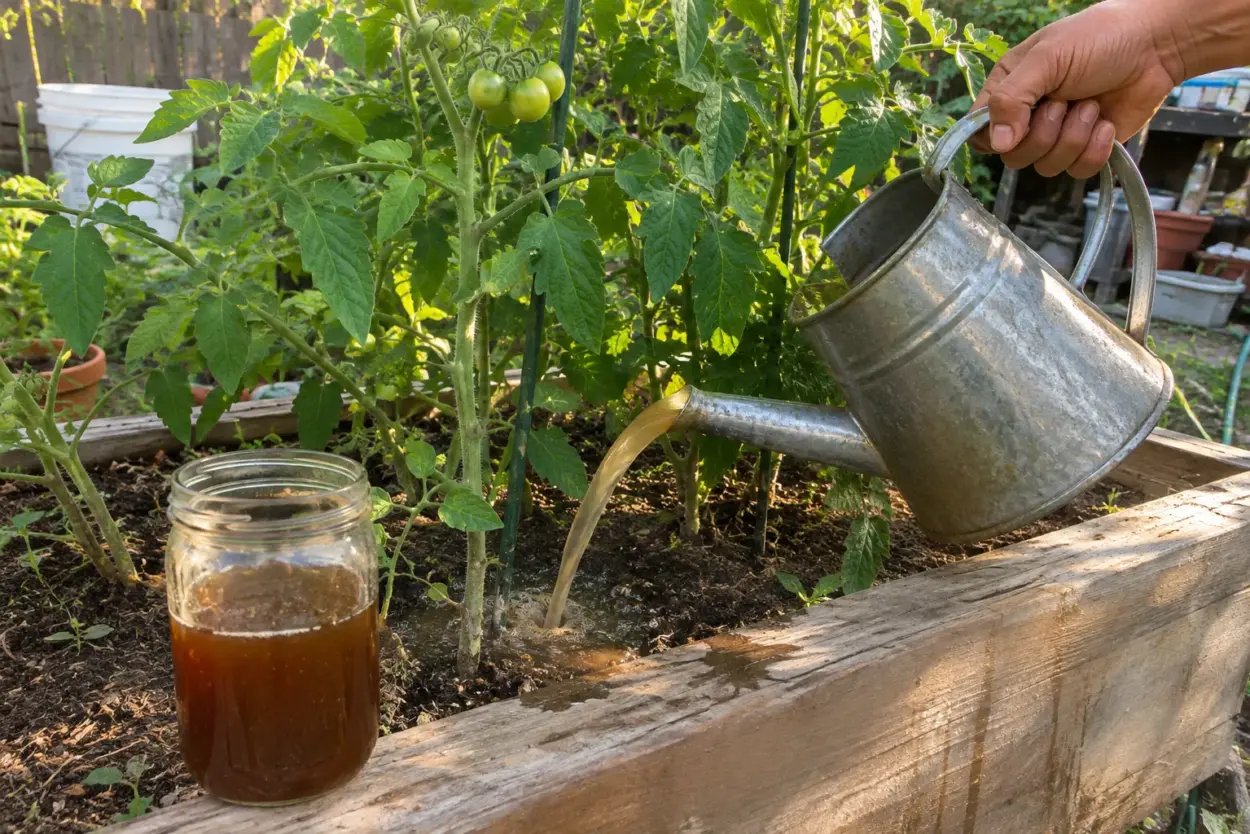
Short answer: pack a bucket with chopped comfrey, nettle or weed leaves, cover them with water (about 1 kg of leaves per 10 liters), lid it and let it ferment for 2 to 3 weeks. Strain it and dilute 1 part concentrate to 10 parts water before watering it onto the soil. Fresh urine diluted 1 part to 10 parts water works the same day and carries more nitrogen than any plant tea.
I keep a lidded bucket of comfrey steeping at the far end of the garden from late spring to early autumn, and it feeds every tomato and squash I grow. Homemade liquid fertilizer works because plants take up nutrients only as ions dissolved in water: a tea simply moves the soluble potassium and nitrogen out of leaves and into a watering can. This guide covers the four methods that hold up to testing, the dilution for each, what the popular kitchen-scrap recipes really deliver and the soil chemistry behind all of it.
At a glance
What you need
- 1 kg (2 lb) comfrey, nettle or weed leaves
- 10 L (2.5 gal) rainwater or tap water
- A 5-gallon bucket with a lid
- A brick or stone to hold the leaves under
- Gloves, a sieve and a watering can
Steps
- Chop the leaves and pack them into the bucket.
- Weigh them down and cover with water.
- Lid it and leave it 2 to 3 weeks, stirring weekly.
- Strain out the sludge.
- Dilute 1:10 with water and pour it on the soil.
The one rule
Dilute until the feed is the color of weak tea. That rule from the Royal Horticultural Society covers every homemade feed, because concentration varies from batch to batch and nobody at home can measure it.
This guide contains Amazon affiliate links. 33Science earns a commission on qualifying purchases. See our affiliate disclosure.
Liquid fertilizer methods compared
Each method extracts a different set of nutrients. Plant teas are potassium feeds, urine is a nitrogen feed and compost tea is a mild general feed. Pick by what the plant needs: leafy crops want nitrogen, fruiting crops want potassium once they flower.
| Method (ready in) | Feeds | Dilution |
|---|---|---|
| Comfrey tea (2 to 3 weeks) | Potassium: tomatoes, peppers, squash, flowers | 1:10 (1:20 for undiluted ooze) |
| Nettle or weed tea (2 to 3 weeks) | Nitrogen, some potassium: leafy greens, young plants | 1:10 |
| Diluted urine (same day) | Nitrogen: corn, cabbage, lawns, hungry crops | 1:5 to 1:10 |
| Compost or worm tea (1 to 2 days) | A little of everything: seedlings, houseplants | As is or 1:1 |
| Wood ash tea (1 day) | Potassium, raises pH: acidic soils only | Weak tea color |
Ingredients and tools
Comfrey leaves
About 7% potassium by dry weight
1 kg per 10 LThe classic. Russian comfrey leaves hold about 70 g of potassium per kg of dry matter, nearly twice a banana peel. The sterile Bocking 14 variety does not self-seed, and one plant gives three or four cuts a year.
Nettle, weeds or grass clippings
4% to 7% nitrogen by dry weight (clippings)
1 kg per 10 LStinging nettle, dandelion, chickweed and lawn clippings all work. Use leaves and stems, not seed heads, and skip anything sprayed with herbicide.
Human urine
3 to 7 g nitrogen per liter, about 90% as urea
1 part per 5 to 10 parts waterThe strongest homemade nitrogen source and sterile enough for a household to use on its own garden fresh. Roughly 7 parts nitrogen to 1 part phosphorus and 3 parts potassium.
Finished compost or worm castings
Castings range from 1-0-0 to 5-5-3
1 part per 5 parts waterMature, sweet-smelling compost or vermicompost only. Unfinished compost can carry pathogens from manure or food waste.
Why leaves turn to liquid
Fresh leaves are about 90% water. That is why the Royal Horticultural Society notes that comfrey packed into a container with no water at all still turns into liquid: the cells break down and release their own sap, along with the potassium dissolved in it.
Tools
- A 5-gallon bucket with a tight lid, or a water butt for big batches
- A brick, stone or plate to keep the leaves under water
- A sieve or paint strainer bag and a funnel
- Glass jars or old milk jugs for the strained concentrate
- Waterproof gloves (comfrey hairs irritate skin and the tea stains)
- A watering can and a measuring jug
How to make comfrey or weed tea fertilizer
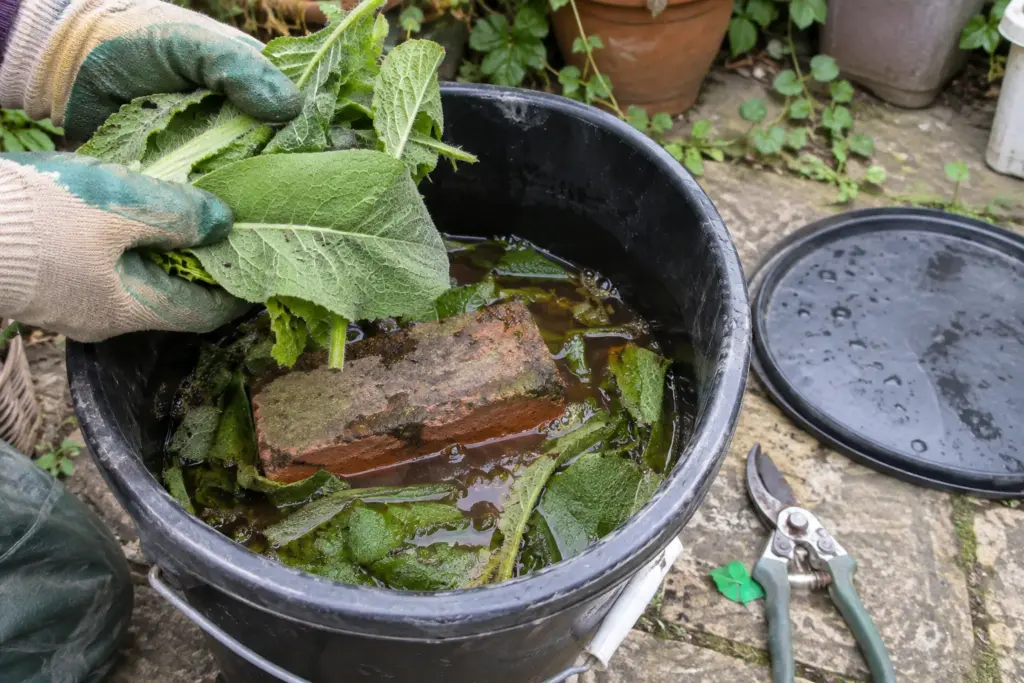
- Cut the leaves. Harvest comfrey just before it flowers, when the leaves are biggest, or pull nettles and weeds before they set seed. Wear gloves.
- Chop and pack. Chop the leaves roughly and pack about 1 kg (a loosely filled 5-gallon bucket is about right) into the bucket. Smaller pieces break down faster.
- Weigh down and cover. Put a brick on top and add 10 liters of water, rainwater if you have it. The leaves must stay under the surface.
- Lid it and wait. Fit the lid and leave the bucket somewhere away from the house for 2 to 3 weeks. Stir once a week. It is ready when the liquid is dark brown to black.
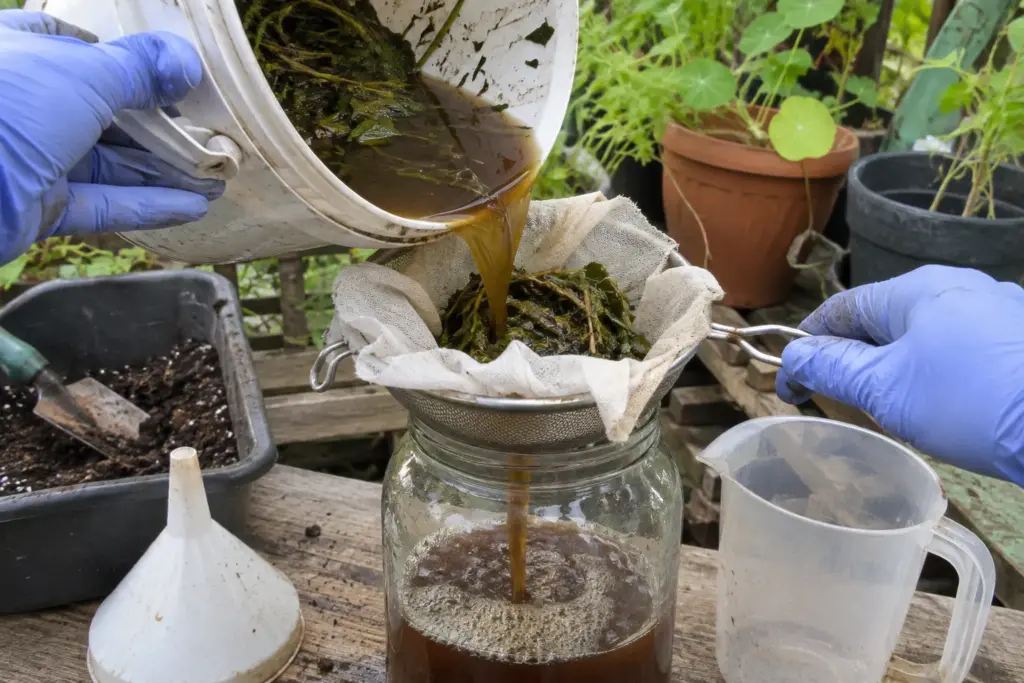
- Strain. Pour it through a sieve or strainer bag into jars. Put the sludge on the compost heap, where it speeds up decomposition.
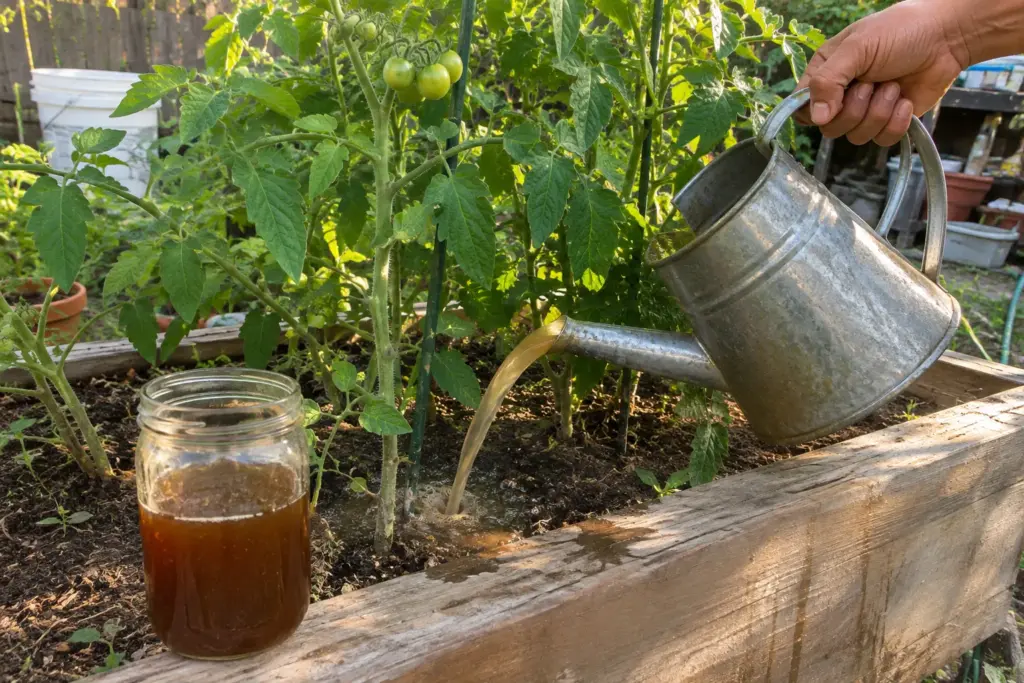
- Dilute and use. Mix 1 part concentrate with 10 parts water and water it onto the soil around the plants.
The no-water method
For a stronger, less smelly concentrate, pack chopped comfrey tightly into a container with a hole in the base, press it down with a weight and collect the black liquid that drips out over a few weeks. Because no water was added, dilute this one 1 part to 20.
About the smell
A bucket of comfrey steeped in water smells like a farmyard by week two. The smell comes from bacteria working without oxygen, and it does not harm the feed. A tight lid and a spot downwind of the house solve it. The no-water method smells far less.
How to use diluted urine as liquid fertilizer
Urine is the most effective homemade fertilizer by a wide margin and the only one with decades of agronomy trials behind it. One adult produces about 300 to 550 liters a year, carrying 2 to 3.5 kg of nitrogen, enough to fertilize 300 to 400 square meters of crops according to the Stockholm Environment Institute.
- Collect it fresh. Use a clean jug with a lid. Fresh urine from a healthy person contains few pathogens.
- Dilute it. Mix 1 part urine with 5 to 10 parts water. Use 1:10 for containers, seedlings and leafy greens, 1:5 for established garden beds.
- Apply to the soil. Pour it onto the soil beside the plants, not over the leaves. Drying urine leaves salts and ammonia behind that scorch foliage.
- Water it in. Follow with plain water or apply before rain. Ammonia escapes into the air if urine sits on the surface.
- Use it within a day. Diluted urine starts converting to ammonia within days and loses nitrogen to the air.
- Stop a month before harvest. Make the last application on crops eaten raw at least one month before picking.
How much: field guidance is about 1.5 liters of undiluted urine per square meter per growing season, split over several feedings. That works out to roughly 1.4 liters (6 cups) for a 10 square foot bed over the whole season, before dilution.
Salt builds up
Urine holds about 8.8 g of sodium chloride per liter. On sandy soil with regular rain the salt washes through, but in pots, greenhouses or dry climates it builds up. Flush containers with plain water once a month, and use urine on salt-tolerant crops such as cabbage, beets and corn rather than on beans or strawberries.
How to make compost tea or worm casting tea
Compost tea is a weak nutrient solution, not the disease cure it is often sold as. Dr. Linda Chalker-Scott of Washington State University reviewed the trials and found that aerated compost teas have no documented effect on plant disease. As a gentle feed for seedlings and houseplants it works fine.
- Fill a bag. Put about 2 cups of finished compost or worm castings into an old pillowcase or strainer bag.
- Steep it. Hang the bag in a bucket with 2.5 gallons (10 liters) of rainwater or tap water left to stand overnight. Steep for 24 to 48 hours, stirring a few times.
- Squeeze and use. Squeeze the bag out, return the compost to the garden and use the tea the same day, undiluted or cut 1:1 with water for seedlings.
Skip the molasses
Many recipes add molasses or sugar to “feed the microbes.” The University of Vermont Extension advises against it: sugar lets E. coli and Salmonella from the compost multiply in the tea. Without additives, compost tea poses little risk. Apply it to the soil, not to leaves you will eat.
Kitchen scrap fertilizers: what works and what does not
Banana peel water, coffee tea and Epsom salt spray fill gardening videos. The chemistry shows that most of them deliver very little, and one can do harm.
| Recipe | What it delivers | Verdict |
|---|---|---|
| Banana peel water | Peels are 3.6% to 4.5% potassium dry, but no published test shows how much reaches the water | Weak. Chop the peels and bury or compost them instead. |
| Coffee grounds tea | Grounds hold 1% to 2% nitrogen, mostly locked in organic matter; brewed grounds are pH 6.5 to 6.8 | Weak, and not acidic. Compost the grounds (under 20% of the pile). |
| Epsom salt water | Magnesium sulfate: 9.9% Mg, 13% S | Only for a confirmed magnesium deficiency: 1 tbsp per gallon. Excess blocks calcium uptake. |
| Wood ash tea | About 6% potash (K2O), pH 11.4 to 12.4 | Real potassium, but strongly alkaline. Only for soil below pH 6, never for blueberries or azaleas. |
| Eggshell water | Calcium carbonate, almost insoluble in neutral water | Nothing dissolves. Crush and compost. |
| Aquarium water | Ammonium and nitrate from fish waste | Good for houseplants if the tank is freshwater and untreated. |
Why soaking is not enough
A nutrient has to dissolve before a root can absorb it. Potassium in a banana peel sits in its cells as K+ and leaks out as the tissue breaks down, which takes weeks of rotting, not a day of soaking. Calcium carbonate in eggshells dissolves only in acid, so eggshell water is just water.
For wood ash, the Royal Horticultural Society suggests 100 g of sieved ash per 10 liters of comfrey concentrate to add potassium. Test your soil first: ash works as lime, and on neutral or alkaline soil it locks up iron and manganese.
How to dilute and apply liquid fertilizer
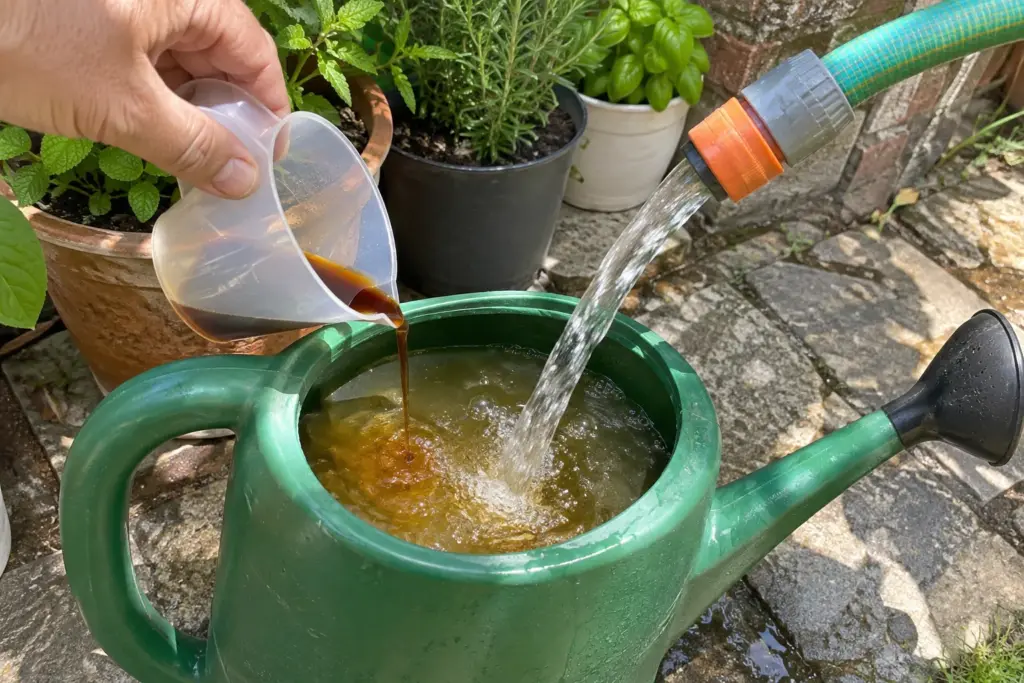
| Feed | Concentrate per gallon (per 10 L) | How often |
|---|---|---|
| Comfrey or weed tea (1:10) | 1½ cups (1 L) | Every 1 to 2 weeks while fruiting |
| No-water comfrey ooze (1:20) | ¾ cup (500 mL) | Every 1 to 2 weeks while fruiting |
| Urine, beds (1:5) | 3 cups (2 L) | Every 2 weeks, stop 1 month before harvest |
| Urine, pots and seedlings (1:10) | 1½ cups (1 L) | Every 2 weeks |
| Compost or worm tea | Undiluted or 1:1 | Every 2 weeks |
| Houseplants (any feed) | Half the rates above | Every 2 to 4 weeks, spring and summer only |
- Water dry soil first. Feeding a bone-dry pot concentrates salts against the roots. Moisten the soil, then feed.
- Pour on the soil. Apply around the base of the plant. The Royal Horticultural Society advises against spraying homemade feeds on leaves.
- Feed in the growing season. Plants absorb nutrients when they are growing. Stop feeding houseplants in winter, when they barely grow.
- Match the feed to the stage. Nitrogen-rich nettle tea or urine for leafy growth, potassium-rich comfrey once tomatoes, peppers and squash start to flower.
The science of liquid fertilizer
The science
Roots absorb nutrients only as dissolved ions: nitrogen as ammonium (NH4+) and nitrate (NO3−), phosphorus as phosphate (H2PO4− and HPO42−) and potassium as K+. A liquid fertilizer delivers those ions already dissolved, which is why it acts within days while a solid organic fertilizer waits for soil microbes to break it down.
What fermentation does to the leaves
Submerged leaves run out of oxygen within a day, and anaerobic bacteria take over. They break cell walls and digest proteins, releasing nitrogen as ammonium. Potassium needs no digestion at all: it is not bound into any molecule but floats free in the cell sap as K+, so it leaches out as soon as the cell membranes fail. That explains why comfrey tea is a potassium feed and why the Garden Organic trial found nothing more to extract after 30 days. Anaerobic breakdown of sulfur-containing amino acids also produces hydrogen sulfide, the source of the rotten-egg smell.
Urea becomes ammonium, then nitrate
About 90% of the nitrogen in urine is urea. Bacteria carrying the enzyme urease split it within days:
CO(NH2)2 + 2 H2O → NH3 + NH4+ + HCO3−
The ammonia raises stored urine to about pH 9 and escapes as gas, which is why old urine smells sharp and loses nitrogen. Diluting it, pouring it on the soil and watering it in keeps the ammonia in solution as ammonium, which clay and organic matter hold by its positive charge. In warm, airy soil, nitrifying bacteria then oxidize ammonium to nitrate:
NH4+ + 2 O2 → NO3− + 2 H+ + H2O
The two hydrogen ions on the right are why nitrogen feeds slowly acidify soil over years. Nitrate is also negatively charged, so soil particles cannot hold it and heavy watering washes it below the roots. Small, frequent feeds lose less than one big dose.
How strong is homemade liquid fertilizer?
Worked numbers for urine at 3 to 7 g of nitrogen per liter:
| Mix | Nitrogen per liter of feed | Nitrogen in ppm |
|---|---|---|
| Undiluted urine | 3 to 7 g | 3,000 to 7,000 |
| 1:5 (1 part in 6) | 0.5 to 1.2 g | 500 to 1,200 |
| 1:10 (1 part in 11) | 0.27 to 0.64 g | 270 to 640 |
| Fish emulsion 5-2-2 at 6 tbsp per gallon | about 1.2 g | about 1,200 |
A 1:5 urine dilution carries about the same nitrogen as commercial fish emulsion mixed at the Colorado State University rate (6 tablespoons, about 89 mL, of a 5% nitrogen product in 3.79 liters). Plant teas are weaker and vary more, which is why the color rule exists. A Garden Organic member trial still found home-brewed comfrey and nettle concentrates stronger than ready-to-use commercial feeds.
Reading N-P-K
The three numbers on a fertilizer label are percentages of nitrogen (N), phosphate (P2O5) and potash (K2O). Phosphorus and potassium are expressed as oxides for historical reasons. To get the actual element, multiply: P = P2O5 × 0.436 and K = K2O × 0.830. A 5-2-2 fish emulsion holds 5% N, 0.9% P and 1.7% K. See our examples of fertilizers with N-P-K values for common products.
Myth: more fertilizer means faster growth
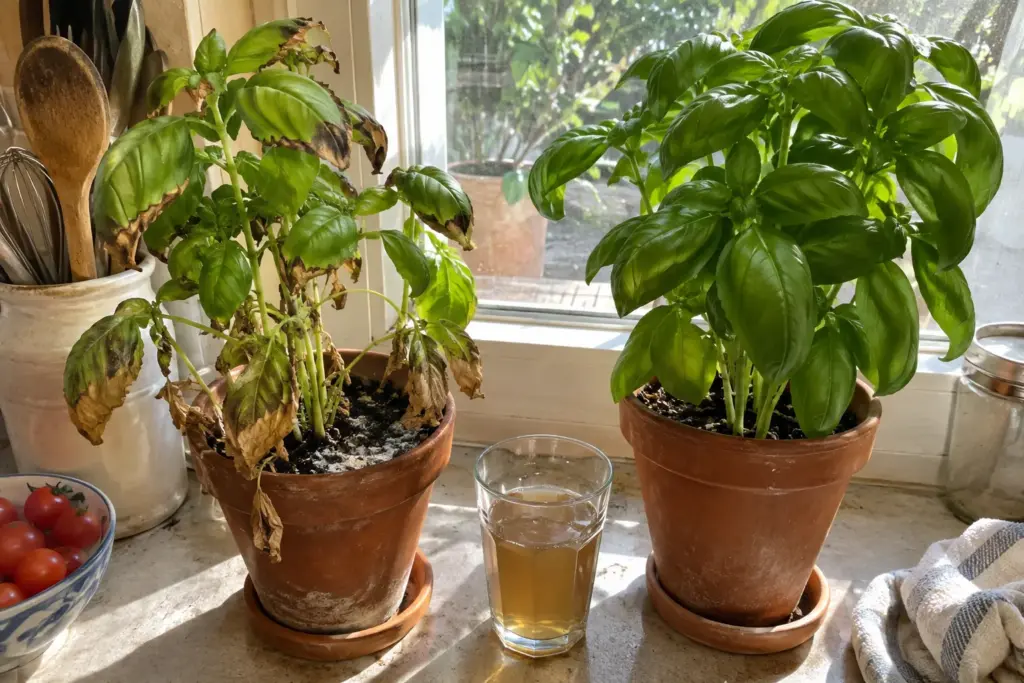
Every fertilizer is a salt solution. When the dissolved salt around the roots exceeds the concentration inside the root cells, osmosis runs backward and water leaves the roots. The plant wilts in wet soil, leaf edges brown and a white crust forms on the pot surface. Undiluted urine and strong teas cause this within days. Dilution is the whole point of the recipe.
Troubleshooting
| Problem | Cause | Fix |
|---|---|---|
| Brown, crispy leaf edges after feeding | Fertilizer burn: too concentrated or applied to dry soil | Flush pots with twice their volume of water; dilute further next time |
| White crust on the soil | Salt buildup from frequent feeding or urine | Leach every 4 to 6 months with twice the pot volume of water |
| Lots of leaves, few tomatoes | Too much nitrogen during fruiting | Switch from urine or nettle to comfrey once flowers form |
| Lower leaves yellow, veins stay green | Possible magnesium deficiency | Soil test, then Epsom salt at 1 tbsp per gallon |
| Lower leaves yellow all over | Nitrogen deficiency | Feed with diluted urine or nettle tea |
| Tea smells unbearable | Anaerobic fermentation | Normal. Tighter lid, move it downwind, or use the no-water method |
| Mosquito larvae in the bucket | Open water standing for weeks | Keep the lid on; a mesh cover works too |
Never double up
Doubling the dose to catch up on a missed feed is the mistake that kills potted plants. Salt damage to roots shows up a few days later, and by then the roots are already gone. Feed weak and often.
Safety
Before you start
- Comfrey is toxic to eat. It contains pyrrolizidine alkaloids that damage the liver. Keep the plant and the tea away from children and pets.
- Stinging nettle hairs inject histamine and formic acid. Wear gloves until the leaves are fully soaked.
- Urine on food crops: use only the household’s own urine on its own garden, apply it to the soil and stop at least one month before harvesting crops eaten raw (WHO and Stockholm Environment Institute guidance). Do not use urine from anyone with a urinary tract infection or on medication.
- Compost tea: no sugar or molasses, use finished compost only, and keep it off lettuce and herbs close to harvest.
- Wood ash is strongly alkaline (pH above 11). Wear gloves and avoid getting it in eyes.
- Label every jar. A jar of brown liquid in the shed looks like many other things.
Strained sludge goes on the compost heap. Leftover diluted feed can be poured onto any bed, never into a storm drain: nitrogen and phosphorus feed algae in streams. Concentrate keeps a few months in a closed jar but loses strength, so make it in batches you will use within the season.
For dry and slow-release options, see our guide to natural fertilizers: what to use, how much and when, and for why manure needs composting first, our composting myths article. The chemistry of ammonium, nitrate and urea is covered in nitrogen compounds explained.
More practical science: browse all our everyday science how-tos, from household chemistry to experiments you can build at home.
Frequently asked questions
Diluted urine is the easiest: mix 1 part fresh urine with 10 parts water and pour it on the soil the same day. For a plant-based option, steep comfrey or nettle leaves in water for 2 to 3 weeks and dilute 1 to 10.
Pack about 1 kg of chopped weed leaves into a bucket, weigh them down, cover with 10 liters of water and leave it lidded for 2 to 3 weeks. Strain it and dilute 1 part to 10 parts water. Use leaves without seed heads.
About 1 kg of leaves to 10 liters of water, steeped 2 to 3 weeks, then diluted 1 part concentrate to 10 parts water. Concentrate made by packing leaves with no water is diluted 1 to 20.
For nitrogen and potassium it can be. Diluted 1 to 5, urine carries about the same nitrogen as fish emulsion mixed at the usual label rate. Homemade feeds vary from batch to batch and supply little phosphorus.
Very little. Banana peels contain about 4 percent potassium by dry weight, but it is released as the peel rots, not during a short soak. Burying or composting the peels feeds plants better.
Every 1 to 2 weeks for vegetables during the growing season and every 2 to 4 weeks at half strength for houseplants in spring and summer. Do not feed houseplants in winter.
Bacteria break down the submerged leaves without oxygen and release ammonia and sulfur compounds such as hydrogen sulfide. The smell does not harm the fertilizer. A tight lid and a spot away from the house help.
Not homemade ones. The Royal Horticultural Society advises against spraying homemade feeds on foliage, and urine leaves salts that scorch leaves as it dries. Apply them to the soil.
Strained comfrey or weed concentrate keeps a few months in a closed container but slowly loses strength. Diluted urine and compost tea should be used the same day.
Only for plants with a confirmed magnesium deficiency, at about 1 tablespoon per gallon. Extension services recommend a soil test first because excess magnesium blocks calcium uptake.
Sources
- Royal Horticultural Society. Homemade fertilisers
- Royal Horticultural Society. Making comfrey feed
- Garden Organic. Does comfrey liquid feed live up to its claims?
- Richert et al. (2010). Practical Guidance on the Use of Urine in Crop Production. Stockholm Environment Institute
- Frontiers in Environmental Science (2022). Nitrogen losses from urine stabilized with base
- Chalker-Scott, L. Washington State University. The Myth of Compost Tea
- University of Vermont Extension. Compost tea for organic farming
- Colorado State University Extension. Organic fertilizers
- Penn State Extension. How much phosphorus and potassium are really in your fertilizer?
- Oregon State University Extension. Coffee grounds and composting
- Chalker-Scott, L. Washington State University. The Myth of Epsom Salts
- Oklahoma State University. Wood ash as a soil amendment (PSS-2238)
- University of Nebraska-Lincoln Extension. Houseplant fertilization
- Feedipedia. Russian comfrey (Symphytum x uplandicum) composition