
Gold Au
- Boiling point2,856 °C
- Density19.28 g/cm³
- Specific heat129 J/(kg K)
- Heat of fusion63.7 kJ/kg
Source: PubChem Periodic Table; specific heat and heat of fusion: Wikipedia: Gold
Solid At 1,000 °C, gold is a solid. That is 64.18 °C below its melting point (1,064.18 °C).
Use Pin to compare to put up to 3 more materials on the same thermometer.
Which heat sources can melt gold? Melting point 1,064.18 °C
Hot enough to melt it (7)
- Oxy-acetylene torch3,480 °CMelts a small piece, which reaches about 3,100 °C
- MAPP / MAP-Pro torch2,020 °CMelts a small piece, which reaches about 1,250 °C
- Propane torch (in air)1,980 °CMelts a small piece, which reaches about 1,150 °C
- Induction furnace1,800 °CMelts a small piece, which reaches about 1,750 °C
- Propane forge1,370 °CMelts a small piece, which reaches about 1,300 °C
- Electric kiln1,300 °CGets hot enough
- Lava1,200 °CMelts a small piece, which reaches about 1,150 °C
Flame is hotter, a real piece will not get there (2)
- Butane torch1,430 °CThe flame is hotter, but a real piece won't reach it (flame +366 °C, a piece reaches about 1,000 °C)
- House fire1,100 °CThe flame is hotter, but a real piece won't reach it (flame +36 °C, a piece reaches about 1,000 °C)
Not hot enough (5)
- Candle flame1,000 °CFlame is not hot enough
- Campfire900 °CFlame is not hot enough
- Charcoal grill750 °CFlame is not hot enough
- Self-cleaning oven480 °CDoes not get that hot
- Kitchen oven260 °CDoes not get that hot
Flame temperature is not the temperature a piece of metal reaches. Heat loss to the air and the mass of the object mean a torch can be hotter than a melting point and still fail to melt a large piece.
Heat source temperatures and sources
- Oxy-acetylene torch: flame or air up to 3,480 °C; a small piece of metal reaches about 3,100 °C (approximate). Melts: cuts and welds steel, melts platinum and titanium; tungsten only barely. Acetylene burning in pure oxygen reaches about 3,480 C. Wikipedia: Adiabatic flame temperature
- MAPP / MAP-Pro torch: flame or air up to 2,020 °C; a small piece of metal reaches about 1,250 °C (approximate). Melts: brazing; a few grams of copper, silver or gold. MAPP gas flame, about 2,020 C in air. Wikipedia: Flame
- Propane torch (in air): flame or air up to 1,980 °C; a small piece of metal reaches about 1,150 °C (approximate). Melts: thin copper wire, small silver and gold pieces; not copper pipe or steel. Adiabatic flame temperature of propane in air is about 1,980 C. Real flames are cooler. Wikipedia: Adiabatic flame temperature
- Induction furnace: flame or air up to 1,800 °C; a small piece of metal reaches about 1,750 °C (approximate). Melts: steel, iron, nickel, platinum in small furnaces. Foundry induction furnaces reach 1,800 C and more. Wikipedia: Induction furnace
- Butane torch: flame or air up to 1,430 °C; a small piece of metal reaches about 1,000 °C (approximate). Melts: solder, a few grams of silver or gold for jewelry. Consumer butane torches are claimed to reach about 1,430 C in air. Wikipedia: Butane torch
- Propane forge: flame or air up to 1,370 °C; a small piece of metal reaches about 1,300 °C (approximate). Melts: aluminum, brass, bronze, silver, gold, copper; heats steel for forging but does not melt it. Gas forges run at about 1,260 to 1,370 C (2,300 to 2,500 F). Wikipedia: Forge
- Electric kiln: flame or air up to 1,300 °C; a small piece of metal reaches about 1,300 °C (approximate). Melts: glass, silver, gold, copper, brass, bronze. Hobby electric kilns top out near 1,300 C (cone 10 is 1,305 C). Wikipedia: Kiln
- Lava: flame or air up to 1,200 °C; a small piece of metal reaches about 1,150 °C (approximate). Melts: aluminum, silver, gold and copper in the hottest basalt flows. Erupting lava is 700 to 1,200 C. Wikipedia: Lava
- House fire: flame or air up to 1,100 °C; a small piece of metal reaches about 1,000 °C (approximate). Melts: aluminum, glass, lead, zinc, sometimes brass; gold jewelry usually survives. Room temperatures reach 600 C at flashover and can pass 1,000 C in a developed fire. Wikipedia: Flashover
- Candle flame: flame or air up to 1,000 °C; a small piece of metal reaches about 350 °C (approximate). Melts: wax, chocolate, solder wire, tin foil edges. The bulk of a candle flame is near 1,000 C; hot spots reach 1,300 to 1,400 C. Wikipedia: Flame
- Campfire: flame or air up to 900 °C; a small piece of metal reaches about 750 °C (approximate). Melts: lead, zinc, aluminum cans in a crucible with good airflow. Typical wood fire coals and flame, 600 to 900 C. The hottest wood flames reach about 1,000 C. Wikipedia: Flame
- Charcoal grill: flame or air up to 750 °C; a small piece of metal reaches about 700 °C (approximate). Melts: lead, zinc; aluminum only in a crucible with forced air. Charcoal fires burn at 750 to 1,200 C; the low end is used as the typical figure. Wikipedia: Flame
- Self-cleaning oven: flame or air up to 480 °C; a small piece of metal reaches about 480 °C (approximate). Melts: lead, zinc, everything a kitchen oven melts. The cleaning cycle runs at roughly 480 C (900 F). Wikipedia: Self-cleaning oven
- Kitchen oven: flame or air up to 260 °C; a small piece of metal reaches about 260 °C (approximate). Melts: chocolate, butter, wax, most plastics, tin (232 °C), 63/37 solder, pewter. Household ovens top out at about 260 C (500 F). Wikipedia: Oven
How to use the melting point calculator
Type a material into the search box or tap one of the popular chips. The calculator recognizes element names, chemical symbols (Au, Ag, Cu) and common spellings such as aluminium. The result card shows the melting point in Celsius, Fahrenheit and Kelvin, the boiling point when it is known, and the source of the value.
The thermometer below the result places the material next to common heat sources, from a kitchen oven to an oxy-acetylene torch. Three tabs answer the follow-up questions:
- Will it melt? Enter any temperature to see whether the material is solid, melting or liquid at that point.
- Energy to melt Enter a mass and a starting temperature to get the heat needed to bring the material to its melting point and melt it, in kJ, kWh, BTU and kcal, with the working shown.
- Alloys & karats For gold, silver, copper, iron, tin and aluminum, compare the pure metal with its common alloys, such as 14k gold, sterling silver, brass and stainless steel.
Use the compare button to pin up to three more materials on the same thermometer. Every result has its own link, so you can share “silver vs copper” or a finished energy calculation.
What is a melting point?
The melting point is the temperature at which a solid turns into a liquid at standard atmospheric pressure. At that temperature the solid and liquid phases exist together, and any heat you add goes into breaking the bonds of the solid instead of raising the temperature. That heat is the heat of fusion.
A pure crystalline substance melts at one sharp temperature. Mixtures do not. Alloys, glass, plastics, waxes and foods melt over a range: they start to soften at the solidus and are fully liquid at the liquidus. The calculator shows both numbers for these materials.
Three factors change a melting point:
- Purity. Impurities lower the melting point and widen the range. This is why chemists use melting point to check the purity of a sample.
- Pressure. Most solids melt at a higher temperature under pressure. Ice is an exception: pressure lowers its melting point slightly.
- Crystal form. Some substances have more than one solid form. Cocoa butter has six, which is why tempered chocolate melts at a different temperature than untempered chocolate.
Melting point and freezing point are the same temperature for a pure substance. The difference is direction: melting goes from solid to liquid, freezing from liquid to solid.
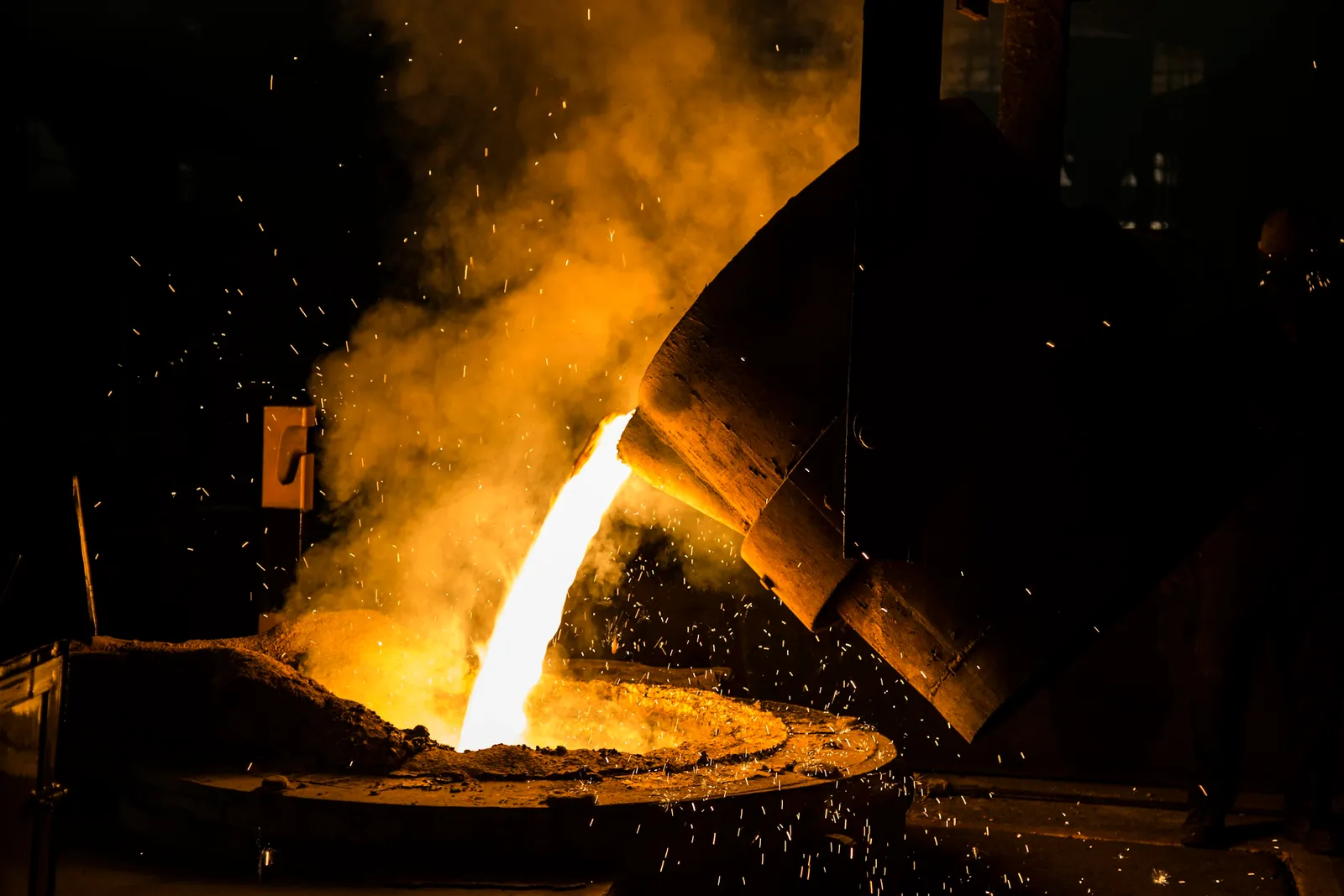
Melting points of common metals and materials
Values are at standard pressure. Pure elements are from the PubChem periodic table. Alloys and everyday materials show typical ranges, because their composition varies by manufacturer. Click a name to load it in the calculator.
| Material | °C | °F | K |
|---|---|---|---|
| Aluminum | 660.32 | 1,220.58 | 933.47 |
| Copper | 1,084.62 | 1,984.3 | 1,357.77 |
| Gold | 1,064.18 | 1,947.5 | 1,337.33 |
| Silver | 961.78 | 1,763.2 | 1,234.93 |
| Iron | 1,538 | 2,800 | 1,811 |
| Steel (carbon) | 1,425 – 1,540 | 2,597 – 2,804 | 1,698 – 1,813 |
| Stainless steel 304 | 1,400 – 1,450 | 2,552 – 2,642 | 1,673 – 1,723 |
| Cast iron | 1,127 – 1,204 | 2,061 – 2,199 | 1,400 – 1,477 |
| Lead | 327.46 | 621.4 | 600.61 |
| Tin | 231.93 | 449.5 | 505.08 |
| Zinc | 419.53 | 787.2 | 692.68 |
| Nickel | 1,455 | 2,651 | 1,728 |
| Titanium | 1,668 | 3,034 | 1,941 |
| Tungsten | 3,422 | 6,192 | 3,695 |
| Platinum | 1,768.4 | 3,215.1 | 2,041.55 |
| Palladium | 1,554.9 | 2,830.8 | 1,828.05 |
| Magnesium | 650 | 1,202 | 923 |
| Chromium | 1,907 | 3,465 | 2,180 |
| Brass (yellow) | 905 – 932 | 1,661 – 1,710 | 1,178 – 1,205 |
| Bronze (tin) | 854 – 999 | 1,569 – 1,830 | 1,127 – 1,272 |
| Sterling silver | 802 – 893 | 1,476 – 1,639 | 1,075 – 1,166 |
| 14k gold | 797 – 874 | 1,467 – 1,605 | 1,070 – 1,147 |
| 18k gold | 860 – 900 | 1,580 – 1,652 | 1,133 – 1,173 |
| Solder 63/37 | 183 | 361 | 456 |
| Mercury | −38.83 | −37.9 | 234.32 |
| Gallium | 29.76 | 85.6 | 302.91 |
| Water / ice | 0 | 32 | 273.15 |
| Salt (sodium chloride) | 801 | 1,474 | 1,074 |
| Sugar (sucrose) | 186 | 367 | 459 |
| Butter | 32 – 35 | 90 – 95 | 305 – 308 |
| Chocolate (dark) | 34 – 45 | 93 – 113 | 307 – 318 |
| Paraffin wax | 46 – 68 | 115 – 154 | 319 – 341 |
| Beeswax | 62 – 64 | 144 – 147 | 335 – 337 |
| Glass (soda-lime) | 726 – 1,005 | 1,339 – 1,841 | 999 – 1,278 |
| PLA plastic | 150 – 160 | 302 – 320 | 423 – 433 |
| HDPE plastic | 120 – 140 | 248 – 284 | 393 – 413 |
| Diamond / carbon | 3,642 (sublimes) | 6,588 (sublimes) | 3,915 (sublimes) |
| Rhenium | 3,186 | 5,767 | 3,459 |
| Osmium | 3,033 | 5,491 | 3,306 |
| Uranium | 1,135 | 2,075 | 1,408 |
Melting points of the most searched materials
Aluminum melting point
Pure aluminum melts at 660.32 °C (1,220.58 °F, 933.47 K). Common alloys melt lower and over a range: 6061 melts between about 582 and 652 °C (1,080 to 1,206 °F). Aluminum is the easiest structural metal to melt at home. A propane-fired furnace or a charcoal furnace with forced air reaches it, and so does a house fire, which is why aluminum car wheels and window frames are often found melted after a fire.
Copper melting point
Copper melts at 1,084.62 °C (1,984.32 °F, 1,357.77 K), about 20 °C above gold. A handheld propane torch flame is hotter than that, but copper conducts heat away so fast that a torch alone rarely melts more than a thin wire. Melting copper for casting takes a furnace and a graphite or clay crucible.
Steel melting point
Steel has no single melting point because it is an alloy of iron and carbon, often with chromium, nickel or manganese. Plain carbon steel melts between about 1,425 and 1,540 °C (2,600 to 2,800 °F). More carbon lowers the melting point. Stainless steel 304 melts between about 1,400 and 1,450 °C (2,550 to 2,650 °F). Steel loses about half of its strength near 600 °C (1,100 °F), long before it melts, which is why structural steel needs fire protection.
Gold melting point
Pure 24k gold melts at 1,064.18 °C (1,947.52 °F, 1,337.33 K). This temperature is one of the fixed points of the International Temperature Scale of 1990 (ITS-90). Karat gold is gold alloyed with silver, copper, zinc or nickel, and it melts lower: 18k yellow gold melts between about 860 and 900 °C and 14k yellow gold between about 800 and 875 °C, depending on the metals in the alloy. The karat gold section below has the full list.
Silver melting point
Fine silver melts at 961.78 °C (1,763.20 °F, 1,234.93 K). Sterling silver, which is 92.5% silver and 7.5% copper, melts between 802 and 893 °C (1,475 to 1,640 °F). The copper is what lowers the melting point and makes sterling harder than fine silver.
Iron melting point
Pure iron melts at 1,538 °C (2,800 °F, 1,811 K). Cast iron, with 2 to 4% carbon, melts much lower, between about 1,130 and 1,200 °C (2,060 to 2,200 °F). That lower melting point is why cast iron was poured into molds centuries before steel could be made in quantity.
Lead melting point
Lead melts at 327.46 °C (621.43 °F, 600.61 K). A camp stove or a turkey fryer burner melts it, which is how people cast fishing weights and bullets. Lead fumes and dust are toxic, so melting it needs outdoor ventilation, and lead should never be melted in a pot used for food.
Tungsten melting point
Tungsten melts at 3,422 °C (6,192 °F, 3,695 K), the highest melting point of any metal. It is used in light bulb filaments, welding electrodes and rocket nozzles for that reason. Only an electric arc, an electron beam or a plasma reaches its melting point. An oxy-acetylene flame, at about 3,480 °C, is barely hotter.
Titanium melting point
Titanium melts at 1,668 °C (3,034 °F, 1,941 K). The aerospace alloy Ti-6Al-4V melts between about 1,604 and 1,660 °C. Molten titanium reacts with oxygen and nitrogen, so it is melted in a vacuum or under argon.
Platinum melting point
Platinum melts at 1,768.4 °C (3,215.1 °F, 2,041.55 K), about 700 °C higher than gold. Jewelers need an oxy-propane or oxy-hydrogen torch to work it, and the light from molten platinum is bright enough to require dark welding glasses.
Brass melting point
Brass is copper alloyed with zinc, and it melts between about 905 and 932 °C (1,660 to 1,710 °F) for common yellow brass. More zinc lowers the melting point. Zinc boils at 907 °C, so molten brass gives off zinc oxide fumes, which cause metal fume fever if inhaled.
Water (ice) melting point
Ice melts at 0 °C (32 °F, 273.15 K) at standard pressure. Melting 1 kg of ice that is already at 0 °C takes 334 kJ, the same energy that would heat that kilogram of liquid water from 0 to 80 °C. Dissolved salt lowers the melting point, which is how road salt works.

Alloys and karat gold
An alloy melts over a range because its metals are mixed at the atomic level. The added metal disrupts the crystal of the main metal, so the bonds break at a lower temperature. Karat gold shows this clearly: the less gold in the alloy, the lower the melting point.
| Alloy | Solidus – liquidus (°C) | Solidus – liquidus (°F) |
|---|---|---|
| 24k gold (pure) | 1,064 | 1,947 |
| 22k yellow gold | 995 – 1,020 | 1,823 – 1,868 |
| 18k yellow gold | 860 – 900 | 1,580 – 1,652 |
| 14k yellow gold | 797 – 874 | 1,467 – 1,605 |
| 10k yellow gold | 830 – 895 | 1,526 – 1,643 |
| 18k white gold | 915 – 948 | 1,679 – 1,738 |
| 14k white gold | 940 – 977 | 1,724 – 1,791 |
| 14k rose gold | 935 – 966 | 1,715 – 1,771 |
| Fine silver (999) | 962 | 1,764 |
| Sterling silver (925) | 802 – 893 | 1,476 – 1,639 |
| Coin silver (900) | 779 – 885 | 1,434 – 1,625 |
| Yellow brass | 905 – 932 | 1,661 – 1,710 |
| Bronze (tin bronze) | 854 – 999 | 1,569 – 1,830 |
| Pewter | 170 – 230 | 338 – 446 |
| Ti-6Al-4V titanium | 1,604 – 1,660 | 2,919 – 3,020 |
| Aluminum 6061 | 582 – 652 | 1,080 – 1,206 |
White gold contains nickel or palladium and melts higher than yellow gold of the same karat. Rose gold contains more copper. Ask the supplier for the solidus and liquidus of a specific casting alloy, since the same karat can vary by more than 50 °C between manufacturers.
Solder is the opposite case: it is designed to melt low. Tin-lead 63/37 solder melts at exactly 183 °C because it is a eutectic, the one mixture of two metals that melts at a single temperature. Lead-free SAC305 solder melts between 217 and 220 °C.
What can melt metal at home?
The temperature of a flame is not the temperature the metal reaches. A torch flame loses heat to the air, and metal conducts heat away from the hot spot. A propane torch flame at about 1,980 °C will melt a thin silver wire but not a copper pipe. To melt more than a few grams, the metal has to sit inside an insulated furnace.
| Heat source | Max temperature | What it can melt | Source |
|---|---|---|---|
| Kitchen oven | 260 °C (500 °F) | chocolate, butter, wax, most plastics, tin (232 °C), 63/37 solder, pewter | Oven |
| Self-cleaning oven | 480 °C (896 °F) | lead, zinc, everything a kitchen oven melts | Self-cleaning oven |
| Charcoal grill | 750 °C (1,382 °F) | lead, zinc; aluminum only in a crucible with forced air | Flame |
| Campfire | 900 °C (1,652 °F) | lead, zinc, aluminum cans in a crucible with good airflow | Flame |
| Candle flame | 1,000 °C (1,832 °F) | wax, chocolate, solder wire, tin foil edges | Flame |
| House fire | 1,100 °C (2,012 °F) | aluminum, glass, lead, zinc, sometimes brass; gold jewelry usually survives | Flashover |
| Lava | 1,200 °C (2,192 °F) | aluminum, silver, gold and copper in the hottest basalt flows | Lava |
| Electric kiln | 1,300 °C (2,372 °F) | glass, silver, gold, copper, brass, bronze | Kiln |
| Propane forge | 1,370 °C (2,498 °F) | aluminum, brass, bronze, silver, gold, copper; heats steel for forging but does not melt it | Forge |
| Butane torch | 1,430 °C (2,606 °F) | solder, a few grams of silver or gold for jewelry | Butane torch |
| Induction furnace | 1,800 °C (3,272 °F) | steel, iron, nickel, platinum in small furnaces | Induction furnace |
| Propane torch (in air) | 1,980 °C (3,596 °F) | thin copper wire, small silver and gold pieces; not copper pipe or steel | Adiabatic flame temperature |
| MAPP / MAP-Pro torch | 2,020 °C (3,668 °F) | brazing; a few grams of copper, silver or gold | Flame |
| Oxy-acetylene torch | 3,480 °C (6,296 °F) | cuts and welds steel, melts platinum and titanium; tungsten only barely | Adiabatic flame temperature |
Flame temperature is not the temperature a piece of metal reaches. Heat loss to the air and the mass of the object mean a torch can be hotter than a melting point and still fail to melt a large piece.
A kitchen oven tops out around 260 °C (500 °F), which melts tin, solder, chocolate, wax and most plastics. Lead needs 327 °C and stays solid. A campfire with good airflow can melt aluminum cans. Gold, silver and copper need a furnace or a torch with extra oxygen.
How to calculate the energy needed to melt a material
Melting a solid takes two steps of energy. First the solid has to be heated from its starting temperature to the melting point. Then it has to absorb the heat of fusion to change phase without getting hotter.
Q = m × c × (Tm − T0) + m × Lf
- m is the mass in kilograms.
- c is the specific heat of the solid, in J/kg·K.
- Tm − T0 is the rise from the starting temperature to the melting point.
- Lf is the heat of fusion, in J/kg.
Example: 1 kg of aluminum from room temperature. Aluminum has a specific heat of 897 J/kg·K and a heat of fusion of 397 kJ/kg. Heating it from 20 °C to 660.32 °C takes 1 × 897 × 640.32 = 574 kJ. Melting it takes another 397 kJ. The total is 971 kJ, or 0.27 kWh. In practice a furnace uses several times that, because most of the heat escapes into the air and the crucible.
The calculator uses specific heat at room temperature. Specific heat rises as metals get hotter, so the real energy is slightly higher than the result, typically by 5 to 15% for metals heated to their melting point.
How melting point is measured in the lab
In a chemistry lab, melting point is a quick test of identity and purity for organic compounds. A few milligrams of the dry sample are packed into a thin glass capillary tube and heated slowly, about 1 to 2 °C per minute near the expected value, in a melting point apparatus such as a Mel-Temp or in an oil bath called a Thiele tube.
The result is recorded as a range: the temperature at which the first drop of liquid appears and the temperature at which the last crystal disappears. A pure compound melts over 1 to 2 °C. An impure one melts lower and over a wider range.
The mixed melting point test identifies an unknown. Mix the unknown with a known compound and measure again. If the melting point stays the same, the two are the same compound. If it drops and broadens, they are different.
Metals are measured with thermocouples or optical pyrometers, and the most precise values come from the fixed points of ITS-90. The freezing points of tin, zinc, aluminum, silver, gold and copper are used to calibrate thermometers worldwide.
Frequently asked questions
What metal has the highest melting point?
Tungsten has the highest melting point of any metal at 3,422 °C (6,192 °F). Rhenium is second at 3,186 °C. Ceramics go higher still: hafnium carbide and tantalum hafnium carbide melt at about 3,900 to 4,000 °C, the highest of any known materials.
What metal has the lowest melting point?
Mercury melts at −38.83 °C (−37.89 °F), so it is liquid at room temperature. Gallium melts at 29.76 °C and will melt in your hand. Cesium melts at 28.44 °C.
At what temperature does gold melt?
Pure 24k gold melts at 1,064.18 °C (1,947.52 °F). Karat gold melts lower: about 860 to 900 °C for 18k yellow gold and 800 to 875 °C for 14k yellow gold, depending on the alloy.
Can a propane torch melt copper?
A propane torch flame burns at about 1,980 °C, well above copper’s melting point of 1,084.62 °C, but it can only melt small pieces such as thin wire. Copper spreads heat too quickly for a torch to melt a pipe or a block. For casting, use a propane furnace with a crucible.
Does gold melt in a house fire?
Usually not. House fires burn at about 600 to 1,100 °C, and most rooms stay below gold’s melting point of 1,064 °C. Gold jewelry is often recovered intact after a fire, while aluminum, which melts at 660 °C, is often found melted.
What is the melting point of steel in Fahrenheit?
Carbon steel melts between about 2,600 and 2,800 °F (1,425 to 1,540 °C). Stainless steel 304 melts between about 2,550 and 2,650 °F (1,400 to 1,450 °C).
Why does salt lower the melting point of ice?
Dissolved salt particles get in the way of water molecules joining the ice crystal, so the water has to be colder to freeze. This is called freezing point depression. Road salt keeps melting ice down to about −9 °C (15 °F) in practice, and a saturated salt solution freezes at about −21 °C (−6 °F).
Is the melting point the same as the freezing point?
For a pure substance, yes. Water melts and freezes at 0 °C. The names describe the direction of the change. Some liquids can be cooled below their freezing point without freezing, which is called supercooling.
Can lava melt gold or steel?
Basaltic lava erupts at about 1,100 to 1,200 °C, hot enough to melt aluminum, silver and gold. It is not hot enough to melt steel or iron, which need about 1,425 to 1,540 °C. Cooler lava flows near 700 to 900 °C melt aluminum but not gold.
How do you find the melting point of an unknown substance?
Pack a small dry sample into a capillary tube, heat it slowly in a melting point apparatus and record the range from the first drop of liquid to the last crystal. Compare the result with reference values, then confirm with a mixed melting point test.
Sources
- PubChem Periodic Table of Elements, National Center for Biotechnology Information
- The International Temperature Scale of 1990 (ITS-90), BIPM
- CRC Handbook of Chemistry and Physics, 104th edition: heat of fusion and specific heat of the elements
- Melting Points of Metals and Alloys, The Engineering ToolBox
Related tools: the Boiling Point Calculator, the Interactive Periodic Table (its temperature slider shows each element as solid, liquid or gas) and the Molar Mass Calculator.