
Horizontal cylinder A round tank lying on its side, such as a septic or fuel storage tank with flat ends.
Volume 50% Height 50%
| Unit | Capacity | Liquid now |
|---|---|---|
| Litres | 2,002 L | 1,001 L |
| US gallons | 528.8 gal | 264.4 gal |
| Imperial (UK) gallons | 440.3 UK gal | 220.2 UK gal |
| Cubic metres | 2.002 m³ | 1.001 m³ |
| Cubic feet | 70.69 ft³ | 35.35 ft³ |
| Oil barrels (42 US gal) | 12.59 bbl | 6.296 bbl |
- Weight of the water998.9 kg (2,202 lb)
- Tank height1.2 m
Dip chart: liquid height to volume
Every 0.05 m of liquid height. Total 2,002 L.
| Liquid height (m) | Volume (L) | Full |
|---|---|---|
| 0 | 0 | 0% |
| 0.05 | 28.54 | 1.4% |
| 0.1 | 79.68 | 4% |
| 0.15 | 144.4 | 7.2% |
| 0.2 | 219.3 | 11% |
| 0.25 | 302.1 | 15.1% |
| 0.3 | 391.4 | 19.6% |
| 0.35 | 485.7 | 24.3% |
| 0.4 | 584.1 | 29.2% |
| 0.45 | 685.7 | 34.3% |
| 0.5 | 789.5 | 39.4% |
| 0.55 | 894.8 | 44.7% |
| 0.6 | 1,001 | 50% |
| 0.65 | 1,107 | 55.3% |
| 0.7 | 1,212 | 60.6% |
| 0.75 | 1,316 | 65.7% |
| 0.8 | 1,418 | 70.8% |
| 0.85 | 1,516 | 75.7% |
| 0.9 | 1,610 | 80.4% |
| 0.95 | 1,700 | 84.9% |
| 1 | 1,783 | 89% |
| 1.05 | 1,857 | 92.8% |
| 1.1 | 1,922 | 96% |
| 1.15 | 1,973 | 98.6% |
| 1.2 | 2,002 | 100% |
Show the formula with your numbers
- Radiusr = d / 2= 1.2 / 2= 0.6 m
- Total volumeV = π × r² × l= π × 0.6² × 1.77= 2.002 m³
- Cross-section area of the liquid (f = fill height)A = r² × acos((r − f) / r) − (r − f) × √(2 × r × f − f²)= 0.6² × acos((0.6 − 0.6) / 0.6) − (0.6 − 0.6) × √(2 × 0.6 × 0.6 − 0.6²)= 0.5655 m²
- Filled volumeV = A × l= 0.5655 × 1.77= 1.001 m³
- Total volume in litres1 m³ = 1,000 L= 2.002 m³ × 1,000= 2,002 L
- Filled volume in litres1 m³ = 1,000 L= 1.001 m³ × 1,000= 1,001 L
- Empty spaceempty = total − filled= 2,002 − 1,001= 1,001 L
- Weight of the liquidweight = volume (L) × density (kg/L)= 1,001 L × 0.998= 998.9 kg (2,202 lb)
How to use the tank volume calculator
Pick the shape that matches your tank, choose the unit you measured in and type the dimensions. The calculator gives the total capacity in US gallons, litres, imperial gallons, cubic feet, cubic metres and barrels at the same time.
To find how much liquid is in the tank right now, move the fill slider or type the liquid height. Measure that height straight up from the lowest inside point of the tank, the same way a dipstick reads it. The result shows the filled volume, the empty space left and the percentage full.
- Dip chart: opens a table of liquid height against volume that you can print and tape next to the tank.
- Weight of contents: choose water, diesel, gasoline, heating oil or a custom density to get the weight in kilograms and pounds.
- Fill time: enter a pump or hose flow rate to see how long the tank takes to fill.
- Show the formula: walks through the math with your own numbers, step by step.
Measure the inside of the tank when you can. Outside dimensions include the wall thickness, which overstates the capacity of a thick plastic or concrete tank by several percent.
The calculator is one of the free science tools on 33Science.
Tank volume formulas
Every tank volume formula is the area of the tank’s cross-section multiplied by its length or height. The shape decides what that area is. In the formulas below, r is the radius (half the diameter), h is the height, l is the length and π is about 3.14159.
Rectangular tank
V = l × w × h
A tank 48 in long, 24 in wide and 20 in high holds 48 × 24 × 20 = 23,040 cubic inches, which is 99.7 US gallons.
Vertical cylinder
V = π × r² × h
A water tank 4 ft across and 6 ft tall has r = 2 ft, so V = 3.14159 × 4 × 6 = 75.4 cubic feet, or 564 US gallons (2,135 litres).
Horizontal cylinder
V = π × r² × l
The full volume uses the same formula as a vertical cylinder, with the length in place of the height. A tank 48 in in diameter and 96 in long holds 752 US gallons. The partial-fill formula is different and has its own section below.
Elliptical (oval) tank
V = π × (w ÷ 2) × (h ÷ 2) × l
Truck fuel tanks and many tanker trailers have an elliptical cross-section. A tank 96 in wide, 50 in high and 240 in long holds 3,917 US gallons.
Capsule tank
V = π × r² × (l − d) + 4/3 × π × r³
A capsule is a cylinder with a hemisphere on each end. Here l is the total length, end to end, and d is the diameter. Propane tanks are close to this shape.
Cone-bottom tank
V = π × R² × hc + π × hb ÷ 3 × (R² + R × ro + ro²)
The first part is the straight cylinder of height hc. The second is the cone or hopper of height hb, which narrows from the tank radius R to the outlet radius ro. With a pointed cone (ro = 0), the cone holds exactly one third of a cylinder of the same height.
Frustum (tapered) tank
V = π × h ÷ 3 × (r1² + r1 × r2 + r2²)
Use this for buckets, tapered water tanks and anything wider at one end. A tank 1 m across at the bottom, 2 m across at the top and 1.5 m tall holds 2,749 litres.
Spherical tank
V = 4/3 × π × r³
A sphere 2 m in diameter holds 4.19 cubic metres, or 4,189 litres.
Tank volume in gallons and litres
Most formulas give the volume in cubic units: cubic inches, cubic feet, cubic centimetres or cubic metres. To turn that into gallons or litres, multiply by the factor in this table. The calculator does this for you and shows every unit at once.
| From | US gallons | Litres |
|---|---|---|
| 1 cubic inch | 0.004329 (1 ÷ 231) | 0.016387 |
| 1 cubic foot | 7.4805 | 28.317 |
| 1 cubic centimetre | 0.000264 | 0.001 |
| 1 cubic metre | 264.17 | 1,000 |
| 1 imperial gallon | 1.2009 | 4.5461 |
| 1 US gallon | 1 | 3.7854 |
The US gallon is defined as exactly 231 cubic inches. The imperial gallon used in the UK is 4.54609 litres, about 20% larger, so a tank listed as 1,000 gallons in a UK catalog holds 1,201 US gallons.
For length, mass and other metric conversions, see the metric conversion chart.
Rectangular and square tank volume in litres
For a rectangular or square tank measured in centimetres, multiply the three dimensions and divide by 1,000. One litre is exactly 1,000 cubic centimetres.
A tank 120 cm long, 50 cm wide and 60 cm high holds 120 × 50 × 60 = 360,000 cm³, which is 360 litres. A square tank 1 m on every side holds 1 cubic metre, which is 1,000 litres. If you measured in metres, multiply the dimensions and then multiply by 1,000.
For an aquarium, use the inside dimensions and set the fill height to the real water level. A 30 cm deep tank filled to 2.5 cm below the rim holds about 8% less than its full volume, and gravel and rocks take up more space on top of that.
Fuel and oil tank volume
Home heating oil tanks are usually not cylinders. The common “275-gallon” indoor tank is an obround, also called a racetrack or oval tank: flat vertical sides with a rounded top and bottom. Choose the Oval (oil tank) shape for these.
A standard 275-gallon oil tank measures 27 in wide, 44 in high and 60 in long. Its real capacity is 268 US gallons (1,014 litres). The number on the label is a nominal size, and the tank never holds its full rated volume. Suppliers also stop filling below the top to leave room for expansion, so a full delivery usually brings the tank to about 225 to 250 gallons.
Full of No. 2 heating oil, that tank holds about 882 kg (1,945 lb) of fuel. The calculator’s weight option uses a density of 0.87 kg per litre for heating oil and 0.832 kg per litre for diesel.
To check how much fuel you have, push a wooden dipstick to the bottom, read the wet mark and enter it as the fill height. Then open the dip chart, print it and keep it with the tank. Below-ground and outdoor tanks often have a float gauge. The gauge shows a fraction of the height, not of the volume, and the next section explains why those are different.
Partially filled horizontal tanks
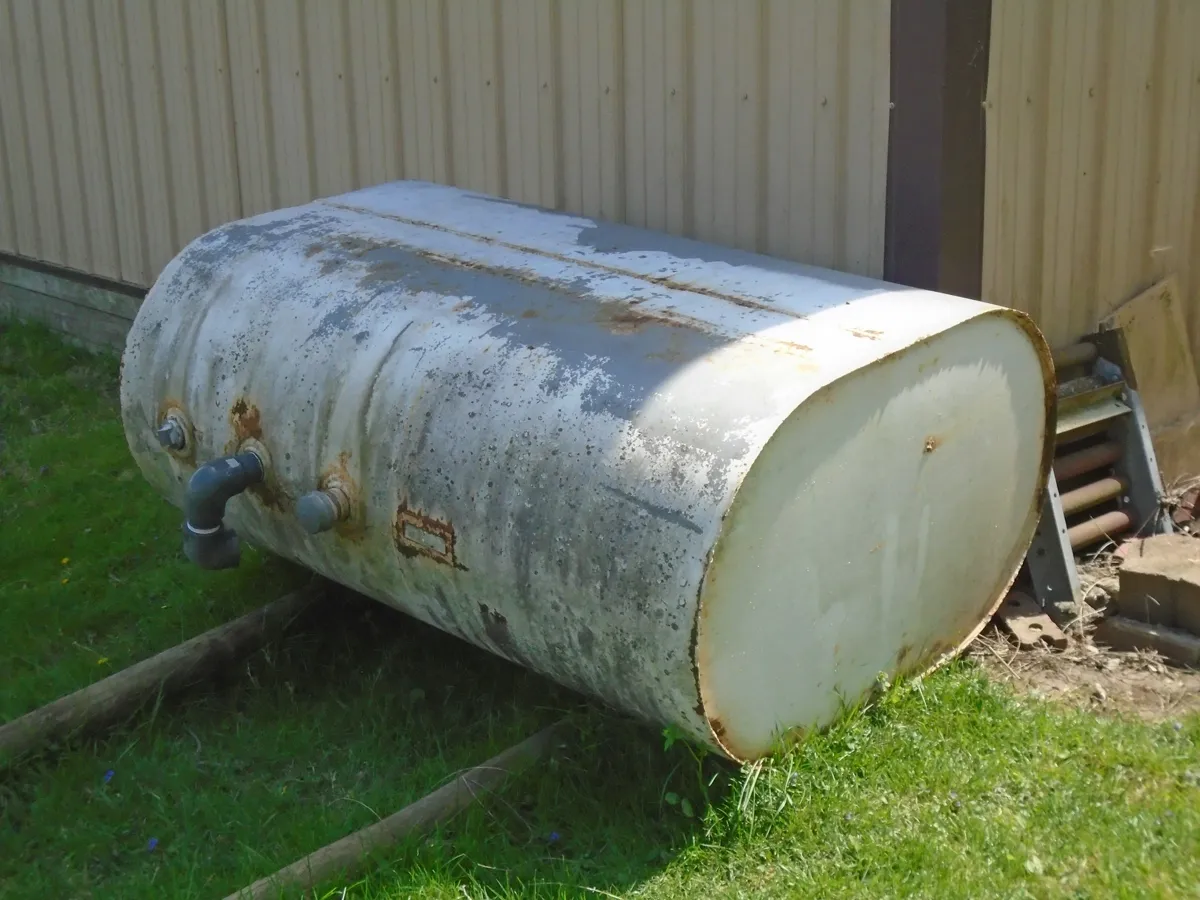
In a vertical cylinder or a rectangular tank, the volume rises in a straight line with the liquid height. Half the height holds half the volume. In a horizontal cylinder it does not, because the tank is narrow at the bottom, widest in the middle and narrow again at the top.
The liquid in a horizontal cylinder forms a circular segment. The filled volume is that segment’s area times the tank length:
V = l × [ r² × arccos((r − h) ÷ r) − (r − h) × √(2rh − h²) ]
The arccos is in radians. For the 48 in × 96 in tank above, which holds 752 gallons when full:
| Liquid height | Share of height | Gallons | Share of volume |
|---|---|---|---|
| 12 in | 25% | 147 | 19.6% |
| 24 in | 50% | 376 | 50% |
| 36 in | 75% | 605 | 80.4% |
A quarter of the height holds less than a fifth of the fuel. Elliptical, oval, capsule and spherical tanks behave the same way, and the calculator applies the correct partial-fill formula to each one. The same effect happens in reverse in a cone-bottom tank, where the first few inches of liquid fill the narrow hopper.
Frequently asked questions
How do I calculate the volume of a tank?
Multiply the area of the tank’s cross-section by its length or height. For a rectangular tank that is length × width × height. For a cylinder it is π × radius² × height (or length, if the tank lies on its side). Then convert the cubic units to gallons or litres.
How many gallons are in a tank?
Find the volume in cubic inches and divide by 231, or find it in cubic feet and multiply by 7.48. A cylinder 4 ft in diameter and 6 ft tall holds 75.4 cubic feet, which is 564 US gallons.
How do I calculate tank volume in litres?
Measure in centimetres, find the volume in cubic centimetres and divide by 1,000. If you measured in metres, multiply the cubic metres by 1,000. A tank 120 × 50 × 60 cm holds 360 litres.
What is the formula for the volume of a cylindrical tank?
V = π × r² × h, where r is half the diameter and h is the height. For a horizontal tank use the length in place of h for the full volume. For a partly filled horizontal tank use the circular segment formula: V = l × [r² × arccos((r − h) ÷ r) − (r − h) × √(2rh − h²)].
How do I calculate the volume of a partially filled horizontal tank?
Measure the liquid depth from the bottom of the tank, then apply the circular segment formula, or enter the depth in the calculator. The relationship is not linear: in a horizontal cylinder, 25% of the height holds only 19.6% of the volume.
How much does a 275-gallon oil tank actually hold?
A standard 275-gallon oval oil tank (27 × 44 × 60 in) holds 268 US gallons when completely full. Fuel suppliers leave room for expansion, so a full fill is usually 225 to 250 gallons.
How do I measure the volume of a fuel tank?
Measure the inside dimensions and choose the matching shape. Truck and trailer fuel tanks are usually elliptical or rectangular, and home heating oil tanks are oval. For the fuel currently inside, measure the depth with a dipstick and enter it as the fill height.
How much does the water in a tank weigh?
Water weighs about 1 kg per litre or 8.33 lb per US gallon. A 1,000-litre tank of water weighs about 998 kg (2,200 lb) at room temperature, plus the weight of the tank itself.
Should I use inside or outside measurements?
Inside measurements give the true capacity. If you can only measure the outside, subtract twice the wall thickness from each dimension. On a 1,000-litre plastic water tank with 1 cm walls, using outside dimensions overstates the capacity by about 5%.
What is the difference between US and imperial gallons?
A US gallon is 3.785 litres (231 cubic inches). An imperial gallon, used in the UK, is 4.546 litres. One imperial gallon equals 1.2 US gallons.