As an Amazon Associate we earn from qualifying purchases. Disclosure
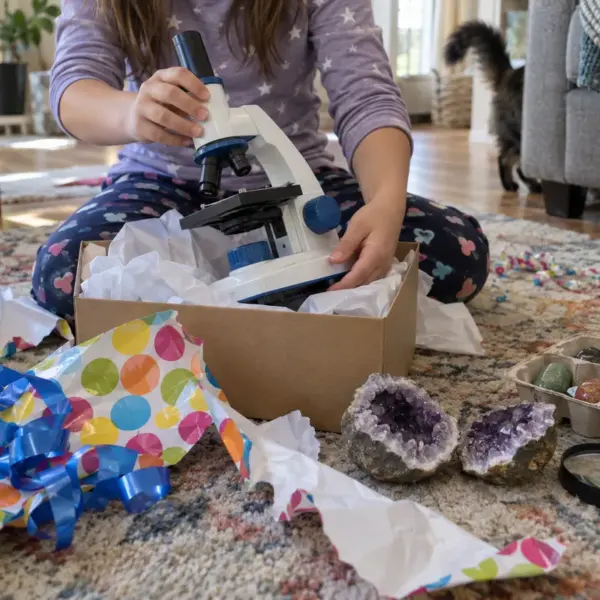
Last December my daughter Noor, then ten, opened her first chemistry set with real chemicals and flipped straight to the page with the bright blue solution. I made her start at experiment one instead: measuring water, rinsing a test tube, squeezing a dropper one drop at a time. The skills from those first pages are what the blue experiment needs.
The best chemistry set for kids is the one rated for the child’s age, with a manual that builds skills in that order. For most kids aged 10 to 12, that is the Thames & Kosmos Chem C1000: 125 experiments, real chemicals such as sodium carbonate and citric acid, and goggles in the box. Under 10, every honest option is kitchen chemistry, and the picks below sort them by age. From 12, step up to the Chem C3000.
I am a geoscientist. Most of my lab hours went into the chemistry of ice-core meltwater. At home, chemistry happens at our kitchen table with Noor, now 11, and her brother Sami, 7. Every set below is chosen by the maker’s age rating and listed contents.
Quick picks
| Pick | Best for | Maker age | Real chemicals |
|---|---|---|---|
| Thames & Kosmos Chem C1000 | Best overall, first real set | 10+ | Yes |
| Thames & Kosmos Kids First Science Kit | Ages 5 to 7 | 5+ | No |
| Atomic Adventures Lab Chemistry Kit | Ages 8 and 9, goggles and gloves included | 8+ | No |
| Thames & Kosmos Chem C2000 | Ages 11 and 12, first burner | 11+ | Yes |
| Thames & Kosmos Chem C3000 | Teens | 12+ | Yes |
| Happy Atoms Complete Set | Learning bonds without chemicals | 10+ | No |
Best chemistry set for kids aged 5 to 7
At five to seven, a chemistry set is kitchen chemistry: color, fizz, gel and density. No set rated this young contains reagent chemicals, and that is correct. What a young child learns is how to handle tools: pouring into a narrow tube, using a dropper and waiting for a result.
Best for ages 5 to 7
1. Thames & Kosmos Kids First Science Kit
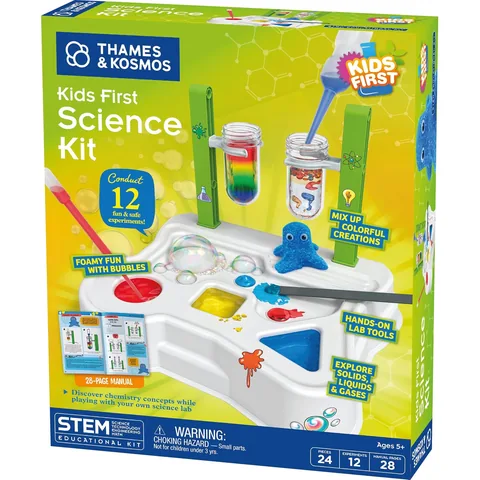
For a five-year-old, start here. The kit has only 12 experiments, and each one uses a real tool: lidded test tubes, pipettes, a spatula and tweezers on a plastic lab station. The topics are surface tension, density, solutions and mixtures, which are the real foundations under every later set.
Twelve experiments sounds thin. At five, each one gets repeated until the kid can do it alone, and that repetition is the lesson.
- Maker age: 5+
- 12 experiments, 28-page full-color manual
- 24 pieces, including 2 lidded test tubes and 2 pipettes
- Supplies: blue alginate powder and dye tablets
Good: real tools sized for small hands, a short manual a parent can read aloud. Not great: no goggles in the box, and only 12 experiments.
Check on Amazon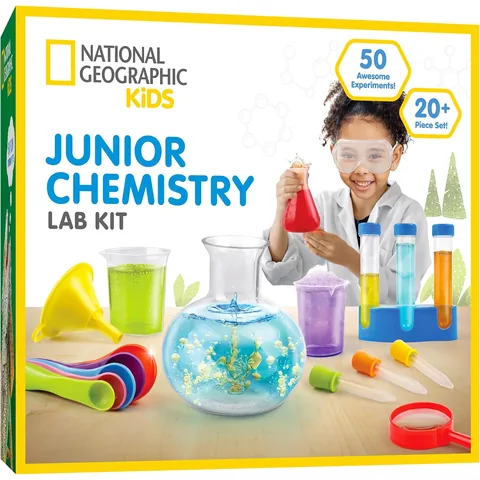
Most experiments for a young child
2. National Geographic Junior Chemistry Set
Fifty experiments built around baking soda, vinegar and other kitchen supplies, with child-size beakers and test tubes. It is the only set in this age group with goggles in the box, which makes it easier to start the goggles habit at four or five.
Because most experiments use pantry items, the set keeps going after the included supplies run out. Plan on refilling baking soda and vinegar.
- Listed age: 4+
- 50 experiments with illustrated step-by-step instructions
- 20+ child-size tools, including beakers, test tubes and safety goggles
Good: goggles included, a long experiment list, refills are pantry items. Not great: it is fizz chemistry from start to finish, and small parts mean close watching under five.
Check on Amazon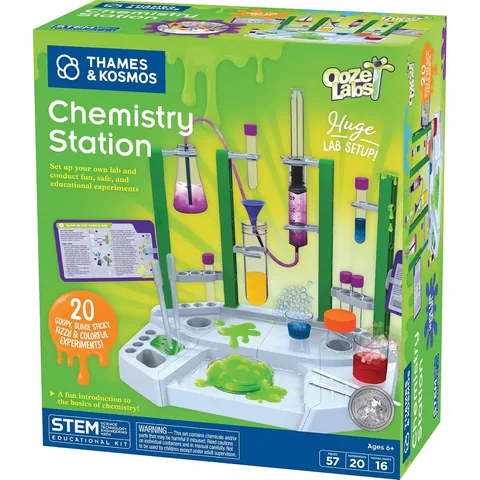
Best for a kid who wants a lab bench
3. Ooze Labs Chemistry Station
The appeal here is the station itself: a base with test tube racks, an Erlenmeyer flask, a petri dish, a funnel, a syringe and filter paper. For a six-year-old who wants to look like a chemist, that matters. The experiments go beyond slime: a red cabbage pH test and paper chromatography are both real lab methods.
- Maker age: 6+
- About 20 experiments on clip-on cards, plus a 16-page manual
- 57 pieces
- No borax, according to the listing
Good: a flask, petri dish, funnel and syringe, plus chromatography and pH tests. Not great: about 20 experiments, no goggles.
Check on AmazonBest chemistry set for ages 8 and 9
Eight and nine is the awkward middle. Kids want real chemistry, but every set with real chemicals starts at age 10. The 8+ sets are bigger kitchen-chemistry kits with more equipment and more reactions. The maker’s age covers both the chemicals and how much the child has to read, so wait for the 10+ sets.
Best for ages 8 and 9
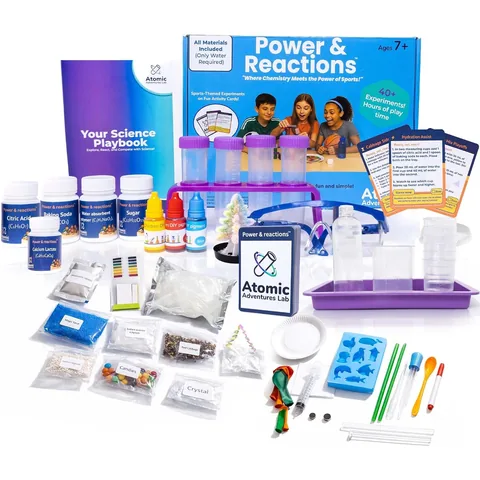
4. Atomic Adventures Lab Chemistry Kit
This kit gets my pick for this age group for one reason: it includes both safety goggles and gloves. Most 8+ sets include neither, and an eight-year-old who learns to put on goggles and gloves before touching anything is ready for a 10+ set two years later.
It runs on 46 activity cards instead of a manual, which suits kids who like to pick an experiment and go. The brand is new, and the listing does not name the chemicals.
- Listed age: 8 to 12 (one line of the listing says 7 to 12)
- 46 activity cards
- Over 100 lab supplies
- Safety goggles and gloves included
Good: goggles and gloves in the box, short activity cards. Not great: the listing does not name the chemicals, and the brand has no long track record.
Check on Amazon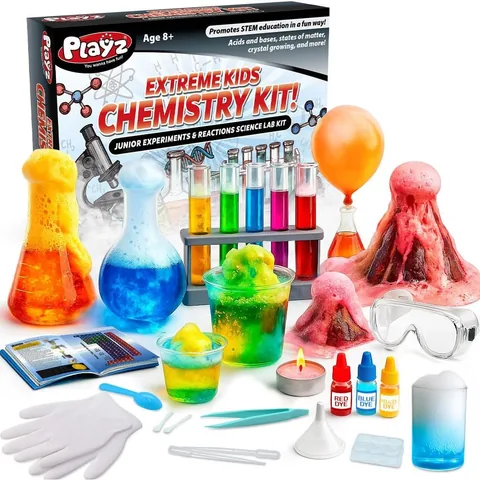
Most experiments at 8+
5. Playz Extreme Chemistry
Fifty-two experiments, including a foaming volcano, a balloon that inflates itself and density stacks, with the supplies in labeled containers that fit in a storage system. The storage matters more than it sounds: a set that packs away neatly comes back out, and one stored in a loose bag loses its parts.
- Maker age: 8+
- 52 experiments
- 51+ tools and ingredients
- Full-color manual, labeled containers
Good: the most experiments in this group, at a budget tier. Not great: no goggles listed, and it includes balloons, which are a choking hazard for younger siblings.
Check on Amazon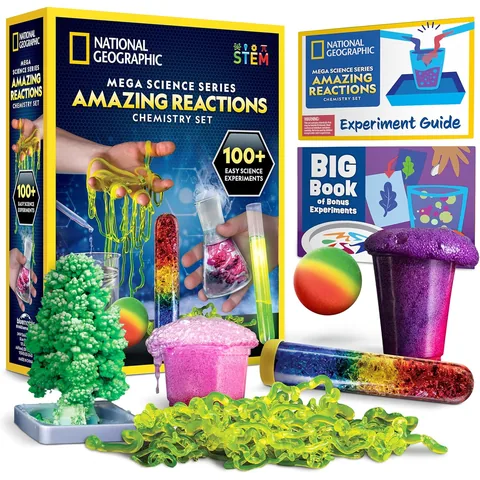
Best for crystals and color changes
6. National Geographic Amazing Chemistry Set
Read the box carefully. “100+ experiments” means 15 experiments with every material included, plus a bonus guide of 85 more that use your household supplies. The 15 are good ones: crystal growing, color changes, a bouncing ball. It also comes with real test tubes, beakers and pipettes.
I would buy it for a kid whose favorite part of science is watching something change color, and skip it for a kid who wants a big box of things to do on the first day.
- Listed age: 8+
- 15 experiments with all materials included
- 85 bonus experiments using household items
- Test tubes, beakers and pipettes
Good: crystals and color changes, with test tubes, beakers and pipettes. Not great: the headline count depends on your pantry, and no goggles are listed.
Check on AmazonAges 10 to 12: the first chemistry sets with real chemicals
Ten is where real chemistry starts. The Thames & Kosmos C-series names its chemicals in the listing and puts goggles in every box. The C1000 is the start; the C2000 adds a flame and twice as many experiments.
Best overall chemistry set for kids
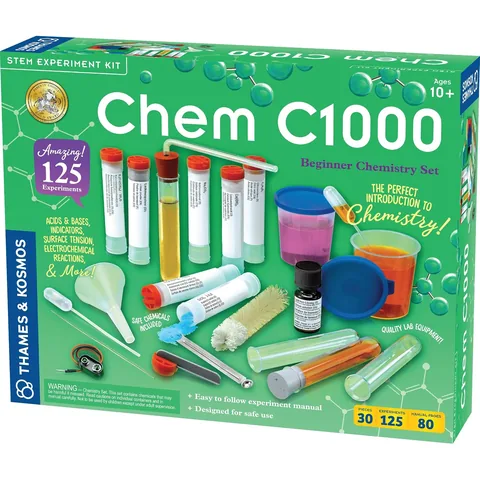
7. Thames & Kosmos Chem C1000 (v2.1)
Give this to a ten-year-old who has asked for “a real chemistry set.” It contains chemicals a school lab would recognize, including sodium carbonate, calcium hydroxide for lime water, citric acid and litmus.
It has no burner. Heat is the step where accidents get serious, so a first set without a flame is a feature. Electrolysis experiments use a 9-volt battery, which you buy separately.
- Maker age: 10+, with adult supervision
- 125 experiments, 80-page full-color manual
- 30 pieces, including test tubes, pipettes and safety goggles
- Needs a 9-volt battery and a few household items, such as baking soda (check the manual’s list)
Good: real chemicals, no open flame, goggles included. Not great: you supply a few household items and the battery.
Check on Amazon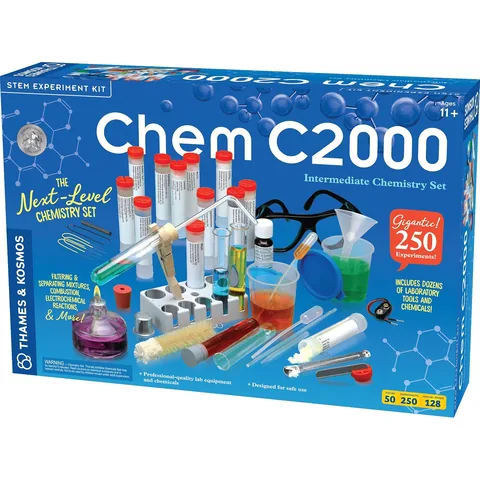
Best for ages 11 and 12
8. Thames & Kosmos Chem C2000
The C2000 doubles the experiment count and adds an alcohol burner with a tripod, glass test tubes and graduated beakers. The chemical list is a big step up: copper(II) sulfate, two potassium hexacyanoferrates, a magnesium strip, sulfur and a luminol mixture for glow-in-the-dark reactions.
Buy it for a careful eleven-year-old, or as the second set after the C1000. Copper sulfate is harmful if swallowed and toxic to aquatic life, so this set needs an adult at the table and a plan for the leftovers.
- Maker age: 11+, with adult supervision
- 250 experiments, 128-page full-color manual
- Alcohol burner with tripod, glass test tubes, 2 graduated beakers, safety goggles
- The listing says it meets EN 71-4, the European safety standard for chemistry sets
Good: real heat experiments, a long chemical list, 250 experiments. Not great: an open flame, and the listing does not say which burner fuel to use, so check the manual first.
Check on Amazon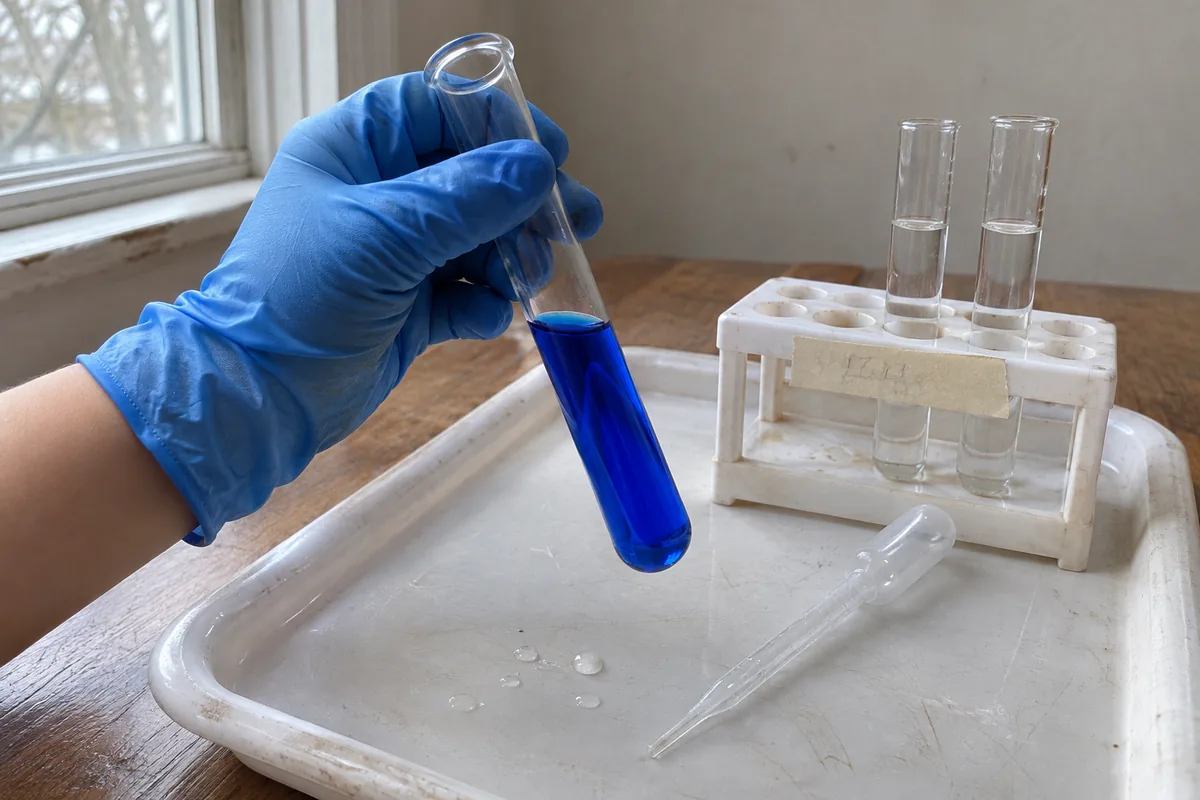
Best chemistry set for teens (12 and up)
For a teenager, the question is whether they want more experiments or a better grasp of why reactions happen. The C3000 covers both. Happy Atoms teaches the second without a single chemical.
Best for teens
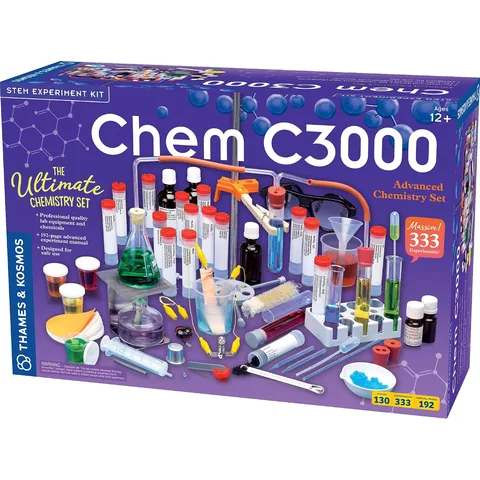
9. Thames & Kosmos Chem C3000
The C3000 is the largest set in the C-series, with a 192-page manual at textbook level. It covers chemical equations, the periodic table and some organic chemistry. It adds iron powder, sodium thiosulfate, potassium iodide and copper and zinc sheets to most of the C2000 chemicals (it drops the luminol mixture).
A teen who finishes it is ready for a school lab. A teen who wants to keep going after that has outgrown kits; our list of science kits for adults is the next step.
- Maker age: 12+, with adult supervision
- 333 experiments, 192-page full-color manual
- 103 pieces, including an alcohol burner, an Erlenmeyer flask and safety goggles
- The listing says it meets EN 71-4
Good: the most experiments and the deepest manual of any set here. Not great: the premium tier, an open flame, and a manual younger kids will not read.
Check on Amazon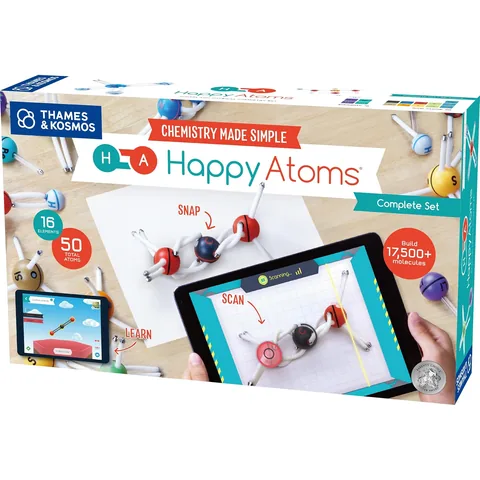
Best for learning bonds without chemicals
10. Happy Atoms Complete Set
Happy Atoms is 50 magnetic atom balls of 16 elements that snap together into molecules. A free phone app scans the model and names the molecule. The app recognizes up to 10,000 molecules. It suits a kid who asks why baking soda and vinegar fizz, because it shows how the atoms in each molecule bond.
Pair it with a C-series set: build a carbon dioxide model, then make the gas in a test tube.
- Maker ages: 10 to 17
- 50 magnetic atom models of 16 elements
- 216 activities, 16-page manual
- Needs a phone or tablet for the app (not included)
Good: no chemicals, no mess, and it shows how molecules are built. Not great: it needs a phone or tablet, and loose magnetic pieces must stay away from toddlers.
Check on AmazonWhat a real chemistry set needs that the box leaves out
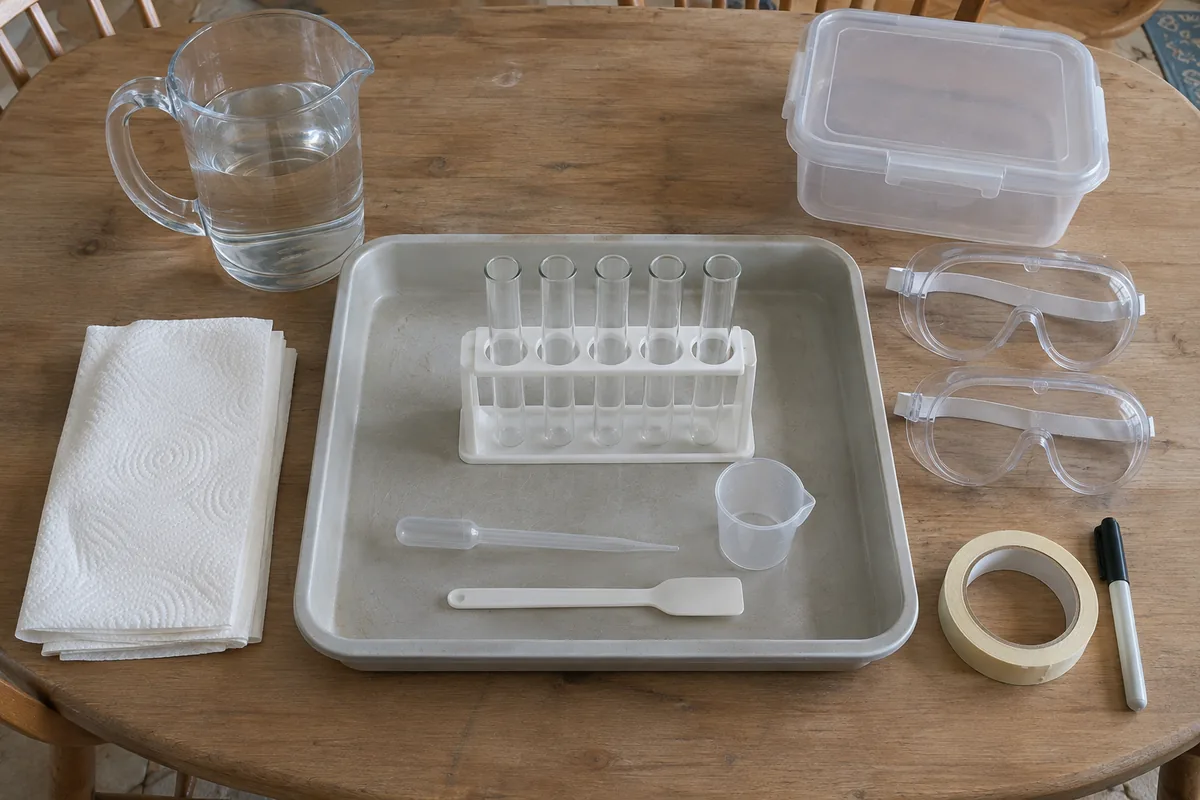
Every chemistry set assumes a few things it does not include: a clear table, a tray, paper towels, a jug of water, an adult, and goggles for everyone at the table, not only the child doing the experiment. The C-series sets also need a few household items and a 9-volt battery.
The first thing I do before any heated experiment is open the kitchen window and turn on the range hood. I learned that respect for fumes during field seasons near volcanic gas vents, where the sulfur smell reaches you before the gauge does. A small alcohol burner at a kitchen table makes far less, but the habit costs nothing.
Spare eye protection for the whole table
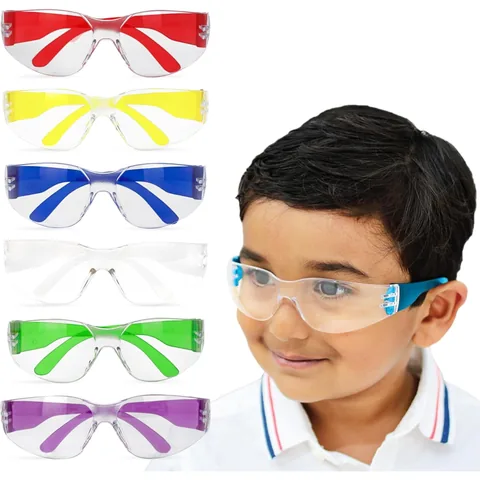
11. BISON LIFE Kids Safety Glasses (6 pack)
Six pairs of polycarbonate glasses with side shields, sized for children. They are for the sibling watching, the friend who came over and the kitchen-chemistry sets that include no eye protection at all. The seller says they meet ANSI Z87.1, the US impact standard.
- 6 pairs, polycarbonate, anti-scratch
- Built-in side shields
- Seller lists ages 3 to 13
Good: enough pairs for every child at the table. Not great: these are safety glasses, not sealed splash goggles. For any C-series set, use the goggles in the box or a splash-rated pair.
Check on Amazon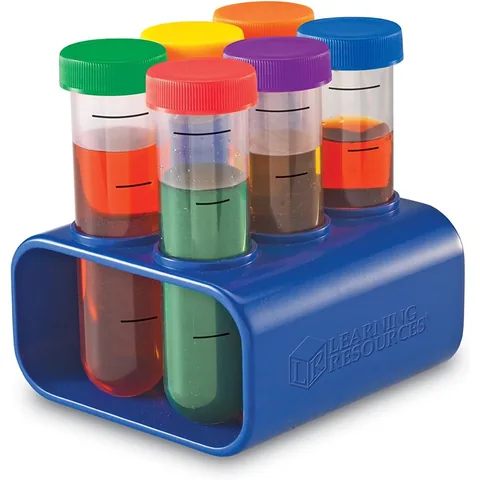
Best add-on for the 5 to 7 sets
12. Learning Resources Primary Science Jumbo Test Tubes
The Kids First kit includes two tubes, which is not enough for a side-by-side test such as “which liquid fizzes most.” These six wide plastic tubes have measuring marks and stand in a rack, so a five-year-old can line up a real comparison.
- 6 tubes with colored lids, a rack and an activity guide
- Each tube 6 inches high and 1.5 inches wide, marked at 25, 50, 75 and 100 ml
- Rated for 10 to 200 °F
- Maker age: 3+
Good: unbreakable, wide enough for small hands to pour into. Not great: plastic, so never near a burner.
Check on AmazonHow to choose a chemistry set for a child
Choose by four things, in this order: the maker’s age rating, whether it has real chemicals, the true experiment count and how many adult hours it needs.
The age on the box is a safety rating
The maker’s age covers the chemicals, the small parts and the reading level of the manual. Treat it as the starting age, and never buy above it because the child is advanced. A bright nine-year-old can follow the C1000’s chemistry, but the rating also assumes a ten-year-old’s care with a dropper of calcium hydroxide.
Real chemicals or kitchen chemistry
Kitchen chemistry uses baking soda, vinegar, food dye and gel powders. Real chemistry sets contain named reagents such as sodium carbonate, copper(II) sulfate or potassium iodide, each with hazard notes in the manual. The quick test: if the box or listing does not name a single chemical, it is a kitchen-chemistry set. Both are worth buying at the right age; just know which one you are getting.
Count the experiments the box can do by itself
“100+ experiments” often means 15 with included supplies plus a list of ideas using your pantry. Look for the number of experiments the kit supplies, and for a numbered manual.
Count the adult hours
A 5+ set needs you to read aloud and clean up. A 10+ set with real chemicals needs an adult at the table for every session; Thames & Kosmos lists adult supervision for the C1000, C2000 and C3000. If no adult can give an hour a weekend, buy Happy Atoms or a kitchen-chemistry set instead. If the child’s interest is broader than chemistry, our science kit for kids quiz covers microscopes, circuits and earth science too.
The most common mistake: buying a set one age band up “so they grow into it.” The child opens it at the wrong age, the manual is too hard, and the box goes to a closet. Buy the set that fits now and the next one up next year.
What to skip
Skip sets that promise “real chemistry” on the box but do not name a single chemical. Skip any set with loose powders in unlabeled bags. Skip slime-only kits sold as chemistry sets, which teach mixing and little else. If a listing gives two different ages, go by the higher one.
How to run the first session safely
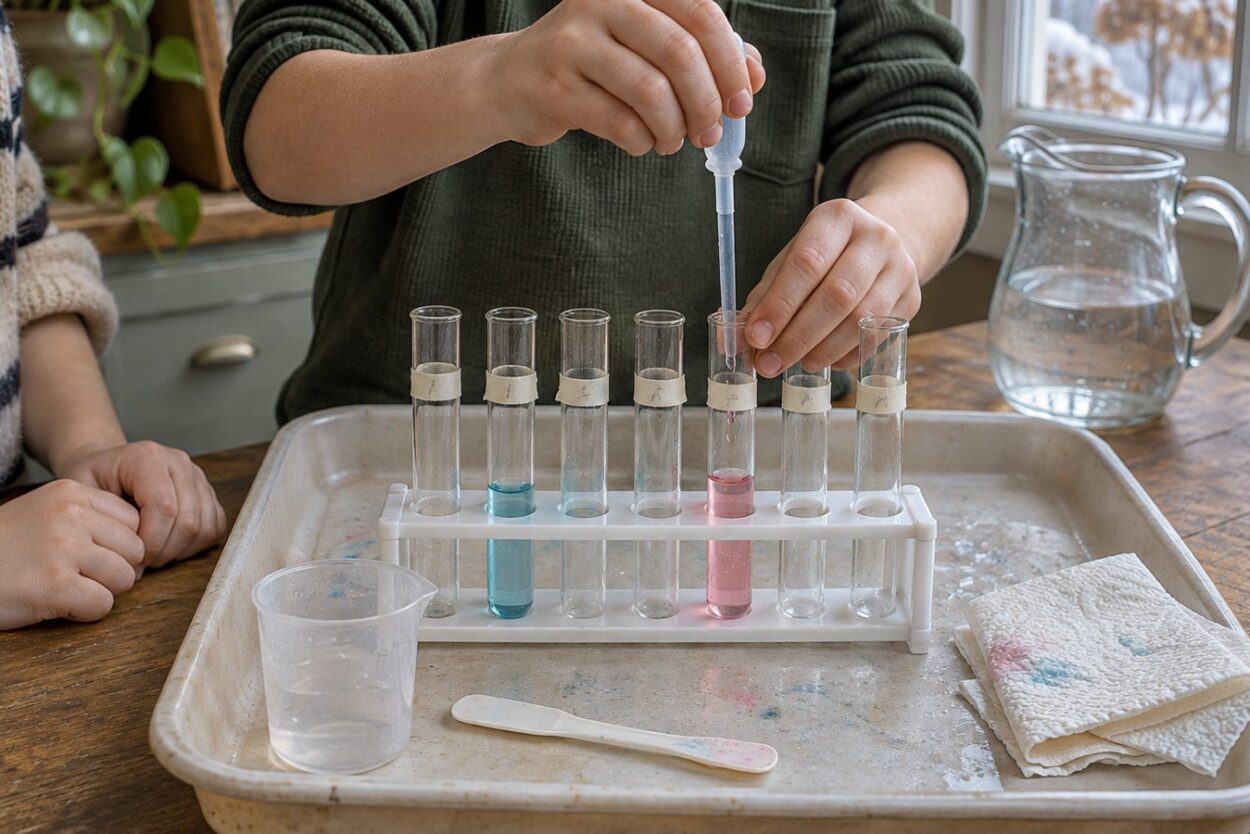
A safe first session takes ten minutes to set up: clear the table, put down a tray, fill a jug of water, put goggles on everyone, label every tube and read the experiment through once before starting.
The labeling rule comes from an ice-core field camp in Antarctica, where every sample got a label before it got opened, at thirty below with frozen fingers. At home, every test tube gets a strip of masking tape and a marker word before anything goes in. Two clear solutions look identical, and the manual’s next step depends on knowing which is which.
- No eating or drinking at the table, and never use kitchen cups or spoons for chemicals.
- Keep chemicals in the set’s own labeled containers, in a lidded box on a high shelf, away from food.
- Tie back long hair before any experiment with the burner.
- Wash hands when the session ends, even if nothing spilled.
- Keep the poison control number by the table (in the US, 1-800-222-1222).
Goggles go on everyone within reach. Last March, Sami was standing on a chair to watch Noor and took his goggles off because, he said, he was not doing anything. Splashes reach the watcher as easily as the child holding the dropper. Kid-size goggles that fit stay on; adult goggles slide down a child’s nose and get pushed up onto the forehead within five minutes. Our guide to lab safety goggles explains the splash rating (D3) to look for once a set has real chemicals.
FAQ
A kitchen-chemistry set works from age 5, when a child can pour and use a dropper with help. Chemistry sets with real reagents start at 10, the age Thames & Kosmos gives its Chem C1000. Between 8 and 9, choose a larger kitchen-chemistry set with goggles rather than moving up early.
Chemistry sets for kids are safe when used at the maker’s age with an adult present. Sets for ages 10 and up contain chemicals that are harmful if swallowed or splashed in the eyes, so goggles, a tray and supervision are required, not optional. Sets for younger children use household-level ingredients.
Thames & Kosmos C-series sets contain named chemicals and long manuals, so they teach real chemistry from age 10. National Geographic chemistry sets are kitchen-chemistry kits aimed at ages 4 to 9, with fizzing, crystal and color-change experiments. They suit different ages, so the right brand depends on the child.
Follow the disposal notes in the set’s manual. Chemicals such as copper(II) sulfate go to your area’s household hazardous waste drop-off, never the drain, because copper sulfate is toxic to fish and other aquatic life. When Noor finished a set this summer, the small labeled bottles went in a shoebox to our town’s drop-off day.
All Thames & Kosmos Chem C1000, C2000 and C3000 sets include safety goggles, as do the National Geographic Junior Chemistry Set and the Atomic Adventures Lab kit. Many kitchen-chemistry sets include none. Buy enough for every child at the table, including the ones only watching.
A teen who has worked through the Chem C3000 is ready for a high-school chemistry lab and for self-directed projects. Good next steps are a microscale lab kit for adults, a molecular model set for organic chemistry, or a summer studying the elements behind each reaction with our interactive periodic table.
Most kids chemistry sets work with tap water, and the manual says when an experiment needs distilled water instead. Distilled water matters most for crystal growing and indicator color tests, where the minerals in hard tap water can cloud a crystal or shift a color.
Sources
- Thames & Kosmos: Chem C1000 (v2.1)
- Thames & Kosmos: Chem C2000
- Thames & Kosmos: Chem C3000
- Thames & Kosmos: Happy Atoms Complete Set
- Thames & Kosmos: Kids First Science Kit
- Thames & Kosmos: Ooze Labs Chemistry Station
- US Consumer Product Safety Commission: Recalls
- America’s Poison Centers
- PubChem: Copper(II) sulfate safety and hazards