Most lists of physics facts hand you a claim and move on. “Time stops at light speed!” Sounds great, but it’s wrong, and it’s why those lists leave you knowing less than when you started. Every one of the 30 facts about physics below comes with the reason it works and a number or comparison you can check.
They’re sorted into five groups, so you can jump to the branch you care about. Where a fact has limits (time dilation at walking speed is real but absurdly small), we say so.
Start Here: The Top Five
Short on time? These five give the best return:
- #3: Astronauts on the space station aren’t weightless. They’re falling, constantly.
- #9: GPS only works because engineers correct for relativity.
- #15: The Sun shines thanks to quantum tunneling.
- #25: The Sun converts about 4 million tonnes of mass into energy every second.
- #27: Most of a proton’s mass isn’t made of the particles inside it.
Contents
- Space and Gravity
- Light and Relativity
- Quantum Physics Facts
- Physics Facts From Everyday Life
- Matter and Energy
- FAQ
Space and Gravity

1. The Sun you see is 8 minutes and 20 seconds old
Sunlight covers the 150 million km to Earth in about 499 seconds. If the Sun vanished right now, you’d keep seeing it and feeling its gravity for just over 8 minutes. Gravity’s influence also travels at light speed, so the Earth wouldn’t fly off in a straight line until that same news arrived.
2. Gravity is absurdly weak
A fridge magnet lifts a paperclip against the pull of the entire planet. Between two protons, the electric force is roughly 10^36 times stronger than gravity. Gravity only dominates at large scales because mass always adds up and never cancels, while positive and negative charges cancel almost perfectly.
3. Astronauts on the ISS aren’t weightless
At 400 km up, gravity is still about 90% as strong as on the ground. The crew floats because the station and everyone inside are in continuous free fall, moving sideways fast enough (about 7.7 km/s) that they keep missing the Earth. Drop an elevator down a shaft and you’d feel the same thing, briefly.
4. A teaspoon of neutron star weighs hundreds of millions of tonnes
A neutron star packs more than the Sun’s mass into a ball roughly 20 km across. Its density is around 10^17 kg per cubic metre, so a 5 mL teaspoon would weigh about half a billion tonnes. That’s close to the combined weight of every human on Earth, in a teaspoon.
5. The Sun would become a black hole if you squeezed it to 3 km
Any mass turns into a black hole if it’s compressed inside its Schwarzschild radius. For the Sun that’s about 2.95 km. For Earth it’s about 9 mm, the size of a marble. And a black hole of one solar mass would leave Earth’s orbit unchanged, because gravity depends on mass and distance, not on what the mass looks like.
6. Ordinary matter is only about 5% of the universe
Stars, planets, gas and you add up to roughly 5% of the universe’s total energy content. About 27% is dark matter, which we detect only through its gravity, and about 68% is dark energy, which appears to drive the expansion of space. Nobody has identified either one yet.
Light and Relativity
7. The speed of light is exactly 299,792,458 m/s
Not “about.” Since 1983 the metre is defined from this number, so the speed of light is fixed by definition and the length of a metre is derived from it. It’s one of the fundamental constants tracked by NIST that underpin the whole system of units.
8. Nothing with mass can reach light speed
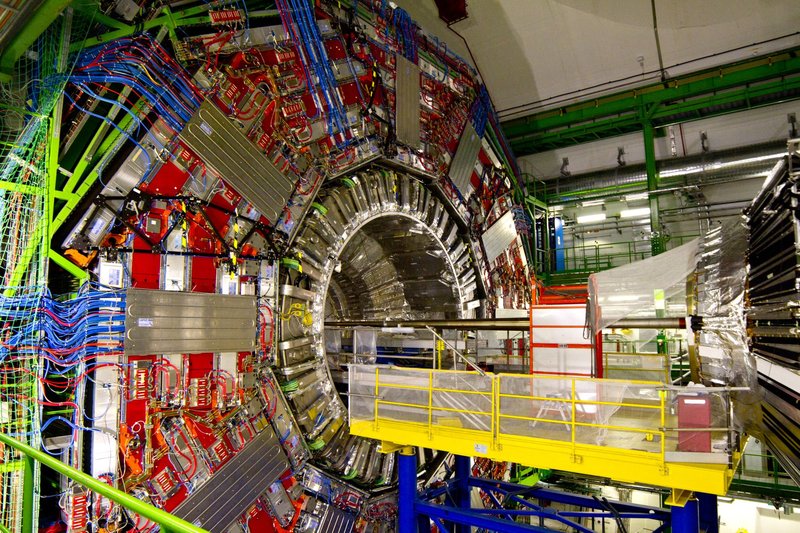
The closer you get, the more energy each extra bit of speed costs, and reaching light speed would take infinite energy. The Large Hadron Collider gets protons to about 99.999999% of light speed, and each one carries the energy of a flying mosquito. They still can’t cross the line.
9. GPS would drift by about 10 km a day without relativity
Satellite clocks tick faster than ground clocks by about 45 microseconds a day because gravity is weaker up there (general relativity). They tick slower by about 7 microseconds a day because they move fast (special relativity). Net result: 38 microseconds a day. Left uncorrected, position errors would pile up at roughly 10 km every 24 hours.
10. Light from the Sun’s core takes thousands of years to get out
Photons made in the core are absorbed and re-emitted countless times on a random walk through dense plasma. Estimates for the trip run from tens of thousands to over 100,000 years. After that, the last stretch to Earth takes 8 minutes. Most of the delay is the first millimetre-by-millimetre crawl.
11. Light has no mass but pushes things
Photons carry momentum, so sunlight exerts a tiny pressure on whatever it hits. It’s why solar sails work: Japan’s IKAROS spacecraft used one in 2010 to travel toward Venus with no propellant. The force is minuscule, roughly the weight of a few grains of sand per square kilometre of sail… but in the vacuum of space, nothing pushes back.
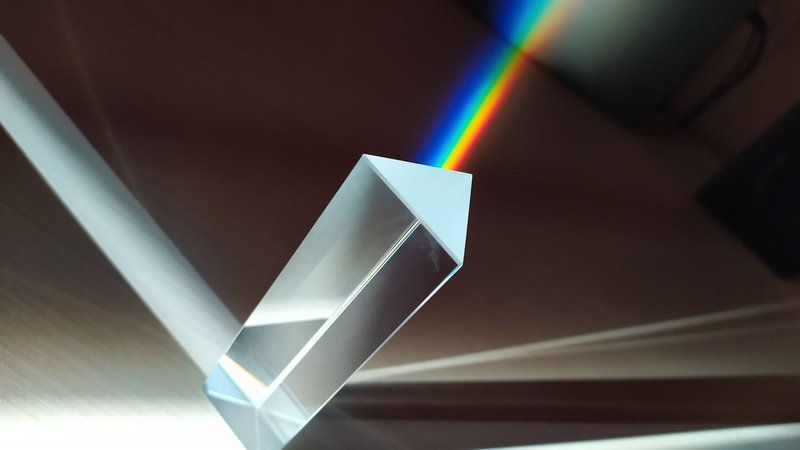
12. The sky is blue because blue light scatters about five times more than red
Air molecules scatter short wavelengths far more than long ones. This is Rayleigh scattering, one of the core effects in optics, and it scales as 1/wavelength^4. Blue at 450 nm scatters roughly 5 to 6 times more than red at 700 nm. Violet scatters even more, but the Sun emits less of it and our eyes respond weakly to it. At sunset the light crosses so much air that the blue is scattered out, leaving orange and red.
Quantum Physics Facts
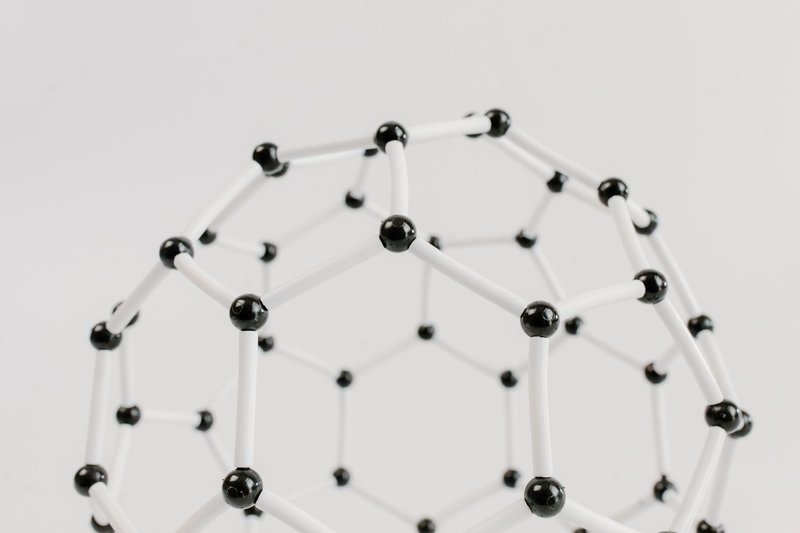
13. Atoms are mostly empty space, with a catch
The nucleus is about 100,000 times smaller than the atom around it. Scale a hydrogen atom to a stadium and the nucleus is a pea at the center. “Empty” is shorthand: the space is filled by the electrons’ probability clouds and electromagnetic fields, which is what you actually feel when you touch something.
14. The uncertainty principle isn’t about clumsy instruments
Heisenberg’s principle says a particle doesn’t have a perfectly defined position and momentum at the same time, no matter how good your equipment is. Pin down where an electron is, and its momentum gets fuzzier. This is a property of nature, not a measurement flaw.
15. The Sun shines thanks to quantum tunneling
At the Sun’s core temperature of about 15 million kelvin, protons don’t have enough energy to overcome their electric repulsion and fuse, by classical physics. They fuse anyway, because a proton has a small probability of “tunneling” through the barrier. Without that, the Sun would be dark.
16. Single electrons make an interference pattern
Fire electrons through two slits one at a time, and the dots on the detector slowly build up stripes, the signature of waves. Each electron seems to pass through both slits and interfere with itself. Put a detector at the slits to see which one it takes, and the stripes vanish.
17. The Pauli exclusion principle is why you don’t fall through the floor
Two electrons can’t occupy the same quantum state. That forces electrons in atoms into stacked shells, which gives atoms their size, gives chemistry its structure, and makes solid objects solid. The same rule holds up neutron stars against collapse.
18. Entanglement can’t send messages faster than light
Measure one of a pair of entangled particles and you instantly know something about the other, however far apart they are. But your result is random, so you can’t use it to transmit information. Experiments by Aspect, Clauser and Zeilinger confirming this behavior won the 2022 Nobel Prize in Physics.
Physics Facts From Everyday Life
19. Ice floats because water expands by about 9% when it freezes
Most liquids shrink as they freeze. Water’s molecules lock into an open hexagonal lattice, so ice is roughly 9% less dense than liquid water. That’s why lakes freeze from the top down and fish survive winter below the ice. It’s also why a water pipe left in a freeze can burst.
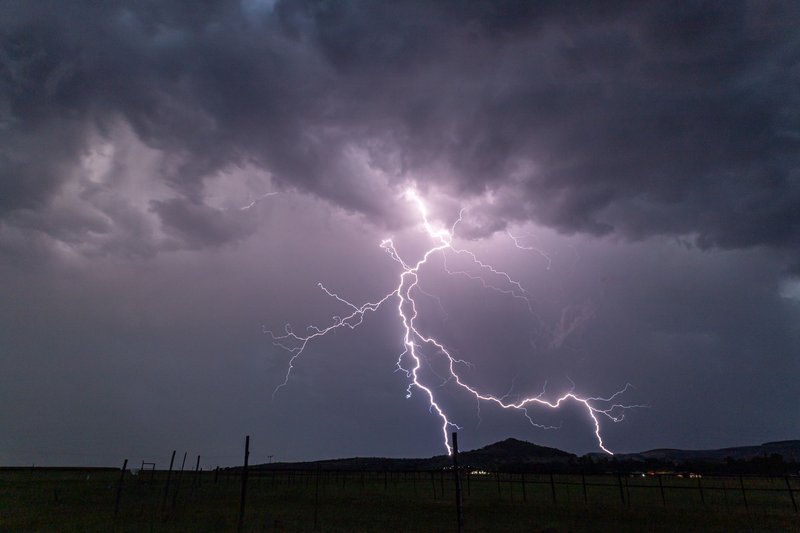
20. Lightning is about five times hotter than the Sun’s surface
A bolt heats the air around it to roughly 30,000 K. The Sun’s surface sits near 5,800 K. The superheated air expands explosively and creates the shock wave you hear as thunder. Count the seconds between flash and bang, divide by three, and you have the distance in kilometres.
21. Sound moves about four times faster in water than in air
Sound travels at about 343 m/s in air at 20 °C and about 1,480 m/s in water. In steel, it’s above 5,000 m/s. Denser, stiffer materials pass vibrations along more quickly, which is why you can hear a train coming by putting your ear to the rail.
22. You can measure the speed of light with chocolate and a microwave
Microwave ovens run at 2.45 GHz and create standing waves, so food heats unevenly. Remove the turntable, put in a bar of chocolate, and the melted spots sit about 6 cm apart, half a wavelength. Double that to get a wavelength of about 12 cm and multiply by the frequency: 0.122 m × 2.45 billion Hz gives roughly 3 × 10^8 m/s.
23. Figure skaters spin faster by pulling in their arms
Angular momentum is conserved when no outside torque acts. Pull your arms in and your moment of inertia drops, so your spin rate has to rise to compensate. A skater can go from about 2 rotations per second to more than 5 without anyone pushing them.
24. A metal bench feels colder than a wooden one at the same temperature
Both are at the same temperature, but metal conducts heat away from your hand much faster, so your skin cools quickly and your nerves read it as cold. Wood is a poor conductor and barely draws any heat. Your fingers sense heat flow, not temperature.
Matter and Energy
25. The Sun converts about 4 million tonnes of mass to energy every second
That’s E = mc² doing real work. Fusion turns hydrogen into helium, and the helium weighs slightly less than the hydrogen that went in. The missing mass becomes the sunlight that reaches us. The Sun has been doing this for about 4.6 billion years and has lost only a tiny fraction of its mass.
26. Absolute zero is −273.15 °C, and you can’t reach it
The third law of thermodynamics says no process can cool something all the way down to 0 K in a finite number of steps. Labs have gotten to within a fraction of a billionth of a degree above it. For comparison, the coldest natural place we know of, the Boomerang Nebula, sits near 1 K.
27. Most of a proton’s mass isn’t the quarks
A proton contains three quarks, but their masses add up to only about 1% of the proton’s. The rest comes from the energy of the strong force binding them and the motion of the quarks and gluons inside. CERN’s overview of the Standard Model explains how these pieces fit together.
28. The Higgs boson was found in 2012
The ATLAS and CMS experiments at CERN announced it on July 4, 2012, about 48 years after it was first proposed. The Higgs field gives fundamental particles like electrons and quarks their mass. It does not give you most of your own mass, which is fact 27.
29. A banana emits antimatter
Bananas contain potassium-40, a radioactive isotope. About once every 75 minutes, one of its atoms decays by emitting a positron, the antimatter twin of the electron. The positron meets an electron almost at once and annihilates in a flash of gamma rays. The amount is far too small to matter for your health.
30. The second law of thermodynamics gives time a direction
Heat flows from hot to cold, never the other way, and entropy in a closed system tends to increase. That’s why a dropped egg doesn’t reassemble and ice melts in a warm drink instead of the drink getting warmer. The underlying equations of motion work equally well forward and backward. The arrow of time comes from probability: there are far more disordered arrangements than ordered ones.
FAQ
What’s the most surprising fact about physics?
For most people it’s either that GPS needs relativity corrections (#9) or that matter is mostly the energy of the strong force rather than the particles’ own mass (#27). Both are measured, everyday-relevant results, not thought experiments.
Which physics facts work best for kids?
Facts 1, 3, 20, 21 and 22 are the easiest to explain and test. The microwave chocolate experiment (#22) is hands-on, and you can count thunder seconds (#20) during any storm.
Are quantum physics facts proven or just theory?
The core results are some of the best-tested in science. Quantum mechanics predicts some quantities to better than ten decimal places. What’s unsettled is how to interpret what the math says is happening, which is a separate question from whether the math works.
What are the main branches of physics?
Classical mechanics, thermodynamics, electromagnetism, optics, relativity, quantum mechanics, and the fields built on top of them such as astrophysics, particle physics and condensed matter physics. The facts above touch all of them.