Table of Contents
- TLDR
- What “active” actually means
- Yellowstone Caldera
- The Absaroka Volcanic Field
- The young volcanoes near Dubois
- Wyoming volcanoes compared
- How Yellowstone is monitored
- What could actually happen
- Ash from other states
- FAQ
TLDR
No volcano in Wyoming is erupting, and none is expected to soon. Yellowstone is the one that counts as an active volcanic system, because it has frequent earthquakes, a magma reservoir under it, a ground surface that rises and falls, and thousands of hot springs and geysers. Its last lava flow was about 70,000 years ago. Every other volcanic area in the state is dormant or extinct.
What “active” actually means
The confusion over this question comes from one word that scientists and everyone else use differently.
Volcanologists generally call a volcano active if it has erupted in the last 11,700 years (the Holocene) or is showing signs of unrest, such as gas release, swarms of earthquakes or ground movement. Dormant means it hasn’t erupted in that window but could in principle wake up. Extinct means the magma supply is gone and it won’t erupt again.
Under that definition, “active” does not mean “erupting,” and it doesn’t mean “about to erupt.” It means the system is alive. That’s why a teaching guide can say Wyoming has no active volcanoes (nothing is erupting) while Teton County emergency managers treat Yellowstone as an active volcanic area. Both statements are defensible. They answer different questions.
Yellowstone Caldera
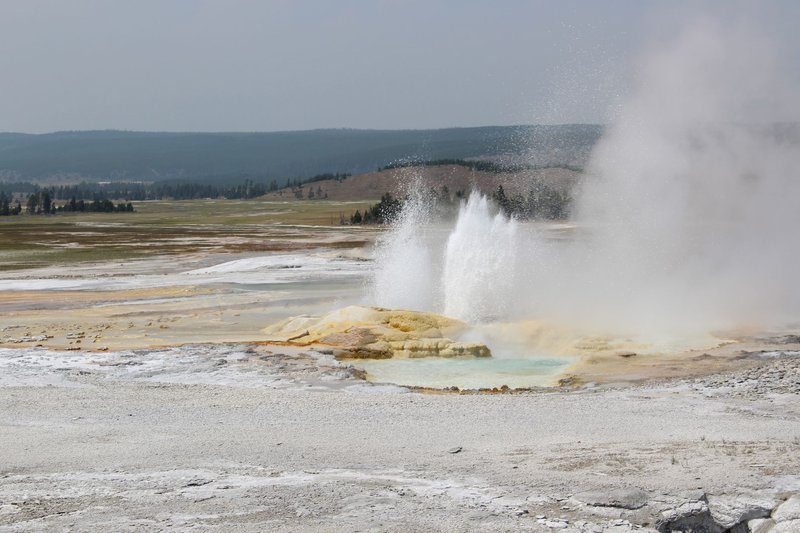
Yellowstone is the only Wyoming volcano that meets the “active” test, and it’s one of the largest volcanic systems on Earth. The park sits inside a caldera, a giant collapsed basin about 30 by 45 miles, left behind by the most recent of three enormous eruptions: roughly 2.1 million years ago, 1.3 million years ago and 640,000 years ago.
The activity since then has been much smaller. The last lava flows came about 70,000 years ago, according to the USGS, and covered the area now known as the Pitchstone Plateau in the southern part of the park. Since the last major eruption, the caldera has filled with dozens of lava flows and rhyolite domes.
The most recent explosive event on the record is the Mary Bay steam explosion about 13,800 years ago. It wasn’t a magma eruption. Superheated water flashed to steam and blasted out a crater roughly 1.5 miles across on the edge of Yellowstone Lake. That event is the reason Yellowstone clears the Holocene bar for “active.”
The evidence that the system is still alive is easy to find. Yellowstone logs around 1,000 to 3,000 earthquakes in a typical year, most too small to feel. The caldera floor rises and sinks by a few centimeters a year as fluid and gas move underground. And the hydrothermal features, including Old Faithful and Steamboat Geyser, are surface vents for heat that still comes from magma below.
Yellowstone owes all of this to a hotspot. The North American plate is sliding southwest over a plume of hot rock, and the volcanic centers it has passed over form the Snake River Plain across Idaho. USGS research tracks that trail, with Yellowstone as the current leading edge.
The Absaroka Volcanic Field
East and northeast of Yellowstone, the mountains of the Absaroka Range are the remains of a much older eruption zone. The Absaroka Volcanic Field formed roughly 53 to 43 million years ago and spread across northwest Wyoming and southwest Montana, burying the landscape under thousands of feet of lava, ash and volcanic debris.
It is not active. The magma is long gone, and erosion has stripped the field down into the jagged peaks and badlands you see now. The field also left a famous oddity: the Heart Mountain detachment near Cody, where a block of rock roughly 1,300 square miles in area slid more than 30 miles across the surface in one of the largest known landslides on land, around 48 million years ago.
The young volcanoes near Dubois
This is the part almost nobody covers. In the Upper Wind River Basin around Dubois, there are small volcanic centers far younger than the Absaroka rocks. Lava Mountain is the best-known, at about 400,000 years old. On a geologic clock, that’s last Tuesday.
These are not part of Yellowstone’s system, and nothing there is showing unrest. They’re best described as dormant: formally past the point where anyone would call them active, but young enough that “extinct” would be an overreach without more study.
A fourth area is worth a mention for completeness. The Leucite Hills near Rock Springs, in southwest Wyoming, hold small volcanic cones and lava flows of an unusual potassium-rich rock type, around 1 million years old. Pilot Butte and Boars Tusk are the landmarks. They’re a long way from active.
Wyoming volcanoes compared
| Name | Location | Age | Status |
|---|---|---|---|
| Yellowstone Caldera | Northwest Wyoming, extends into Montana and Idaho | Last lava flows about 70,000 years ago; Mary Bay steam explosion about 13,800 years ago | Active volcanic system, not erupting |
| Absaroka Volcanic Field | Northwest Wyoming, east of Yellowstone | About 53 to 43 million years | Extinct |
| Upper Wind River Basin (Lava Mountain) | Near Dubois, west-central Wyoming | About 400,000 years | Dormant, no unrest |
| Leucite Hills | Near Rock Springs, southwest Wyoming | About 1 million years | Dormant to extinct |
How Yellowstone is monitored
Yellowstone is one of the most heavily instrumented volcanoes in the country. The Yellowstone Volcano Observatory, run by the USGS together with the University of Utah, the National Park Service and other partners, tracks it with seismometers, GPS stations, satellite radar, gas sensors and stream gauges.
The result is that a change in behavior would show up in the data. Any large eruption would be preceded by months or years of dramatic signals: intense earthquake swarms, rapid ground uplift, major shifts in gas output. The observatory posts monthly updates, and in the rare case of real unrest, you’d hear about it from them first.
What could actually happen
Yellowstone can do three very different things, and they don’t carry the same odds.
A hydrothermal explosion is the most likely. These happen when trapped hot water suddenly turns to steam. Small ones occur regularly. In July 2024, one erupted at Biscuit Basin and threw debris across a boardwalk, with no injuries. They’re local, quick and hard to predict, which makes them the hazard park staff think about most.
A lava flow is possible but rare. The most recent happened about 70,000 years ago, and lava flows are slow enough that they threaten land rather than people.
A caldera-forming supereruption is the least likely. The USGS puts the chance of one in any given year at about 1 in 730,000. The three previous ones were spaced roughly 600,000 to 800,000 years apart, but volcanoes don’t run on a timetable, and the magma beneath Yellowstone is mostly solid rock with only a small fraction molten, not a tank ready to empty.
So a visitor in the park should worry about staying on the boardwalks, not about a supereruption.
Ash from other states
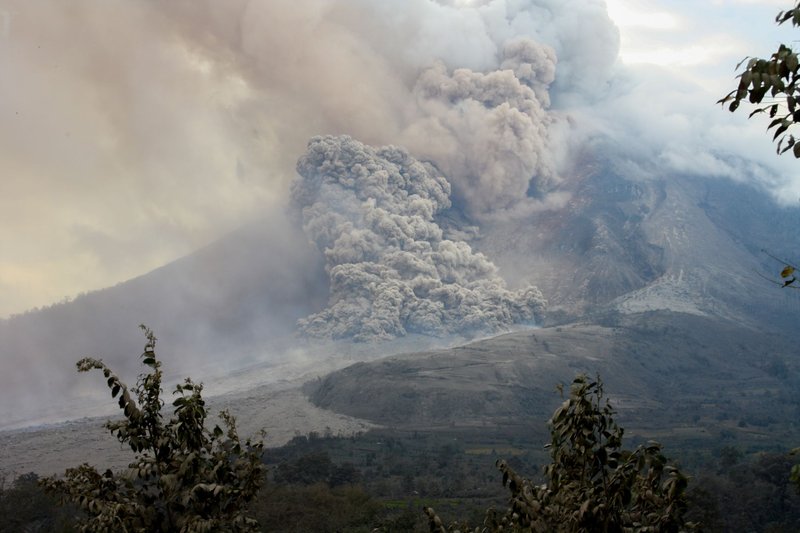
Wyoming’s volcanic risk isn’t only local. Ash from large eruptions in the Cascades can travel hundreds of miles east. The 1980 Mount St. Helens eruption dropped ash across Montana, Idaho and parts of Wyoming, and older Cascade eruptions, including the one that formed Crater Lake about 7,700 years ago, left ash layers across the region.
For most people the realistic impact would be a few days of grounded flights, clogged air filters and slick roads, not anything catastrophic.
FAQ
Does Wyoming have any active volcanoes? Yes, one: the Yellowstone volcanic system. It isn’t erupting, but it’s considered active because of its earthquakes, ground movement and hydrothermal activity, and because of the Mary Bay explosion in the last 13,800 years.
When did Yellowstone last erupt? The last lava flows were about 70,000 years ago. The last major explosive event was the Mary Bay steam explosion about 13,800 years ago. Smaller hydrothermal explosions still happen.
Is Yellowstone dormant or active? Active. It has not erupted lava recently, but a volcano doesn’t have to be erupting to be classed as active.
Will Yellowstone erupt soon? Nothing in the monitoring data points to it. The yearly chance of a caldera-forming eruption is about 1 in 730,000.
Are there other volcanoes in Wyoming? Yes, but they are old. The Absaroka Volcanic Field is about 53 to 43 million years old and extinct. The Lava Mountain area near Dubois is about 400,000 years old and dormant.