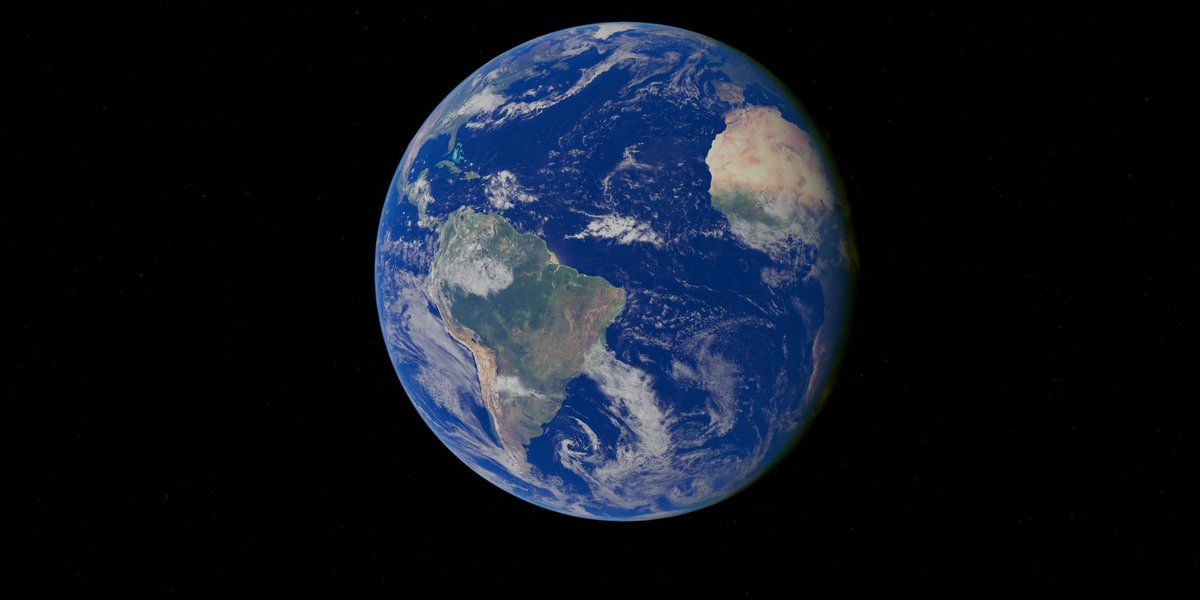
Earth science tells you what the planet is made of and what it has done. Physics tells you why it behaves that way. Every earthquake, hurricane, mountain range and compass reading is a physics problem that happens to be happening on a rock.
The field that sits between the two is called geophysics, and it’s the reason we know what the Earth’s core is like even though nobody has drilled past about 12 kilometers of the 6,371 kilometers to the center.
This guide is organized by Earth system, not by textbook chapter. Each section has one everyday example and one idea, with no jargon you need a degree to parse.
Contents
- Gravity and the shape of the planet
- Seismic waves and the Earth’s interior
- Heat flow and plate tectonics
- The magnetic field and the geodynamo
- Fluid dynamics in the air and oceans
- Radioactive decay and dating the Earth
- Which physics explains which process
- Careers and degree paths
- Summary
Gravity and the shape of the planet
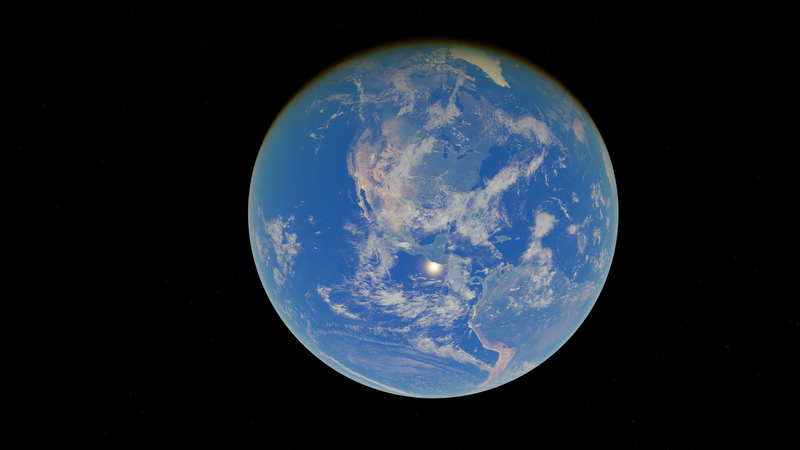
Earth isn’t a sphere. It spins once a day, and that spin flings material outward at the equator. The result is a planet about 21 kilometers wider across the equator than from pole to pole.
Gravity follows the shape. A bathroom scale reads slightly higher at the North Pole than at the equator, because you’re closer to the center of the planet and the spin doesn’t offset your weight. The difference is roughly half a percent: standard gravity is about 9.78 m/s² at the equator and 9.83 m/s² at the poles.
The key idea is Newton’s law of gravitation (one of many scientific laws that describe repeatable patterns in nature): the pull between two masses grows with the masses and shrinks with the square of the distance. Geophysicists use it in reverse. If gravity is a hair stronger over one spot, something dense is underneath, such as a metal ore body or a thick slab of old crust. Satellites like NASA’s GRACE mission map those tiny variations and track groundwater and ice sheets by their changing mass.
Seismic waves and the Earth’s interior
An earthquake is a sudden release of stored elastic energy, the same physics as snapping a ruler you’ve bent too far. The energy leaves as waves, and the waves carry information about everything they pass through.
There are two types that matter for the interior. P waves are compressional, like sound, and travel through solids and liquids. S waves shake material side to side, and liquids can’t carry them. In 1906 the geologist Richard Oldham noticed that S waves from big quakes never arrived on the far side of the planet. Something in the middle was liquid. That’s the outer core, a layer of molten iron and nickel about 2,200 kilometers thick. In 1936 Inge Lehmann found faint P waves bouncing off a smaller solid center, the inner core.
The idea in one line: wave speed depends on stiffness and density, so a change in speed marks a change in material. Every layer boundary in the textbook diagram of the Earth was found this way, with no one ever going there.
The same principle works on a small scale. You can tell a ripe watermelon from an unripe one by tapping it and listening, and that’s a rough version of what a seismologist does with a planet. The USGS “This Dynamic Earth” publication lays out how these waves led to the layered model of the Earth.
Heat flow and plate tectonics
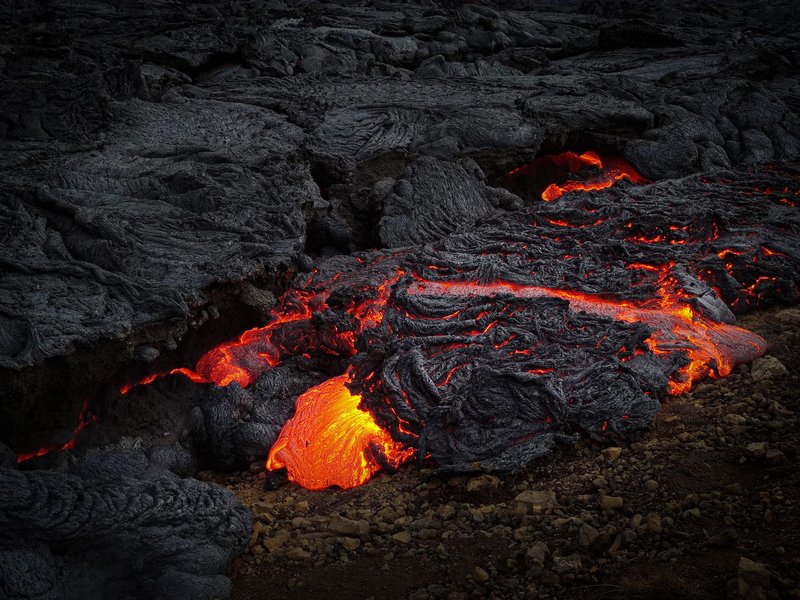
The Earth is still hot from its formation and from the decay of radioactive elements in its rock. About 47 terawatts of heat leak out through the surface, which is several times humanity’s total energy use.
Heat has to go somewhere, and in the mantle it moves by convection. Hot rock is slightly less dense, so it rises. Cooler rock is denser, so it sinks. The mantle is solid on human timescales, but over millions of years it flows like extremely stiff putty. Pot a pan of thick soup on the stove and watch the slow churn: same physics, a few billion times slower.
At the surface that churn shows up as plate tectonics. Plates move at 2 to 10 centimeters a year, about the speed your fingernails grow. That sounds like nothing until you multiply by 100 million years, which is enough to open the Atlantic Ocean.
Researchers still argue about how much plates are pushed by mantle flow and how much they are pulled by their own cold, dense edges sinking at subduction zones. The current view gives slab pull the larger role. Either way, the driver is the planet cooling off. Carnegie Science researchers study how the minerals involved behave under the extreme pressure and temperature of the deep Earth.
The magnetic field and the geodynamo
Your compass works because the Earth’s outer core is a giant electrical generator. Liquid iron is a conductor. It churns because heat escapes from the inner core and because the planet rotates. Moving conductor plus a magnetic field produces electric current, and current produces more magnetic field. This self-sustaining loop is the geodynamo.
The field isn’t stable. The magnetic north pole drifts, and in recent decades it has moved at tens of kilometers a year across the Arctic. Rock records show the field has reversed many times, with the most recent full flip about 780,000 years ago. Lava that cools records the field direction at the moment it solidifies, which is how we know.
The field also shields the surface. It deflects charged particles from the Sun, which is why the aurora shows up near the poles, where the field lines funnel those particles into the upper atmosphere. Navigation systems depend on up-to-date models, which is why NOAA and the British Geological Survey publish the World Magnetic Model and refresh it every five years.
Fluid dynamics in the air and oceans
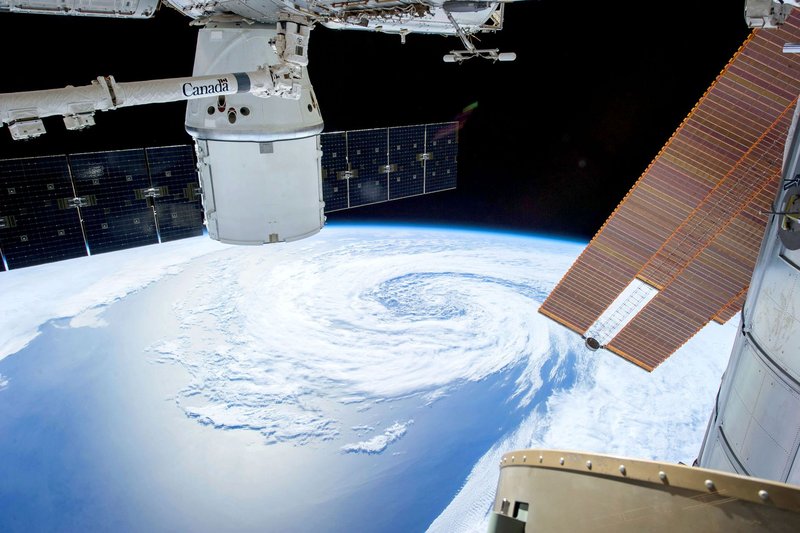
Air and water are fluids, and the same equations describe both. The three forces to know are pressure differences (air moves from high to low), gravity (cold, dense fluid sinks), and the Coriolis effect.
The Coriolis effect comes from the Earth’s rotation. A moving parcel of air or water seems to curve, to the right in the Northern Hemisphere and to the left in the Southern. Hurricanes spin counterclockwise north of the equator and clockwise south of it for this reason. A common myth says your bathtub drain does the same. It doesn’t, since a tub is far too small for the effect to beat the shape of the basin and the water’s leftover motion.
Heat drives the rest. The equator gets more sunlight than the poles, and the atmosphere and oceans move that heat toward the poles. Ocean currents like the Gulf Stream are why Western Europe is milder than Canada at the same latitude. Weather forecasting is fluid dynamics plus thermodynamics, run on supercomputers.
Radioactive decay and dating the Earth
Some atoms are unstable and turn into other atoms at a steady, predictable rate. Each unstable version of an element is an isotope with its own rate, and the time for half of a sample to decay is its half-life. Carbon-14 has a half-life of 5,730 years, which makes it useful for archaeology and recent geology. Uranium-238 has a half-life of about 4.47 billion years, which makes it useful for rocks as old as the planet.
The method: measure how much parent isotope is left and how much daughter product has built up, then work backward. In 1956 Clair Patterson used lead isotopes from the Canyon Diablo meteorite to date the Earth at about 4.55 billion years. The accepted figure today is 4.54 billion, give or take about 1 percent.
Decay does a second job. It releases heat, and that heat helps drive the mantle convection and the geodynamo covered above. A long chain of Earth processes traces back to the slow breakdown of uranium, thorium and potassium.
Which physics explains which process
| Physics concept | Earth process it explains | Everyday version |
|---|---|---|
| Gravitation and rotation | Planet shape, tides, mass changes in ice and groundwater | Weighing slightly less at the equator |
| Wave propagation | Earthquakes, layers of the interior | Tapping a watermelon |
| Convection and heat conduction | Plate tectonics, volcanoes | Soup churning on a stove |
| Electromagnetism | The magnetic field, the aurora | A compass needle |
| Fluid dynamics and the Coriolis effect | Weather, hurricanes, ocean currents | A hurricane’s spin |
| Radioactive decay | Rock dating, internal heat | A half-life clock in every rock |
Careers and degree paths
Physics and Earth science meet in a handful of careers, and the degree you pick sets which one you can reach.
- Geophysics. Seismologists, exploration geophysicists and volcanologists. Typical path: a bachelor’s in physics, geology or geophysics, then a master’s or PhD. Employers include the USGS, universities, and energy and mining companies.
- Atmospheric physics and meteorology. Weather forecasting, climate modeling and air quality. Typical path: a degree in atmospheric science, physics or math, with a heavy dose of fluid dynamics.
- Planetary science. Applying the same tools to Mars, the Moon and the moons of Jupiter. Space agencies and universities hire here, and the field leans on physics more than geology.
- Oceanography and hydrology. Currents, sea level and groundwater, where the physics is fluid flow and heat.
If you’re choosing a major, take physics through calculus-based mechanics and electromagnetism, plus at least one geology course. Programs with names like “Physics and Earth Science” or “Earth and Physical Sciences” exist at many colleges, and they cover both halves.
Summary
Earth science physics comes down to six ideas. Gravity and rotation set the planet’s shape. Waves reveal its interior. Heat flow moves its plates. A liquid-metal dynamo generates its magnetic field. Fluid motion drives its weather and oceans. Radioactive decay keeps the clock and feeds the furnace.
Once you know those six, the news looks different. An earthquake becomes a wave. A hurricane becomes a spinning fluid. A compass becomes a window on a core you will never visit.