Most guides to Irish birds pick a lane. Either you get a 500-species taxonomic table meant for someone with a life list, or you get seven birds and a plug for a hiking tour. Neither one tells you what a first-timer standing on a clifftop in County Kerry actually needs: what you’re looking at, and whether you’re even in the right place at the right time of year.
Ireland’s bird life splits cleanly into four worlds. The garden regulars that show up whether you’re trying or not. The seabird cliffs where hundreds of thousands of birds crowd onto ledges for a few frantic months. The wetlands that fill with Arctic and Greenland arrivals every winter. And a handful of rare, hard-won species that are worth building a trip around. This guide moves through all four, with identification markers you can actually use and a season attached to every entry.
Table of Contents
- Quick Reference: Who, Where, When
- Garden Birds You’ll See Without Trying
- The Seabird Cliffs
- Ireland’s Comeback Bird: The White-Tailed Eagle
- Winter Wetlands: Geese and Swans
- The Rare Ones Worth Planning Around
- Where to Go, Season by Season
- Look-Alikes That Trip Up Beginners
Quick Reference: Who, Where, When
| Bird | Best region | Best months | Habitat |
|---|---|---|---|
| Robin, Blue Tit, Blackbird | Anywhere | Year-round | Gardens, hedgerows |
| Atlantic Puffin | Skellig Michael, Saltee Islands (Kerry, Wexford) | Late April–early August | Sea cliffs, burrows |
| Northern Gannet | Great Saltee, Little Skellig, Bull Rock | April–September | Offshore rock colonies |
| Chough | West coast, Cliffs of Moher to the Dingle Peninsula | Year-round | Coastal cliffs, grassland |
| White-Tailed Eagle | Killarney National Park, Lough Léin | Year-round, most visible spring | Lakes, mountain valleys |
| Greenland White-Fronted Goose | Wexford Wildfowl Reserve | October–mid-April | Farmland, wetlands |
| Corncrake | Tory Island, Mullet Peninsula, Inishbofin | May–July (calling males) | Long grass, hay meadows |
Garden Birds You’ll See Without Trying
Ireland’s most-recorded bird isn’t some rarity — it’s the one sitting on your fence. BirdWatch Ireland’s long-running Garden Bird Survey, now in its 33rd year, consistently finds the Robin in about 95% of gardens surveyed, with Blackbird and Blue Tit close behind. If you’re starting from zero, this is where to start too.
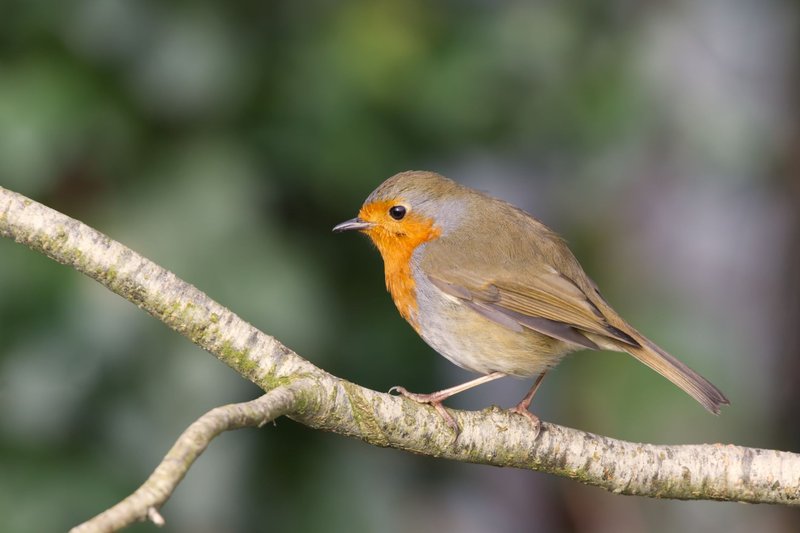
The Robin is orange-breasted, round, and fearless enough to land near a spade while you’re still digging. Unlike in most of Europe, Irish and British robins hold territory and sing through winter, which is why you’ll hear one on a grey December morning when almost nothing else is singing.
The Blackbird — glossy black male, a duller brown female that’s frequently mistaken for a different species entirely — has one of the most musical songs of any Irish bird, a loose, unhurried warble delivered from rooftops at dusk.
Blue Tit and Great Tit show up at the same feeders and get confused constantly. Blue Tit: blue cap, yellow underparts, noticeably smaller. Great Tit: black head, white cheek patch, and a bold black stripe running down its yellow chest — thicker on males, broken or thinner on females.
The Wren, despite being Ireland’s smallest common bird, has a song wildly out of proportion to its size — a rapid, trilling burst that carries much farther than a bird that small should manage. And the Goldfinch, red-faced with a gold wing-bar, has become one of the more visible garden success stories of the past decade, drawn in by the boom in niger-seed feeders.
The Seabird Cliffs
This is where Ireland stops being a garden-bird country and becomes a genuinely world-class one. The southwest and southeast coasts hold some of the densest seabird colonies in Europe, and the season is short — miss the window and the cliffs go quiet.
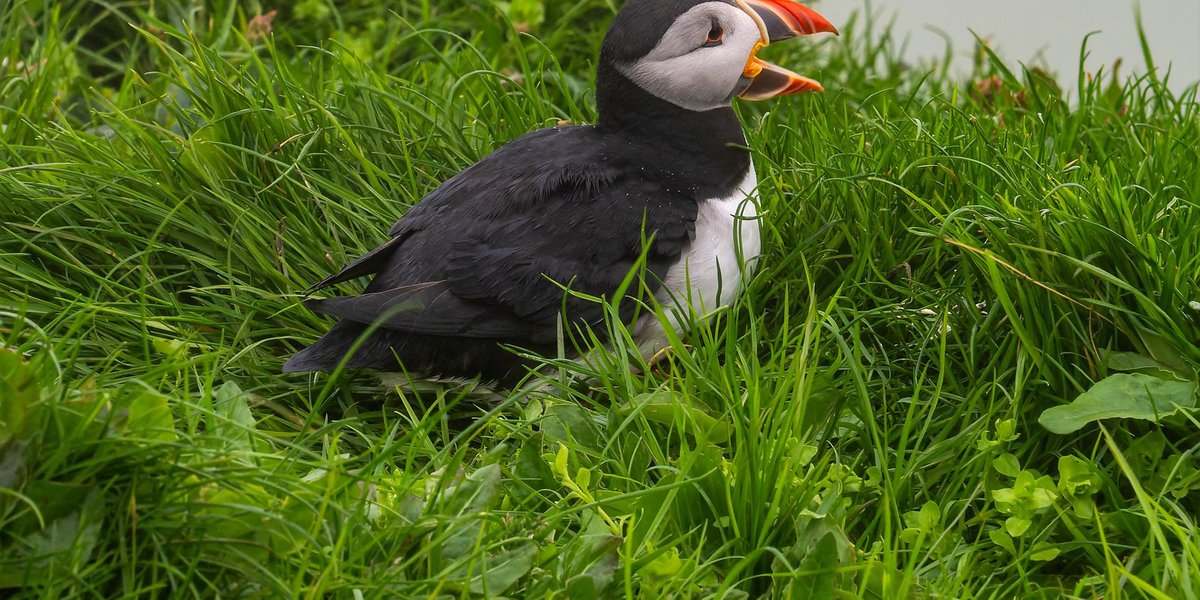
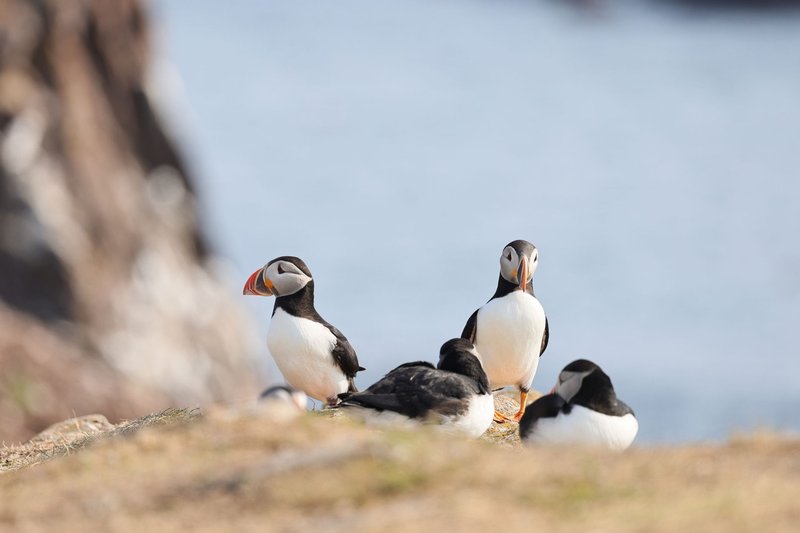
Atlantic Puffins are the draw, and for good reason: multicolored bill, orange legs, a waddling, slightly comic gait on land that gives way to fast, whirring flight offshore. They arrive at colonies in late April, are at peak visibility through May and June while establishing burrows, and clear out again by early August. Skellig Michael holds more than 3,000 puffins in season, and Great Saltee off County Wexford is the mainland-accessible alternative if a boat to the Skelligs isn’t in the cards.
Northern Gannets nest in the same stretch of coast — Great Saltee, Little Skellig, and Bull Rock in County Cork hold Ireland’s main colonies — but they’re unmistakable even at a distance: pure white with black wingtips, a six-foot wingspan, and a vertical plunge-dive from up to 30 meters that ends in a headfirst impact hard enough to hear from shore.
Razorbills and Guillemots pack onto the same ledges and get mixed up by almost every beginner. Razorbill: thick, blunt, blade-like black bill with a white stripe. Guillemot: thinner, pointed, all-dark bill, and a slightly more slender build overall. Both stand upright in dense colonies that, from a distance, look like a crowd at a football match.
Then there’s the Chough — a crow, but not like any crow you already know. Glossy black all over, with a curved red bill and red legs that make it impossible to confuse with a jackdaw once you’ve seen the color. Ireland holds a meaningful share of the global chough population along its western cliffs, from Donegal down to the Saltees, and its call is often described as sounding more like a laser sound effect than a bird.
Ireland’s Comeback Bird: The White-Tailed Eagle
Ireland’s largest bird of prey vanished as a breeding species in the early 1900s, hunted and poisoned into local extinction. It came back through a deliberate reintroduction: young eagles brought over from Norway starting in 2007 and released in Killarney National Park. It worked. The population now sits at roughly 150 individuals with 17 known breeding pairs across the country, and a pair has bred successfully on Killarney’s Lough Léin for five consecutive years, according to the National Parks and Wildlife Service.
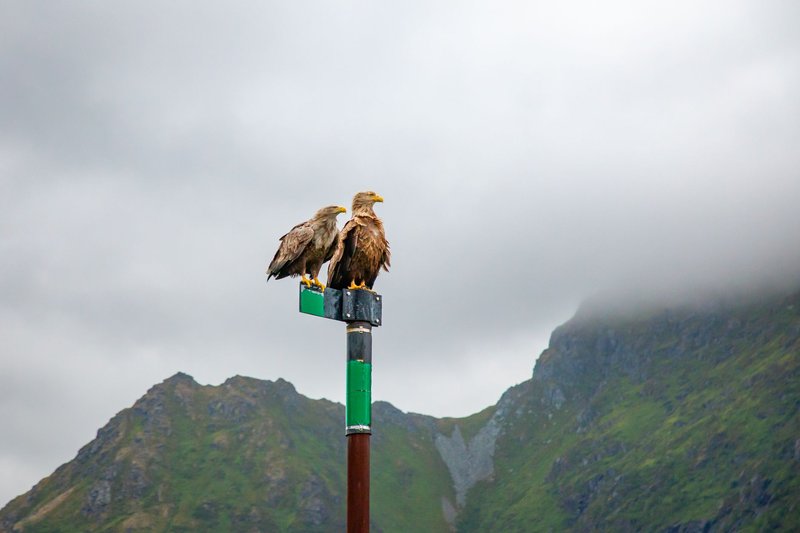
With a wingspan that can top two meters, it’s sometimes called a “flying barn door” — an ungainly, broad-winged silhouette that soars on flat wings rather than the shallow V of a golden eagle. Your best odds are a boat trip on the Lakes of Killarney, departing from Reen Pier near Ross Castle, or scanning the Black Valley and the shoreline around Lough Léin from a fixed point with patience and binoculars.
Winter Wetlands: Geese and Swans
While the cliffs empty out after summer, the wetlands fill up. The North Slob at the Wexford Wildfowl Reserve becomes, every October, the wintering ground for roughly a third of the entire world population of the Greenland White-Fronted Goose — a genuinely rare subspecies that breeds in west Greenland, stops over in Iceland, and spends the winter almost nowhere else on Earth outside Ireland and a handful of Scottish sites. They stay until mid-April.
Sharing the reserve are more than 2,000 Pale-Bellied Brent Geese, smaller and darker than the white-fronts, breeding in Arctic Canada and turning up on Irish estuaries and mudflats by the thousand through winter. The Whooper Swan — bigger than a Mute Swan, with a straight neck and a yellow-and-black bill rather than the Mute Swan’s orange-and-black one — arrives from Iceland around the same time, often in family groups that stay together through the season.
The Rare Ones Worth Planning Around
A few species are rare enough, or elusive enough, that seeing one becomes the actual point of the trip.
The Corncrake is the headline case: a secretive rail that spends its life hidden in tall grass, more often heard than seen, with a call that sounds like a comb dragged across a stick — “crex crex,” which is also its scientific name. Habitat loss from earlier mowing seasons pushed it to the edge of extinction in Ireland; BirdWatch Ireland’s conservation work, tied to delayed hay-cutting agreements with farmers, has helped populations recover in recent years. Your best shot is Tory Island or the Mullet Peninsula in Mayo, listening at dusk in May or June rather than looking.
The Barn Owl — ghostly pale, heart-shaped face — hunts low over rough grassland at dusk and is genuinely rare in Ireland compared to Britain, thanks largely to a shrinking supply of old barns and hollow trees for nesting. The Peregrine Falcon, the fastest animal on the planet in a stoop, nests on sea cliffs and increasingly on tall buildings in Irish cities, including Dublin. And the Kingfisher — electric blue back, orange underparts — is a flash-and-gone sighting along slow rivers and canals, more often caught as a streak of color than a clean look.
Where to Go, Season by Season
Spring (April–May): Seabird colonies come alive as puffins and gannets return to cliffs. Corncrakes start calling in the west. This is also the best window for spotting white-tailed eagles, before summer foliage thickens around Killarney’s lakes.
Summer (June–August): Peak seabird season — Skellig Michael, Great Saltee, and the Cliffs of Moher are all at their loudest and most crowded, in the good sense. Corncrakes are still calling into July. Puffins clear out by early August, so don’t leave this one for late summer.
Autumn (September–October): The seabird cliffs empty fast. This is the transition month — Greenland white-fronted geese and Brent geese start arriving at Wexford from October onward.
Winter (November–March): Wexford Wildfowl Reserve is the destination, thick with geese and whooper swans. Garden birds become the main event everywhere else — this is peak feeder season, and when BirdWatch Ireland runs its annual Garden Bird Survey.
Look-Alikes That Trip Up Beginners
A few pairs cause most of the confusion out in the field:
- Razorbill vs. Guillemot — bill shape is the tell. Thick and blade-like with a white stripe (Razorbill) versus thin and all-dark (Guillemot).
- Blackbird (female) vs. Song Thrush — both brown, but the Song Thrush has a heavily spotted breast; the female Blackbird’s underside is more uniformly mottled brown.
- Chough vs. Jackdaw — both black and social on coastal cliffs, but only the Chough has the curved red bill and red legs. A Jackdaw’s bill and legs are black, and it has a pale grey nape.
- Greenland White-Fronted Goose vs. Greylag Goose — the white-front has, unsurprisingly, a white patch at the base of its bill and barred black markings on its belly; the Greylag doesn’t have either.
None of these are difficult once you know what to check first. That’s really the whole method behind Irish bird identification: know the one or two features that actually separate the look-alikes, and don’t get distracted by everything else.