TLDR
Plasma is ionized gas — atoms that have been stripped of enough electrons to conduct electricity and respond to magnetic fields. It shows up everywhere: naturally in lightning, the Sun, and the aurora; artificially in neon signs, fluorescent tubes, and welding arcs; and in specialized tech like semiconductor etching chambers and fusion reactors. Fire is a partial, weak plasma at best. Blood plasma is a completely different thing that just happens to share the name.
Table of Contents
- What Plasma Actually Is
- Natural Plasma
- Everyday Artificial Plasma
- Industrial and Medical Plasma
- The Four States of Matter, Compared
- FAQ
What Plasma Actually Is
Heat a gas enough, or hit it with a strong enough electric field, and something breaks. Electrons get knocked loose from their atoms, leaving behind a soup of free electrons and positively charged ions. That soup is plasma — a gas that conducts electricity, responds to magnetic fields, and glows when its stray electrons fall back into place.
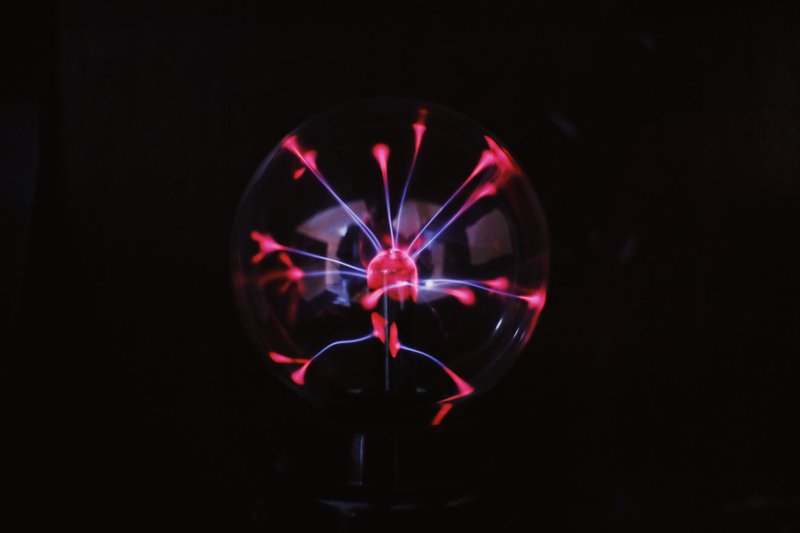
Scientists call it the fourth state of matter because it doesn’t behave like a solid, liquid, or gas. It has no fixed shape or volume like a gas, but unlike ordinary gas, it’s electrically charged and pushes back against magnetic fields. Over 99% of the visible universe is plasma. Almost none of your daily life is, which is exactly why the examples below are worth knowing.
Natural Plasma
Stars, Including the Sun
A star is a ball of plasma held together by its own gravity. The Sun’s core runs around 15 million degrees Celsius, hot enough that hydrogen atoms lose their electrons entirely and fuse together, releasing the energy that eventually reaches Earth as sunlight. The visible surface, the photosphere, is cooler plasma at around 5,500°C — still nowhere close to solid, liquid, or gas.
Lightning
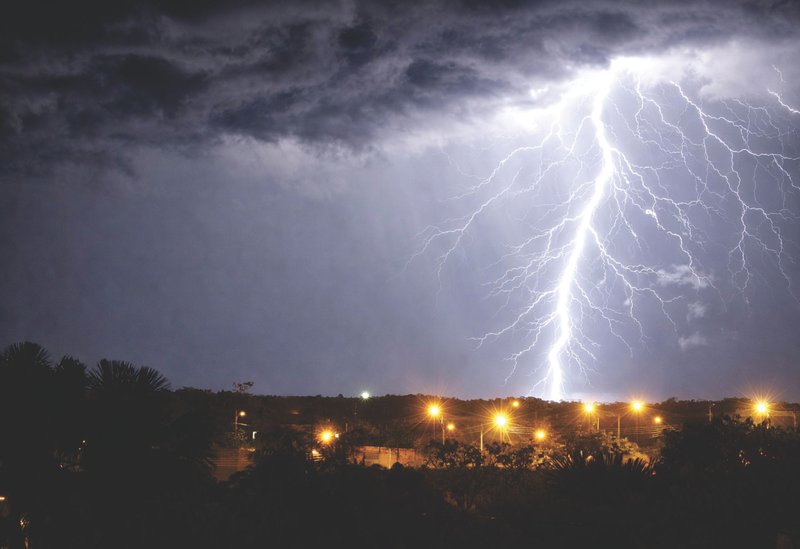
A lightning bolt superheats the air in its path to roughly 30,000 Kelvin in a fraction of a second — hotter than the surface of the Sun. That heat strips electrons from nitrogen and oxygen molecules, turning a narrow column of air into a brief, brilliant plasma channel. The thunderclap you hear afterward is the shockwave from air expanding that fast.
Auroras
The Northern and Southern Lights happen when charged particles streaming from the Sun collide with gases in Earth’s upper atmosphere, exciting oxygen and nitrogen atoms until they glow. According to NASA, the collisions happen 60 to 250 miles up, and the color depends on which gas gets hit — green and red from oxygen, blue and purple from nitrogen. It’s plasma physics playing out as a light show you can see with the naked eye.
Solar Wind
The Sun doesn’t just emit light — it constantly sheds a stream of charged particles called the solar wind, plasma flowing outward from its corona at 250 to 500 miles per second. This is the same plasma that triggers auroras when it reaches Earth, and the same thing satellite operators watch closely because a strong burst can disrupt radio communications and power grids.
Nebulae
Interstellar space isn’t empty. Nebulae are vast clouds of gas and dust, much of it ionized by radiation from nearby young stars, glowing in the reds and blues you see in telescope images. The Orion Nebula, visible even from suburban backyards with binoculars, is plasma lit up by the very stars forming inside it.
The Ionosphere
Earth’s upper atmosphere, from about 30 to 600 miles up, is partially ionized by solar radiation into a thin plasma layer called the ionosphere. It’s not dense enough to notice, but it’s dense enough to reflect certain radio frequencies back toward the ground — the reason AM radio signals can bounce around the curve of the Earth at night.
Everyday Artificial Plasma
Neon Signs
A neon sign is a glass tube filled with noble gas, with an electric current driving current through it hard enough to ionize the gas into plasma. The classic orange-red comes from actual neon; other colors come from swapping in argon, krypton, or xenon, sometimes paired with colored glass. The glow is the gas’s ionized electrons releasing energy as light as they recombine with atoms.
Fluorescent and CFL Light Tubes
Inside a fluorescent tube, an electric current ionizes mercury vapor into plasma, which emits ultraviolet light. That UV light is invisible on its own, so the tube’s inner wall is coated with phosphor that absorbs it and re-emits it as the white light you actually see. Compact fluorescent bulbs (CFLs) work the same way, just coiled into a smaller shape.

Plasma Globes
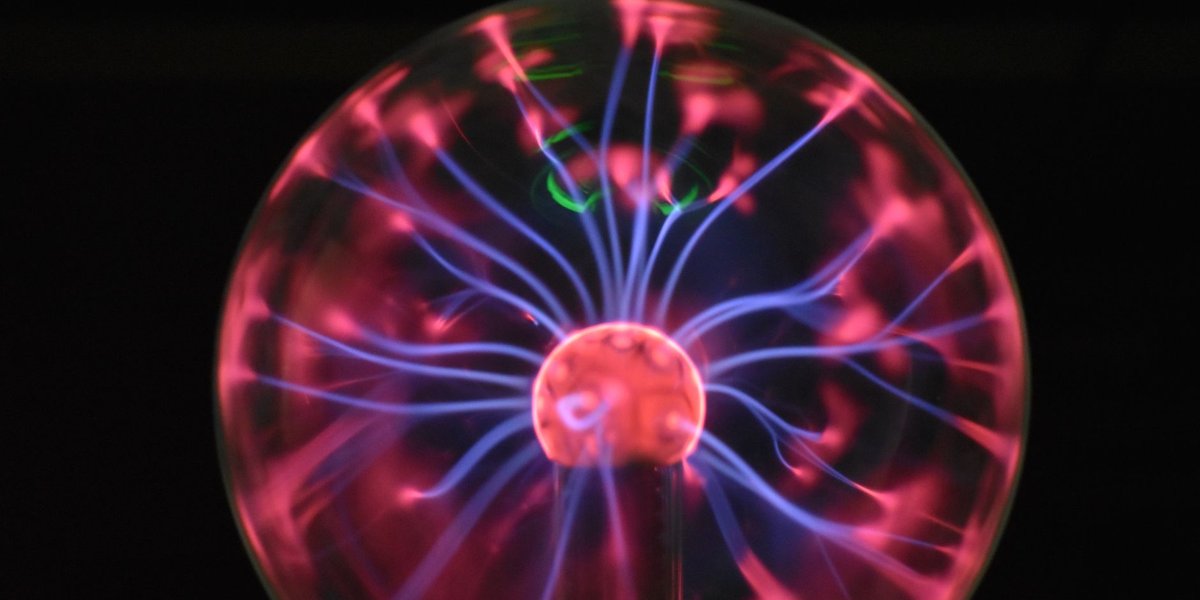
The desktop toy with tendrils of light chasing your finger around the glass is a small, contained, low-pressure gas ionized by a high-frequency electric field at the center electrode. Touch the glass and your body becomes the easiest path to ground, so the plasma filament bends toward your hand. It’s a genuinely accurate, if miniature, demonstration of how plasma seeks the path of least resistance.
Plasma TVs
Older plasma televisions packed millions of tiny sealed cells, each filled with a xenon-neon gas mixture, between two glass panels. An electric charge ionized the gas in individual cells, producing UV light that struck phosphors to create red, green, or blue sub-pixels. The technology largely lost out to LED and OLED screens on cost and burn-in risk, but for over a decade it was the go-to example of plasma physics sitting in people’s living rooms.
Industrial and Medical Plasma
Welding Arcs and Plasma Cutters
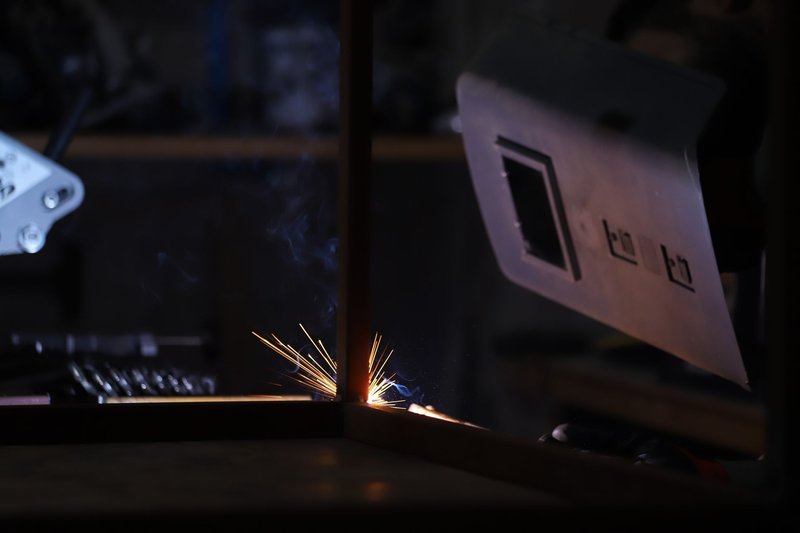
Arc welding strikes an electric arc between an electrode and the metal being joined, and that arc is a column of plasma running hot enough — often over 6,000°C — to melt steel. Plasma cutters use a similar principle in reverse, forcing pressurized gas through a narrow nozzle and ionizing it into a needle-thin plasma jet hot enough to cut through metal plate rather than melt it in bulk.
Semiconductor Plasma Etching
Every chip in your phone was shaped, in part, by plasma. Chipmakers load a masked silicon wafer into a vacuum chamber and ionize a process gas — often a fluorine or chlorine compound — into plasma. The ions accelerate toward the wafer and chemically strip away exposed material with precision measured in nanometers, according to Penn’s Singh Center for Nanotechnology. Wet chemical etching can’t hit that precision; plasma etching is what makes modern transistor density possible.
Fusion Reactors
Machines like ITER and the various tokamaks running in national labs confine hydrogen plasma at temperatures north of 150 million°C — roughly ten times hotter than the Sun’s core — using powerful magnetic fields, since no physical container could survive contact with it. The goal is to force hydrogen isotopes to fuse the way stars do, releasing far more energy than it takes to run the reactor. Nobody’s cracked sustained net-positive fusion power at commercial scale yet, but the plasma physics involved is some of the most tightly controlled on Earth.
Cold Plasma Sterilization
Not all plasma is scorching. “Cold” or non-thermal plasma, generated at low pressure or with pulsed electric fields, stays close to room temperature while still carrying enough ionized, reactive particles to kill bacteria and viruses on contact. Hospitals use it to sterilize heat-sensitive instruments that couldn’t survive an autoclave, and researchers are testing it for wound treatment and even food safety applications.
Ion Thrusters
Spacecraft like NASA’s Dawn probe and various commercial satellites use ion thrusters that ionize a gas, usually xenon, and use electric fields to accelerate the resulting plasma out the back of the engine. The thrust is tiny compared to chemical rockets, but ion engines run for months at a time on a fraction of the fuel, which is why they’re the standard choice for deep-space missions and satellite station-keeping.
The Four States of Matter, Compared
| State | Particle Behavior | Shape & Volume | Conducts Electricity? | Everyday Example |
|---|---|---|---|---|
| Solid | Particles locked in fixed positions | Fixed shape, fixed volume | No | Ice cube |
| Liquid | Particles close together, free to flow | No fixed shape, fixed volume | No | Water |
| Gas | Particles spread out, moving freely | No fixed shape, no fixed volume | No | Air |
| Plasma | Particles ionized, free electrons and ions | No fixed shape, no fixed volume | Yes | Lightning |
The jump from gas to plasma isn’t about temperature alone — it’s about ionization. A gas becomes plasma only once enough of its atoms have lost electrons that the whole mass starts behaving electrically, which is why plasma responds to magnetic fields in ways a gas never does.
FAQ
Is fire a plasma?
Mostly no, technically sometimes. Ordinary flame is combustion — a chemical reaction between fuel and oxygen that produces heat, light, and hot gas, not a meaningfully ionized one. The proportion of charged particles in a candle flame or campfire is too low for it to behave like true plasma. Very hot flames, like an oxy-acetylene torch, do contain a thin layer of weakly ionized gas, so the honest answer is that fire sits on the edge of the definition rather than squarely inside it.
Is blood plasma the same thing as physics plasma?
No, and the shared name is a coincidence of history. Blood plasma is the straw-colored liquid component of blood that carries red and white blood cells, proteins, and nutrients — it has nothing to do with ionized gas. Physicist Irving Langmuir borrowed the term “plasma” in the 1920s because the way ionized gas carried charged particles reminded him of how blood plasma carries cells. The National Institutes of Health covers the medical definition if that’s the one you were actually after.
Can plasma exist at room temperature?
Yes. Most plasma examples on this list are extremely hot, but cold plasma, used in sterilization and some medical treatments, stays near room temperature while remaining ionized. The trick is achieving ionization through electric fields at low pressure rather than through raw heat.
Why is plasma called the fourth state of matter?
Because it doesn’t fit the other three. Solids, liquids, and gases are all made of electrically neutral atoms or molecules; plasma is made of free-floating ions and electrons. That single difference changes almost everything about how it behaves, from conducting electricity to responding to magnetic fields, which is why physicists gave it its own category instead of calling it “extra hot gas.”