Michigan has two things most rockhounding states don’t: a billion-year-old rift that pumped the Upper Peninsula full of native copper, and two ice ages that ground up half of Canada and dumped the debris on its beaches. That combination is why you can walk a Lake Michigan shoreline and pick up a 350-million-year-old coral fossil in the same afternoon you find a rock that only glows under UV light.
This isn’t a list of pretty rocks you’ll never actually find. Every entry here has a real collecting location attached to it, a way to tell it apart from a lookalike, and a note on whether you’re legally allowed to keep it. Fifteen minerals and gemstones, in order of how likely you are to actually find one.
Table of Contents
- How Michigan Got So Mineral-Rich
- How to Identify What You’ve Found
- What’s Legal to Collect (And Where)
- Gear Worth Bringing
- Best Season to Hunt Each One
- 15 Minerals and Gems Found in Michigan
- Where to Start
How Michigan Got So Mineral-Rich
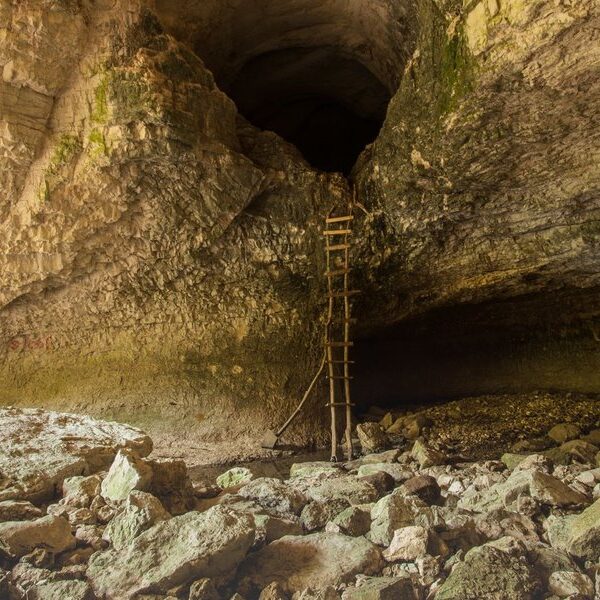
About 1.1 billion years ago, the North American continent tried to tear itself apart along a line that now runs from Kansas up through Lake Superior and back down through Michigan. It failed, but not before pumping enormous volumes of basalt lava through the crack. That basalt cooled with gas bubbles trapped inside it — cavities that later filled with agate, copper, datolite, and prehnite. Geologists call the whole formation the Midcontinent Rift, and it’s the reason the Keweenaw Peninsula produced more native copper than anywhere else on Earth for over a century.
Then the glaciers showed up. The last ice sheet retreated from Michigan roughly 11,000 years ago, but not before it bulldozed bedrock from as far away as Ontario and dragged it south, grinding it into gravel along the way. That’s why you find Lake Superior agates on beaches in the Lower Peninsula, hundreds of miles from any basalt outcrop — the ice carried them there and the waves have been sorting them out of the gravel ever since.
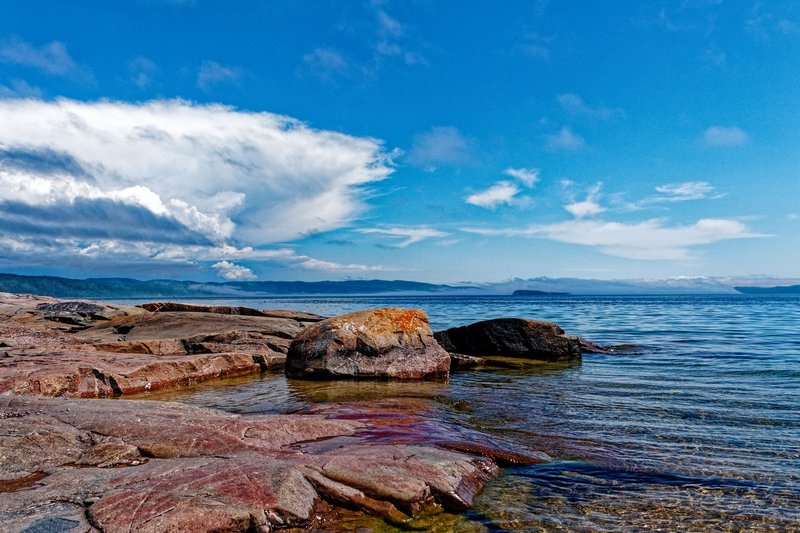
Every entry on this list traces back to one of those two events: rift rock in the Upper Peninsula, or glacial reshuffling everywhere else.
How to Identify What You’ve Found
Most misidentifications come down to skipping the streak test. Color lies — weathering, wet rock, and lighting all change how a mineral looks — but a mineral’s streak (the color of its powder when scraped across unglazed porcelain) and its hardness on the Mohs scale don’t.
| Test | How to do it | What it tells you |
|---|---|---|
| Hardness | Try to scratch the specimen with a fingernail (2.5), a copper penny (3.5), a steel knife (5.5), then quartz (7) | Narrows down the mineral family fast |
| Streak | Scrape the rock across an unglazed ceramic tile | The powder color is often more diagnostic than the surface color |
| Luster | Look at how light reflects off a fresh break | Glassy, metallic, waxy, and dull all point to different mineral groups |
| Reaction to acid | A drop of vinegar on calcite will fizz | Separates calcite from harder look-alikes like quartz |
| UV response | Shine a longwave/shortwave UV flashlight in the dark | Confirms sodalite (Yooperlite) and some fluorite and calcite |
Keep a cheap streak plate and a UV flashlight in your bag and you’ll rule out more wrong guesses in the field than any app will.
What’s Legal to Collect (And Where)
Michigan’s rules are more permissive than most states, but they’re not a free-for-all, and where you’re standing changes what applies to you.
| Land type | Rule |
|---|---|
| State parks and state-owned land | 25-pound annual limit per person on rocks, minerals, and fossils combined, for personal use only |
| Great Lakes shoreline up to the ordinary high water mark | Counts as public trust land — same 25-pound annual limit applies, since the lakebed is state-owned |
| Isle Royale National Park | All collecting is prohibited under federal law, including greenstone pebbles on the beach |
| Keweenaw National Historical Park boundaries | Collecting is prohibited on NPS land; adjacent state forest and private mining-heritage sites may allow it |
| Private property, including old mine dumps | Legal only with the landowner’s explicit permission — many Keweenaw copper dumps are privately held |
| Beach glass and slag glass | Legally classified as trash, so it doesn’t count against your 25-pound limit |
The 25-pound cap is an annual total, not a per-trip allowance, and the Michigan Department of Environment, Great Lakes, and Energy is the agency that enforces it — rangers have confiscated hauls that blew well past the limit. Isle Royale is the one everyone gets wrong: it’s tempting to think a beach pebble doesn’t count, but the National Park Service treats any removal of natural material as a federal violation, full stop. If you want greenstone, hunt the Keweenaw shoreline instead, where it occasionally washes up outside park boundaries.
Gear Worth Bringing
You don’t need much to start, and most of it is under $30:
- UV flashlight (365nm) — non-negotiable for Yooperlite hunting, and useful for spotting fluorescent calcite and fluorite too
- Rock hammer and cold chisel — for freeing specimens from matrix rock, not for hammering on beach cobbles (that’s how you crack a good find in half)
- 5-gallon bucket and a garden trowel — for gravel-sifting at agate beaches
- Rock tumbler — turns a pocketful of dull gray Petoskey stones and agates into something you’d actually display
- Streak plate and a 10x loupe — the two cheapest identification tools that actually work
- Waterproof boots or waders — the best Lake Superior agates are usually a few inches underwater, not sitting dry on the sand
Best Season to Hunt Each One
| Season | What’s working in your favor |
|---|---|
| Spring (late March–May) | Snowmelt and ice breakup push rock down the Superior shoreline, refreshing gravel beds — the best window for Yooperlite and agates |
| Summer (June–August) | Low, calm water makes wading for Petoskey stones and agates easier, and most inland sites and mine-dump access are open |
| Fall (September–November) | Storm season on Lake Superior churns up fresh gravel after each blow — go the day after a storm, not during one |
| Winter | Mostly off-limits for beach hunting, but a good season to research county-specific spots and legal access before spring |
15 Minerals and Gems Found in Michigan
1. Petoskey Stone
Michigan’s official state stone since 1965, and the one every visitor has heard of before they arrive. A Petoskey stone is fossilized colonial coral, Hexagonaria percarinata, that lived in a shallow tropical sea covering Michigan around 350 million years ago. Dry, it looks like a plain gray cobble. Wet — or polished — the honeycomb pattern of individual coral cells snaps into focus.
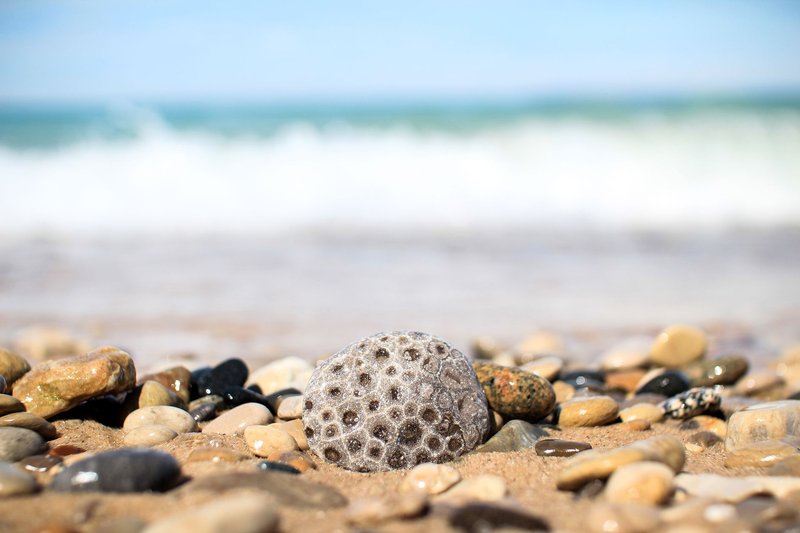
Your best odds are the beaches around Little Traverse Bay in Emmet and Charlevoix counties, especially Magnus Park and Petoskey State Park itself. Wading in ankle-deep water and looking for the hexagonal pattern under the surface beats scanning dry sand.
2. Charlevoix Stone
Often mistaken for a Petoskey stone by beginners, Charlevoix stone is a different fossil coral species, Favosites, with a tighter, more honeycomb-uniform cell pattern than Petoskey stone’s eye-like segments. It formed in the same ancient reef system and shows up on the same beaches, which is exactly why the two get confused.
Fitzgerald Park and the beaches near the city of Charlevoix are the reliable spots. If the “eyes” in the pattern look more like small hexagonal pores than distinct segmented rings, you’re holding Charlevoix stone, not Petoskey.
3. Isle Royale Greenstone (Chlorastrolite)
Adopted as Michigan’s official state gem in 1972, chlorastrolite — nicknamed greenstone — is a variety of pumpellyite that forms in the gas cavities of ancient basalt flows, the same rift rock that produced the Keweenaw’s copper. Its turtle-shell or star-shaped segmented pattern in shades of green is unlike anything else on this list, and genuine specimens are small, rarely bigger than a fingernail.
As the name suggests, Isle Royale is the classic source — and also the one place you legally can’t collect it, since it’s inside a national park. Your realistic shot is beach gravel on the Keweenaw Peninsula shoreline, where eroded rift rock occasionally releases a pebble.
4. Yooperlite
The newest star of Michigan rockhounding, Yooperlite wasn’t identified as a distinct find until 2017, when a Lake Superior shoreline hunter noticed certain gray syenite cobbles glowing bright orange under UV light. The glow comes from fluorescent sodalite embedded in the rock. In daylight, Yooperlite looks like an unremarkable speckled gray stone — you genuinely cannot find it without a UV flashlight and dark conditions.
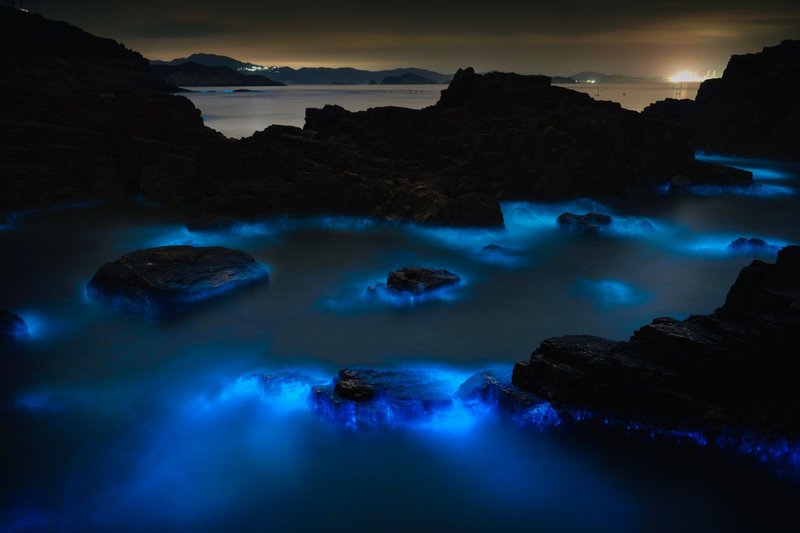
Night hunts along Lake Superior beaches in the eastern Upper Peninsula, particularly near Grand Marais and along the Keweenaw shoreline, are the standard approach. Late March through April, right after ice breakup pushes fresh gravel onto the beach, is peak season.
5. Lake Superior Agate
Banded, translucent, and stained orange-red by iron oxide, Lake Superior agates formed the same way as the basalt-hosted gems above — as mineral deposits filling gas cavities in rift lava, later freed by weathering and scattered by glaciers across the entire state. A true agate will show translucent banding when you hold it up to sunlight; a plain jasper or chert won’t.
The Keweenaw Peninsula, Whitefish Point, and the gravel beaches near Grand Marais in Alger County are the most productive spots, though glacially transported agates do occasionally show up as far south as Lower Peninsula gravel pits.
6. Native Copper
The mineral that built the Keweenaw Peninsula’s mining towns. Michigan copper deposits are unusual because the copper occurs as pure, metallic native copper rather than copper ore that needs smelting — a geological rarity tied directly to the Midcontinent Rift’s basalt flows. Between 1845 and 1968, Keweenaw mines produced roughly five million metric tons of it, more than any other copper district in the world at the time.
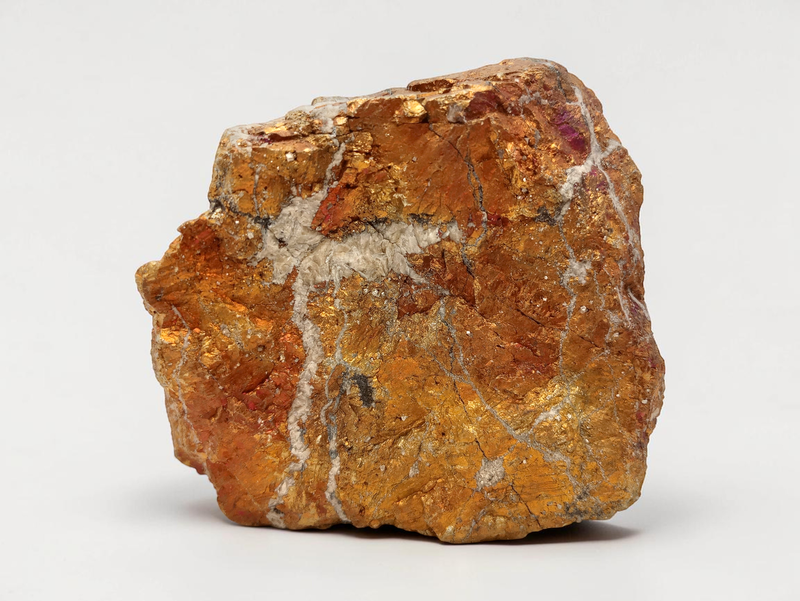
Old mine dump piles around Calumet, Ahmeek, and the Copper Country towns are where specimens turn up today, though most of that land is a mix of private mining claims, state forest, and National Historical Park boundaries — verify ownership before you dig, and stick to public collecting events like Keweenaw Mineral Days if you’re unsure.
7. Datolite
A calcium borosilicate mineral that crystallized inside the same amygdaloidal basalt cavities as the copper deposits, datolite in the Keweenaw shows up in colors most people don’t expect from a “mineral” — pink, orange, green, even mottled combinations, with a porcelain-like waxy luster when polished. Unpolished, it looks like an unassuming chalky nodule.
It’s almost always found alongside old copper workings rather than on open beaches, since it forms in the same rock the copper miners were digging through.
8. Prehnite
A pale green to yellow-green mineral that, like datolite and agate, crystallized in the gas pockets of Keweenaw basalt. Prehnite typically forms in botryoidal masses — rounded, grape-like clusters — rather than sharp crystal points, which is the fastest way to tell it apart from quartz or calcite at a glance.
It’s a copper-country find rather than a beach find, most often turning up in the same mine-dump gravel as datolite and native copper.
9. Puddingstone (Jasper Conglomerate)
Not a single mineral but a distinctive rock: red and pink jasper pebbles cemented into a lighter quartzite matrix, giving it a look genuinely reminiscent of fruitcake or plum pudding. Puddingstone is a glacial transplant — its source bedrock is actually in Ontario’s Georgian Bay area, and Michigan’s glaciers carried boulders of it south and scattered them across the state, especially in southern Michigan’s gravel deposits and farm fields.
Finding one is closer to a scavenger hunt than a beach search — check gravel pits, plowed fields, and glacial till deposits rather than lakeshores.
10. Unakite
A pink-and-green mottled rock made of pink feldspar, green epidote, and quartz, unakite isn’t native Michigan bedrock either — like puddingstone, it’s a glacial erratic carried down from Canadian Shield bedrock to the north. It’s common enough in glacial gravel that most rockhounds find one by accident while searching for agates.
The mottled pink-and-green color is distinctive enough that misidentification is rare, which makes it a good confidence-builder for beginners.
11. Leland Blue
Not a mineral at all — it’s glass slag, a byproduct of the 19th-century iron smelting furnaces that once operated in Leland, in Leelanau County. Leland Blue ranges from powder blue to steel gray, often with swirled, almost marbled patterns, and it’s become one of the most collected “stones” on Lake Michigan’s northern shoreline precisely because it’s rare and man-made rather than geological.
Because it’s classified as glass and industrial waste rather than a natural rock, Leland Blue doesn’t count against Michigan’s 25-pound collecting limit — one of the few finds on this list you can gather without watching the scale.
12. Chert and Jasper
Michigan’s chert and jasper varieties, sometimes called Kona-style jasper by collectors, form in banded iron formations and dolomite bedrock, showing up as reddish, banded, or mottled rocks with a waxy to dull luster. Chert scratches glass but won’t scratch quartz, which separates it from true agate when the banding looks similar.
Gravel pits and stream cuts throughout the Upper Peninsula are the most consistent source, often turning up in the same deposits as Lake Superior agate.
13. Calcite
Common in Michigan’s limestone-rich bedrock, particularly around the Lower Peninsula’s Presque Isle County quarries, calcite crystals range from clear rhombohedral points to fibrous white masses. The giveaway test is simple: a drop of vinegar or any weak acid on calcite fizzes almost immediately, while quartz and most other look-alikes show no reaction at all.
Active and abandoned limestone quarries are the typical source, though access often requires permission since most operating quarries are private property.
14. Pyrite
Michigan’s “fool’s gold” shows up in two different settings: as small metallic cubes scattered through Keweenaw copper-bearing rock, and separately within Marshall Sandstone formations in the southern Lower Peninsula. Its brassy metallic luster and cubic crystal habit are distinctive, though the giveaway that separates it from actual gold is the streak test — pyrite leaves a greenish-black streak, gold leaves a yellow one.
15. Amygdaloidal Basalt
The rock that makes half of this list possible. Amygdaloidal basalt is Keweenaw rift lava riddled with gas-bubble cavities — the “amygdules” — that later filled with agate, prehnite, datolite, or native copper as groundwater deposited minerals inside them over millions of years. Finding a piece with an intact agate or copper nodule still embedded in the surrounding basalt is a different kind of prize than a loose, weathered pebble; it shows you exactly how the mineral formed.
Basalt outcrops and shoreline exposures around the Keweenaw Peninsula are the place to look, particularly where wave action has freshly exposed a rock face.
Where to Start
If this is your first trip, skip the Keweenaw copper dumps and the night-hunting gear until you’ve got a few finds under your belt. Start with Petoskey State Park for coral fossils in daylight, or a spring morning on a Grand Marais beach with a UV flashlight for Yooperlite — both are beginner-friendly, both have a real chance of a find in an afternoon, and neither requires figuring out who owns the land you’re standing on.