North Korea logs around 386 bird species, which is a strange fact to sit with given how few outsiders ever get to look. The country that guards its borders most jealously also happens to host one of the most consequential accidental wildlife refuges on Earth. The Demilitarized Zone, fenced and mined and emptied of people for seventy years, has quietly become a sanctuary for cranes that nearly went extinct everywhere else.
So this isn’t a trip-planning guide. Access for foreign birders is effectively nonexistent, and that’s the point. What follows is a tour of the species that make this avifauna worth knowing: the national bird most people guess wrong, the crane that shows up on Korean wedding screens and ink paintings, and the endangered migrants that pour through Mundok and the Yellow Sea coast every spring and fall.
Table of Contents
- The National Bird (and Why People Get It Wrong)
- The Cranes: Korea’s Living Symbols
- Endangered Migrants of the Yellow Sea Coast
- Common Birds You’d Actually See
- Where the Birds Are: Key Habitats
- Comparison Table
- Frequently Asked Questions
The National Bird (and Why People Get It Wrong)
1. Northern Goshawk (Accipiter gentilis)
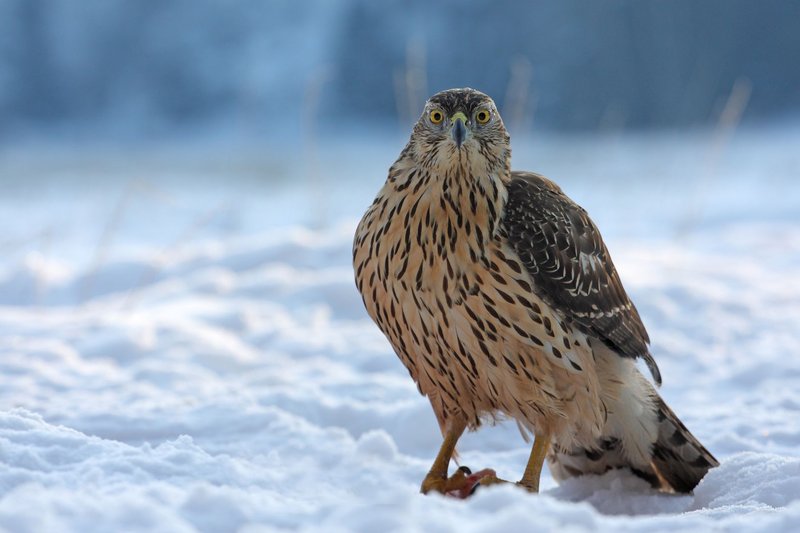
Ask which bird represents North Korea and most people reach for something dramatic — an eagle, maybe a crane. The official answer is the Northern Goshawk, locally tied to the falconry tradition of chamsuri and prized historically by Korean nobility for hunting.
It’s a forest raptor, roughly 18 to 24 inches long with a wingspan pushing four feet on the females, who run noticeably larger than males. Look for the slate-gray back, the finely barred pale underparts, and a bold white stripe over a fierce red eye. Goshawks don’t soar over open fields the way buteos do; they ambush through dense woodland, threading between trunks at speed. Spotting one is more about catching a gray blur than studying a bird.
The Cranes: Korea’s Living Symbols
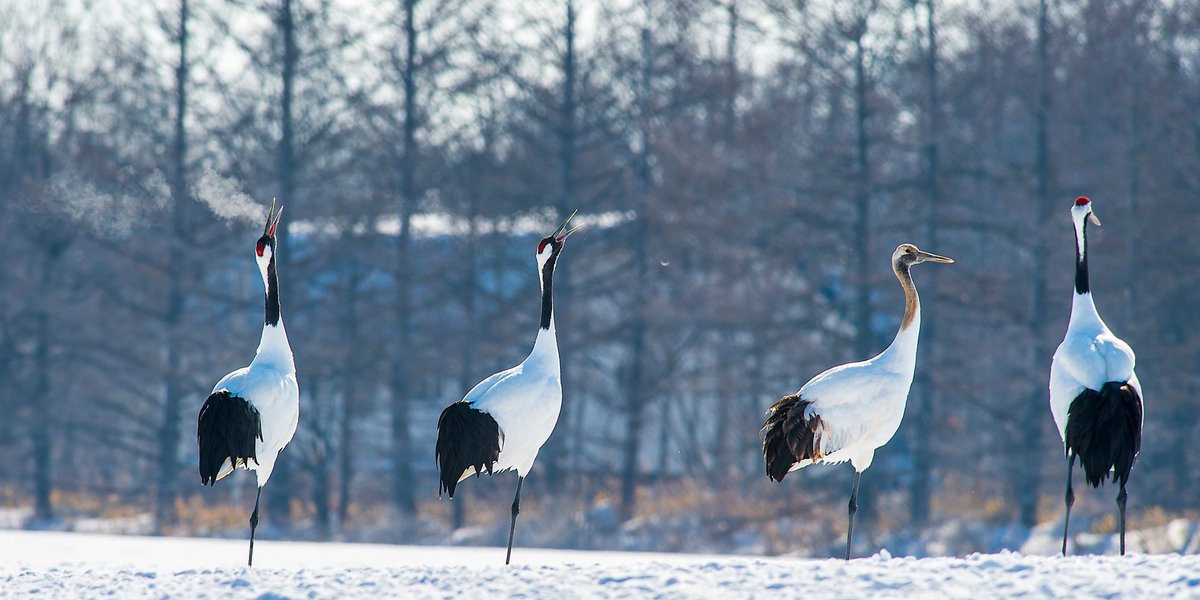
Cranes carry more cultural weight in Korea than any other bird. They appear on the old 500-won coin, in court paintings, on the embroidered rank badges of Joseon-era officials. Three crane species pass through or winter on the peninsula, and the DMZ is central to all of them.
2. Red-crowned Crane (Grus japonensis)
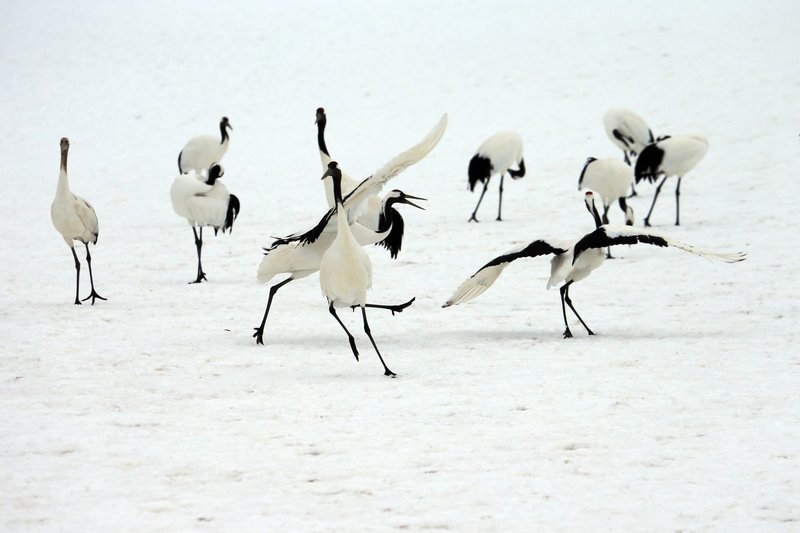
The one you picture when you picture a Korean crane. Standing nearly five feet tall with a snow-white body, black neck and a bare red crown, it’s among the rarest cranes on the planet — fewer than 3,000 mature individuals remain, per the IUCN Red List. The mainland population winters in and around the DMZ, where the absence of farming and development gives them undisturbed wetland to forage in. Korean tradition links the crane to longevity and fidelity, which is why it still turns up on wedding decorations.
3. White-naped Crane (Antigone vipio)
Slightly smaller and grayer, with a distinctive red face patch and a white stripe running down the back of the neck. White-naped Cranes stage in the DMZ and the Han River estuary during migration, often mixing into flocks with their red-crowned cousins. They’re vulnerable globally, and Korea’s coastal estuaries are a critical refueling stop on their route between Mongolia and southern wintering grounds.
4. Hooded Crane (Grus monacha)
Darker than the others — a slaty-gray body with a white head and neck and a small red crown patch. Hooded Cranes are less tied to North Korea specifically but pass through on migration, and seeing the three crane species in one wetland is part of what makes the DMZ corridor extraordinary.
Endangered Migrants of the Yellow Sea Coast
North Korea’s west coast sits on the East Asian–Australasian Flyway, one of the busiest migration highways on Earth. Tidal mudflats here feed millions of shorebirds, and several of the most threatened are Yellow Sea specialists.
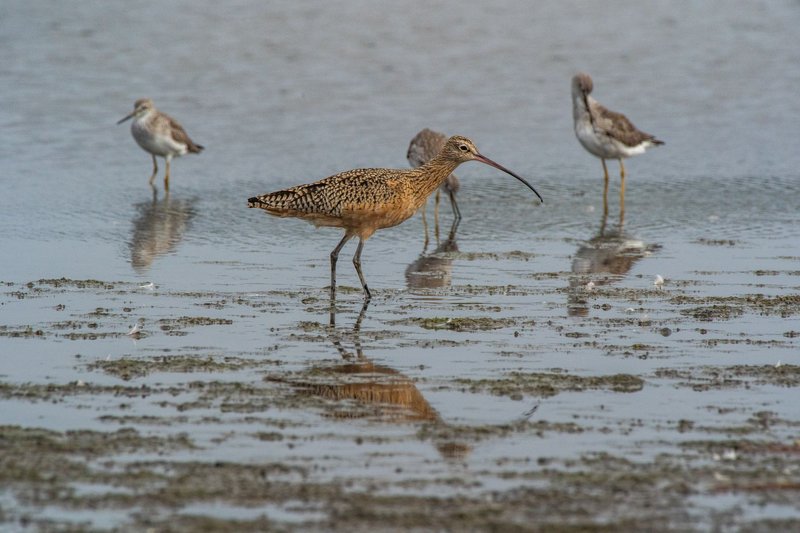
5. Spoon-billed Sandpiper (Calidris pygmaea)
A tiny shorebird with a spatula-shaped bill found on no other species, and one of the most endangered birds in the world — the global population is measured in the low hundreds. It depends on Yellow Sea mudflats to refuel during migration, which makes North Korea’s relatively undeveloped tidal flats unexpectedly important. Reclamation projects across the region have gutted this habitat elsewhere.
6. Baikal Teal (Sibirionetta formosa)
A small dabbling duck with an intricately patterned green-and-gold face, the drake looking almost hand-painted. Baikal Teal gather in enormous swirling flocks on Korean wetlands in winter, sometimes numbering in the tens of thousands, a spectacle that ranks among the region’s great wildlife events.
7. Swan Goose (Anser cygnoides)
The wild ancestor of the domestic Chinese goose, with a long black bill and a sharp line dividing the dark crown from the pale cheek. It’s vulnerable globally and uses Korean coastal wetlands during migration.
8. Black-faced Spoonbill (Platalea minor)
One of the rarest spoonbills, recognizable by the black facial skin around the bill and the flat spatulate bill it sweeps side to side through shallow water. The species breeds on small islets off the Korean coast, and the DMZ-area estuaries are part of its limited range.
9. Scaly-sided Merganser (Mergus squamatus)
A fish-eating duck with a shaggy crest and distinctive scaled flank pattern. Endangered and tied to clean, fast-flowing rivers, it winters on Korean waterways.
10. Steller’s Sea Eagle (Haliaeetus pelagicus)
Among the heaviest eagles alive, with a massive orange-yellow bill and bold white shoulders and tail. These giants drift down from the Russian Far East in winter, hunting fish and waterfowl along the coast.
Common Birds You’d Actually See
Strip away the rarities and you’re left with the everyday cast — the birds that fill North Korean gardens, rice paddies, and forest edges, many of them familiar across East Asia.
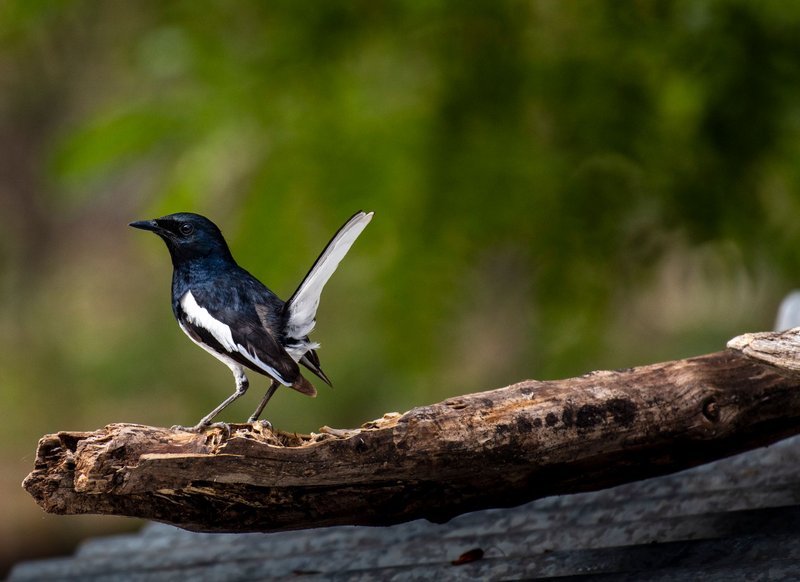
11. Oriental Magpie (Pica serica)
The unofficial favorite of the whole Korean peninsula. Glossy black and white with a long iridescent tail, it’s woven into folklore as a bringer of good news and is one of the most commonly seen birds across both Koreas.
12. Azure-winged Magpie (Cyanopica cyanus)
Smaller and more elegant than the Oriental Magpie, with a black cap, pale gray body and striking sky-blue wings and tail. They move in noisy, sociable flocks through wooded parks and edges.
13. Vinous-throated Parrotbill (Sinosuthora webbiana)
A tiny, round, long-tailed bird with a stubby finch-like bill, usually heard before it’s seen — flocks chatter constantly through reedbeds and scrub. Endlessly active and almost comically cute.
14. Daurian Redstart (Phoenicurus auroreus)
The male is unmistakable: gray crown, black face, bright orange-rust belly and a white wing patch. Common in winter around gardens and open country, often flicking its tail from a low perch.
15. Brown-eared Bulbul (Hypsipetes amaurotis)
A noisy, gray-brown bird with a rusty cheek patch and an undulating flight. Abundant in wooded areas and a constant presence in the soundscape of Korean forests.
16. Great Tit (Parus major)
The widespread tit, with a black head, white cheeks and a black stripe down a yellow belly. A confident garden bird and one of the easiest to recognize across the region.
17. Eurasian Tree Sparrow (Passer montanus)
The default sparrow of East Asia, distinguished from the house sparrow by the chestnut crown and the neat black cheek spot. It fills villages, farmland, and city edges everywhere.
18. Common Pheasant (Phasianus colchicus)
The ring-necked pheasant, native here rather than introduced. Cocks are spectacular — coppery body, iridescent green head, white collar — and explode out of grassland with a clatter when flushed.
19. Mandarin Duck (Aix galericulata)
Arguably the most ornate duck alive. The drake’s orange “sail” feathers, white eye-stripe and multicolored plumage make it a fixture of Korean wedding symbolism, where a pair represents lifelong devotion.
20. Black-billed Magpie’s cousin, the Large-billed Crow (Corvus macrorhynchos)
A heavy-billed crow common across the peninsula’s forests and towns, intelligent and adaptable, with a deep harsh call. It rounds out the everyday corvid trio with the two magpies above.
Where the Birds Are: Key Habitats
Three areas do most of the heavy lifting for North Korean birdlife.
The Demilitarized Zone. Roughly 160 miles long and 2.5 miles wide, abandoned by humans since 1953, the DMZ has become a refuge by accident. Its wetlands and untilled fields are the main mainland wintering ground for Red-crowned and White-naped Cranes. Conservationists have long argued it should be formally protected as a peace park.
Mundok Migratory Bird Reserve. On the west coast at the mouth of the Chongchon River, Mundok’s tidal flats and reclaimed wetlands are a designated Ramsar site and a major stopover for geese, ducks, and shorebirds on the flyway.
Mountain forests — Mt. Myohyang and Mt. Kumgang. These forested massifs hold the woodland species: goshawks, tits, bulbuls, woodpeckers, and the forest songbirds that don’t show up on coastal mudflats.
Timing matters more than location. Spring (April–May) and autumn (September–October) migration concentrate the most species, while the cranes and wintering eagles peak in the cold months from November through February.
Comparison Table
| Species | Size | Status | Where / When |
|---|---|---|---|
| Northern Goshawk | 18–24 in | Least Concern | Mountain forests, year-round |
| Red-crowned Crane | ~58 in | Endangered | DMZ wetlands, winter |
| White-naped Crane | ~50 in | Vulnerable | DMZ, Han estuary, migration |
| Hooded Crane | ~39 in | Vulnerable | Wetlands, migration |
| Spoon-billed Sandpiper | ~6 in | Critically Endangered | West coast mudflats, migration |
| Baikal Teal | ~16 in | Least Concern | Wetlands, winter |
| Black-faced Spoonbill | ~30 in | Endangered | Coastal islets & estuaries |
| Steller’s Sea Eagle | ~37 in | Vulnerable | Coast, winter |
| Oriental Magpie | ~18 in | Least Concern | Everywhere, year-round |
| Mandarin Duck | ~18 in | Least Concern | Wooded waterways |
Frequently Asked Questions
What is the national bird of North Korea? The Northern Goshawk, a forest raptor tied to Korea’s historic falconry tradition. People often guess an eagle or a crane, but the goshawk holds the official title.
Why is the Red-crowned Crane important to Korea? It’s a deep cultural symbol of longevity and fidelity, appearing in classical paintings, on currency, and in wedding decorations. It’s also one of the rarest cranes on Earth, and its mainland wintering population depends heavily on the DMZ.
How many bird species live in North Korea? Roughly 386 species have been recorded, according to checklists such as the Wikipedia list of birds of North Korea, spanning resident birds, breeding migrants, and passage visitors.
Can tourists go birdwatching in North Korea? Practically, no. Independent travel is banned and the kind of access birders need doesn’t exist. The species here are best appreciated as part of the wider East Asian flyway rather than as a destination.
Why is the DMZ good for birds? Seventy years without farming, building, or hunting turned a militarized strip into undisturbed wetland and grassland — exactly what cranes and migrating waterfowl need. It’s become one of the most important accidental refuges in Asia.