Table of Contents
- The Short Answer
- Why Actinium Barely Has a Chemistry
- The Known Actinium Compounds
- Actinium Oxide (Ac₂O₃)
- The Actinium Halides
- Actinium Hydride and the Odd Ones Out
- Why Actinium Chemistry Looks Borrowed From Lanthanum
- Actinium-225: Where This Chemistry Actually Matters
- Handling Actinium Compounds
The Short Answer
Actinium forms a short list of compounds, and every single one sits at the +3 oxidation state. No exceptions, no exotic +4 or +2 outliers like you’d find with some of its actinide neighbors further down the row.
| Compound | Formula | Color | Structure type | How it’s made |
|---|---|---|---|---|
| Actinium oxide | Ac₂O₃ | White | Hexagonal, La₂O₃-type | Burning Ac metal or heating the hydroxide |
| Actinium fluoride | AcF₃ | White | Hexagonal, LaF₃-type | Precipitation from Ac³⁺ solution with HF |
| Actinium chloride | AcCl₃ | White | Hexagonal, UCl₃-type | Reacting Ac₂O₃ with HCl gas at high heat |
| Actinium bromide | AcBr₃ | White | Hexagonal, UCl₃-type | Reacting Ac₂O₃ with HBr |
| Actinium hydride | AcH₂ | Black | Cubic, fluorite-type | Direct reaction of Ac metal with hydrogen gas |
| Actinium sulfate | Ac₂(SO₄)₃ | White | — | Dissolving Ac compounds in sulfuric acid |
| Actinium nitrate | Ac(NO₃)₃ | White | — | Dissolving Ac compounds in nitric acid |
| Actinium phosphate | AcPO₄ | White | — | Precipitation reaction |
| Actinium sulfide | Ac₂S₃ | — | — | Reaction with hydrogen sulfide |
That’s close to the entire known catalog. There’s no actinium carbide with any staying power, no stable actinium nitride outside of trace research reports, and nothing resembling the sprawling coordination chemistry you’d get from a transition metal.
Why Actinium Barely Has a Chemistry
Two problems collide here, and either one alone would be enough to keep the compound list short.
The first is supply. Actinium doesn’t occur in nature in any usable quantity — it shows up as a trace decay product in uranium ores, at roughly a fraction of a gram per ton of pitchblende. Nearly everything chemists have ever worked with was made artificially, by irradiating radium-226 with neutrons in a reactor. The entire world’s synthesized stock of actinium, accumulated since its 1899 discovery, is measured in grams, not kilograms. You can’t run a broad synthetic program — testing dozens of reaction pathways, growing large single crystals, screening ligands — on a material that expensive and that scarce.
The second problem is the actinium atom itself: every isotope is radioactive, and the ones actually available in quantity decay fast enough to complicate any experiment that takes longer than a few weeks. Actinium-227, the longest-lived isotope anyone works with in bulk, has a half-life of about 21.8 years, which sounds workable until you remember its decay daughters are themselves radioactive and pile up in the sample, contaminating spectroscopic measurements with their own signals. Chemists studying actinium are frequently fighting self-heating, radiolysis of their own solvents, and daughter-product interference at the same time they’re trying to grow a crystal big enough to put in an X-ray diffractometer.

Put those two constraints together and you get a chemistry that was mapped mostly by analogy rather than exhaustive synthesis. Researchers made the compounds they reasonably expected to exist, based on how lanthanum — actinium’s chemical twin — behaves, confirmed the structures with the small samples available, and largely stopped there.
The Known Actinium Compounds
Beyond the oxide and halides, the confirmed roster includes actinium hydride, actinium sulfate, actinium nitrate, actinium phosphate, and actinium sulfide. A few phosphide and oxysulfide compounds have also been reported in the literature, generally synthesized as tracer-scale byproducts of isotope purification work rather than as the target of dedicated study. None of these have been characterized with anywhere near the thoroughness of, say, lanthanum’s compound library, simply because nobody has had the milligrams to spare.
Actinium Oxide (Ac₂O₃)
Actinium oxide forms when actinium metal burns in air or when actinium hydroxide is heated past its decomposition point. It crystallizes in the same hexagonal structure as lanthanum oxide, with actinium ions sitting in seven-coordinate sites surrounded by oxygen. It’s the compound chemists reach for as the starting material for nearly everything else on this list — react it with the right acid or halogen source, and you get the corresponding salt.
The Actinium Halides
Actinium forms trihalides with fluorine, chlorine, and bromine — AcF₃, AcCl₃, and AcBr₃ — each a white solid that adopts a hexagonal lattice matching its lanthanum counterpart almost dimension for dimension. AcCl₃ and AcBr₃ are typically prepared by passing the corresponding hydrogen halide gas over heated actinium oxide, a reaction that converts the oxide to the halide and drives off water. An actinium iodide has been proposed in some analyses but isn’t confirmed with the same confidence as the other three; the scarcity of sample material makes it one of the harder gaps to close.
Actinium Hydride and the Odd Ones Out
Actinium hydride, AcH₂, breaks the color pattern — it’s black rather than white, which tracks with how lanthanum hydride and the other light rare-earth hydrides also darken relative to their oxide and halide cousins. It forms a fluorite-type cubic structure and, like many rare-earth hydrides, is non-stoichiometric: the hydrogen content can drift above the strict AcH₂ ratio depending on how the reaction was run. It’s made by exposing actinium metal directly to hydrogen gas, no acid step required.
Actinium sulfate, nitrate, phosphate, and sulfide round out the list. These are standard-issue +3 salts, made the way you’d make the equivalent lanthanum compound: dissolve an actinium source in the relevant acid, or run a precipitation reaction, and isolate the solid. Their crystal structures are documented far more thinly than the oxide or halides, mostly because there hasn’t been enough material to run a full diffraction study on each one.
Why Actinium Chemistry Looks Borrowed From Lanthanum
The +3-only pattern isn’t a coincidence. Actinium’s outer electron configuration — [Rn]6d¹7s² — leaves it with exactly three electrons to lose, and losing all three gets the ion to a stable, empty-shell-adjacent configuration. Lanthanum does the same thing one row up, which is why the two elements sit as chemical analogs even though they’re separated by an entire block of the periodic table. Their ionic radii are close enough (about 112 pm for La³⁺ versus 118 pm for Ac³⁺) that actinium compounds consistently crystallize in the same structure types as their lanthanum equivalents, just with slightly longer bond lengths to accommodate the bigger ion.
This is also why so much of what’s “known” about actinium chemistry is really inference. When a researcher has micrograms of material and needs to predict how it should behave, starting from lanthanum’s well-documented chemistry and adjusting for ionic radius is the only practical approach. Most of what appears in actinium compound tables was confirmed this way — synthesized in trace quantity, checked against the lanthanum-analog prediction, and logged.
Actinium-225: Where This Chemistry Actually Matters
None of this stayed a laboratory curiosity. Actinium-225 has become one of the more closely watched isotopes in oncology because it’s an alpha emitter with a half-life of about 9.9 days — long enough to manufacture, ship, and attach to a targeting molecule, short enough that it doesn’t linger in a patient’s body indefinitely.
Alpha particles carry far more destructive energy per decay than the beta particles used in older radioisotope therapies, but they only travel a few cell diameters before stopping. That combination is the whole appeal of targeted alpha therapy: attach Ac-225 to an antibody or peptide that homes in on a specific type of tumor cell, and the radiation does its damage almost exclusively to that cell and its immediate neighbors, sparing surrounding healthy tissue in a way conventional radiation can’t match. It’s currently in clinical trials for prostate cancer, acute myeloid leukemia, and several neuroendocrine tumors, typically conjugated to a chelator that holds the actinium ion — still, notably, in its usual +3 state — in place on the targeting molecule.
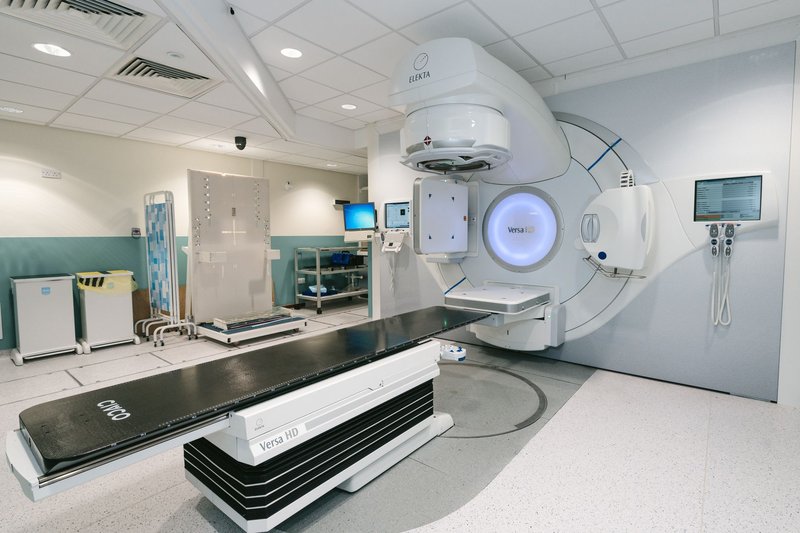
That chelation step is where the “boring” +3-only chemistry becomes directly useful. Because actinium’s coordination behavior mirrors lanthanum’s so predictably, the chelators used to trap gadolinium and other rare-earth ions in medical contexts translate reasonably well to actinium, which is part of why Ac-225 radiopharmaceuticals could move from lab curiosity to clinical pipeline as fast as they have. The global supply constraint hasn’t gone away, though — production still depends on thorium-229 generators or accelerator irradiation of radium or thorium targets, and demand from oncology programs now regularly outstrips what suppliers can turn around.
Handling Actinium Compounds
Every compound on this list inherits actinium’s full radioactivity, and the decay chain doesn’t stop at actinium itself — Ac-227 and its daughters run through a sequence of alpha and beta emitters before settling on stable lead, which means a sample that’s sat around for a few months carries more than just the actinium you started with. Work with these compounds happens in shielded gloveboxes with alpha- and gamma-monitoring in place, following the same handling discipline used for other transuranic and highly radioactive research materials — guidance the Environmental Protection Agency lays out in general terms for any material that decays through multiple radioactive stages. It’s also why so much of the compound characterization work described above happened once, decades ago, on microgram samples, and has rarely been repeated since — there’s been little practical reason to remake compounds that are already logged, given the cost and hazard of producing fresh actinium.