An aldehyde is any compound carrying the –CHO group: a carbon double-bonded to an oxygen, with a hydrogen stuck on the same carbon. That hydrogen is the whole personality of the molecule. It sits the carbonyl carbon at the very end of a chain, which is why aldehydes oxidize so easily and why your nose notices a lot of them.
Most lists hand you the same five — formaldehyde, acetaldehyde, benzaldehyde, cinnamaldehyde, vanillin — and call it a day. They’re all here, but so are nine more that actually explain where aldehydes show up: in your retina, in your blood sugar, in perfume bottles, and in the stuff used to preserve dissection specimens. Here are 14 named aldehydes, grouped by what they do.
Table of Contents
- Quick comparison table
- Simple aliphatic aldehydes
- Aromatic aldehydes
- Fragrance and flavor aldehydes
- Biologically important aldehydes
- How aldehydes are named
- A safety note on formaldehyde
Quick comparison table
| Aldehyde | Formula | Where it comes from | Common use |
|---|---|---|---|
| Formaldehyde | HCHO | Industrial synthesis | Resins, embalming, disinfectant |
| Acetaldehyde | CH₃CHO | Ethanol metabolism, fruit | Plastics, perfumes, alcohol breakdown |
| Propionaldehyde | CH₃CH₂CHO | Petrochemical processing | Plastics, rubber accelerators |
| Butyraldehyde | C₃H₇CHO | Propylene hydroformylation | Solvents, plasticizers |
| Glutaraldehyde | OHC(CH₂)₃CHO | Industrial synthesis | Cold sterilant, tissue fixative |
| Benzaldehyde | C₆H₅CHO | Bitter almonds, apricot pits | Almond flavoring, dye precursor |
| Cinnamaldehyde | C₆H₅CH=CHCHO | Cinnamon bark oil | Cinnamon flavor, fungicide |
| Vanillin | C₈H₈O₃ | Vanilla pods (mostly synthetic) | Vanilla flavoring, fragrance |
| Salicylaldehyde | C₆H₄(OH)CHO | Synthesis from phenol | Chelating agents, perfumery |
| Citral | C₁₀H₁₆O | Lemongrass, lemon peel | Lemon scent, vitamin A synthesis |
| Citronellal | C₁₀H₁₈O | Citronella, lemon-scented gum | Insect repellent, fragrance |
| Retinal | C₂₀H₂₈O | Vitamin A in the diet | Vision (light detection) |
| Glyceraldehyde | C₃H₆O₃ | Carbohydrate metabolism | Glycolysis intermediate, chirality reference |
| Glucose | C₆H₁₂O₆ | Photosynthesis, diet | Primary cellular fuel |
Simple aliphatic aldehydes
These are the straight-chain workhorses. No ring, just a carbon backbone ending in –CHO. They’re the ones you’ll meet first in an organic chemistry course because their reactivity is the cleanest demonstration of what the carbonyl actually does.
1. Formaldehyde (HCHO). The smallest possible aldehyde — one carbon, no chain to speak of. It’s a gas at room temperature, which is why it’s usually sold dissolved in water as formalin. Formaldehyde goes into resins for plywood and particleboard, into disinfectants, and famously into embalming fluid. It’s also a known carcinogen, which is the catch (more on that below).
2. Acetaldehyde (CH₃CHO). Two carbons. This is the molecule your liver makes when it breaks down alcohol, and it’s the reason a hangover feels the way it does — acetaldehyde is more toxic than the ethanol it came from. Industrially it’s a building block for acetic acid and various plastics. It also turns up naturally in ripe fruit, contributing to that slightly bruised-apple smell.
3. Propionaldehyde (CH₃CH₂CHO). Three carbons. Pungent, used mostly as an intermediate in making plastics and rubber processing chemicals. Not glamorous, but it shows the pattern: each carbon you add changes the boiling point and the smell.
4. Butyraldehyde (C₃H₇CHO). Four carbons. Made on a massive scale by reacting propylene with carbon monoxide and hydrogen (hydroformylation), then converted into solvents and plasticizers. If you want to see industrial aldehyde chemistry at work, butyraldehyde is the textbook case.
5. Glutaraldehyde (OHC(CH₂)₃CHO). A dialdehyde — two –CHO groups, one on each end of a five-carbon chain. Those two reactive ends are why it cross-links proteins so well, which makes it a powerful cold sterilant for medical instruments and a fixative for preserving biological tissue. Electron microscopy labs run on it.
Aromatic aldehydes
Attach the –CHO directly to a benzene ring and the molecule changes character. The ring stabilizes things, and a lot of these compounds smell good enough to end up in food and perfume.
6. Benzaldehyde (C₆H₅CHO). The simplest aromatic aldehyde and the source of artificial almond flavor. It occurs naturally in bitter almonds and the pits of apricots and cherries, bound up with the cyanide-releasing compound amygdalin — which is why eating a handful of raw bitter almonds is a genuinely bad idea. Synthetically it’s a precursor for dyes and the flavor compound mandelic acid.
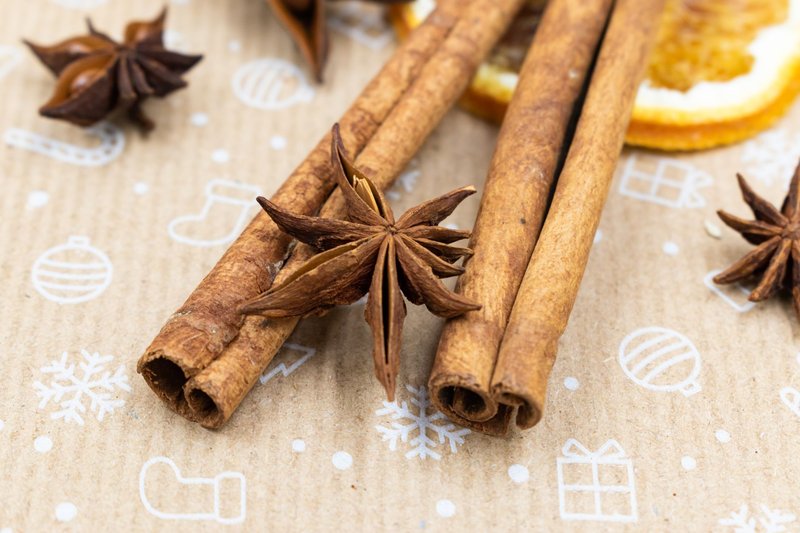
7. Cinnamaldehyde (C₆H₅CH=CHCHO). This is cinnamon. It makes up most of the essential oil from cinnamon bark, and it’s what your brain reads as “cinnamon” before you’ve even tasted anything. Beyond flavoring, it works as a natural fungicide and is being studied as a food preservative.
8. Vanillin (C₈H₈O₃). The dominant flavor compound in vanilla. Real vanilla pods contain it, but the overwhelming majority of vanillin in food is synthesized — some from wood pulp byproducts, some from petrochemicals — because actual vanilla is one of the most expensive spices on earth. It carries both an aldehyde group and a phenol group on the same ring.
9. Salicylaldehyde (C₆H₄(OH)CHO). Benzaldehyde with a hydroxyl group sitting right next door on the ring. That neighboring –OH lets it grab metal ions, which makes it useful for building chelating agents in chemistry labs. It has a sharp, slightly bitter scent and shows up in trace amounts in some plants.
Fragrance and flavor aldehydes
A whole branch of the perfume industry runs on aldehydes. The famous example is Chanel No. 5, which leaned hard on synthetic aliphatic aldehydes back in 1921 and made them fashionable. These three are the natural terpene aldehydes you’ll actually recognize by smell.
10. Citral (C₁₀H₁₆O). The lemon molecule. It’s the main aroma component of lemongrass and a big part of lemon and lime peel. Citral is also a starting material for making vitamin A and ionones (the violet-smelling compounds), so it bridges flavor chemistry and vitamin synthesis.
11. Citronellal (C₁₀H₁₈O). Close cousin to citral, found in citronella oil and lemon-scented eucalyptus. This is the active ingredient behind those citronella candles — it’s a documented insect repellent, and it gives off a fresh, citrusy-green note that perfumers use directly.
Biologically important aldehydes
This is the category the thin pages skip entirely, and it’s the most interesting one. Aldehydes aren’t just industrial chemicals — they’re doing essential jobs inside your body right now.
12. Retinal (C₂₀H₂₈O). The reason you can see. Retinal is the aldehyde form of vitamin A, and it sits inside the protein rhodopsin in your retina. When light hits it, the molecule physically changes shape — a cis double bond flips to trans — and that tiny geometric snap is the first step of vision. According to the National Eye Institute, severe vitamin A deficiency is a leading cause of preventable childhood blindness, precisely because retinal runs out.
13. Glyceraldehyde (C₃H₆O₃). The simplest sugar with a chiral center — three carbons, one aldehyde group, the textbook molecule for teaching D and L configuration. Its phosphate form, glyceraldehyde-3-phosphate, is a central intermediate in glycolysis, the pathway your cells use to extract energy from glucose. If you’ve drawn a Fischer projection, you’ve drawn this one.
14. Glucose (C₆H₁₂O₆). Yes — blood sugar is technically an aldehyde. In its open-chain form, glucose is an aldohexose: a six-carbon sugar with an aldehyde group at carbon one. This is exactly why sugars belong to the broader family of polyhydroxy aldehydes and ketones that make up the carbohydrates. Most of the time in solution it curls into a ring and hides that aldehyde, but the group is real, and it’s why glucose reacts with Tollens’ and Benedict’s reagents as a reducing sugar. Your entire metabolism is built on an aldehyde.
How aldehydes are named
The IUPAC system is straightforward once you see the pattern. Take the longest carbon chain that includes the –CHO carbon, drop the “-e” from the parent alkane name, and add “-al.”
- One carbon → methane → methanal (formaldehyde)
- Two carbons → ethane → ethanal (acetaldehyde)
- Three carbons → propane → propanal (propionaldehyde)
- Four carbons → butane → butanal (butyraldehyde)
The aldehyde carbon is always carbon number one — it has to be at the end of the chain, so it gets the lowest position automatically. For aromatic aldehydes, you usually keep the common name (benzaldehyde) or use “carbaldehyde” for the ring attachment. The old common names (formaldehyde, acetaldehyde) stuck around because chemists were using them long before the systematic rules existed, and nobody wanted to give them up.
A safety note on formaldehyde
Formaldehyde is the one aldehyde on this list you should treat with respect. The U.S. National Toxicology Program classifies it as a known human carcinogen, linked to nasopharyngeal cancer and leukemia in people with long-term occupational exposure. It off-gasses from some pressed-wood furniture, certain hair-smoothing treatments, and tobacco smoke. The concentrations in everyday products are regulated and generally low, but the embalming-fluid reputation is earned — this is not a molecule to handle casually in a poorly ventilated room.
The other aldehydes here range from harmless to genuinely useful, but the same –CHO group that makes them reactive is what makes formaldehyde dangerous at scale. That reactivity is the throughline of the entire family: one carbon, one oxygen, one hydrogen, and a chemistry that touches everything from your dinner to your eyesight.