A meson is a particle made of one quark and one antiquark, held together by the strong force. It has integer spin, which makes it a boson, and it belongs to the hadron family along with protons and neutrons.
Here are twelve examples of mesons, grouped by the quarks inside them. Masses and lifetimes come from the Particle Data Group and are rounded.
Examples of Mesons at a Glance
| Name | Symbol | Quark content | Mass (MeV/c²) | Mean lifetime |
|---|---|---|---|---|
| Charged pion | π⁺ | u d̄ | 139.6 | 2.6 × 10⁻⁸ s |
| Neutral pion | π⁰ | (u ū − d d̄)/√2 | 135.0 | 8.5 × 10⁻¹⁷ s |
| Charged kaon | K⁺ | u s̄ | 493.7 | 1.2 × 10⁻⁸ s |
| Neutral kaon | K⁰ | d s̄ | 497.6 | 0.9 × 10⁻¹⁰ s (K-short), 5.1 × 10⁻⁸ s (K-long) |
| Eta | η | mix of u ū, d d̄, s s̄ | 547.9 | ~5 × 10⁻¹⁹ s |
| Rho | ρ⁰ | (u ū − d d̄)/√2 | 775 | ~4.5 × 10⁻²⁴ s |
| Omega | ω | (u ū + d d̄)/√2 | 783 | ~7.8 × 10⁻²³ s |
| Phi | φ | s s̄ | 1019.5 | ~1.6 × 10⁻²² s |
| D meson | D⁺ | c d̄ | 1869.7 | 1.0 × 10⁻¹² s |
| B meson | B⁺ | u b̄ | 5279.3 | 1.6 × 10⁻¹² s |
| J/psi | J/ψ | c c̄ | 3096.9 | ~7 × 10⁻²¹ s |
| Upsilon | Υ(1S) | b b̄ | 9460.3 | ~1 × 10⁻²⁰ s |
Every charged meson has an antiparticle with the quarks swapped. The antiparticle of π⁺ is π⁻ (d ū), and the antiparticle of K⁺ is K⁻ (s ū). The π⁰ is its own antiparticle.
Light Mesons: Pions, Eta, Rho and Omega
Pions are the lightest mesons and the ones you’ll meet first in a course. They’re built only from up and down quarks, and at about 140 MeV/c² they weigh roughly one-seventh of a proton.
Their job in physics history is bigger than their mass suggests. In 1935 Hideki Yukawa proposed that nucleons stick together by swapping a particle of about that mass, and the pion turned out to be it. He received the 1949 Nobel Prize in Physics for the prediction. Today we’d say the residual strong force between nucleons acts through meson exchange, with pions dominating at long range.
The η, ρ, and ω are heavier relatives from the same up, down, and strange quark pool. The ρ and ω have nearly the same quark makeup but different quark-spin arrangements, which is why they’re resonances that live around 10⁻²³ to 10⁻²⁴ seconds. They don’t travel anywhere. They show up in detectors only as peaks in the data.
Strange Mesons: Kaons and Phi
Kaons contain one strange quark or antiquark. The name comes from a puzzle: in 1940s cosmic-ray experiments, these particles were produced fast, in about 10⁻²³ seconds, but lived about 10⁻¹⁰ to 10⁻⁸ seconds. That’s trillions of times longer than their production implied.
Murray Gell-Mann and Kazuhiko Nishijima solved it in the early 1950s by assigning a new quantum number, “strangeness.” The strong force conserves it, so kaons can’t decay through the strong force. Only the slow weak force can break it.
Neutral kaons are odd on top of that. K⁰ and its antiparticle mix into two states with very different lifetimes, K-short and K-long, which is why the table lists two values.
The φ meson is s s̄, a strange quark paired with its own antiquark. It decays mostly into two kaons.
Charm Mesons: D and J/ψ
D mesons carry a charm quark or antiquark. They live about a picosecond, long enough to travel a fraction of a millimeter, and detectors use that short flight to identify them.
The J/ψ is c c̄ and has its own story. In November 1974, two teams working independently found it: Samuel Ting at Brookhaven and Burton Richter at SLAC. It shared the 1976 Nobel Prize in Physics, and the finding convinced most physicists that quarks were real, not a bookkeeping trick.
At 3,097 MeV/c², the J/ψ is lighter than twice the D mass, so it can’t split into two D mesons. It has to annihilate by a more roundabout route, which stretches its lifetime to about 10⁻²⁰ seconds. That’s 1,000 times longer than a ρ meson, even though it’s far heavier.
Bottom Mesons: B and Upsilon
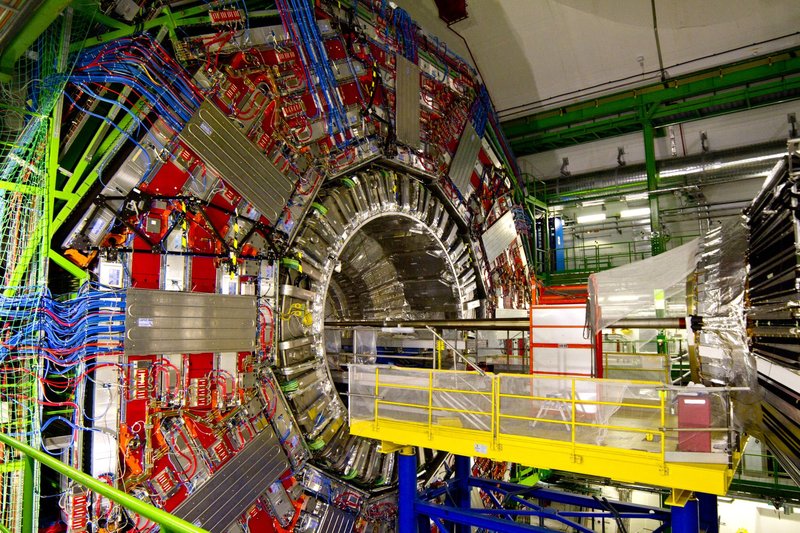
B mesons contain a bottom quark and live about 1.5 picoseconds. They’re studied heavily at facilities such as CERN because B decays show tiny differences between matter and antimatter.
The Υ (upsilon) is b b̄, discovered at Fermilab in 1977. It plays the same role for bottom that J/ψ plays for charm, and it’s the heaviest standard meson in the table at about 9.46 GeV/c². The top quark is the exception: it decays before it can form mesons, so no top mesons exist.
Meson vs Baryon
Count the quarks. A meson has two (quark plus antiquark), and a baryon has three. A proton is u u d and a neutron is u d d, so both are baryons, a type of hadron.
That gives them different properties. Baryons are fermions with half-integer spin and carry baryon number 1, and that number is conserved, which is a big reason the proton is so stable. Mesons have baryon number 0, so nothing prevents them from decaying.
Why Mesons Decay So Fast
A quark and an antiquark in the same particle can annihilate. No conservation law blocks that, so every meson eventually falls apart. How long it takes depends on which force is doing the work:
- Strong decays (ρ, ω, φ): 10⁻²⁴ to 10⁻²² seconds.
- Electromagnetic decays (π⁰, η): about 10⁻¹⁹ to 10⁻¹⁶ seconds. The π⁰ turns into two photons.
- Weak decays (π⁺, K, D, B): 10⁻¹³ to 10⁻⁸ seconds. A π⁺ becomes a muon and a neutrino.
When a decay is allowed by the strong force, it’s near instant. When only the weak force can do it, the meson lasts long enough to leave a visible track.
FAQ
Is a muon a meson? No. The muon is a lepton, a fundamental particle with no quark content. The old name “mu meson” stuck around from the 1930s, before physicists knew it had nothing to do with the strong force.
Is a proton a meson? No. A proton is a baryon with three quarks (u u d).
Is the Z(4430) a meson? Not in the standard sense. It’s a tetraquark candidate with four quarks: a charm-anticharm pair plus a light quark and antiquark. Belle reported it in 2007 and LHCb confirmed it in 2014. Exotic states like this fall outside the quark-antiquark rule.
Are mesons bosons? Yes. Two spin-½ quarks combine into total spin 0 or 1, and integer spin means boson. Pions and kaons are spin 0, while ρ, ω, φ, and J/ψ are spin 1.
Summary of Meson Examples
The list reduces to a pattern: swap the quark flavor and you get a new family. Up and down give pions, strange gives kaons, charm gives D and J/ψ, and bottom gives B and Υ. The heavier the quarks, the heavier the meson. The lifetime depends on which force can break it down.