TLDR
The main uses of krypton are lighting (fluorescent tubes, photographic flashes, high-intensity bulbs), insulating gas inside high-end windows, krypton fluoride lasers, medical and industrial imaging with radioactive isotopes, chip manufacturing, and ion thrusters on satellites. Historically, krypton-86 also defined the metre from 1960 to 1983. In nearly every case the reason is the same: krypton is inert, heavy, and a poor conductor of heat.
Table of contents
- Why krypton is useful at all
- Lighting
- Insulated windows
- Excimer lasers
- Medical imaging
- Semiconductor manufacturing
- Ion thrusters for satellites
- The metre and ice dating
- Uses of krypton at a glance
- FAQ
Why krypton is useful at all
Krypton is element 36, a noble gas that makes up roughly one part per million of the atmosphere. William Ramsay and Morris Travers isolated it in 1898 from liquefied air, and named it from the Greek kryptos, “hidden.” The Royal Society of Chemistry’s element profile lists it as colourless, odourless and almost completely unreactive.
Three properties drive nearly every application:
- It’s inert. It won’t corrode a filament or react with a lamp’s electrodes.
- It’s heavy. Krypton atoms are about twice as massive as argon atoms, so they move more slowly and carry less heat.
- It glows in distinctive wavelengths. Excited krypton emits sharp spectral lines, including the pale white-violet light of a discharge tube.
The catch is price. Air is the only commercial source, and there’s far less krypton in it than argon (about 1 ppm against nearly 1%). You use krypton where argon or neon would fall short, not as a default.
Lighting
Lighting is the oldest commercial use. Some fluorescent tubes are filled with a krypton-argon mix instead of pure argon. The heavier krypton atoms reduce energy lost in the gas, so the tube produces the same light for slightly less power. Those lamps are marketed as energy-saving tubes.
Krypton also fills some incandescent and halogen bulbs. A heavier fill gas slows tungsten evaporating off the filament, which lets the filament run hotter, giving whiter light and longer life than an argon bulb of the same size.
Then there are flashes. Krypton flash lamps produce intense, brief bursts used in high-speed photography, and high-intensity discharge lamps for airport runway and approach lighting rely on the same gas family for bright, precise pulses.
Insulated windows
Double and triple glazing trap a layer of gas between panes. Air works. Argon works better, and is cheap. Krypton works best.
The reason is thermal conductivity. Heat crosses a gap by conduction and convection, and a heavier gas does both more slowly. Krypton’s conductivity is roughly 40% below argon’s, and well under half of air’s. That has a practical payoff: argon needs a gap around 16 mm to perform at its best, while krypton does its best at about 9 to 12 mm. Window makers use it when the frame can’t take a thick sealed unit, or when they want the best possible U-value from a triple-glazed pane.
It costs several times more than argon, so you mostly find it in premium or passive-house glazing, not standard builder windows. Some manufacturers blend the two gases to split the difference.
Excimer lasers
An excimer laser fires when a noble gas and a halogen briefly bond in an excited state and then fall apart, releasing ultraviolet light. Krypton plus fluorine gives a krypton fluoride (KrF) laser at 248 nm.
KrF lasers were the workhorse of deep-ultraviolet photolithography, printing circuit patterns onto silicon wafers. They’re also used in laser fusion research, where large KrF systems have been built to compress fuel pellets with very uniform beams.
One common mix-up: LASIK eye surgery generally uses an argon fluoride laser at 193 nm, not krypton fluoride. Both belong to the same excimer family, and the first excimer eye-surgery work was built on that same technology, which is why krypton keeps getting credited for it.
Medical imaging
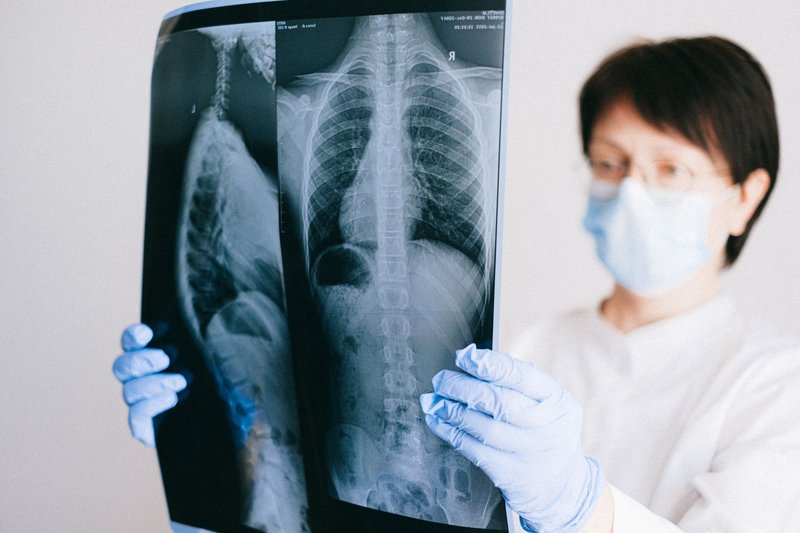
Krypton has several radioactive isotopes, and a few have found medical roles.
- Krypton-81m has a half-life of about 13 seconds. Inhaled as a gas, it lets nuclear medicine scanners map airflow in the lungs, and the short half-life means the patient receives very little lasting radiation.
- Hyperpolarized krypton-83 is being developed as an MRI contrast gas for lung imaging. Its signal is sensitive to the surface of the airways, which gives researchers a way to study lung tissue that xenon-129 doesn’t always capture.
- Krypton-85, a beta emitter with a half-life of roughly 10.8 years, has been used to study lung function and blood flow, and in industry to detect leaks and gauge the thickness of sheet material.
Because krypton is inert, none of these isotopes chemically bind to tissue. The body breathes them out.
Semiconductor manufacturing
Chipmakers use krypton in two places. The first is the KrF laser described above. The second is plasma etching, where krypton-containing gas mixtures help carve the deep, narrow channels in 3D NAND flash memory. Those channels can be more than a hundred layers deep, and the process needs a gas that is inert but heavy enough to give ions the momentum to cut straight down.
Demand from the chip industry is a main reason krypton supply and pricing have become sensitive to events like disruptions in Ukrainian and Russian gas production.
Ion thrusters for satellites
Ion and Hall-effect thrusters push a spacecraft by ionizing a gas, turning it into plasma, and accelerating it with electric fields. Xenon is the traditional propellant because it’s heavy and easy to ionize. Krypton is lighter and gives somewhat less thrust efficiency, but it’s far cheaper, which matters when you’re launching thousands of satellites. SpaceX adopted krypton for its first-generation Starlink satellites for that reason.
The metre and ice dating
Two uses are historical or specialist, but worth knowing.
The metre. From 1960 to 1983, the metre was defined as 1,650,763.73 wavelengths of the orange-red light emitted by krypton-86. It was the first time a unit of length was tied to an atomic property instead of a physical bar kept in Paris. In 1983 the definition moved to the distance light travels in a fraction of a second, which is more precise still. UCL’s case study on krypton’s discovery covers how the element went from a faint spectral line to a measurement standard.
Ice dating. Krypton-81 has a half-life of about 229,000 years and forms in the upper atmosphere from cosmic rays. Air trapped in glacier ice carries a tiny amount of it, and as the ice ages, the krypton-81 decays. Counting the atoms left tells you how old the ice is. The method reaches from roughly 50,000 years to over a million years, well beyond what carbon-14 can handle, and has been used to date Antarctic ice around 120,000 years old.
Uses of krypton at a glance
| Use | Property exploited | Industry |
|---|---|---|
| Fluorescent and incandescent fill gas | Inert, heavy, low heat loss | Lighting |
| Flash and high-intensity lamps | Bright discharge in gas | Photography, aviation |
| Window insulation | Very low thermal conductivity | Construction |
| KrF excimer laser (248 nm) | Bonds with fluorine in excited state | Chipmaking, fusion research |
| Krypton-81m, krypton-83, krypton-85 | Inert gas with usable isotopes | Medicine, industry |
| Plasma etching | Heavy, inert ions | Semiconductors |
| Ion thruster propellant | Heavy, easy to ionize, cheaper than xenon | Spaceflight |
| Krypton-86 length standard | Sharp spectral line | Metrology (1960-1983) |
| Krypton-81 dating | Long half-life | Glaciology, hydrology |
FAQ
Is krypton dangerous? Stable krypton is non-toxic. In high concentrations it displaces oxygen like any inert gas, so it’s an asphyxiation hazard in enclosed spaces. Radioactive krypton-85 is a separate matter and is handled as a radiological material.
Why use krypton instead of argon? Krypton is heavier, conducts less heat, and emits different light. Argon is about a hundred times more abundant, so it wins on cost. Krypton wins where performance per millimetre or per watt matters.
How is krypton made? It’s separated from liquefied air by fractional distillation, as a by-product of producing oxygen and nitrogen. Because it’s so scarce in air, that process is why it’s expensive.
Is krypton related to Kryptonite? No. Kryptonite is fictional, from Superman. The comic-book planet Krypton shares the name, but the element has nothing to do with green glowing rocks.
Does krypton glow? Yes. A krypton discharge tube emits pale white light with a violet tint, and the exact colour depends on the pressure and the voltage applied.