Most myths about astrophysics survive because they sound reasonable. A black hole has strong gravity, so it must suck things in. The Big Bang has “bang” in the name, so it must have exploded. Each one is a small, plausible step away from what physicists actually measure.
Below are 11 common misconceptions, grouped by theme: black holes, the Big Bang and expansion, dark matter and dark energy, and stars. Each one gives the claim, a verdict, and the explanation.
Table of contents
- Black holes
- Myth 1: Black holes suck in everything around them
- Myth 2: The Sun will become a black hole
- Myth 3: Falling into a black hole always kills you at the edge
- Myth 4: Nobody has ever seen a black hole
- The Big Bang and expansion
- Myth 5: The Big Bang was an explosion in empty space
- Myth 6: Nothing can go faster than light, so the universe can’t expand faster than light
- Myth 7: The Big Bang theory explains where the universe came from
- Dark matter and dark energy
- Myth 8: Dark matter is just ordinary matter we can’t see
- Myth 9: Dark matter and dark energy are the same thing
- Stars and pop culture
- Myth 10: The Sun is a yellow star
- Myth 11: The time warp in Interstellar is movie nonsense
- Quick reference
Black holes
Myth 1: Black holes suck in everything around them
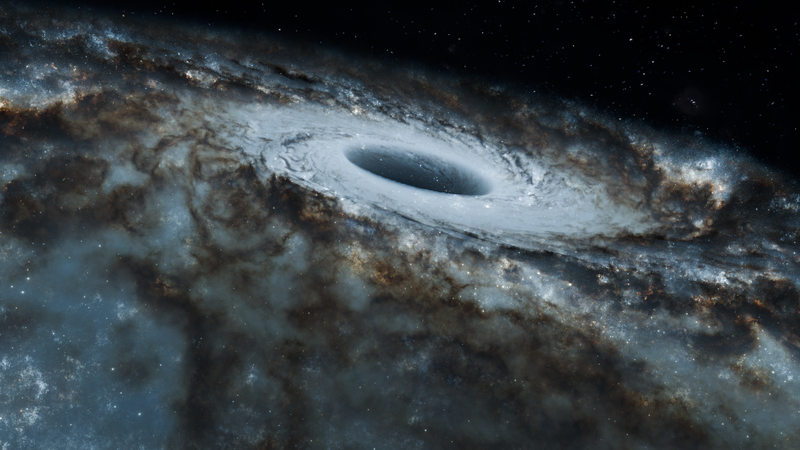
Verdict: False. A black hole pulls with gravity, not suction, and at a distance its gravity is the same as any other object with the same mass.
Here’s the test. Replace the Sun with a black hole of exactly one solar mass. Earth’s orbit doesn’t change. Neither do Jupiter’s or Neptune’s. We’d freeze in the dark, but we wouldn’t spiral inward. NASA’s Goddard team makes the same point when it sorts black hole fact from fiction.
Gravity only becomes extreme close to the event horizon. Stay at a safe distance and a black hole is just a very compact mass that planets and stars can orbit for billions of years. The supermassive one at the center of our galaxy has been circled by stars for as long as we’ve tracked them.
Myth 2: The Sun will become a black hole
Verdict: False. The Sun doesn’t have enough mass.
A star needs to start with roughly 20 times the Sun’s mass or more to collapse into a black hole at the end of its life. Our Sun will swell into a red giant in about 5 billion years, then shed its outer layers into space and leave behind a white dwarf, a dense ember about the size of Earth. No explosion, no black hole.
This one also gets mixed up with the supernova myth. The Sun can’t go supernova either. That fate belongs to much more massive stars, or to white dwarfs that gain mass from a companion star.
Myth 3: Falling into a black hole always kills you at the edge
Verdict: It depends on the size of the black hole.
What kills you is the tidal force, the difference in gravitational pull between your head and your feet. Near a small, stellar-mass black hole that difference is brutal, and you’re stretched out long before you reach the horizon. Physicists call it spaghettification, and the name is accurate.
A supermassive black hole is the opposite case. Its horizon is so large that the pull changes gently across it. You could cross the event horizon of a black hole with millions of solar masses and feel nothing unusual at that instant. You just couldn’t turn back. The tidal forces that finish you come later, deeper inside.
Myth 4: Nobody has ever seen a black hole
Verdict: Outdated. We’ve photographed two.
In 2019 the Event Horizon Telescope collaboration released the first image of a black hole, the one at the center of galaxy M87, which weighs about 6.5 billion solar masses. In 2022 it followed with Sagittarius A*, the roughly 4-million-solar-mass black hole at the center of the Milky Way. NASA’s black hole overview covers how astronomers detect them, including through the X-rays from heated gas and the orbits of nearby stars.
The images show the glowing ring of hot gas around the shadow, not the black hole itself. That’s the correct way to “see” something that emits no light.
The Big Bang and expansion
Myth 5: The Big Bang was an explosion in empty space
Verdict: False. There was no pre-existing empty space for it to explode into.
An explosion has a center and expands outward through something. The Big Bang has no center. Space itself was hot, dense and everywhere, and it has been stretching ever since. Every point in the universe was part of that early state, which is why there’s no spot in the sky where you can point and say it started there.
The usual picture is a balloon with dots drawn on it. As it inflates, every dot moves away from every other dot, and no dot is the center. The dots don’t move across the rubber. The rubber stretches.
Myth 6: Nothing can go faster than light, so the universe can’t expand faster than light
Verdict: False. Relativity limits how fast things move through space, not how fast space expands.
The farther away a galaxy is, the faster it recedes, and past a certain distance that recession speed exceeds the speed of light. No galaxy is outrunning a light beam in its own neighborhood. The space between us is simply growing. That’s why the observable universe has a radius of about 46 billion light-years even though the universe is only 13.8 billion years old.
It also means some galaxies are now permanently out of reach. Light they emit today will never get to us.
Myth 7: The Big Bang theory explains where the universe came from
Verdict: Misleading. It describes how the universe evolved from a hot, dense state, not what came before or why it started.
The theory is built on observations: galaxies receding from one another, the cosmic microwave background left over from when the universe was about 380,000 years old, and the measured abundance of hydrogen and helium. It runs the clock back to a fraction of a second after the beginning. At the very start, where density and temperature are at their extreme, our current physics stops working, and “what caused it” is an open question.
If someone tells you science has explained the origin of the universe, they’ve skipped a step. If someone tells you the Big Bang is just a guess, they’ve skipped a lot more.
Dark matter and dark energy
Myth 8: Dark matter is just ordinary matter we can’t see
Verdict: False. Most of it can’t be ordinary matter.
The obvious explanation is dim stars, cold gas, brown dwarfs and rogue planets. Astronomers searched for exactly that, and surveys looking for objects bending the light of background stars found far too few. The ratio of light elements formed in the early universe and the patterns in the cosmic microwave background put a hard cap on ordinary matter: about 5% of the universe’s total content.
Dark matter makes up about 27%. The Bullet Cluster, two galaxy clusters that collided, shows the effect clearly: the hot gas, which holds most of the ordinary mass, was slowed by the collision, while the gravitational lensing signal passed straight through. The mass was not where the visible matter was.
Myth 9: Dark matter and dark energy are the same thing
Verdict: False. They share a word and little else.
Dark matter has gravity that pulls things together. It holds galaxies from flying apart and gave early galaxies the clumps they grew in. Dark energy does the opposite. It’s the label for whatever is driving the expansion of the universe to speed up, a result first found in 1998 by two teams studying distant supernovae.
By the best current numbers, from the Planck satellite, the universe is roughly 68% dark energy, 27% dark matter and 5% ordinary matter. Neither dark component has been identified directly. NASA’s overview of dark matter and dark energy is a good place to see what’s known and what’s still open.
Stars and pop culture

Myth 10: The Sun is a yellow star
Verdict: False. The Sun is white.
Astronomers classify it as a G-type star, and the “yellow dwarf” label stuck. But the Sun emits all visible colors, with its peak output in the green part of the spectrum. Mixed together, those colors look white. From space, astronauts see a white Sun.
It looks yellow or orange from the ground because our atmosphere scatters the blue light out of the direct beam, and the effect is strongest when the Sun is low at sunrise and sunset. The atmosphere does the coloring, not the star.
Myth 11: The time warp in Interstellar is movie nonsense
Verdict: Mostly accurate physics, with extreme assumptions.
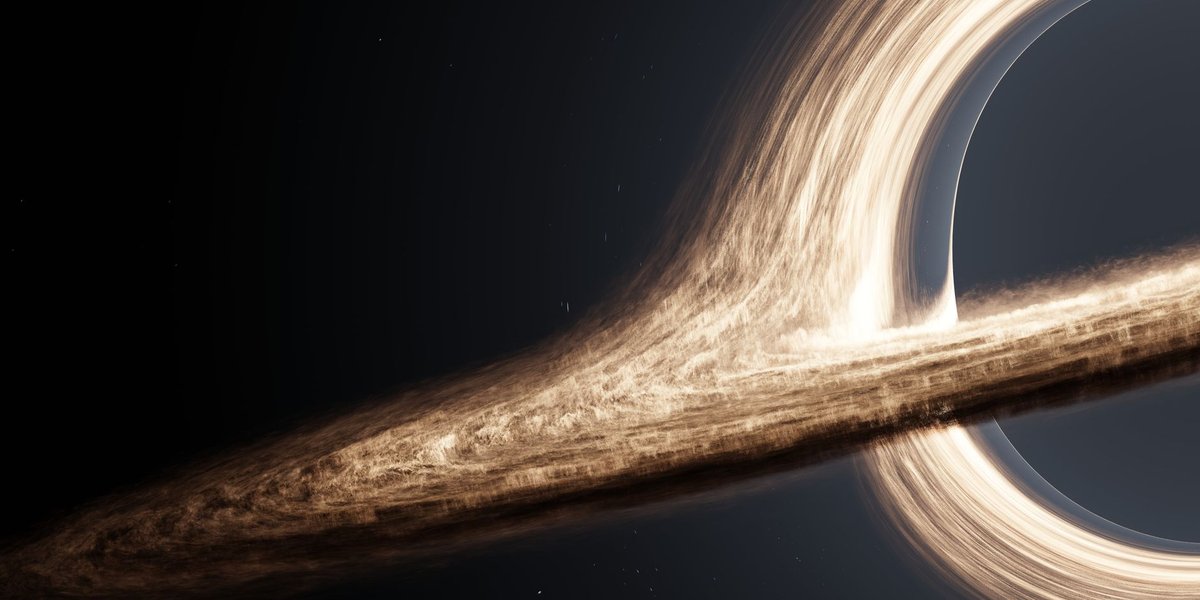
In the film, an hour on a planet near the black hole Gargantua equals seven years back on the ship. Relativity does predict that time runs slower deeper in a gravitational field, and the effect has been measured with atomic clocks at different altitudes on Earth. Physicist Kip Thorne, who advised on the film and worked out the visuals, built Gargantua as a very fast-spinning black hole, which is the case where a planet could orbit near the horizon without being destroyed.
The part to doubt is whether such a planet could exist and stay stable. Nobody has found one. But the time dilation itself comes straight from Einstein’s equations, and so does the lopsided ring of light in the movie’s visuals. The researchers’ work on the black hole’s appearance was published in a peer-reviewed physics journal.
Quick reference
| # | Myth | Verdict |
|---|---|---|
| 1 | Black holes suck in everything | False. Gravity is the same as any object of equal mass |
| 2 | The Sun will become a black hole | False. Not enough mass |
| 3 | You die at the horizon | Depends on the black hole’s size |
| 4 | No one has seen a black hole | Outdated. Imaged in 2019 and 2022 |
| 5 | The Big Bang was an explosion in space | False. Space itself expanded |
| 6 | The universe can’t expand faster than light | False. Relativity limits motion through space |
| 7 | The Big Bang explains the origin of the universe | Misleading. It describes the evolution |
| 8 | Dark matter is ordinary matter we can’t see | False. Ordinary matter is about 5% |
| 9 | Dark matter and dark energy are the same | False. One pulls, the other pushes |
| 10 | The Sun is yellow | False. It is white |
| 11 | Interstellar’s time warp is nonsense | Mostly real physics, extreme setup |