Table of Contents
- Why Dominica Has So Many Endemics
- Birds
- Reptiles
- Amphibians
- Invertebrates
- Where to See Them
- The Short Version
Dominica is 29 miles long, mostly vertical, and still has active fumaroles venting sulfur near its summits. That combination — young volcanic rock, rainforest that gets over 300 inches of rain a year in the interior, and almost no flat land to develop — is why an island smaller than New York City has produced its own parrot species, its own frog, its own lizards, and more than 60 beetles that live nowhere else on Earth.
This isn’t a “best of” list. It’s a working checklist of what’s actually endemic to Dominica, organized the way a naturalist would walk through it: birds first, because they’re what everyone comes for, then the reptiles and amphibians you’ll actually stumble across on a trail, then the smaller stuff that gets ignored in the glossy wildlife guides but makes up most of the island’s biodiversity.
Why Dominica Has So Many Endemics
Endemism needs isolation, and Dominica has it in three layers. First, it’s a genuinely young volcanic island — no land bridge ever connected it to South America or the rest of the Antilles, so whatever arrived here got here by flying, swimming, or rafting on debris, and then stayed put. Second, the interior is brutally steep. Morne Diablotin tops out above 4,700 feet, and the terrain between the coast and the central ridge is so folded that populations of the same species can end up isolated from each other within a few miles, which is exactly the kind of pressure that produces new species over time.
Third — and this is the one people underrate — Dominica never developed the way its neighbors did. No mass tourism strip, no large-scale agriculture clearing the interior. Roughly 60% of the island is still forested, including old-growth montane forest that would be long gone on a place like Antigua or Barbados. Species that need deep, undisturbed forest canopy, like the sisserou parrot, simply ran out of habitat elsewhere in the Caribbean. Dominica is one of the last places that still had it.
Birds
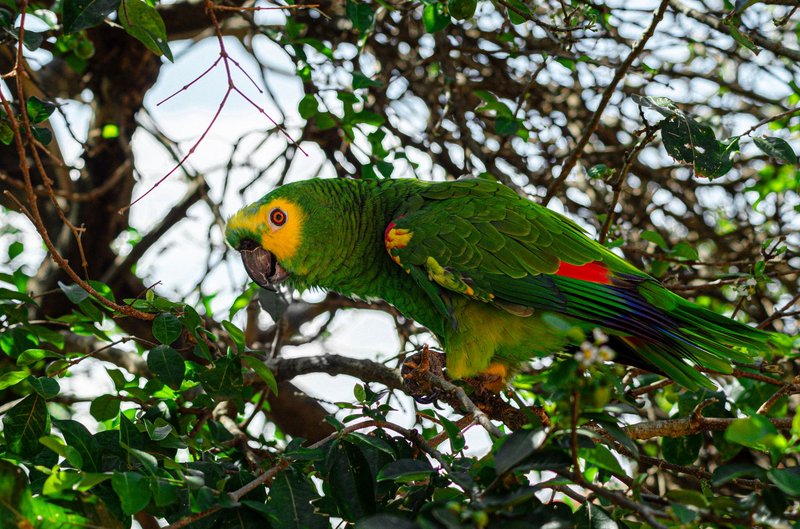
Every serious list of Dominica’s wildlife starts here, because the island’s two endemic parrots are the reason ornithologists put Dominica on the map in the first place.
Sisserou (Imperial Amazon) — Amazona imperialis. This is Dominica’s national bird, and it’s on the flag for a reason: it’s the largest Amazon parrot in the world, purple-headed with a deep green body, and it lives almost nowhere but the old-growth canopy above 2,000 feet. It’s also critically endangered. Population estimates dropped hard after Hurricane Maria stripped the interior forest in 2017 — a 2018 survey found just 11 birds at nine sites, and even now conservationists put the wild population somewhere around 50 mature individuals, according to the World Parrot Trust. Groups like EcoBalance and the Caribaea Initiative are running active nest-monitoring and habitat programs, but this is a species you’re more likely to hear — a low, guttural call carrying across a ravine — than see.
Red-Necked Amazon (Jaco) — Amazona arausiaca. The sisserou’s smaller, more common cousin. Green overall with a red patch at the throat and blue-tinged wings, the Jaco favors mid-elevation forest and travels in noisier, more visible flocks than the Sisserou does. Its population sits in the 850–1,000 range, which sounds healthier until you remember that’s the entire global population of the species, confined to one island. Both parrots are fully protected under Dominican law, and hunting either one is a serious offense — a hard-won protection that wasn’t always in place.
Beyond the parrots, Dominica also hosts several endemic subspecies of hummingbird and forest thrush that birders track specifically, but the two Amazons are the headline act, and for good reason: nowhere else in the world will you see either species in the wild. A complete guide to birds of Dominica catalogs all 36 species found on the island.
Reptiles
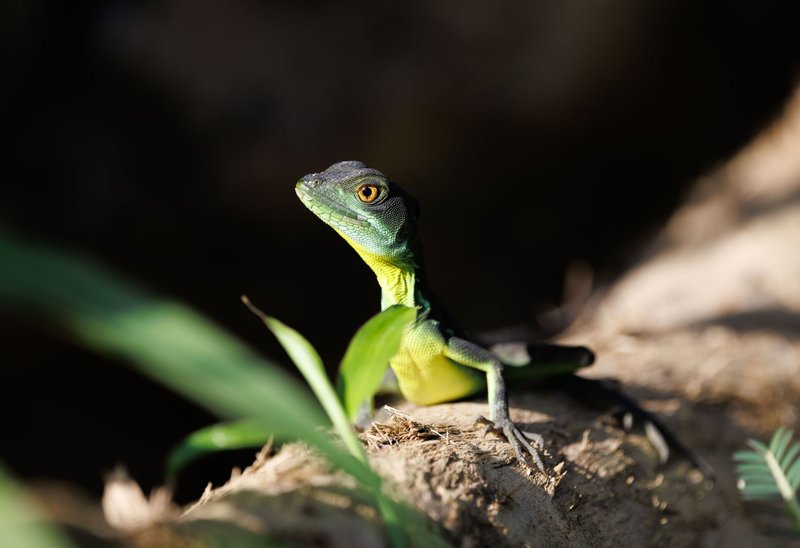
Dominica’s reptiles don’t get the postcard treatment the parrots do, but they’re arguably easier to actually encounter — you’ll see one of these within your first hour on any forest trail.
Dominican Anole — Anolis oculatus. This is the island’s signature lizard, and it does something genuinely interesting: its coloring shifts by elevation and region, from grayish-brown lowland populations to green-and-blue forms higher in the mountains. Herpetologists treat it as a textbook case of geographic variation within a single endemic species, which makes it more scientifically interesting than most tourists give it credit for as it does push-ups on a porch railing.
Dominican Ground Lizard — Ameiva fuscata. A fast-moving, sun-loving lizard found in drier coastal scrub and open ground, distinct from the shade-dwelling anole in both habitat and behavior. It’s active, skittish, and gone before you get a good look — which is fairly typical for the genus.
Dominica Skink — Mabuya dominicana (also referenced as Marisora dominicana). Less commonly spotted than the anole or ground lizard, the skink favors leaf litter and forest floor debris rather than open perches, so most sightings happen by accident rather than by looking for one.
Amphibians
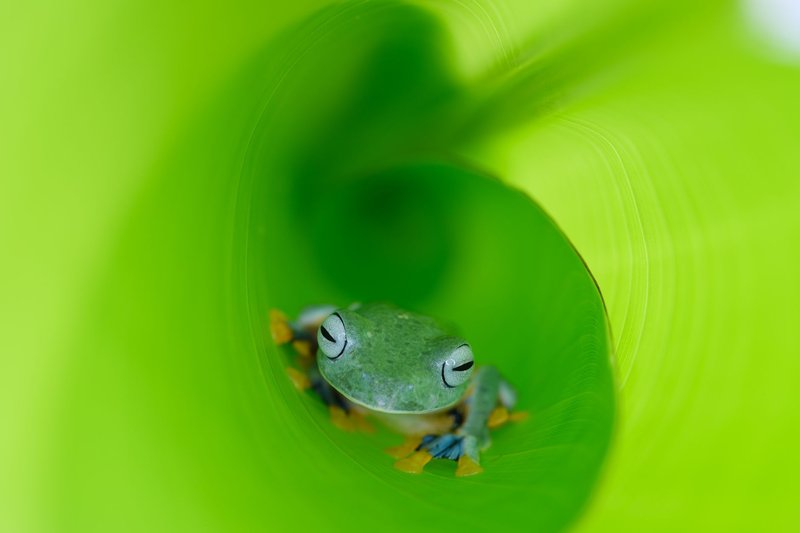
Dominica Frog (Gounouj) — Eleutherodactylus amplinympha. This is the island’s true amphibian endemic — found only in Dominica’s interior forest between roughly 980 and 3,940 feet elevation. Like most Eleutherodactylus species, it skips the tadpole stage entirely: eggs hatch directly into miniature frogs, no pond required, which is part of why it can live at elevations most frogs can’t.
Mountain Chicken Frog — Leptodactylus fallax. Worth mentioning even though it isn’t strictly Dominica-only — it also occurs on Montserrat — because Dominica holds one of its last strongholds, and the story is a hard one. This is one of the largest frogs in the world, historically hunted as a food source (hence the name), and it’s been devastated by chytrid fungus, a disease that has wiped out amphibian populations globally. It’s now critically endangered, and Dominica’s populations are a genuine conservation priority, not a footnote.
Invertebrates
This is the category every glossy wildlife article skips, and it’s the one with the most actual species in it.
Endemic Butterflies. Dominica has several butterfly species and subspecies found only on the island, tied closely to specific endemic host plants in the rainforest understory. They don’t get individual fame the way the parrots do, but they’re a genuine indicator of forest health — lose the host plants, lose the butterflies.
Land Snails. Dominica’s forest floor supports a distinct assemblage of endemic land snails, a group scientists pay close attention to precisely because snails don’t travel — a species confined to one valley on one island is about as clear a signal of isolation-driven evolution as biology gets.
Beetles. More than 60 beetle species are believed to be endemic to Dominica, spanning everything from wood-boring species tied to specific tree types to ground beetles restricted to high-elevation cloud forest. Nobody puts a beetle on a tourism brochure, but this is the group that actually accounts for most of Dominica’s endemic biodiversity by species count — the parrots are two species; the beetles are dozens.
Where to See Them
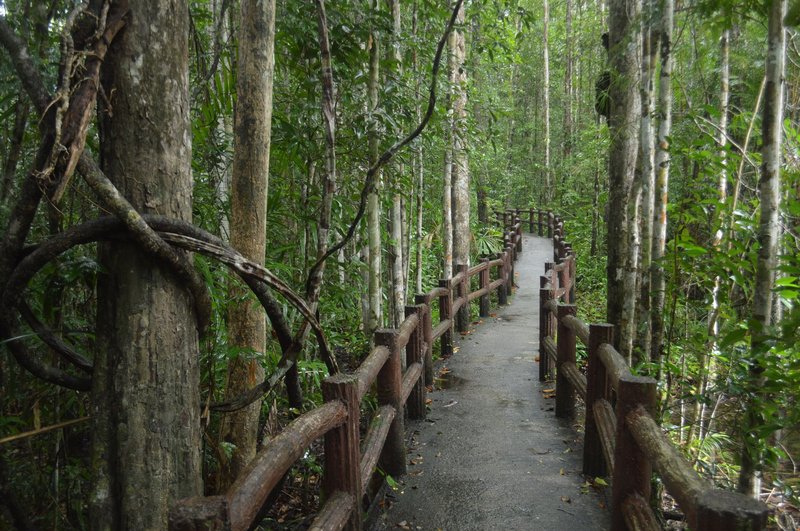
Most of this list lives inside Morne Trois Pitons National Park, a UNESCO World Heritage Site covering the volcanically active interior — boiling lake, fumaroles, elfin woodland, the works. It’s the single best area on the island for encountering endemic species in one trip, though “encountering” the Sisserou specifically usually means the Syndicate Nature Trail, a roughly 1.75-mile loop through the Northern Forest Reserve built with parrot-watching in mind, including an observation platform positioned for both endemic Amazons. Early morning is non-negotiable — parrots are active at dawn and go quiet once the heat sets in.
For the anole, ground lizard, and Dominica frog, you don’t need a dedicated excursion — any forest trail interior to the coast, from Middleham Falls to the Boeri Lake trail, will put you in their range. Local guides, several of whom specialize in birding and are worth hiring specifically for parrot sightings, dramatically improve your odds over going in blind — the forest is dense enough that a bird 30 feet up a canopy tree is easy to miss without someone who knows exactly which call to listen for.
The Short Version
Dominica’s isolation, volcanic terrain, and largely intact rainforest turned a 290-square-mile island into a factory for species found nowhere else — two parrots, three reptiles, an endemic frog, and a long tail of butterflies, snails, and beetles that rarely make anyone’s list but do most of the actual work of making this island’s biology unique. The IUCN Red List tracks the Sisserou’s status as Critically Endangered, and that status is really the headline: this is wildlife you can still see, but the window for seeing it in the wild is not indefinite. If you’re planning a trip built around it, go for the Syndicate Nature Trail at dawn, hire a guide who knows the calls, and don’t expect the parrots to perform on command — they didn’t get this rare by being easy to find.