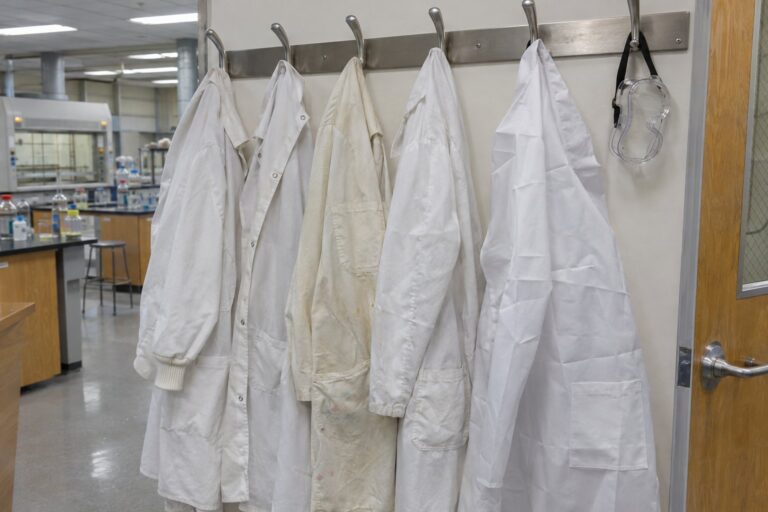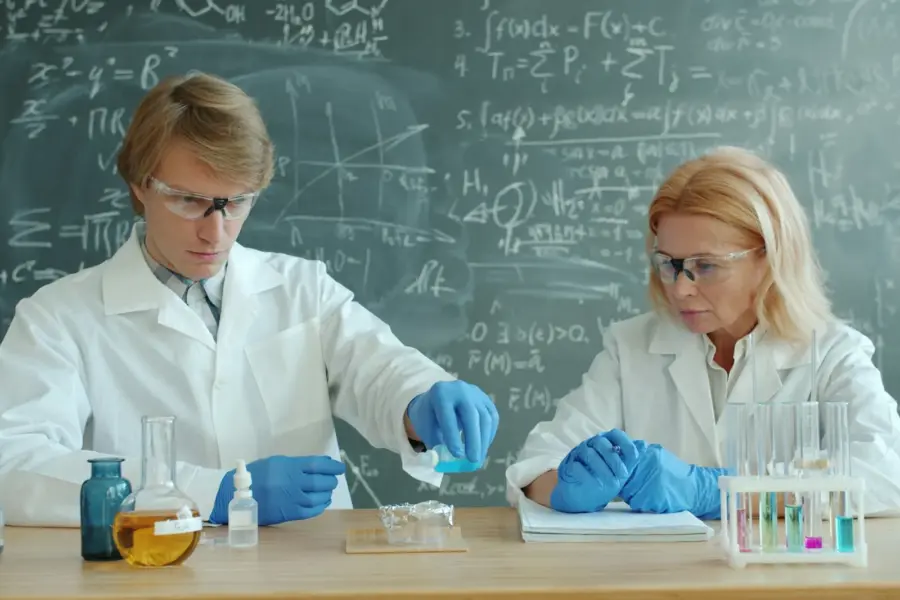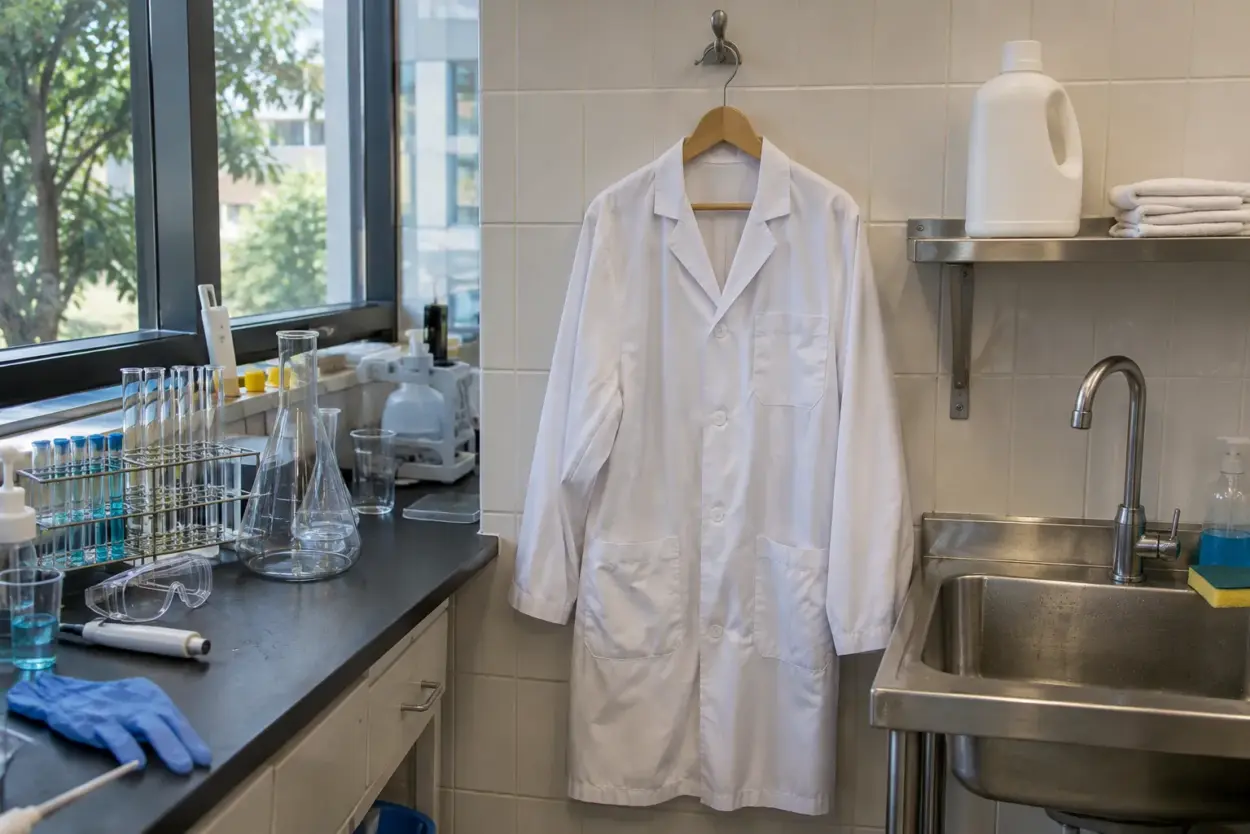
Short answer: Wash a lab coat by itself, on the cycle its care label allows, with regular detergent and no chlorine bleach. Do that only if the coat has never touched hazardous chemicals, biological material or radioactive material and your lab allows home washing. A contaminated coat does not go in a home washer: take it off, bag it and ask your safety office or lab laundry service.
The common mistake is tossing the coat in with the family laundry. The second is not knowing what is already on it: acid dried into cotton keeps weakening the fibers, and the washer is where the damage shows up. This page covers who should wash which coat, the steps for a clean coat, stain removal, why acid destroys cotton and how flame-resistant coats differ.
This article contains Amazon affiliate links. 33science earns a commission on qualifying purchases. See our affiliate disclosure.
Can you wash a lab coat at home?
Only if the coat has never touched hazardous chemicals, biological material or radioactive material, and your lab or school allows it. Most university safety offices ban home washing outright: MIT states that personnel are not allowed to launder lab coats at home, and Arizona State says not to take lab coats home or to public laundries. Ohio University and Purdue draw a narrower line: a coat that is only dirty can go in a home washer, a contaminated one cannot. Your lab’s rule overrides everything on this page.
The reason is where residue travels. A home washer, the rest of the load and the people who handle the laundry all pick up whatever is on the coat. OSHA calls home laundering of contaminated protective equipment unacceptable because contamination “could migrate to the homes of employees” (that letter covers bloodborne pathogens, and it is the same logic behind the chemical rules). OSHA’s rules cover employees, so students follow their school’s policy.
| Situation | Who washes it |
|---|---|
| Food, dust, sweat, ink | Home washer if your lab allows it, otherwise the lab laundry service. |
| Chemical splash, wet or dried | Not the home washer. Report it to EHS. Whether the coat is laundered or discarded as hazardous waste is a case-by-case call made with the safety data sheet. |
| Biological material | Your biosafety office decides. Some schools autoclave the coat first. |
| Radioactive material | Radiation safety office. Arizona State excludes these coats from its free laundry service. |
| Not sure what is on it | Treat it as contaminated and ask before it goes in any washer. |
| Flame-resistant coat with oil, grease or industrial soil | Professional laundering, per the FR makers Bulwark and Westex. |
Campus laundry services are built for this. Arizona State runs a free service with weekly pickup, UC Santa Barbara picks coats up every Tuesday, and MIT says to use a lab coat laundry rather than an ordinary dry cleaner. Empty the pockets before you hand the coat over. If a job contaminates coats often, switch to disposable lab coats for that work and throw them away after use, which is what University of Texas at Austin advises when chemical, biological or radiological contamination is a concern.
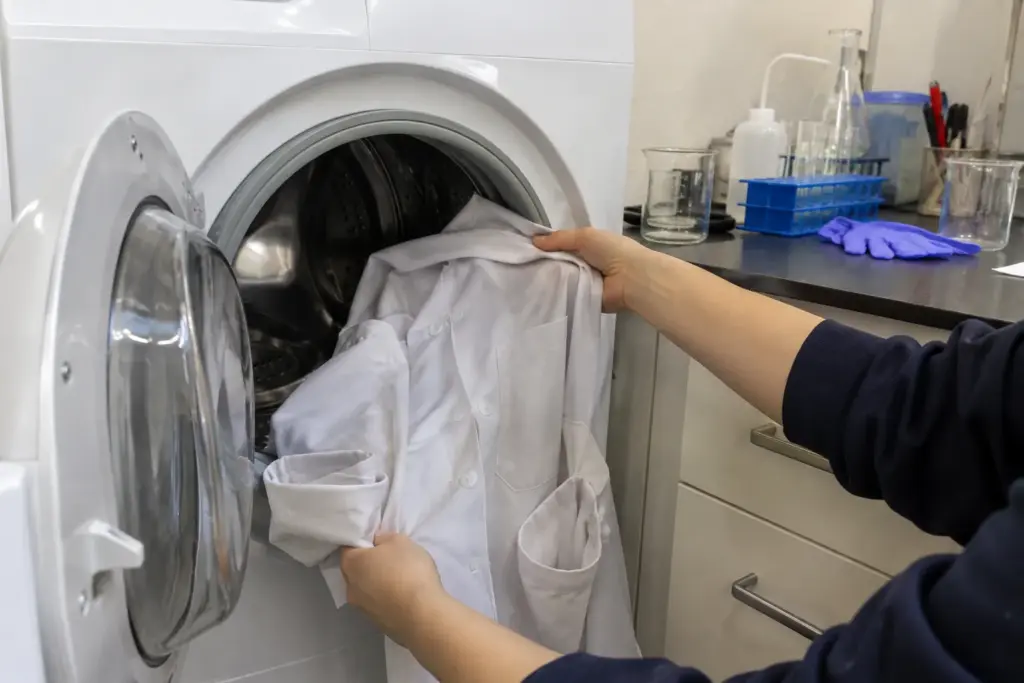
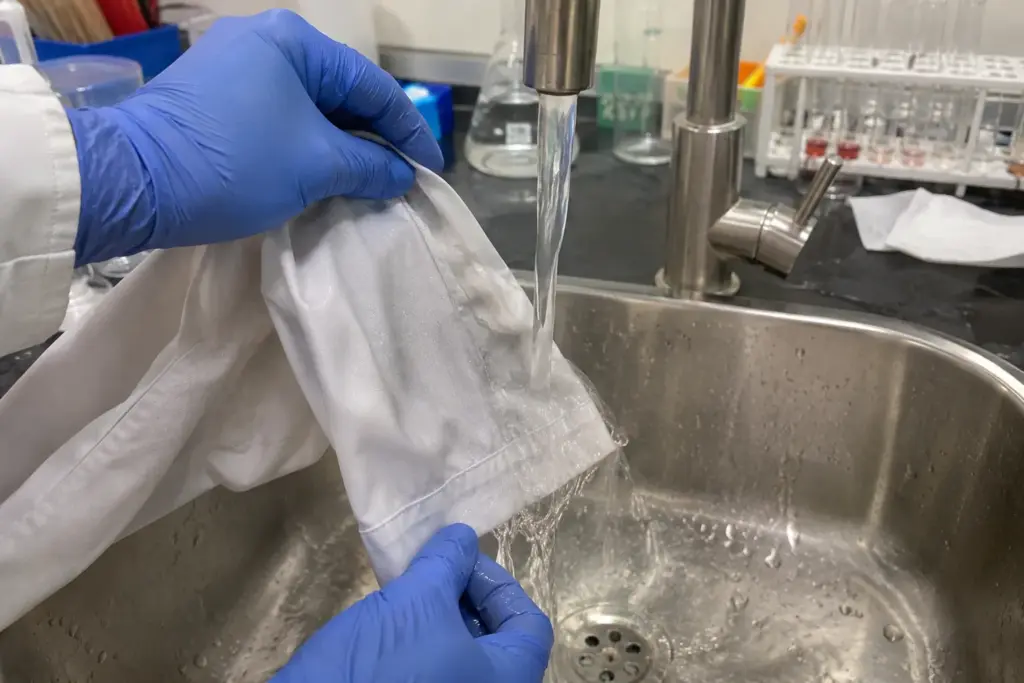
How to wash a lab coat at home, step by step
These steps are for a clean or lightly soiled cotton or poly-cotton coat that your lab lets you wash yourself. Flame-resistant coats have their own rules below.
How to remove common stains from a lab coat
Test any remover on a seam, never mix removers (ammonia and chlorine bleach in particular) and keep bleach for the last attempt. These methods come from Cornell University and New Mexico State University extension guides and apply to a coat that is otherwise clean. A coat with chemical on it goes to EHS, not into this routine.
| Stain | What to do |
|---|---|
| Ink and dyes | Sponge with water, soak in detergent with a few drops of vinegar for 30 minutes, then work uncolored rubbing alcohol through with an absorbent pad, changing the pad as it picks up color. |
| Coffee and tea | Detergent with vinegar, then alcohol, then an enzyme presoak for 30 minutes. |
| Your own blood | Rinse in cold water, then soak in an enzyme stain remover for about 30 minutes. Blood from a lab sample means biological contamination, so send that coat to your biosafety office. |
| Iodine | Treat with a sodium thiosulfate solution, 1 teaspoon in half a cup of water, then flush with water. Thiosulfate turns iodine into colorless iodide. Use this only if the coat has nothing else on it. |
| Rust | Use a commercial rust remover exactly as directed, after a seam test. It is a harsh process, so try other methods first, and never combine it with chlorine bleach. |
Why acid destroys a cotton lab coat
Cotton is cellulose, and acid breaks cellulose down. Cotton Incorporated’s fiber reference states that cotton can be disintegrated by hot dilute acids or cold concentrated acids such as sulfuric acid, but is unaffected by cold weak acids. Alkalis do not adversely affect cotton. That asymmetry is why a splash of concentrated acid eats a hole in a cuff while a spill of dilute base leaves it intact.
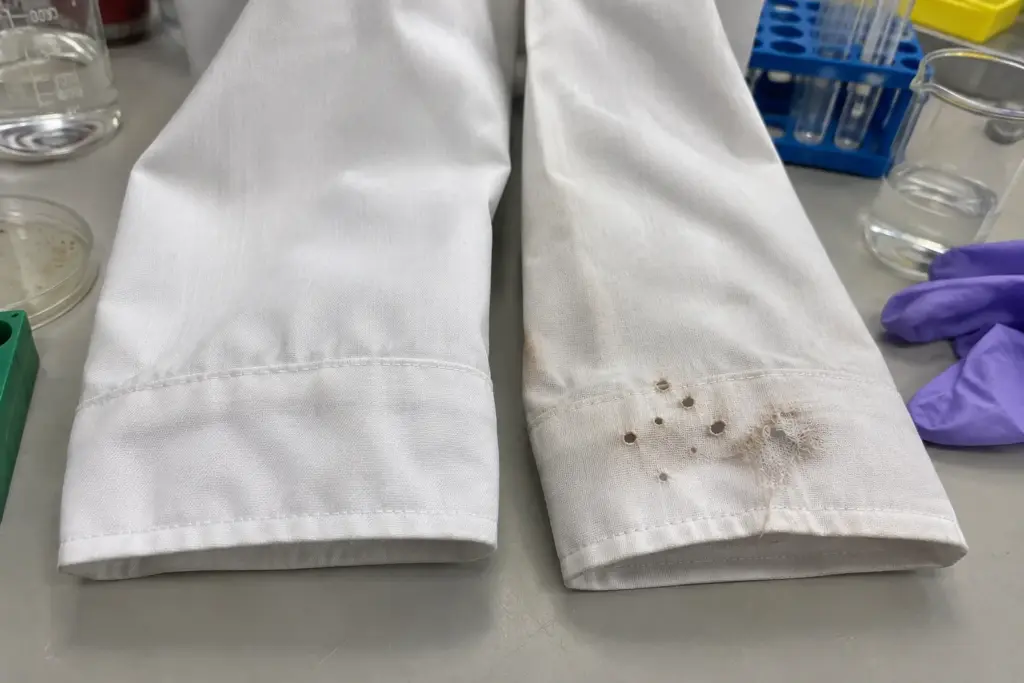
The damage often appears after the wash. The Drycleaning and Laundry Institute notes that acid weakens cotton fibers while polyester resists it far better, and that the agitation of laundering flushes the weakened cotton away, leaving thin spots in a blend. A forensic poster from the University of Strathclyde tested strong acids on cotton: hydrochloric acid dried within 24 hours and left visible damage that spread beyond the original spot, and nitric acid weakened fibers outside the spot until the fabric tore when pulled at 48 hours.
Fabric choice changes the trade-off. Georgia Tech advises 100% cotton near open flames, while safety offices note anecdotal evidence that polyester blends hold up better to corrosives. Our buying guides sort coats by that trade-off: best lab coats for men and best lab coats for women.
Bleach, softener and other products to avoid
Skip chlorine bleach on any coat that may hold lab chemicals. Columbia University’s safety office describes bleach as an oxidizer that reacts with organic chemicals, acids and ammonia compounds, and the CDC reports that mixing bleach with vinegar or ammonia releases chlorine and chloramine gases that can seriously damage lung tissue. Bleach also weakens cotton and fades fabric over time.
How to wash a flame-resistant lab coat
Wash it alone in liquid detergent, with no chlorine bleach, hydrogen peroxide, fabric softener or starch. Bulwark says bleach and peroxide can break down flame-resistant fibers, and that softener and starch leave residue that interferes with flame resistance and increases flammability risk. Washing it apart from other laundry also keeps flammable lint and residue off the coat. Liquid detergent rinses cleaner than powder, and Westex adds that soft water is preferred because hard-water films can be flammable.
Wash temperatures differ by maker, from 140°F for Westex woven fabric to 167°F for LAPCO, so follow the label on your coat. Oils, grease and industrial soil call for professional laundering, and Westex says a coat contaminated by hazardous materials should only be commercially laundered. FR does not mean chemical proof either: ASU warns that treated cotton may not resist acid. Both buying guides include a flame-resistant pick: for men and for women.
How often to wash a lab coat, and when to replace it
Weekly for heavy use, every two weeks or monthly for lighter use, and sooner after any spill or visible soiling. That is MIT’s guidance: for heavy use a weekly schedule may be recommended, and the frequency depends on how much the coat is used and whether it is contaminated. Case Western’s contracted service launders coats monthly.
Replace the coat when it is:
- torn, severely stained or visibly degraded (University of North Dakota, USC)
- thin or holed after acid, since weakened cotton washes away and leaves thin spots (Drycleaning and Laundry Institute)
- damaged by contamination, which MIT treats as hazardous waste
- a treated flame-resistant coat past the maker’s replacement guidance
Torn pockets and missing buttons can be repaired. UC Santa Barbara’s laundry vendor fixes them. For a new coat, compare picks in the men’s guide or the women’s guide, and pair it with splash-rated goggles.
Frequently asked questions
No. Wash it alone. Safety offices at Cornell and Ohio University say to run a lab coat separately from personal clothing, because residue can transfer to the rest of the load.
Only if it has never touched hazardous chemicals, biological material or radioactive material, and your lab allows it. MIT and many other schools ban home washing entirely.
The residue can spread to the washer, the other clothes in the load and the people who handle the laundry. Laundry services are not equipped for significant contamination, which is why EHS decides whether such a coat is cleaned or discarded.
Yes, if the care label allows it, on low heat and removed as soon as the cycle ends. Cotton shrinks from tumbling, so a short tumble followed by hang drying protects the fit.
Avoid it. Chlorine bleach weakens cotton, reacts with many lab chemicals and releases toxic gas if it meets ammonia or acid. Use an enzyme or oxygen-based stain remover and a seam test instead.
Weekly with heavy use and every two weeks or monthly with light use, plus right after any spill or visible soiling.
Hot water and detergent do most of the work. The CDC cites 160°F for at least 25 minutes in commercial healthcare laundries, a standard for laundry services rather than home machines, so use your institution’s service when disinfection matters.
Often yes when it is not contaminated: wash it alone in liquid detergent with no bleach, softener or starch, and follow the maker’s label. Oily or hazardous soil requires professional laundering.
Sources
- MIT EHS. Lab Coat Program Guidance
- MIT EHS. Lab Coat Program FAQs
- Arizona State University. Lab Coat Program
- UC Santa Barbara EH&S. Laboratory Coat Laundering Program FAQs
- Ohio University. Laboratory Sanitation
- OSHA. Letter of interpretation, 2007-06-22
- CDC. Laundry and Bedding, Environmental Infection Control Guidelines
- Cotton Incorporated. Textile Fibers
- Drycleaning and Laundry Institute. Acid Damage on Shirts
- Bulwark Protection. FR Garment Care
- CDC. MMWR 2020;69(23), Knowledge and Practices Regarding Safe Household Cleaning and Disinfection for COVID-19 Prevention
- New Mexico State University Extension. Stain Removal, C-502