Flip a light switch and the bulb comes on instantly, yet the electrons in the wire are barely moving. In a typical household copper wire, they drift at well under a millimeter per second. What travels fast is the electromagnetic signal that pushes them, at a large fraction of the speed of light. Keeping those two ideas straight is most of what separates an electrical engineer from everyone else holding a flashlight.
These facts about electrical engineering are sorted into four groups: history, how the field works, everyday impact, and careers. Each one names its source, so you can check it.
Quick Facts
| First university degree program | TU Darmstadt, Germany, 1883 |
| Founding technologies | Telegraph (1840s), AC power (1880s-90s), transistor (1947) |
| Core math | Calculus, differential equations, complex numbers, linear algebra |
| Main subfields | Power, electronics, control, signal processing, telecommunications, RF and microwave |
| U.S. median pay (BLS, May 2024) | $111,910 per year |
| U.S. jobs (BLS) | Roughly 300,000 |
Contents
- History: How Electrical Engineering Began
- How the Field Works
- Everyday and Modern Impact
- Careers and Pay
- A Short Timeline
- FAQ
History: How Electrical Engineering Began
1. The first electrical engineering degree dates to 1883. TU Darmstadt in Germany created the first chair in the subject in 1882 for Erasmus Kittler, and the first degree program followed in 1883, according to the university’s own history. Before that, people who worked with electricity were physicists, instrument makers, and telegraph operators. The profession was invented because the technology outgrew all three.
2. The telegraph was the first big electrical industry. Samuel Morse sent “What hath God wrought” from Washington to Baltimore on May 24, 1844, a demonstration the Library of Congress preserves. A wire carrying on-off pulses over roughly 40 miles was enough to make distance irrelevant for news. Telegraph companies then became the first employers of people we’d now call electrical engineers.
3. The first transatlantic cable worked for about three weeks. In 1858, Queen Victoria sent President Buchanan a message of about 98 words, and it took around 16 hours to get through. The cable failed within weeks, reportedly after too much voltage was applied to push signals through. A durable link wasn’t completed until 1866, and the lesson was that engineering the physics of a cable matters as much as having the cable.
4. AC beat DC partly because of transformers. Edison’s Pearl Street Station in New York began serving customers with direct current in 1882. But DC can’t be stepped up to high voltage easily, and low voltage loses most of its energy over distance. Alternating current can be stepped up and down with transformers, which is why the Niagara Falls AC plant, running from 1895, could send power about 26 miles to Buffalo.
5. The transistor replaced thousands of glowing tubes. ENIAC, completed in 1945, used about 18,000 vacuum tubes and filled a large room. Bell Labs demonstrated the transistor in December 1947, and its Nobel Prize recognition for Bardeen, Brattain, and Shockley came in 1956. Nearly every device you own now depends on that one swap.
How the Field Works
6. Electrical engineers write the imaginary unit as j, not i. In circuit analysis, i already means current, so engineers use j for the square root of negative one. Charles Steinmetz brought complex numbers into AC analysis in the 1890s, turning messy trigonometry into algebra. Imaginary numbers aren’t a classroom curiosity here. They’re how you calculate a real motor.
7. Four equations describe all of classical electromagnetism. James Clerk Maxwell unified electricity and magnetism in the 1860s, and Oliver Heaviside later condensed his work into the four equations taught today. Heinrich Hertz generated and detected radio waves in the late 1880s, confirming Maxwell’s prediction. Radio, radar, and Wi-Fi are applications of that single framework.
8. The field has at least six major subdisciplines. Power engineering handles generation and the grid. Electronics designs circuits and chips. Control systems keep things stable, from thermostats to autopilots. Signal processing cleans up audio, images, and data. Telecommunications moves information between places. RF and microwave engineering works with radio-frequency hardware like antennas. The jobs share math but rarely share a day-to-day.
9. Your phone runs on a 200-year-old math idea. Fourier analysis, which breaks a signal into frequencies, is the base of signal processing. The Cooley-Tukey fast Fourier transform paper of 1965 made it fast enough to use everywhere. Wi-Fi’s OFDM modulation and audio compression both depend on it.
Everyday and Modern Impact
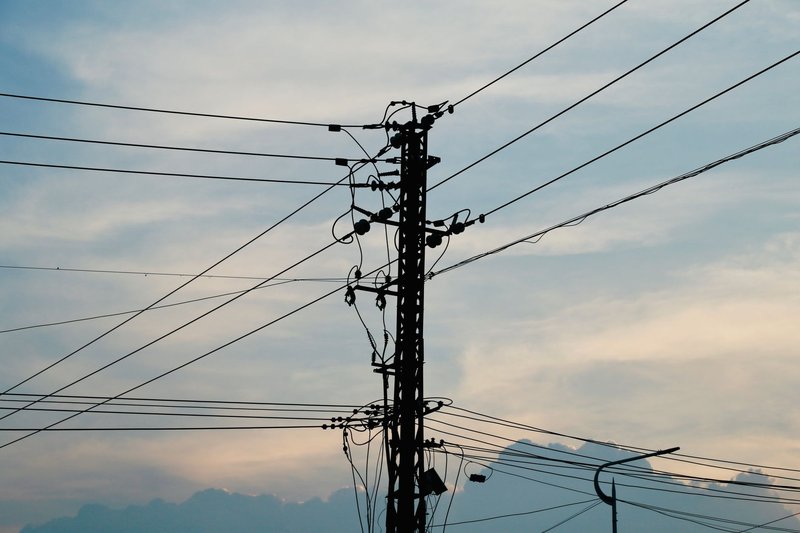
10. The grid has to balance supply and demand every second. Electricity can’t be stored cheaply at large scale, so generation must match consumption continuously. The frequency, 60 Hz in North America and 50 Hz in Europe, drifts if the two don’t match, and protective equipment trips when it drifts too far. Operators and power engineers spend careers keeping that number steady.
11. Solar power created the “duck curve.” California’s grid operator, CAISO, named it in 2012: midday solar floods the grid, net demand sags, then climbs steeply at sunset when everyone gets home and solar fades. The steep evening ramp is the hard part, and it’s driving demand for batteries, flexible demand, and new grid controls. This is one of the main reasons power engineering is hiring again.
12. About 5% of U.S. electricity is lost on the way to you. The U.S. Energy Information Administration estimates that transmission and distribution losses average around 5% of electricity delivered. Raising voltage cuts losses, so China built a ±1,100 kV direct current line, the Changji-Guquan project, that runs about 3,300 km. Pushing power that far with so little loss is a feat of insulation and converter design.
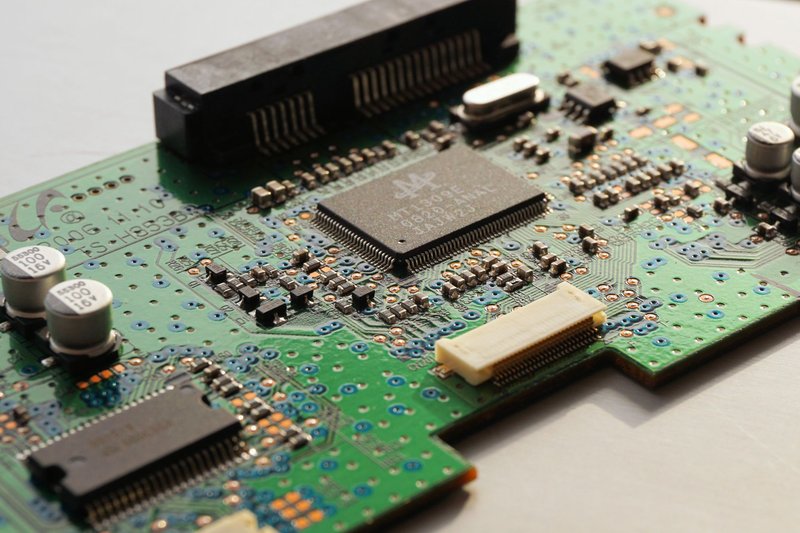
13. A flagship processor holds tens of billions of transistors. The number sits on a chip that fits on a fingertip. The “3 nm” and “5 nm” labels on chips are marketing names for generations, not literal feature sizes, but the real structures are still in the nanoscale, which the U.S. National Nanotechnology Initiative defines as roughly 1 to 100 nanometers. A human hair is about 80,000 nm wide.
14. The Apollo Guidance Computer was one of the first to use integrated circuits. MIT’s Instrumentation Laboratory built it with early integrated circuits, and it ran with about 4 KB of erasable memory and roughly 72 KB of fixed rope memory, as NASA’s history of the system describes. Weight and reliability mattered more than speed. That constraint pushed the early chip industry forward.
Careers and Pay
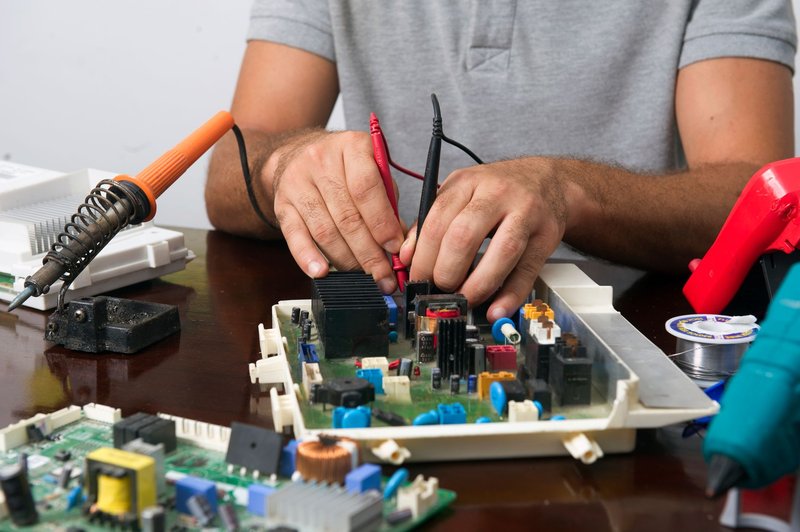
15. U.S. median pay is above $111,000. The Bureau of Labor Statistics reports a median annual wage of $111,910 for electrical and electronics engineers in May 2024, more than double the median for all occupations. About 300,000 people hold the job in the U.S., and BLS projects growth roughly in line with the average for all occupations. Many older web pages quote 2020-2021 figures, which are now out of date.
16. Most electrical engineers don’t work for power companies. BLS lists engineering services, research and development, electric power, and semiconductor and electronic manufacturing among the biggest employers, so the work is spread across industries. A given engineer might design circuits for medical devices, test aircraft avionics, or tune a cellular base station.
17. A single professional society writes the standards you use. IEEE has more than 400,000 members worldwide, according to its own overview, and was formed in 1963 by merging the AIEE (founded 1884) and the IRE. The Wi-Fi in your home runs on IEEE 802.11, and Ethernet on 802.3.
A Short Timeline
| Year | Event |
|---|---|
| 1837 | Cooke and Wheatstone patent an electric telegraph in Britain |
| 1844 | Morse sends the first long-distance telegraph message in the U.S. |
| 1858 | First transatlantic cable carries messages, then fails |
| 1882-83 | Pearl Street Station opens; TU Darmstadt starts the first degree |
| 1887-88 | Hertz demonstrates radio waves |
| 1895 | Niagara Falls AC plant begins generating |
| 1945 | ENIAC completed with about 18,000 vacuum tubes |
| 1947 | Transistor demonstrated at Bell Labs |
| 1963 | IEEE formed from AIEE and IRE |
FAQ
Is electrical engineering hard?
Yes, and mostly because of the math. Expect calculus, differential equations, linear algebra, and complex numbers, applied to circuits, signals, and electromagnetics, often at the same time. Students who like building things and don’t mind abstract problem sets tend to do fine. Students who dislike math usually don’t.
What do electrical engineers do?
They design, test, and maintain electrical systems and devices: power grids, circuits, chips, communication equipment, motors, sensors, and control systems. Some work mostly with software and simulations, others with hardware in a lab or at a plant. The six subfields above are the most common ways to split the work.
How much do electrical engineers earn?
The BLS median was $111,910 per year in May 2024. Pay varies by industry, location, and experience, and BLS updates the figure yearly, so check the current listing before you plan around a number.
If these facts about electrical engineering leave you wanting more, the history and the subfields are the best places to keep digging.