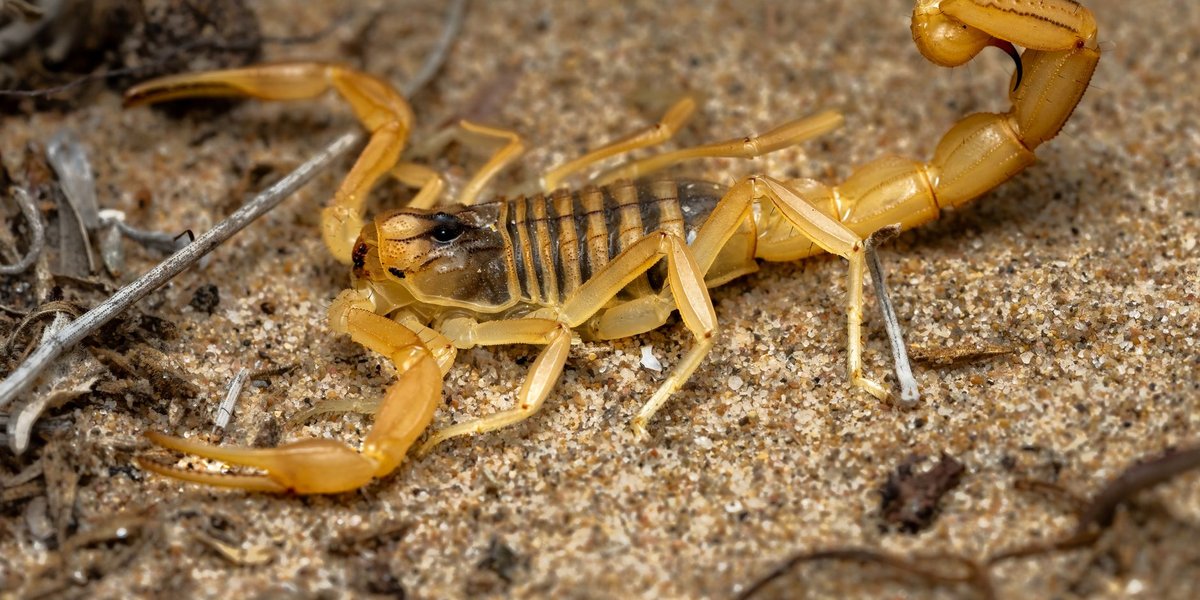
Scorpions come in more than 2,500 described species, and the sting of most of them is no worse than a wasp’s. Roughly 25 to 40 species can seriously hurt or kill a person, and nearly all of those belong to one family, the Buthidae. The rest range from palm-sized pets to thumbnail-sized creatures living in English dockyards.
This list covers 16 examples of scorpions, sorted by what you’d actually want to know: which ones are dangerous, which are giants, which end up in the pet trade, and which live in North America and Europe. Every entry gives size, range, habitat and a one-line venom verdict. A comparison table sits near the end, followed by the animals people mistake for scorpions.
Quick facts
- Scorpions are arachnids, closer to spiders and ticks than to insects.
- All scorpions are venomous; venom strength has little to do with size.
- The big-clawed, bulky species tend to be the mild ones. Slender claws and a thick tail are the warning sign.
- Every scorpion glows blue-green under UV light.
Table of contents
- Dangerous scorpions
- Giant and pet-trade scorpions
- North American and European natives
- Scorpion comparison table
- Scorpion look-alikes
Dangerous scorpions
These six account for most of the world’s serious scorpion stings. The pattern is consistent: slim pincers, a thick tail, and a venom that attacks the nervous system. Children, the elderly and people with heart conditions are at the highest risk.
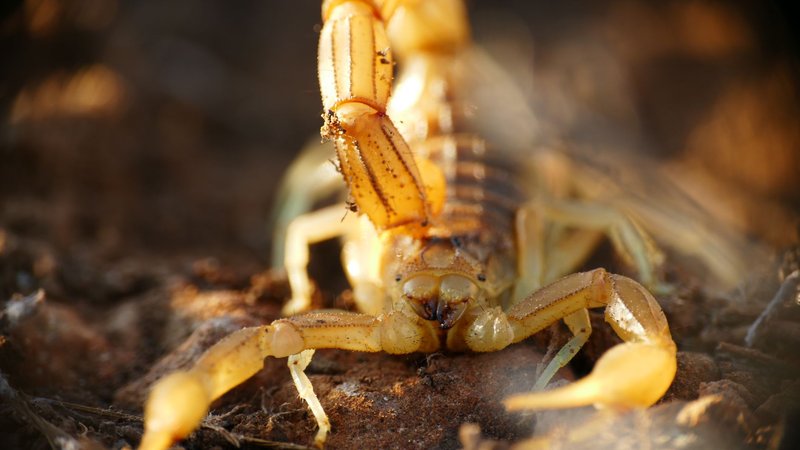
1. Deathstalker (Leiurus quinquestriatus)
Size: 8 to 10 cm. Range: North Africa and the Middle East. Habitat: Deserts and dry scrubland. Verdict: Potentially deadly.
The deathstalker is pale yellow, thin-clawed and quick to sting, which is a bad combination. Its venom is one of the most potent known and causes intense pain, and in children or frail adults it can be fatal without treatment. It also has an odd second career: chlorotoxin, a peptide from its venom, binds to glioma cells and has been developed as a fluorescent tumor-imaging agent.
2. Arizona bark scorpion (Centruroides sculpturatus)
Size: About 7 cm. Range: Arizona, plus parts of New Mexico, Nevada, Utah, California and northwestern Mexico. Habitat: Desert, but also houses, where it climbs walls and ceilings. Verdict: Dangerous, rarely fatal.
This is the only scorpion in the United States considered medically dangerous. A sting brings sharp pain, numbness and tingling, and in small children it can cause jerking muscles and trouble breathing. Deaths are rare, and the FDA approved the antivenom Anascorp in 2011, a product developed in Mexico where scorpion stings were a long-standing public health problem.
3. Brazilian yellow scorpion (Tityus serrulatus)
Size: 6 to 7 cm. Range: Brazil, spreading through the country’s southeast and beyond. Habitat: Cities. Garbage, sewers, construction rubble and cracks in walls. Verdict: Dangerous, deadly to children.
This one doesn’t need a mate. The species appears to be an all-female lineage that reproduces by parthenogenesis, so a single scorpion can start a colony. Brazil now reports well over 100,000 scorpion stings a year, and this species is behind most of the serious cases.
4. Indian red scorpion (Hottentotta tamulus)
Size: 6 to 9 cm. Range: India, Pakistan, Nepal and Sri Lanka. Habitat: Dry rural land, farm fields, stone walls and the floors of village homes. Verdict: Deadly, especially to children.
Brick-red with a dark tail tip, it lives close to people who often sleep on the floor and work barefoot. Severe stings can cause heart failure and fluid in the lungs. The drug prazosin has been used to treat these cases where antivenom is scarce.
5. Yellow fat-tailed scorpion (Androctonus australis)
Size: Up to 10 cm. Range: North Africa and parts of the Middle East. Habitat: Sandy and semi-arid ground, usually under stones or in burrows. Verdict: Potentially deadly.
The name describes the tail: thick, muscular and carried like a club, with slender pincers underneath. Androctonus means “man-killer” in Greek, and the genus earns it. It’s one of the main causes of fatal scorpion stings in North Africa.
6. Spitting thick-tailed scorpion (Parabuthus transvaalicus)
Size: 10 to 15 cm. Range: Southern Africa. Habitat: Arid scrubland and rocky ground. Verdict: Serious, occasionally fatal.
Large for a dangerous species, and it has a defense most scorpions lack: it can spray venom from the stinger tip, a metre or more. The spray is mostly a risk to the eyes, where it causes intense pain. A direct sting is the real danger, because the venom is neurotoxic.
Giant and pet-trade scorpions
Size and danger don’t track each other. The largest scorpions in the world have thick pincers and weak venom, which is exactly why keepers like them. If you want a pet scorpion, this is the shelf to shop from, not the one above.
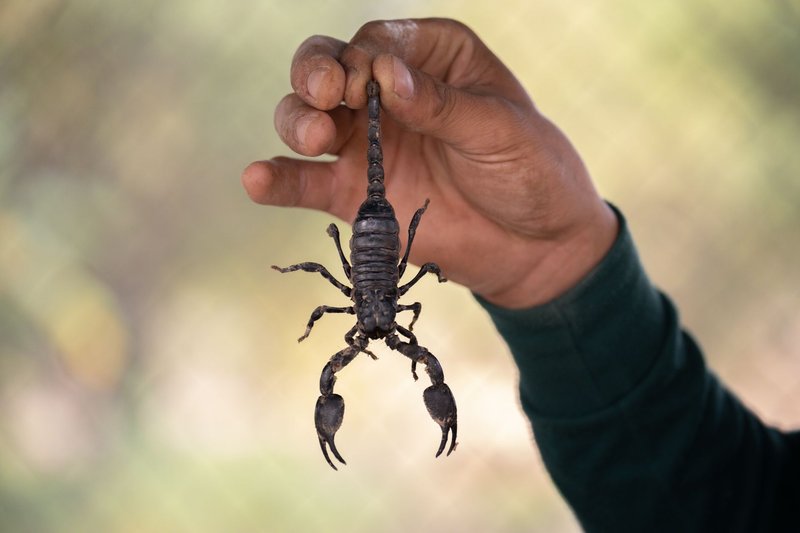
7. Asian giant forest scorpion (Heterometrus swammerdami)
Size: Up to 23 cm. Range: Southern India. Habitat: Forest floors and termite mounds, where it digs burrows. Verdict: Painful, not dangerous.
Often cited as the longest scorpion in the world. It’s glossy black, bulky and slow, and it relies on heavy claws more than venom to subdue prey. Colonies sometimes share a burrow system.
8. South African giant rock scorpion (Hadogenes troglodytes)
Size: Up to about 21 cm. Range: South Africa, Zimbabwe and Mozambique. Habitat: Narrow rock crevices. Verdict: Mild.
Built for tight spaces, it has a flattened body, a long thin tail and slim pincers that look too small for the animal. It’s among the longest scorpions on record, and the flat profile lets it slip into cracks only a few millimetres wide.
9. Emperor scorpion (Pandinus imperator)
Size: 12 to 20 cm. Range: West Africa. Habitat: Rainforest and savanna, in burrows and under logs. Verdict: Mild, similar to a bee sting.
The classic pet scorpion, and the reason many people can name a scorpion at all. The enormous claws do most of the work, so the stinger is a backup. Wild-caught Pandinus are covered by CITES trade rules, so captive-bred animals are the better buy.
10. Tanzanian red claw scorpion (Pandinus cavimanus)
Size: About 10 cm. Range: East Africa. Habitat: Savanna and dry woodland, under rocks and in burrows. Verdict: Mild, but more defensive than the emperor.
A cousin of the emperor with rust-red claws and a short temper. It’s common in the pet trade and has a reputation for pinching first and asking questions never. The venom is weak, so the bad-tempered claws are the main hazard.
11. Asian forest scorpion (Heterometrus spinifer)
Size: Up to about 12 cm. Range: Southeast Asia. Habitat: Tropical forest floors, under logs and in burrows. Verdict: Painful, not dangerous.
A close relative of the giant in entry 7, and the more practical version for keepers: smaller, hardy and calm. It’s one of the most widely sold forest scorpions. Same genus, same black coloring, a fraction of the length.
North American and European natives
These are the scorpions you’d most plausibly meet in your own backyard, on a hike or, in one case, in a Kent dockyard. All of them are far milder than the Arizona bark scorpion above.
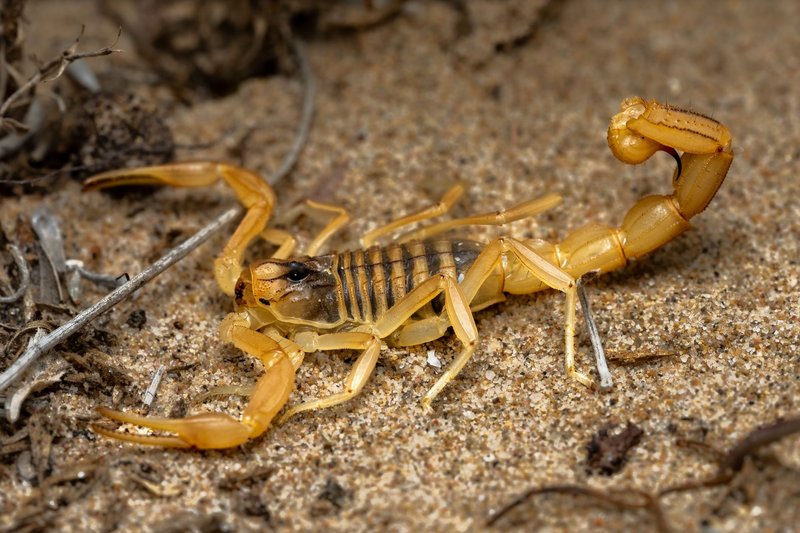
12. Giant desert hairy scorpion (Hadrurus arizonensis)
Size: 12 to 14 cm. Range: Southwestern United States and northwestern Mexico. Habitat: Sandy desert, in burrows. Verdict: Painful, comparable to a bee sting.
The largest scorpion in North America, tan with a dark back and a coat of fine hairs that detect ground vibrations. It looks frightening and behaves like a heavyweight bruiser rather than a venom specialist. It also turns up in the pet trade.
13. Striped bark scorpion (Centruroides vittatus)
Size: Up to about 7 cm. Range: Texas and the central United States. Habitat: Woodland, grassland, and the undersides of rocks, bark and boards. Verdict: Painful, usually not serious.
Probably the scorpion most Texans actually run into. It’s straw-yellow with two dark stripes down its back and a thin tail. It’s a close relative of the dangerous bark scorpion, but its sting generally acts like a bad wasp sting.
14. Northern scorpion (Paruroctonus boreus)
Size: About 5 cm at most. Range: The western United States and southern Canada. Habitat: Sagebrush, grassland and dry slopes, hiding under rocks. Verdict: Mild.
It lives farther north than almost any other North American scorpion, reaching Alberta, Saskatchewan and British Columbia. Winter is spent underground. The sting is mild and the animal is small and shy.
15. Hentz striped scorpion (Centruroides hentzi)
Size: About 5 to 6 cm. Range: The southeastern United States, including Florida and Georgia. Habitat: Pine woods, sandhills, and under bark and debris. Verdict: Painful, rarely serious.
The most common scorpion across much of Florida and the Southeast. It has a dark triangle on its head and two dark stripes along its back. Expect a sting that burns for a few hours and then goes away.
16. European yellow-tailed scorpion (Euscorpius flavicaudis)
Size: 3 to 4 cm. Range: Southern Europe and North Africa, with an introduced colony in England. Habitat: Walls, rocks and old masonry. Verdict: Harmless to most people, an ant-bite sting.
A small black scorpion with a yellowish tail tip. A population has lived in the dockyard walls at Sheerness, Kent since the 19th century, probably arriving with cargo from southern Europe, and it’s the best-known wild scorpion colony in Britain. It’s tiny, and a sting is a minor event.
Scorpion comparison table
| Scorpion | Size | Region | Sting severity |
|---|---|---|---|
| Deathstalker | 8 to 10 cm | North Africa, Middle East | Potentially deadly |
| Arizona bark scorpion | About 7 cm | Southwestern US, northwest Mexico | Dangerous, rarely fatal |
| Brazilian yellow scorpion | 6 to 7 cm | Brazil | Dangerous, deadly to children |
| Indian red scorpion | 6 to 9 cm | South Asia | Deadly, especially to children |
| Yellow fat-tailed scorpion | Up to 10 cm | North Africa, Middle East | Potentially deadly |
| Spitting thick-tailed scorpion | 10 to 15 cm | Southern Africa | Serious |
| Asian giant forest scorpion | Up to 23 cm | Southern India | Painful |
| South African giant rock scorpion | Up to about 21 cm | Southern Africa | Mild |
| Emperor scorpion | 12 to 20 cm | West Africa | Mild |
| Tanzanian red claw scorpion | About 10 cm | East Africa | Mild |
| Asian forest scorpion | Up to about 12 cm | Southeast Asia | Painful |
| Giant desert hairy scorpion | 12 to 14 cm | Southwestern US, Mexico | Painful |
| Striped bark scorpion | Up to about 7 cm | Central US | Painful |
| Northern scorpion | About 5 cm | Western US, southern Canada | Mild |
| Hentz striped scorpion | About 5 to 6 cm | Southeastern US | Painful |
| European yellow-tailed scorpion | 3 to 4 cm | Southern Europe, North Africa | Harmless |
Sizes are approximate adult body lengths, including the tail, and vary by population and sex.
Scorpion look-alikes
Three animals regularly get mistaken for scorpions. None of them is one.
- Whip scorpions (vinegaroons). They have scorpion-style pincers and a long whip-like tail, but no stinger and no venom. The common American species, Mastigoproctus giganteus, defends itself by spraying an acetic-acid mist that smells like vinegar.
- Pseudoscorpions. Tiny, usually just a few millimetres long, with pincers and no tail. They live in soil, leaf litter and old books, and they’re harmless to people.
- Wind scorpions (camel spiders). Fast, pale desert hunters in the order Solifugae, with huge jaws. They aren’t spiders or scorpions, and they have no venom.
A quick identification rule: if there’s a tail curled over the back with a stinger on the end, it’s a true scorpion. If not, it’s something else.