A gene is a stretch of DNA that carries the instructions for making one specific product, usually a protein. That’s the whole definition. Everything else about genes, from eye color to inherited disease, follows from what those proteins do inside your cells.
The easiest way to hold the idea in your head is a recipe book. Your DNA is the entire library of recipes, a gene is one recipe, and the protein is the dish. Your cells don’t cook every recipe at once. A muscle cell makes different dishes than a neuron, even though both hold the same library.
Key takeaways
- A gene is a segment of DNA that holds instructions for a protein or a functional RNA molecule.
- Humans have about 20,000 protein-coding genes, packed into 23 pairs of chromosomes.
- Cells read a gene in two steps: transcription (DNA to RNA) and translation (RNA to protein).
- You inherit one copy of each gene from each parent. Dominant and recessive describes how the two copies interact.
- Genes influence traits and health but rarely decide them alone. Environment and gene regulation matter too.
Table of contents
- What genes are made of
- Gene vs. DNA vs. chromosome vs. genome
- How a gene becomes a protein
- How many genes do humans have?
- Where your genes come from
- Dominant and recessive genes
- How genes shape traits and health
- Three myths about genes
- Genetic testing and gene therapy
- FAQ
What genes are made of
Genes are made of DNA, short for deoxyribonucleic acid. DNA is a long chain of building blocks called nucleotides, and each nucleotide carries one of four chemical bases: adenine (A), thymine (T), cytosine (C) or guanine (G). Two chains pair up and twist into the double helix, with A always bonding to T and C always bonding to G.
The order of those letters is the information. A gene might run from a few hundred letters to over two million. The dystrophin gene, which is damaged in Duchenne muscular dystrophy, is one of the longest in the human genome at roughly 2.4 million base pairs. Most of that length is not the recipe itself. Genes contain coding stretches called exons, interrupted by non-coding stretches called introns that get cut out before the message is used.
That detail surprises people. If you stretched out the typical human gene and highlighted the part that ends up in the protein, you’d be highlighting a small fraction of it.
Gene vs. DNA vs. chromosome vs. genome
These four words get swapped constantly. They describe different scales of the same thing.
| Term | What it is | Rough scale in humans |
|---|---|---|
| Nucleotide / base | One letter (A, T, C or G) | About 3.1 billion in a set of chromosomes |
| Gene | A stretch of DNA that codes for a product | About 20,000 protein-coding genes |
| Allele | One version of a gene | Most genes have several known variants |
| Chromosome | A DNA molecule wound around proteins into a compact package | 46 per cell, in 23 pairs |
| Genome | All of an organism’s DNA | One full set per parent, so two copies in most cells |
DNA is the material. A gene is a functional unit of that material. A chromosome is how the material is packaged, and the genome is the whole collection. An allele is a variant of one gene: the gene for a blood-group protein is one gene, and the A, B and O versions are its alleles.
The National Human Genome Research Institute keeps a glossary that defines these terms in the same way, if you want a second reference.
How a gene becomes a protein
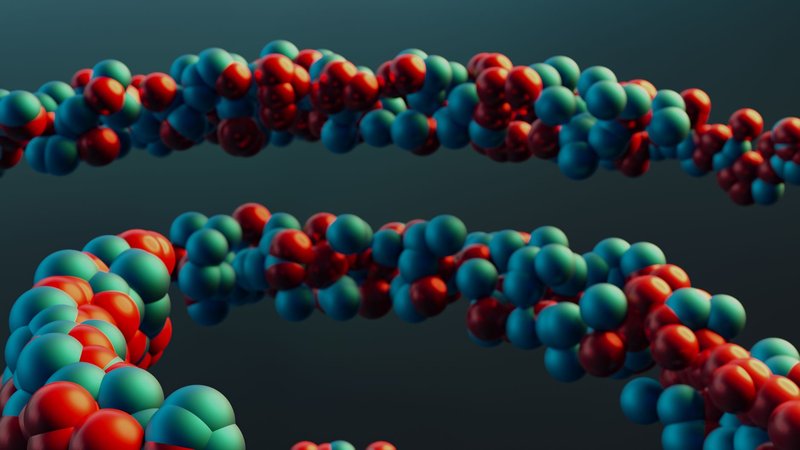
Your DNA stays inside the nucleus. Proteins get built outside it. So the cell needs a messenger, and it uses RNA. The process of reading a gene, called gene expression, has two steps.
Step 1: Transcription. An enzyme called RNA polymerase unzips the gene and copies one strand into a molecule of messenger RNA (mRNA). Think of photocopying one recipe so the original never leaves the shelf. The introns are trimmed out, and the exons are stitched together.
Step 2: Translation. The mRNA travels out to a ribosome. The ribosome reads the message three letters at a time. Each three-letter group, called a codon, specifies one amino acid. The codon GAG, for example, calls for glutamic acid. The ribosome links amino acids into a chain, and the chain folds into a working protein.
With four letters read in groups of three, there are 64 possible codons for just 20 amino acids. Several codons therefore mean the same thing, and a few mean “stop.” The MedlinePlus genetics overview from the National Library of Medicine walks through the same pathway with diagrams.
Not every gene ends in a protein. Some genes produce RNA molecules that do their jobs as RNA, such as the ones that build ribosomes or help regulate other genes.
Cells also control when a gene gets read. Every cell in your body carries nearly the same DNA, but a liver cell switches on liver genes and keeps most neuron genes quiet. Differences between cell types come from regulation, not from different DNA.
How many genes do humans have?
About 20,000 protein-coding genes. For a long time scientists expected far more, partly because the human genome is so large and partly because humans seemed more complex than worms or flies. Before the Human Genome Project finished, estimates ran as high as 100,000.
The actual number turned out to be modest. A roundworm has roughly 20,000 genes too. Complexity doesn’t come from gene count. It comes from how genes are regulated, how a single gene can be spliced into multiple protein versions, and how those proteins interact.
The protein-coding portion also takes up a tiny share of the genome, around 1 to 2 percent. The rest includes regulatory switches, genes that make functional RNAs, repeated sequences and stretches whose purpose is still being worked out.
Humans share most of their genes with other species. Two unrelated people are about 99.9 percent identical in their DNA. Chimpanzees match us at roughly 98 to 99 percent across aligned sequence, and mice have a counterpart for the large majority of human protein-coding genes. That overlap is why mice are used to study human disease.
Where your genes come from

You have 46 chromosomes, arranged as 23 pairs. One chromosome of each pair came from your mother’s egg and the other from your father’s sperm. So for nearly every gene, you carry two copies, one from each parent. The exceptions are genes on the sex chromosomes: people with one X and one Y chromosome carry only one copy of most X-linked genes.
Eggs and sperm are made through a process called meiosis, which shuffles the parental chromosomes before dividing them. Segments swap between the paired chromosomes in a step called crossing over. As a result, each egg or sperm carries a unique mix, and siblings (except identical twins) get different combinations from the same two parents.
The study of how traits pass between generations started with Gregor Mendel, an Augustinian friar who crossed pea plants in the 1860s and counted the offspring. He never saw a gene or a chromosome. He inferred that discrete units of inheritance must exist from the ratios in his pea pods. The word “gene” itself did not appear until 1909, coined by the Danish botanist Wilhelm Johannsen.
Dominant and recessive genes
Since you hold two copies of most genes, the question is what happens when the copies differ. Alleles interact in a few ways.
- Dominant: One copy is enough to show the trait. Huntington’s disease works this way. Inherit one altered copy and you will develop the condition.
- Recessive: The trait shows only if both copies carry the variant. Cystic fibrosis and sickle cell disease are recessive. A person with one altered copy is a carrier and usually has no symptoms.
- Codominant: Both alleles show at once. In the ABO blood system, someone with an A allele and a B allele has type AB blood.
“Dominant” does not mean common or stronger. It describes how an allele behaves when paired with another one. Some dominant conditions are very rare, and some recessive variants are carried by a lot of people.
Sickle cell disease is a clean example of how small a change can be. The MedlinePlus entry on sickle cell disease explains that a change in the HBB gene swaps a single amino acid in hemoglobin. One altered letter in the DNA, GAG becoming GTG, produces hemoglobin that clumps into stiff fibers and bends red blood cells into a sickle shape. A person with two copies of the variant has the disease. A person with one copy gains partial protection against malaria, which is why the variant is common in regions where malaria has been widespread.
How genes shape traits and health
Some traits come down to one gene. Most don’t.
Cystic fibrosis, sickle cell disease and Huntington’s disease each trace to a single gene, and these are called monogenic conditions. Huntington’s is caused by a repeated stretch in the HTT gene: the three-letter sequence CAG repeats over and over. People with fewer than about 36 repeats are unaffected, while 40 or more repeats lead to the disease. The MedlinePlus Huntington disease entry covers the pattern in detail.
Height, skin color, eye color, heart disease risk and most common conditions are polygenic: many genes each add a small push, and environment adds more. Large studies have found thousands of genetic variants associated with adult height, each with a tiny effect. Eye color was once taught as a simple brown-dominates-blue trait. It involves several genes, with OCA2 and HERC2 on chromosome 15 doing much of the work, and parents with blue eyes can occasionally have a child with green or brown eyes.
Three myths about genes
“One gene, one trait.” True for a handful of conditions, false for nearly everything else. Most traits come from many genes interacting, and one gene often affects several traits.
“Genes are destiny.” A gene variant that raises risk is not a diagnosis. Type 2 diabetes, heart disease and many cancers depend on genetic risk plus diet, activity, age and exposures. Even single-gene conditions vary in severity and timing from person to person.
“Your genes are fixed, so nothing you do matters.” Your DNA sequence stays mostly constant, but gene activity does not. Chemical tags on DNA and on the proteins it wraps around can switch genes up or down in response to the cell’s environment. This area, called epigenetics, is why identical twins with the same DNA drift apart in health and appearance over decades.
Genetic testing and gene therapy
Genetic tests read part of your DNA to look for variants. Diagnostic tests confirm or rule out a suspected condition. Carrier tests check whether you hold one copy of a recessive variant. Newborn screening looks for treatable conditions in the first days of life. Direct-to-consumer ancestry kits read a sample of positions across your genome and compare them against reference populations.
A result describes risk or status, not a prediction. A variant linked to a condition may have a low chance of causing it. A clean result on a consumer test doesn’t exclude every possible variant, because most tests check only a selection. If a test result worries you, a genetic counselor can explain what it means for you.
Gene therapy takes the opposite direction: instead of reading genes, it changes how they work. Approaches include adding a working copy of a gene using a harmless virus as a delivery vehicle, and editing the DNA directly with tools like CRISPR. In late 2023, regulators in the United States and United Kingdom approved the first CRISPR-based therapy, for sickle cell disease and a related blood disorder, beta thalassemia. It remains expensive and complex to deliver, and treatments exist for only a few conditions so far.
FAQ
What is a gene in simple terms?
A gene is a section of DNA that holds the instructions for building one protein or functional RNA molecule. Proteins do most of the work in cells, so genes indirectly control how your body is built and runs.
What is the difference between a gene and a chromosome?
A chromosome is a packaged strand of DNA that contains many genes. Humans have 46 chromosomes, and each carries hundreds to thousands of genes. A gene is one functional segment on a chromosome.
Are genes and DNA the same thing?
Not exactly. DNA is the molecule. Genes are specific sections of DNA with a function. Large parts of your DNA are not genes in the traditional sense, though many of those regions help control when genes turn on.
Do all my cells have the same genes?
Almost all of them do. Red blood cells lose their nucleus when they mature, and egg and sperm cells carry only half a set. Otherwise every cell holds the same DNA. Cell types differ because they use different genes.
Can genes change?
Yes. Mutations happen when DNA is copied incorrectly or damaged. Most are harmless, some cause disease, and a few help. Mutations in egg or sperm can pass to children. Mutations in other cells, such as a skin cell, stay with that cell and its descendants.
How many genes do I share with my parents?
You get half your DNA from each parent, so you share about 50 percent of your inherited variants with each. Since all humans share about 99.9 percent of their DNA, the part that actually differs is a tiny fraction of the genome.