
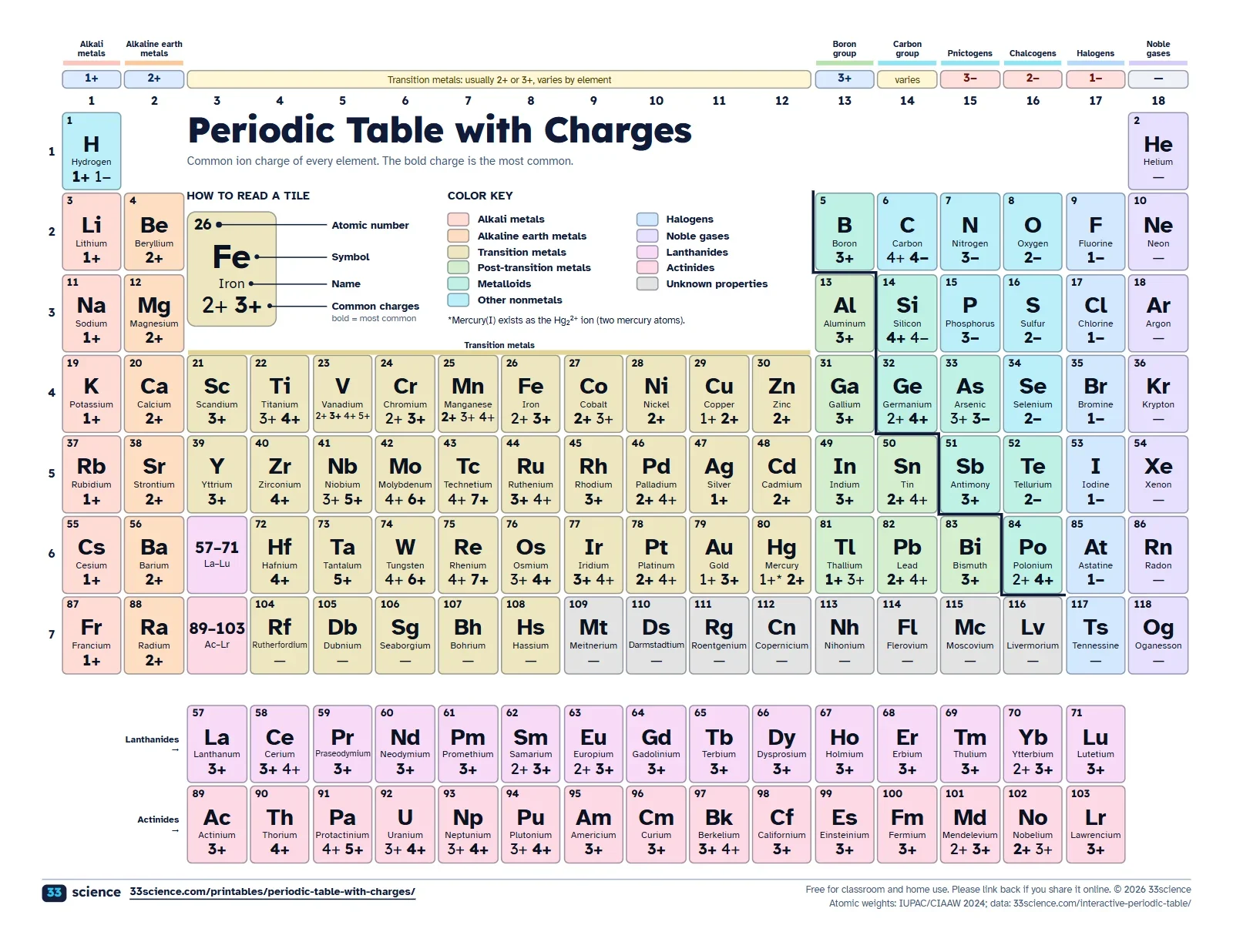
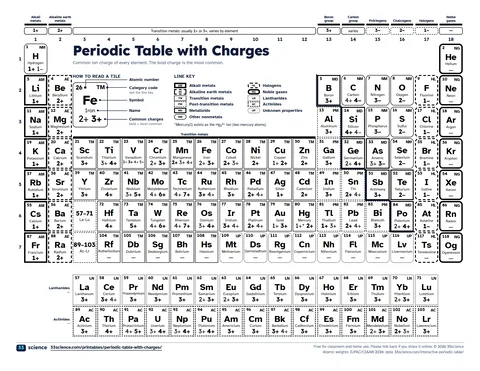
A periodic table with charges shows the ion each element usually forms: sodium 1+, magnesium 2+, aluminum 3+, oxygen 2−, chlorine 1−. Download it in color or black and white, or print the blank quiz with its answer key. Every sheet is a free PDF in US Letter and A4, and the group rules below predict most charges.
Color periodic table with charges
US Letter · 1 page · 374 KB · PDF
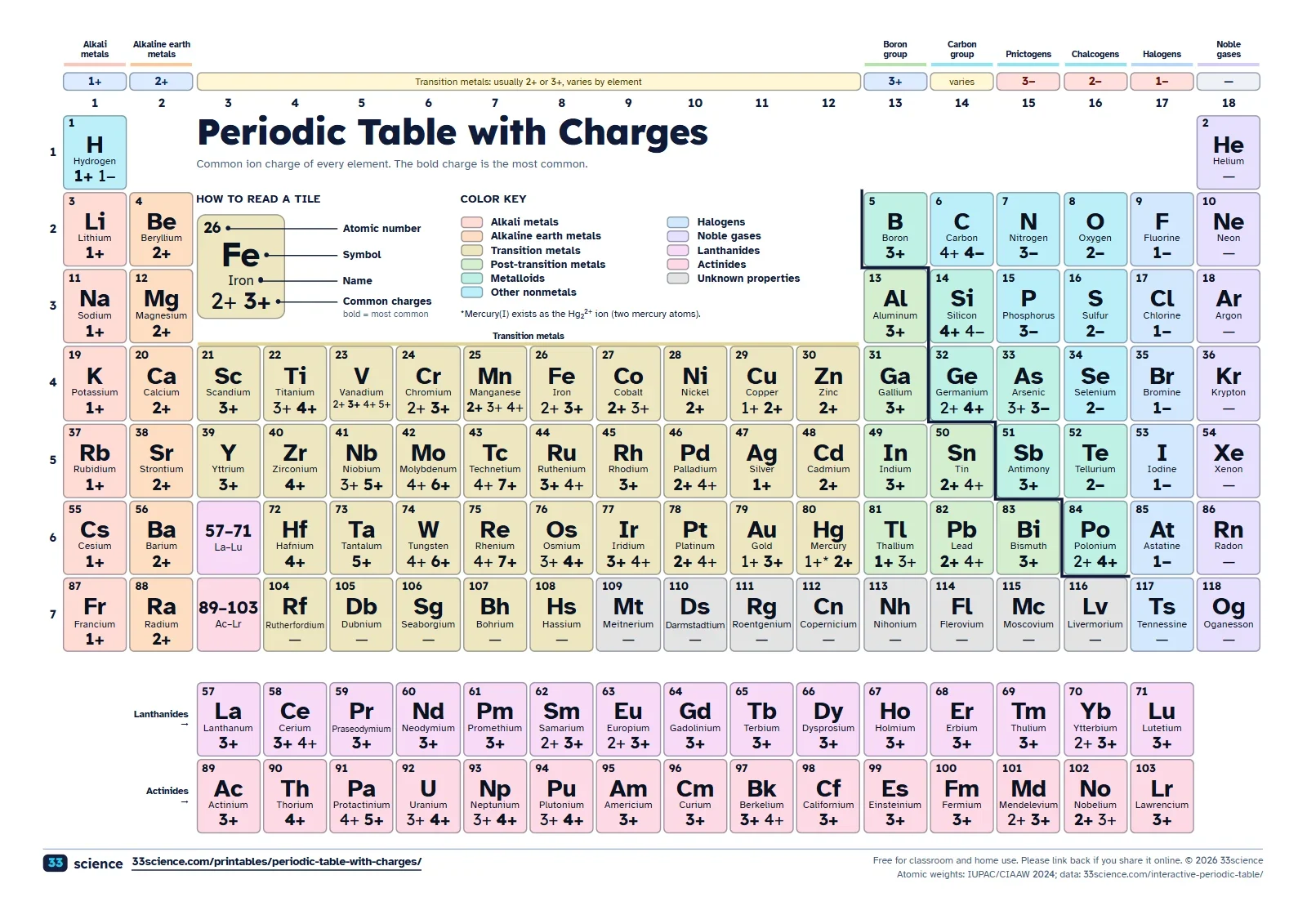
The common ion charge on every tile. Elements with more than one charge show them all, with the most common in bold.
Black and white periodic table with charges
US Letter · 1 page · 363 KB · PDF
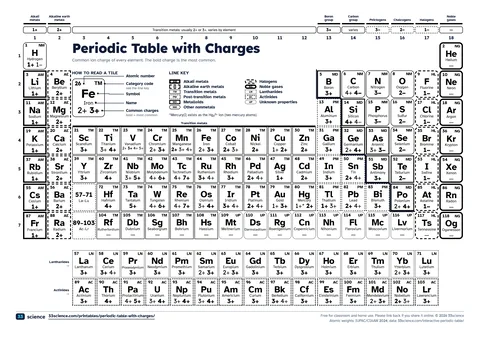
The same charges chart in black and white, for low ink use and photocopying.
Charges quiz, blank
US Letter · 1 page · 220 KB · PDF
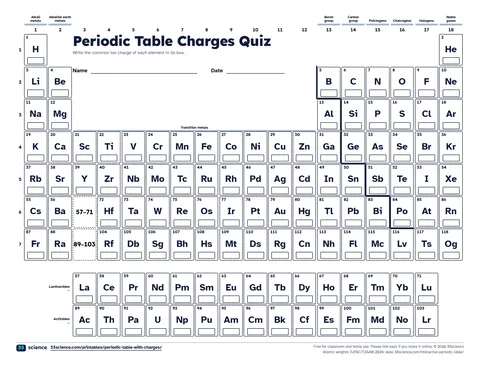
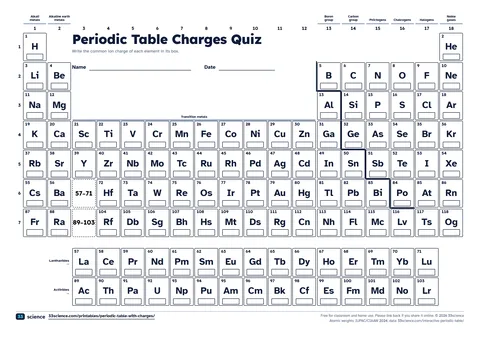
A blank quiz: write the common charge of each element in its box. The answer key is the completed chart.
Free for classroom and home use. Please link back if you share it online.
How to predict an ion’s charge from its group
A main-group element forms the ion that gives it the same number of electrons as the nearest noble gas. Metals on the left of the table lose electrons and become positive ions. Nonmetals on the right gain electrons and become negative ions. The size of the charge is the number of electrons lost or gained.
- Group 1: 1+ (Li+, Na+, K+)
- Group 2: 2+ (Mg2+, Ca2+)
- Group 13: 3+ (Al3+)
- Group 15: 3− (N3−, P3−)
- Group 16: 2− (O2−, S2−)
- Group 17: 1− (F−, Cl−)
- Group 18: no charge. Noble gases already have full outer shells.
The pattern needs no memorizing. For groups 1 and 2 the charge equals the group number. For group 13 it is the group number minus 10. For groups 15 to 17 it is the group number minus 18, which gives a negative number.
Sodium has 11 electrons. It loses one and is left with 10, the same as neon, so sodium forms Na+. Chlorine has 17 electrons. It gains one and has 18, the same as argon, so it forms Cl−. Oxygen has 8, gains 2 to reach 10 and forms O2−. Boron, carbon and silicon break the pattern: they share electrons in bonds and almost never form simple ions. Charts still print a charge for them, 3+ for boron and 4+ or 4− for carbon and silicon, and the sheets here do the same.
Charges of elements: common ion charges table
The table lists the common charge for each main group, then the transition metals and the heavy metals that need a Roman numeral.
Main-group elements by group
| Group | Typical charge | Common ions | Anion names |
|---|---|---|---|
| 1 Alkali metals | 1+ | H+, H−, Li+, Na+, K+, Rb+, Cs+, Fr+ | hydride |
| 2 Alkaline earth metals | 2+ | Be2+, Mg2+, Ca2+, Sr2+, Ba2+, Ra2+ | – |
| 13 Boron group | 3+ | B3+, Al3+, Ga3+, In3+, Tl+, Tl3+ | – |
| 14 Carbon group | 4+ or 2+ | C4+, C4−, Si4+, Si4−, Ge2+, Ge4+, Sn2+, Sn4+, Pb2+, Pb4+ | carbide, silicide |
| 15 Pnictogens | 3− | N3−, P3−, As3+, As3−, Sb3+, Bi3+ | nitride, phosphide, arsenide |
| 16 Chalcogens | 2− | O2−, S2−, Se2−, Te2−, Po2+, Po4+ | oxide, sulfide, selenide, telluride |
| 17 Halogens | 1− | F−, Cl−, Br−, I−, At− | fluoride, chloride, bromide, iodide, astatide |
| 18 Noble gases | None | He, Ne, Ar, Kr, Xe, Rn, Og (no common ions) | – |
Metals with more than one common charge
The bold charge is the one most charts treat as the main one. The Roman numeral in a compound name tells you which charge is meant.
| Metal | Symbol | Common charges | In names |
|---|---|---|---|
| Titanium | Ti | 3+, 4+ | titanium(III), titanium(IV) |
| Vanadium | V | 2+, 3+, 4+, 5+ | vanadium(II), vanadium(III), vanadium(IV), vanadium(V) |
| Chromium | Cr | 2+, 3+ | chromium(II), chromium(III) |
| Manganese | Mn | 2+, 3+, 4+ | manganese(II), manganese(III), manganese(IV) |
| Iron | Fe | 2+, 3+ | iron(II), iron(III) |
| Cobalt | Co | 2+, 3+ | cobalt(II), cobalt(III) |
| Copper | Cu | 1+, 2+ | copper(I), copper(II) |
| Niobium | Nb | 3+, 5+ | niobium(III), niobium(V) |
| Molybdenum | Mo | 4+, 6+ | molybdenum(IV), molybdenum(VI) |
| Technetium | Tc | 4+, 7+ | technetium(IV), technetium(VII) |
| Ruthenium | Ru | 3+, 4+ | ruthenium(III), ruthenium(IV) |
| Palladium | Pd | 2+, 4+ | palladium(II), palladium(IV) |
| Tin | Sn | 2+, 4+ | tin(II), tin(IV) |
| Tungsten | W | 4+, 6+ | tungsten(IV), tungsten(VI) |
| Rhenium | Re | 4+, 7+ | rhenium(IV), rhenium(VII) |
| Osmium | Os | 3+, 4+ | osmium(III), osmium(IV) |
| Iridium | Ir | 3+, 4+ | iridium(III), iridium(IV) |
| Platinum | Pt | 2+, 4+ | platinum(II), platinum(IV) |
| Gold | Au | 1+, 3+ | gold(I), gold(III) |
| Mercury | Hg | 1+ (as Hg22+), 2+ | mercury(I), mercury(II) |
| Thallium | Tl | 1+, 3+ | thallium(I), thallium(III) |
| Lead | Pb | 2+, 4+ | lead(II), lead(IV) |
Mercury(I) exists as the Hg22+ ion (two mercury atoms).
Metals with one common charge
These metals need no Roman numeral in their names: silver nitrate, zinc chloride, aluminum oxide.
| Charge | Metals |
|---|---|
| 1+ | Silver (Ag) |
| 2+ | Nickel (Ni), Zinc (Zn), Cadmium (Cd) |
| 3+ | Aluminum (Al), Scandium (Sc), Gallium (Ga), Yttrium (Y), Rhodium (Rh), Indium (In), Bismuth (Bi) |
| 4+ | Zirconium (Zr), Hafnium (Hf) |
| 5+ | Tantalum (Ta) |
Lanthanides and actinides
| Series | Most common charge | Different main charge | Other charges |
|---|---|---|---|
| Lanthanides (57 to 71) | 3+ | – | Ce4+, Sm2+, Eu2+, Yb2+ |
| Actinides (89 to 103) | 3+ | Th4+, Pa5+, U4+, Np4+, Pu4+, No2+ | Pa4+, U3+, Np3+, Pu3+, Bk4+, Md2+, No3+ |
Elements 104 to 118 are made a few atoms at a time and have no established common charge, so their tiles show a dash.
Why transition metals have more than one charge
Transition metals have no noble gas to match. Their outer s electrons and inner d electrons are close in energy, so an atom can give up different numbers of electrons depending on what it bonds to. Iron loses its two 4s electrons to form Fe2+. It loses one 3d electron as well to form Fe3+, which leaves a half-full 3d subshell. Copper forms Cu+ and Cu2+.
A Roman numeral in the name gives the charge. Iron(II) chloride is FeCl2 and iron(III) chloride is FeCl3. Older names use endings instead: ferrous for Fe2+, ferric for Fe3+, cuprous for Cu+ and cupric for Cu2+.
You can work backward from a formula. In ionic compounds oxide is O2−. In CuO one Cu balances one O2−, so copper is 2+ and the name is copper(II) oxide. In Cu2O two Cu share a 2+ total, so each is 1+ and the name is copper(I) oxide. Practice this with naming ionic compounds practice or the ionic compound formula writer.
Exceptions students meet
- Ag+, Zn2+, Cd2+ and Al3+ have one charge. Silver, zinc and cadmium are transition metals, but they take a single charge, so the name needs no Roman numeral: silver nitrate, zinc chloride.
- Tin and lead need numerals too. Tin forms Sn2+ and Sn4+. Lead forms Pb2+ and Pb4+. They are post-transition metals, not transition metals.
- Mercury(I) is a pair. Mercury forms Hg2+, and it also forms Hg22+, two bonded atoms that share a 2+ charge. Mercury(I) chloride is Hg2Cl2, not HgCl.
- Hydrogen goes both ways. H+ forms when acids such as HCl dissolve in water. H−, the hydride ion, forms with reactive metals, as in NaH.
- Gold forms Au+ and Au3+.
Ion charges vs oxidation states
A charge chart lists the ions that atoms form and keep, which are the ones you meet in a first chemistry course. An oxidation state is a bookkeeping number assigned to an atom in any compound, including molecules that contain no ions. Carbon is +4 in carbon dioxide, but CO2 is a molecule and there is no C4+ ion. Manganese is +7 in permanganate, MnO4−, but no Mn7+ ion exists. When a table gives a wider range of numbers for one element, it is listing oxidation states. A few heavy metals, such as molybdenum, tungsten and rhenium, form almost no simple ions, so their tiles here show their usual oxidation state instead.
How to use the blank charges quiz
- Print the blank charges quiz. Each tile shows the element and leaves room for its charge.
- Fill in the main-group elements first, using the group rules above. This takes no memory.
- Fill in the transition metals and heavy metals from your notes, writing every charge the element commonly takes.
- Mark the sheet against the answer key.
- Print a fresh copy and repeat a week later. Laminating the blank lets a class reuse it with dry-erase markers.
After charges, the next step is ions made of several atoms, such as sulfate and nitrate. Read about polyatomic ions and test yourself with the polyatomic ions quiz. The molar mass calculator turns any ionic formula into a mass.
For the full 118-element tables, including blank and kids versions, see the printable periodic table. For each element’s atom, melting point and electronegativity, use the interactive periodic table.
Frequently asked questions
What charge does iron have?
Iron forms two common ions, Fe2+ and Fe3+. The Roman numeral in the name gives the charge: iron(II) chloride contains Fe2+ and iron(III) chloride contains Fe3+. Iron is a transition metal, so it has no single fixed charge, and the charge you need depends on the compound.
Do noble gases have a charge?
No. Noble gases in group 18 have full outer electron shells, so in ordinary chemistry they do not gain or lose electrons and form no ions. That is why the charge is blank or marked with a dash for helium, neon, argon, krypton, xenon and radon.
How do you find the charges of elements on the periodic table?
Use the group number. Group 1 gives 1+, group 2 gives 2+, group 13 gives 3+, group 15 gives 3-, group 16 gives 2- and group 17 gives 1-. Group 18 has no charge. Transition metals do not follow this rule, because most of them form more than one ion.
What is the charge of hydrogen?
Hydrogen is usually 1+. H+ forms when an acid such as HCl dissolves in water. With reactive metals hydrogen can gain an electron and form the hydride ion, H-, as in sodium hydride, NaH. Both ions appear in introductory chemistry.
What charges do zinc, silver and aluminum have?
Each has one common charge. Zinc forms Zn2+, silver forms Ag+ and aluminum forms Al3+. Because each has only one common charge, their compound names use no Roman numeral: zinc chloride, silver nitrate and aluminum oxide.
Is a charge the same as an oxidation state?
No. A charge is the real electric charge on an ion. An oxidation state is a bookkeeping number assigned to an atom in any compound, including molecules. Carbon is +4 in CO2, but CO2 contains no C4+ ion. A charge chart shows common ions, while oxidation states cover a wider range.
Is there a blank periodic table of charges with an answer key?
Yes. This page has a blank charges quiz and an answer key, each in Letter and A4. Print the blank, fill in the charge for each element, then check it against the key. Start with the main-group elements, which follow the group rules, and finish with the transition metals.