TLDR
A base is a substance that neutralizes acids. In water, it raises the pH above 7 by adding hydroxide ions (OH⁻) or by soaking up hydrogen ions (H⁺). Baking soda, soap, bleach, and drain cleaner are all bases. They differ wildly in strength, and the strong ones burn skin.
Table of contents
- What is a base?
- Common bases at a glance
- The three definitions of a base
- Properties of bases
- Strong bases vs weak bases
- Where bases show up at home
- Safety: why lye burns
- A neutralization you can run in your kitchen
- Other meanings of “bases”
- Practice questions
- FAQ
What is a base?
A base is a chemical that reacts with an acid to cancel out its acidity. Dissolve one in water and the solution has a pH above 7.
That’s the whole idea. The details come from how a base does the canceling, which is where the three formal definitions come in below.
Common bases at a glance
Most of the bases you’ll meet in a first chemistry course fit in this table.
| Name | Formula | Strong or weak | Where you meet it |
|---|---|---|---|
| Sodium hydroxide (lye) | NaOH | Strong | Drain cleaner, soap making |
| Potassium hydroxide | KOH | Strong | Liquid soaps, alkaline batteries |
| Calcium hydroxide | Ca(OH)₂ | Strong (but poorly soluble) | Garden lime, mortar, plaster |
| Magnesium hydroxide | Mg(OH)₂ | Weak (barely dissolves) | Milk of magnesia, antacids |
| Ammonia | NH₃ | Weak | Window cleaner, fertilizer |
| Sodium bicarbonate | NaHCO₃ | Weak | Baking soda |
| Sodium hypochlorite | NaOCl | Weak base, strong oxidizer | Household bleach |

The three definitions of a base
Chemists have three models. Each one is wider than the last, and each catches bases the earlier ones miss.
Arrhenius: a base makes hydroxide in water. Drop NaOH in water and it splits into Na⁺ and OH⁻. More OH⁻ in the water means a base. Simple, but it only works for substances that contain hydroxide to begin with.
Brønsted-Lowry: a base accepts a hydrogen ion. Ammonia has no OH⁻ in its formula, yet it’s clearly a base. It grabs an H⁺ from water: NH₃ + H₂O ⇌ NH₄⁺ + OH⁻. The hydroxide shows up as a result of the grab. Think of a base as a thing with a free hand, and an acid as a thing that’s willing to hand over a proton.
Lewis: a base donates an electron pair. This is the widest net. Ammonia fits again, because it has a spare pair of electrons on the nitrogen that it can share. Lewis bases also cover reactions with no water or hydrogen ions in sight, which is why organic chemists like this definition.
If you’re studying for a test, learn Brønsted-Lowry first. It handles most of what you’ll be asked.
Properties of bases
Bases in water share a recognizable set of behaviors:
- pH above 7. Pure water at 25°C sits at 7. Bases push it up, with strong ones reaching 13 or 14. The USGS water science school has a clear pH scale and explains why each step is a tenfold change in hydrogen ion concentration.
- Slippery feel. Strong-ish bases turn the oils in your skin into soap. That’s the slick film you feel on wet hands after touching soap or diluted bleach. (Don’t test this on purpose with the strong ones.)
- Bitter taste. Baking soda and milk of magnesia taste bitter and chalky. Tasting unknown chemicals is a bad way to identify them, but it’s why old textbooks list this one.
- Turns litmus paper blue. Red litmus goes blue in a base. Phenolphthalein turns pink.
- Neutralizes acids. Base plus acid gives a salt and water. HCl + NaOH → NaCl + H₂O. That salt is ordinary table salt.
- Conducts electricity in solution. Dissolved bases release ions, and ions carry current.
Strong bases vs weak bases
You don’t need to memorize a list to tell these apart. You need one question: does the base fall apart completely in water, or only partly?
A strong base dissociates fully. Every NaOH unit that dissolves releases its OH⁻. A weak base reacts only partially, so most of it stays as the original molecule at any moment. Ammonia is the standard example: in a typical household ammonia solution, only a small fraction of the NH₃ molecules have picked up an H⁺.
Strength is not the same as concentration. A drop of NaOH in a swimming pool is dilute but still a strong base. A thick solution of ammonia is concentrated but still a weak one. Concentrated weak bases can still hurt you; they just do it differently from strong ones.
A shortcut that covers most cases: the strong bases are the hydroxides of group 1 metals (LiOH, NaOH, KOH) and the heavier group 2 metals (Ca(OH)₂, Sr(OH)₂, Ba(OH)₂). Nearly everything else you’ll see, including ammonia, amines, and bicarbonate, is weak.
Where bases show up at home
Bases are in more places than acids, and most of them are cleaning products.
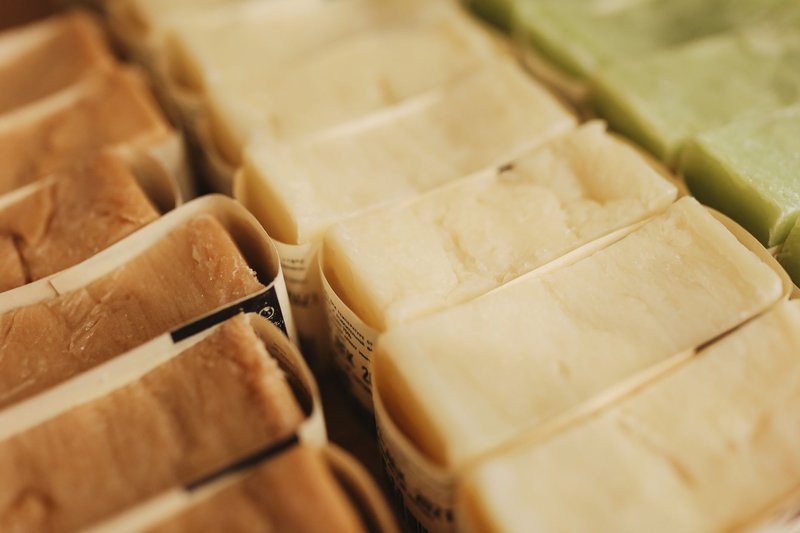
- Soap and detergent. Traditional soap is made by reacting fat with lye, which is why bars land around pH 9 to 10. Fat and oil are the dirt; the base helps break them up.
- Baking soda. Mildly basic, around pH 8. It reacts with acids in batter (buttermilk, lemon juice) and releases CO₂, which makes pancakes rise.
- Antacids. Stomach acid has a pH around 1.5 to 3.5. Magnesium hydroxide and calcium carbonate tablets neutralize some of it.
- Bleach. Household bleach is a basic solution, typically pH 11 to 13, which keeps the active ingredient stable.
- Window and oven cleaners. Ammonia-based sprays cut through grease. Oven cleaners often use NaOH or KOH.
- Your blood. Healthy human blood holds a pH of about 7.4, slightly basic, and your body works constantly to hold it there.
Safety: why lye burns
Strong bases are rougher on skin than most strong acids of the same concentration. Acids tend to coagulate proteins at the surface, which forms a barrier that limits how deep the damage goes. Strong bases do the opposite. They break down fats and proteins, so the tissue liquefies and the chemical keeps working inward. The CDC’s NIOSH pocket guide for sodium hydroxide lists skin and eye burns as the main exposure hazards and calls for immediate flushing.
Practical rules:
- Wear gloves and eye protection when you handle drain cleaner or any lye-based product.
- If it gets on skin, rinse with running water for at least 15 minutes. Don’t hunt for a neutralizer first; the heat from the reaction can make the injury worse.
- Never mix bleach with ammonia. The combination releases toxic chloramine gas.
- Never mix bleach with acids such as vinegar or toilet bowl cleaner. That releases chlorine gas.
- When diluting a strong base, add the base to water, not water to the base. The dissolving releases heat.
A neutralization you can run in your kitchen
Vinegar is a weak acid (acetic acid). Baking soda is a weak base. Mix them and you get sodium acetate, water, and carbon dioxide:
CH₃COOH + NaHCO₃ → CH₃COONa + H₂O + CO₂
The fizz is the CO₂ escaping. That’s why the classic volcano experiment erupts: it’s a neutralization with a gas as a byproduct. Once the fizzing stops, the leftover liquid is close to neutral, though not perfectly, since it depends on how much of each you added.
A good follow-up: put a drop of red cabbage juice in each cup. It turns pink in acids and blue-green in bases, so you can watch the pH shift as you add baking soda.
Other meanings of “bases”
The word does a lot of work outside chemistry, so here’s the short version in case you landed here by accident:
- Number bases. In math, base 10 is the decimal system we count in. Computers use base 2 (binary), and programmers often write in base 16 (hexadecimal).
- DNA bases. Adenine, thymine, guanine, and cytosine are called bases because they’re chemical bases in the Brønsted-Lowry sense. Their order spells out genetic information.
- Military and baseball bases. Different field entirely.
Practice questions
Try these before you read the answers.
- Is NH₃ an Arrhenius base? A Brønsted-Lowry base?
- A solution has a pH of 11. Is it acidic, neutral, or basic?
- Is a very dilute solution of NaOH a strong base or a weak base?
- What products form when HCl reacts with KOH?
- Why shouldn’t you pour water onto solid lye?
Answers:
- Not an Arrhenius base (no OH⁻ in the formula), but yes a Brønsted-Lowry base, since it accepts H⁺.
- Basic.
- Strong. Strength describes how fully it dissociates, not how concentrated it is.
- KCl and H₂O.
- Dissolving lye releases a lot of heat, which can make the water splatter. Add the lye to water slowly instead.
FAQ
What is the difference between an acid and a base? Acids donate hydrogen ions and have a pH below 7. Bases accept hydrogen ions (or release hydroxide) and have a pH above 7. Mix the two and they neutralize each other into a salt and water.
What is an alkali? An alkali is a base that dissolves in water. All alkalis are bases, but not every base is an alkali. Magnesium hydroxide, for example, barely dissolves, so it’s a base without being much of an alkali.
Is baking soda a strong or weak base? Weak. Its pH in solution is around 8.
Can a base have a pH of exactly 14? Concentrated strong base solutions can reach 14 or slightly above. The scale isn’t capped at 14; it just covers the range you’ll see in most everyday work.
Are bases always dangerous? No. You eat baking soda in cake and swallow magnesium hydroxide for heartburn. The strong ones are the ones that need real caution.