Wales is a small country with an outsized mineral resume. Gold rare enough to outprice platinum. A copper mountain that once supplied a fifth of the world’s needs. A mineral so uncommon it was named after the country itself. None of that is folklore — it’s geology, and it’s still sitting in the ground (and in a few museum drawers) today.
Most write-ups on this topic read like a database export: alphabetical, exhaustive, and impossible to use if you’re actually trying to understand where things are and why. This one is organized the way a geologist would explain it to you over a pint — by region, by what’s actually notable, and with a straight answer to the question everyone skips: can you legally go pick any of this up yourself?
Table of Contents
- Why Wales Punches Above Its Weight
- Snowdonia: The Gold Belt
- Anglesey and Parys Mountain: The Copper Kingdom
- The Central Wales Orefield: Lead and Silver Country
- The South Wales Coalfield: Iron, Pyrite, and the Minerals Coal Built On
- A Quick Visual ID Guide
- Is It Legal to Collect Minerals in Wales?
- Welsh Gold: Why Collectors and Jewelers Pay a Premium
- The Short Version
Why Wales Punches Above Its Weight
Wales sits on some of the oldest, most folded and faulted rock in Britain — Cambrian, Ordovician, and Silurian sequences that have been squeezed, heated, and shot through with mineral-rich fluids for hundreds of millions of years. That kind of geological violence is exactly what produces ore veins. It’s also why a country roughly the size of Massachusetts has produced gold, copper, lead, zinc, silver, manganese, and a genuine scientific rarity or two — cymrite and brookite among them, both first identified from Welsh rock.
The mining stopped decades ago in most places. The minerals didn’t go anywhere.
Snowdonia: The Gold Belt
Run a line roughly from Barmouth to Dolgellau and you’re tracing what’s genuinely called the “Dolgellau gold belt” — a narrow band of quartz veins cutting through Cambrian slate and grit that has produced most of Britain’s native gold. The Clogau mine, active from the 1860s until 1911, pulled out an estimated 78,500 troy ounces before it closed. Gwynfynydd, a few miles north, kept producing intermittently into the 20th century and has periodically reopened for small-scale operations since.
Further south, at Dolaucothi in Carmarthenshire, the Romans got there first. They built leats and reservoirs to hydraulically mine the hillside for gold roughly two thousand years ago — engineering sophisticated enough that the National Trust, which now manages the site, runs underground tours through the same tunnels.
Snowdonia isn’t just gold, either. Copper turns up at old workings like Sygun near Beddgelert, and manganese ore was worked commercially near the coast into the 20th century to feed the steel industry. But gold is what put this region on the map, and it’s the reason “Welsh gold” is a phrase jewelers still use as a selling point.
Anglesey and Parys Mountain: The Copper Kingdom
If Snowdonia is about rarity, Parys Mountain is about sheer volume. People have been extracting metal from this hill near Amlwch since the Bronze Age, and there’s decent evidence the Romans worked it too. But the real story starts in 1768, when a mass of near-surface copper ore was discovered that turned Amlwch, almost overnight, into the source of roughly a third of the world’s copper supply for a stretch of the 1780s.
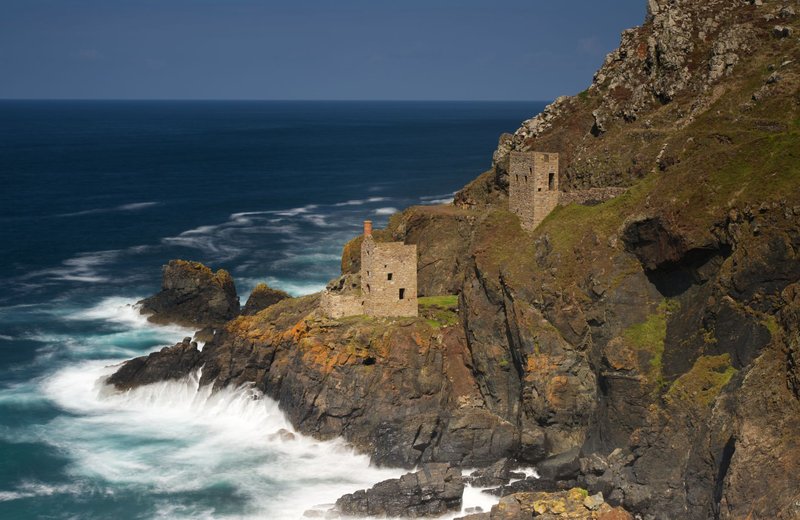
The numbers are hard to overstate: between 1768 and 1904, Parys Mountain gave up 3.5 million tons of ore and about 130,000 tons of copper, hollowed out through 20 kilometers of underground workings. Royal Navy ships got their hulls coppered with Anglesey metal during the fleet-wide copper-sheathing program of 1778–1782 — a direct line from a Welsh hillside to Britain’s naval advantage during the American Revolutionary War.
The site today is a moonscape of ochre and violet spoil, protected as a Site of Special Scientific Interest for both its geology and the rare metal-tolerant lichens that have colonized the toxic ground. It’s also, along with the copper, a source of zinc, lead, silver, and trace gold — a genuinely polymetallic deposit, which is part of why it stayed profitable for over a century.
The Central Wales Orefield: Lead and Silver Country
Stretch from Aberystwyth east toward Llanidloes and you’re in what geologists call the Central Wales Orefield — a scatter of lead-zinc-silver veins that made this stretch of mid-Wales one of Britain’s major lead-mining districts through the 18th and 19th centuries. Cwmystwyth, Van, and Dylife are the names that come up most; Cwmystwyth in particular has been worked on and off since the Bronze Age, making it one of the longest continuously exploited mineral sites in the country.
The ore here is mostly galena (lead sulfide) with a meaningful silver content, which is why some of these mines were profitable enough to fund grand Victorian mine buildings that still stand, half-collapsed, on the hillsides. Most of the district was worked out or made uneconomical by cheaper imported ore before the First World War, and almost nothing has operated since. What’s left is a landscape of spoil heaps, adits, and — for the geologically curious — some of the best surface access to lead-zinc mineralization anywhere in the UK.
The South Wales Coalfield: Iron, Pyrite, and the Minerals Coal Built On
The South Wales Coalfield isn’t a mineral story in the gold-and-silver sense — it’s a coal story. But coal measures carry their own mineral suite, and it’s the one that actually built the Industrial Revolution’s Welsh chapter. Blackband ironstone, a siderite-rich seam running through the coal measures, was the raw material that let Merthyr Tydfil become the iron-making capital of the world in the early 1800s, before richer ores elsewhere made it obsolete.
Pyrite — “fool’s gold” — is common enough in the coal seams themselves, and its slow oxidation is the reason old colliery spoil tips often run acidic and stain streams orange. Quartz veins and occasional barite turn up in the sandstones too. None of it has the glamour of Welsh gold, but if you want to understand why South Wales industrialized the way it did, the mineral story is the coalfield’s mineral story, full stop.
A Quick Visual ID Guide
If you’re standing in front of a rock in Wales trying to work out what you’re looking at, this is the shortcut version:
| Mineral | Where it turns up | What to look for | Rarity today |
|---|---|---|---|
| Native gold | Dolgellau gold belt (Snowdonia), Dolaucothi | Bright yellow, malleable, in quartz veins | Very rare — most is museum- or jewelry-held |
| Copper ore (chalcopyrite) | Parys Mountain, Anglesey | Brassy yellow with a purple-blue tarnish | Common on spoil heaps, low economic grade now |
| Galena (lead ore) | Central Wales Orefield (Cwmystwyth, Van, Dylife) | Dull silver-grey cubes, heavy for its size | Common on old spoil tips |
| Cymrite | Benallt Mine, Llŷn Peninsula | Pale, glassy barium feldspar | Extremely rare — a genuine scientific curiosity |
| Brookite | Twll Maen Grisial, Prenteg | Dark, elongated titanium-oxide crystals | Rare; type locality specimens are collector-grade |
| Pyrite | South Wales Coalfield | Brassy gold cubes with a metallic shine | Very common |
Is It Legal to Collect Minerals in Wales?
Short answer: not by default. Unlike Scotland, where a more permissive “responsible access” culture applies to a lot of open ground, Wales does not have a blanket right to remove material from land you don’t own. If a site isn’t specifically designated for public rock collecting, you need the landowner’s permission — full stop, regardless of how small the sample is.
That matters most at the famous sites. Parys Mountain’s SSSI status means collecting without consent is a legal offense, not just bad etiquette, because it protects both the geology and the lichen ecosystem growing on it. National Trust land, including Dolaucothi, generally prohibits hammering or removal outside of organized, supervised activities. Natural Resources Wales, the government body responsible for protected sites and access land, is the right first call if you’re planning to collect anywhere near a designated area.
The realistic path for beginners is old mine spoil tips on accessible, non-designated land, ideally with the landowner’s blessing — abandoned lead workings in the Central Wales Orefield are the most forgiving starting point, since a century of weathering has already broken plenty of galena and quartz loose without you needing to touch bedrock. Local rock and mineral societies are worth joining before you go it alone; they tend to have existing landowner relationships and know which sites are actually open.
Welsh Gold: Why Collectors and Jewelers Pay a Premium
No mining operation currently produces Welsh gold at commercial scale, which means the supply is, functionally, whatever was pulled out of the ground before the mines closed — a total historical output estimated at under 100,000 troy ounces across every Welsh site combined. Compare that to the roughly 3,000 tons the world mines annually and you can see why “rare” undersells it.
That scarcity shows up directly in price. Jewelers routinely charge a premium of 5–10% over standard 18-karat gold even for pieces that blend in only a small percentage of genuine Welsh metal, and pure or high-provenance Welsh gold has traded for many multiples of the spot price — auction results and dealer listings put it anywhere from several times to, in some cases, close to thirty times standard gold value. A set of Clogau gold pieces mined between 1979 and 1981 went to auction in November 2017 estimated at £9,000 and sold for £44,000, which tells you the premium isn’t marketing copy — buyers actually pay it.
Part of that is provenance and story: the same Dolgellau gold belt has supplied wedding rings for the British royal family since the 1920s, and jewelers lean hard on that lineage. But part of it is genuinely finite supply in a way most gold simply isn’t. When a seam closes for good, whatever’s already out of the ground is all there will ever be.
The Short Version
Wales isn’t one mineral story, it’s four regional ones stitched together by geology: gold in Snowdonia’s quartz veins, industrial-scale copper at Parys Mountain, lead and silver threading through the Central Wales Orefield, and the iron and pyrite that powered the South Wales coalfield’s rise. Add in genuine scientific rarities like cymrite and brookite, both first described from Welsh rock, and you’ve got a mineral inventory that a country this size has no business having.
If you want to see it rather than just read about it, start with a supervised site — Dolaucothi for gold-mining history, Parys Mountain’s public trail for the copper landscape — before venturing onto spoil tips with a landowner’s permission in hand. And if you’re eyeing a piece of Welsh gold jewelry, now you know exactly what you’re paying for: not just metal, but a supply that got smaller the day the last mine shut.