Table of Contents
- TLDR
- What Makes a Planet “Terrestrial”
- Terrestrial Planets vs. Gas and Ice Giants
- The Four Terrestrial Planets
- How Terrestrial Planets Form
- Terrestrial Exoplanets
- Common Questions
TLDR
Terrestrial planets are the four rocky worlds closest to the Sun — Mercury, Venus, Earth, and Mars. They’re small, dense, and built from metal and silicate rock rather than gas, with solid surfaces you could (in theory, and with a very good heat shield) stand on. That puts them in a different category entirely from Jupiter, Saturn, Uranus, and Neptune, which are mostly hydrogen, helium, and ices with no surface to land on at all. Density is the giveaway: terrestrial planets average around 4,000–5,500 kg/m³, while the giants barely clear 700–1,600 kg/m³. Earth is the only one in the group not currently a dust bowl or a pressure-cooker.
What Makes a Planet “Terrestrial”
“Terrestrial” comes from terra — Earth, and by extension, ground. A terrestrial planet has a solid, differentiated interior: a metallic core (mostly iron and nickel), a rocky mantle, and a thin crust on top. No thick hydrogen-helium envelope, no ill-defined “surface” that’s just where the gas gets dense enough to call it one.
Mercury, Venus, Earth, and Mars are the terrestrial planets in our solar system, in order from the Sun. They occupy the inner solar system — everything inside the asteroid belt — while the four giants sit beyond it. That’s not a coincidence. Where a planet ends up forming determines what it’s made of, and proximity to the Sun is the reason the inner four are rock and the outer four are gas and ice.
Structurally, terrestrial planets share a layered design: a dense core, a semi-molten mantle that drives geological activity (where present), and a crust. Earth and Mars still show active or recently-active surface processes — plate tectonics on Earth, volcanism and possible marsquakes on Mars. Mercury and Venus are geologically quieter today, though Venus is covered in relatively young volcanic plains that suggest it wasn’t always that way.
Terrestrial Planets vs. Gas and Ice Giants
The split between the two planet types isn’t subtle. Put them side by side and the numbers do the arguing.
| Feature | Terrestrial Planets | Gas / Ice Giants |
|---|---|---|
| Examples | Mercury, Venus, Earth, Mars | Jupiter, Saturn, Uranus, Neptune |
| Composition | Rock, metal (iron, silicates) | Hydrogen, helium, ices (water, ammonia, methane) |
| Average density | ~4,000–5,500 kg/m³ | ~700–1,600 kg/m³ |
| Surface | Solid, walkable | None defined — gas transitions to liquid/metallic interior |
| Size | Small (Earth-sized or smaller) | Large to massive (Jupiter is ~11x Earth’s diameter) |
| Moons | Few or none (0–2 each) | Dozens each |
| Rings | None | All four have ring systems |
| Rotation | Slower (Venus takes 243 Earth days) | Fast (Jupiter’s day is under 10 hours) |
That density gap is the single most useful number in the whole comparison. Saturn is so light on average that it would float in a bathtub big enough to hold it — its density is under 700 kg/m³, less than water. Earth, at roughly 5,514 kg/m³, is the densest planet in the solar system, terrestrial or otherwise, because gravity has spent 4.5 billion years compacting its iron core.
Rings are the other clean dividing line, and it comes back to composition. Ring systems form from countless small particles of ice and rock held in a stable orbital plane — something giant planets have the gravitational reach and abundant icy material to sustain. Terrestrial planets are too small, too close to the Sun (where ice sublimates rather than lingers), and don’t have the debris supply to hold a ring together for long.
The Four Terrestrial Planets
Mercury
The smallest planet and the closest to the Sun, Mercury is basically a giant iron core with a thin rock shell wrapped around it — its core makes up about 85% of its radius, far more proportionally than any other terrestrial planet. Daytime temperatures hit 430°C; at night, with essentially no atmosphere to hold heat, they crash to -180°C. It has no moons and no meaningful atmosphere, just a thin exosphere of atoms knocked loose by solar wind.
Venus
Venus is Earth’s size-twin — nearly identical diameter and mass — but its surface is the hottest in the solar system at roughly 465°C, hotter than Mercury despite being farther from the Sun. A crushing carbon dioxide atmosphere 90 times denser than Earth’s traps heat through a runaway greenhouse effect. Its clouds are sulfuric acid, and it rotates backward compared to most planets, so slowly that a single Venusian day is longer than its year.
Earth
The only terrestrial planet with liquid water covering most of its surface, and the only one known to host life. Plate tectonics constantly recycle its crust, a strong magnetic field deflects solar radiation, and a nitrogen-oxygen atmosphere sits in the narrow range that keeps water liquid rather than frozen solid or boiled away — the same fate that likely befell Venus.
Mars
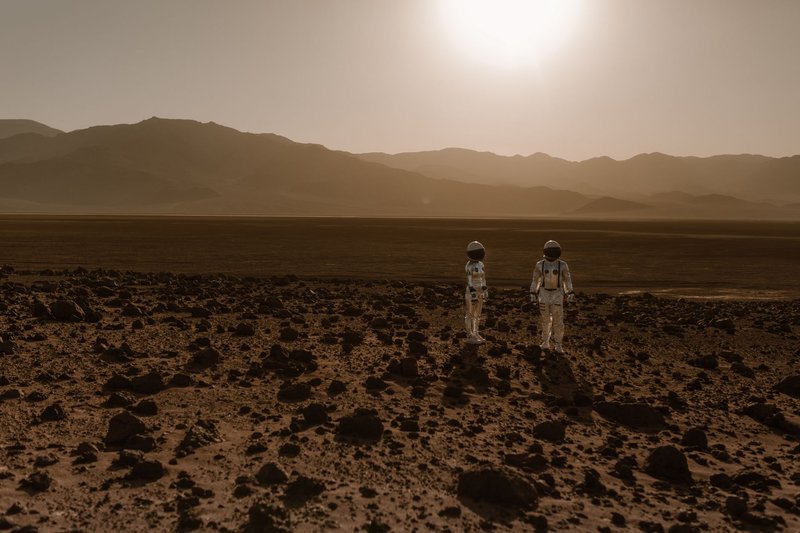
Smaller and colder than Earth, with a thin CO2 atmosphere too weak to hold much heat. Mars carries the largest volcano in the solar system, Olympus Mons, at roughly 22 km tall — nearly three times Everest — and Valles Marineris, a canyon system long enough to stretch across the continental United States. Evidence of ancient riverbeds and lakebeds suggests it once had liquid water on the surface, which is a large part of why it’s the primary target for current and future life-detection missions.
How Terrestrial Planets Form
Terrestrial planets build up through a process called core accretion, starting in the same protoplanetary disk that eventually produces the whole planetary system. Close to a young star, temperatures are too high for ice and volatile gases to condense — only metals and silicate rock can solidify there. That’s the entire reason the inner solar system ended up rocky: the “frost line” marks where it got cold enough for ice to survive, and everything inside that line was left with rock and metal as the only stable building blocks.
Dust grains collide and stick, gradually building into pebbles, then boulders, then kilometer-scale planetesimals. Planetesimals collide and merge under their own gravity, growing into planetary embryos over a few million years. The final stage is violent: embryos collide with each other in giant impacts, and one of those impacts — a Mars-sized body striking the young Earth — is the leading theory for how the Moon formed. Because these worlds accreted from dense material and stayed relatively small, they never gathered enough mass or gravitational pull to capture and hold onto a thick hydrogen-helium envelope the way the outer planets did. That single fact — insufficient mass, insufficient cold, insufficient time before the Sun’s early solar wind cleared out the leftover gas — is why terrestrial planets stayed small and rocky instead of ballooning into gas giants.
Terrestrial Exoplanets
The terrestrial category isn’t limited to our solar system. Among the thousands of known exoplanets, a meaningful fraction are classified as rocky based on their size and estimated density — small enough, and dense enough, to rule out a thick gas envelope. Proxima Centauri b, orbiting the nearest star to our Sun, and several planets in the TRAPPIST-1 system are among the most closely studied rocky exoplanets, some sitting in their star’s habitable zone where liquid water could theoretically persist on the surface.
Finding a rocky planet is one thing; confirming it has an atmosphere, let alone water or biosignatures, is a much harder problem that current instruments are only starting to tackle. The James Webb Space Telescope has already begun analyzing the atmospheres of a few rocky exoplanet candidates, and early results have been sobering — several turned out to have thin or no atmosphere at all, a reminder that “terrestrial” and “habitable” aren’t the same word. Being rocky is a prerequisite for a world like Earth. It’s not a guarantee.
Common Questions
Why don’t terrestrial planets have rings? Rings need a steady supply of small icy and rocky particles held in orbit by strong gravity. Terrestrial planets are too small to hold onto that kind of debris field, and their proximity to the Sun means any ice in the neighborhood sublimates instead of sticking around.
What’s the difference between terrestrial and jovian planets? “Jovian” just means Jupiter-like — the term for the outer gas and ice giants. Terrestrial planets are small, rocky, and dense; jovian planets are large, gaseous, and light for their size, with thick atmospheres and no solid surface.
Are dwarf planets like Pluto terrestrial? Not by the standard definition. Pluto has a rocky-icy composition and a solid surface, but it’s classified separately as a dwarf planet because it hasn’t cleared its orbital neighborhood of other debris — one of the key differences between dwarf planets and full planets defined by the International Astronomical Union.