TLDR
- Aldehyde: the carbonyl carbon (C=O) sits at the end of the chain and carries at least one hydrogen. General form R-CHO. Names end in -al.
- Ketone: the carbonyl carbon sits inside the chain, bonded to two carbon groups. General form R-CO-R’. Names end in -one.
- Reactivity: aldehydes are more reactive and oxidize easily. Ketones resist mild oxidation.
- Test: Tollens’ reagent gives a silver mirror with an aldehyde and nothing with a ketone.
- Boiling points: neither class hydrogen-bonds to itself, so both boil lower than alcohols of similar mass.
Contents
- Differences between aldehydes and ketones at a glance
- Structure: where the carbonyl sits
- Naming with IUPAC rules
- Why aldehydes react faster
- Boiling points and solubility
- Tests that tell them apart
- Spotting them in a spectrum
- Real-world examples
- Practice quiz
Differences between aldehydes and ketones at a glance
Both families contain the carbonyl group, a carbon double-bonded to an oxygen. The differences between aldehydes and ketones come down to what else is attached to that carbon. In an aldehyde, at least one of the two remaining bonds goes to hydrogen. In a ketone, both go to carbon.
That one swap changes the name, the reactivity, the tests you can run, and what the molecule does in the lab.
| Feature | Aldehyde | Ketone |
|---|---|---|
| Functional group | -CHO (terminal) | >C=O (internal) |
| General formula | R-CHO | R-CO-R’ |
| Groups on the carbonyl carbon | One H and one R (or two H in formaldehyde) | Two carbon groups |
| IUPAC suffix | -al (or -carbaldehyde on a ring) | -one |
| Position of C=O | Always carbon 1 | Carbon 2 or higher |
| Reactivity to nucleophiles | Higher | Lower |
| Oxidation | Easy, gives a carboxylic acid | Hard, needs strong conditions and breaks C-C bonds |
| Reduction product | Primary alcohol | Secondary alcohol |
| Tollens’, Fehling’s, Benedict’s | Positive (aliphatic aldehydes) | Negative (with exceptions below) |
| Schiff’s reagent | Magenta color returns | No color change |
| Typical examples | Formaldehyde, ethanal, benzaldehyde | Acetone, butanone, camphor |
A note on formulas, since several study sites get this wrong: a saturated acyclic aldehyde and a saturated acyclic ketone with the same number of carbons share the formula CnH2nO. Propanal and propanone are both C3H6O. They are isomers, and neither has an O-H bond. The oxygen is bonded only to the carbonyl carbon.
Structure: where the carbonyl sits

The carbonyl carbon is sp2 hybridized. It sits at the center of a flat triangle with bond angles near 120 degrees, and the C=O bond is polarized because oxygen pulls electrons harder than carbon does. That leaves a partial positive charge on carbon and a partial negative charge on oxygen.
An aldehyde puts a hydrogen on that carbon, which is why the group is written -CHO and can only appear at the end of a carbon chain. Formaldehyde (H2C=O) is the extreme case: two hydrogens and no carbon groups at all.
A ketone wraps the carbonyl in two carbon groups, so it can’t sit at the end of a chain. Those groups can be identical, as in acetone (two methyl groups), or different, as in butanone (methyl and ethyl). They can also be linked into a ring, as in cyclohexanone.
Here’s a quick check that settles most exam questions. Look at the carbonyl carbon and count the carbon neighbors. Zero or one means aldehyde. Two means ketone.
Naming with IUPAC rules
The IUPAC Blue Book sets the rules, and for these two families they’re short.
Aldehydes
- Find the longest chain that includes the carbonyl carbon.
- Drop the final -e of the alkane name and add -al.
- The carbonyl carbon is always carbon 1, so no locant is written.
Examples: methanal (HCHO), ethanal (CH3CHO), 3-methylbutanal. When the -CHO group is attached to a ring, the suffix becomes -carbaldehyde, as in cyclohexanecarbaldehyde. Benzaldehyde keeps its retained name.
Ketones
- Find the longest chain that includes the carbonyl carbon.
- Drop the final -e and add -one.
- Number from the end that gives the carbonyl carbon the lowest number, and write that number before the suffix.
Examples: propanone (the systematic name for acetone, with no number because the carbonyl can only be in one place), butanone, pentan-2-one, pentan-3-one, cyclohexanone.
The numbers matter. Pentan-2-one (CH3COCH2CH2CH3) and pentan-3-one (CH3CH2COCH2CH3) are different compounds. Propanone and butanone need no locant because there’s only one place for the carbonyl to go.
Why aldehydes react faster
The characteristic reaction of both families is nucleophilic addition. A nucleophile attacks the partly positive carbon, the C=O pi electrons shift onto oxygen, and the flat sp2 carbon becomes a tetrahedral sp3 carbon.
Aldehydes win that race for two reasons.
Sterics. Hydrogen is tiny. An aldehyde carbon has one small hydrogen and one R group, so a nucleophile has an open path in. A ketone carbon has two R groups. When the carbon goes from flat to tetrahedral, those groups get pushed closer to the incoming nucleophile, and the crowding in the product raises the energy of the transition state.
Electronics. Alkyl groups donate electron density toward the carbon they’re attached to, through the inductive effect and hyperconjugation. A ketone has two of them feeding the carbonyl carbon, which weakens its partial positive charge. An aldehyde has one. A weaker positive charge attracts nucleophiles less strongly.
You can see the effect in numbers. Hydration, where water adds across the C=O to make a gem-diol, is a clean test case. At equilibrium in water, formaldehyde is almost entirely hydrated as methanediol (an equilibrium constant around 2,000). Acetaldehyde is roughly half hydrated (a constant near 1). Acetone is barely hydrated at all (around 0.001). The same ordering shows up with cyanide, alcohols, hydride reagents and Grignard reagents.
Aromatic aldehydes add a wrinkle. In benzaldehyde, the ring donates electron density into the carbonyl by resonance, so benzaldehyde is less reactive than ethanal.
Boiling points and solubility
Here’s where many sources go wrong. Aldehydes and ketones do not hydrogen-bond to themselves. Hydrogen bonding needs an H attached to O, N or F, and neither family has one. What holds the molecules together is dipole-dipole attraction plus London dispersion forces.
That explains the pattern in the data:
| Compound | Type | Molar mass (g/mol) | Boiling point (°C) |
|---|---|---|---|
| Butane | Alkane | 58 | -1 |
| Propanal | Aldehyde | 58 | 48 |
| Propanone | Ketone | 58 | 56 |
| Propan-1-ol | Alcohol | 60 | 97 |
Carbonyl compounds boil well above alkanes of the same size because of the permanent dipole. They boil well below alcohols because alcohols hydrogen-bond to each other and carbonyls can’t.
The ketone edges out the aldehyde by about 8 degrees here. Acetone has a larger dipole moment than propanal, so the molecules attract each other a bit more. The same small gap shows up across other aldehyde and ketone pairs of equal mass.
Water is a different story. The carbonyl oxygen has lone pairs, so it accepts hydrogen bonds from water molecules. That makes the small members fully miscible with water: methanal, ethanal and propanone mix in any proportion. Solubility falls as the hydrocarbon part grows, and past about five carbons the compounds are only slightly soluble.
Tests that tell them apart
Most of the classic tests exploit the same fact. An aldehyde has an H on the carbonyl carbon, so it’s easy to oxidize to a carboxylic acid. A ketone has no such H, and oxidizing it means breaking a carbon-carbon bond, which mild reagents can’t do.
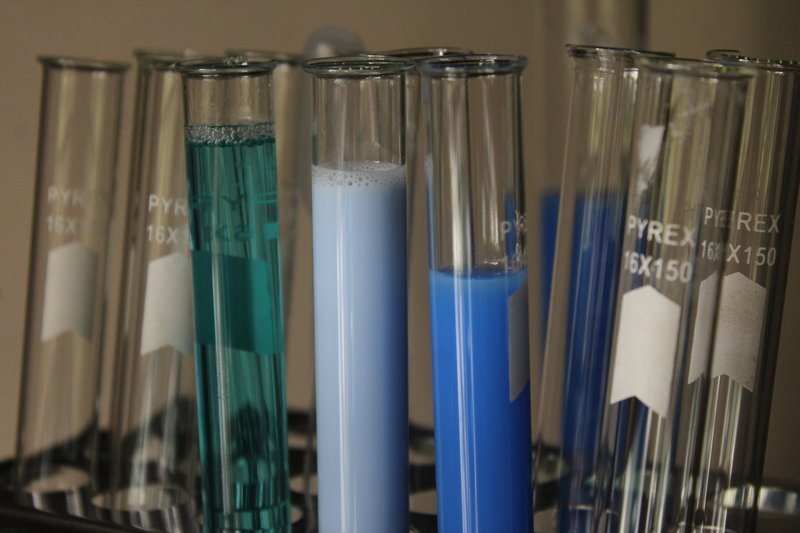
Tollens’ test (silver mirror). Tollens’ reagent is silver nitrate dissolved in ammonia, which contains the diamminesilver(I) ion, [Ag(NH3)2]+. Warm it gently with an aldehyde and silver ions are reduced to metallic silver, which coats the inside of clean glass as a mirror.
RCHO + 2[Ag(NH3)2]+ + 3OH– → RCOO– + 2Ag + 4NH3 + 2H2O
A ketone leaves the solution clear.
Fehling’s and Benedict’s tests. Both use copper(II) ions in alkaline solution, held in place by tartrate (Fehling’s) or citrate (Benedict’s). The solution starts deep blue. With an aliphatic aldehyde and heat, Cu2+ is reduced to copper(I) oxide, a brick-red precipitate.
RCHO + 2Cu2+ + 5OH– → RCOO– + Cu2O + 3H2O
Ketones leave the solution blue. One catch that exam writers love: benzaldehyde does not give a positive Fehling’s test, even though it’s an aldehyde. Aromatic aldehydes are not oxidized by Fehling’s reagent, though they do respond to Tollens’.
Schiff’s reagent. This is a magenta dye decolorized with sulfur dioxide. An aldehyde restores the pink-purple color within a minute or so. A ketone such as acetone does not.
Acidified dichromate. Warm an aldehyde with acidified potassium dichromate(VI) and the orange solution turns green as chromium(VI) is reduced to chromium(III). A ketone leaves it orange. This one also oxidizes primary and secondary alcohols, so it can’t prove a compound is an aldehyde by itself.
2,4-DNP (Brady’s reagent). This one does not separate the two families. Both give a yellow-to-orange precipitate, which confirms a carbonyl group is present. Use it first to establish that you have an aldehyde or ketone, then use Tollens’ to decide which.
Iodoform test. Methyl ketones (R-CO-CH3) give a pale yellow precipitate of triiodomethane with iodine and sodium hydroxide. Acetone passes. Ethanal also passes, which is the lone aldehyde that does.
Exceptions. Alpha-hydroxy ketones, including the sugar fructose, can give a positive Tollens’ or Benedict’s result, because under basic conditions they rearrange into aldehyde-like forms. If a question mentions fructose, expect this.
Spotting them in a spectrum
Real labs rarely rely on color changes alone. Spectra give a cleaner answer.
- Infrared: both families show a strong C=O stretch near 1700-1740 cm-1. Aldehydes usually sit a little higher (around 1725-1740) than ketones (around 1715). The giveaway for an aldehyde is a pair of weak C-H stretches near 2720 and 2820 cm-1.
- Proton NMR: the aldehyde hydrogen shows up far downfield at roughly 9-10 ppm. Ketones have no signal there.
- Carbon-13 NMR: carbonyl carbons appear around 190-220 ppm. Ketones tend to sit at the high end of that range (about 205-220), and aldehydes lower (about 190-205).
Real-world examples
Formaldehyde (methanal). The simplest aldehyde is a gas at room temperature, boiling at -19 °C. Dissolved in water as a roughly 37% solution called formalin, it preserves tissue and is a feedstock for resins used in plywood and particleboard. The National Cancer Institute notes that it is classified as a human carcinogen, which is why exposure limits exist.
Benzaldehyde. This is the smell of bitter almonds and cherry flavoring. Left open to air, it slowly oxidizes to benzoic acid, which is why old bottles develop white crystals around the cap. Aldehydes are easy to oxidize, and this is the everyday proof.
Cinnamaldehyde and vanillin. Cinnamon bark gets its flavor from cinnamaldehyde. Vanilla’s signature compound, vanillin, has an aldehyde group alongside an ether and a phenol.
Acetone (propanone). The simplest ketone and the active ingredient in many nail polish removers. It mixes with water and with most organic solvents, which is why it’s also a lab cleaning staple. PubChem lists its boiling point at 56 °C and notes that the body produces small amounts of it naturally.
Butanone and cyclohexanone. Butanone (methyl ethyl ketone) is an industrial solvent. Cyclohexanone is a precursor in the production of nylon.
Camphor. A bicyclic ketone (C10H16O) from the camphor laurel tree, used in balms and as a moth deterrent. Its carbonyl is locked inside a ring system, which is a clear case of a ketone you couldn’t mistake for an aldehyde.
Biology. Sugars, a major class of carbohydrates, are classified by this exact split. Glucose is an aldose, carrying an aldehyde group. Fructose is a ketose, carrying a ketone. Steroid hormones such as testosterone and progesterone also contain ketone groups.
Practice quiz
Try these before you scroll to the answers.
- Two isomers have the formula C4H8O: CH3CH2CH2CHO and CH3COCH2CH3. Name each, and say which gives a silver mirror with Tollens’ reagent.
- Name CH3COCH2CH2CH3.
- Why can’t a ketone have its carbonyl on carbon 1 of a chain?
- An unknown liquid of formula C3H6O gives no reaction with Tollens’ reagent but forms a yellow precipitate with iodine and sodium hydroxide. What is it?
- Propanal boils at 48 °C and propan-1-ol at 97 °C, despite nearly identical molar masses. Why?
Answers
- CH3CH2CH2CHO is butanal, an aldehyde, and it gives the silver mirror. CH3COCH2CH3 is butanone, a ketone, and it does not.
- Pentan-2-one. The carbonyl carbon is second from the end, and that numbering gives the lower locant.
- A carbonyl on carbon 1 has only one carbon neighbor, since the chain ends there. A ketone needs two, so a terminal carbonyl is by definition an aldehyde.
- Propanone (acetone). It’s a ketone, so Tollens’ is negative, and it’s a methyl ketone, so the iodoform test is positive. Propanal would reverse both results.
- Propan-1-ol has an O-H group and hydrogen-bonds to itself. Propanal has no O-H, so its molecules attract each other through dipole-dipole forces only, which are weaker.