A lever is a rigid bar that pivots around a fixed point so that a small push at one place moves a heavy load at another. That’s the whole definition. Everything else about levers, from seesaws to your forearm, is a variation on where the pivot sits and where the push goes in.
This guide covers the three classes of levers, a memory trick that sorts any lever in about two seconds, the formula for mechanical advantage with worked numbers, and the levers hiding inside your body.
Contents
- The three parts of every lever
- The three classes of levers
- How to tell the classes apart: FLE 123
- The lever formula and mechanical advantage
- Levers in the human body
- Archimedes and the origin of the law of the lever
- A five-minute lever experiment
- Quick quiz and FAQ
The three parts of every lever
Every lever, however odd it looks, has the same three ingredients.
- Fulcrum: the pivot point. The bar rotates around it.
- Effort: the force you apply. Physics textbooks also call it the input force.
- Load: the thing you’re trying to move or resist. It’s also called the output force.
The distances matter as much as the forces. The effort arm is the distance from the fulcrum to where you push. The load arm is the distance from the fulcrum to the load. A lever works by trading these distances against each other: the farther from the fulcrum you push, the less force you need.
The three classes of levers
Levers are sorted into three classes by one thing only: which of the three parts sits in the middle. The shape of the bar doesn’t matter, and neither does what the lever is made of.
| First class | Second class | Third class | |
|---|---|---|---|
| Middle part | Fulcrum | Load | Effort |
| Layout | Effort, fulcrum, load | Fulcrum, load, effort | Fulcrum, effort, load |
| Mechanical advantage | Greater than, equal to, or less than 1 | Always greater than 1 | Always less than 1 |
| What it gives you | Force or speed, depending on pivot position | Extra force | Extra speed and range of motion |
| Everyday examples | Seesaw, crowbar prying a lid, scissors, claw hammer pulling a nail | Wheelbarrow, bottle opener, nutcracker, door | Tweezers, fishing rod, broom, baseball bat |
First-class levers: the fulcrum in the middle
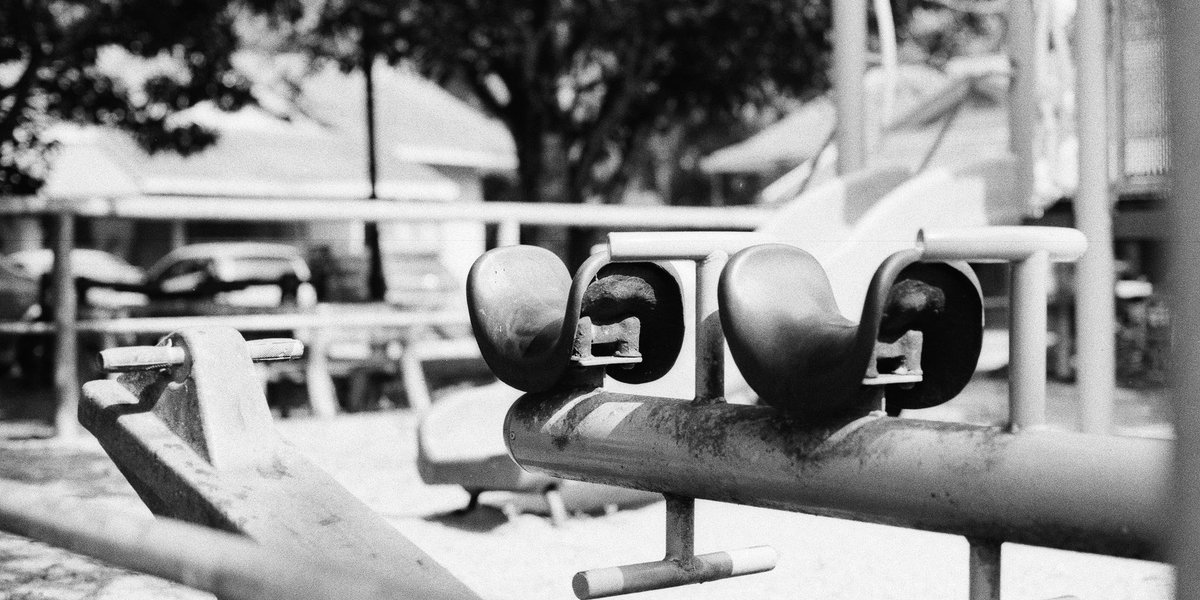
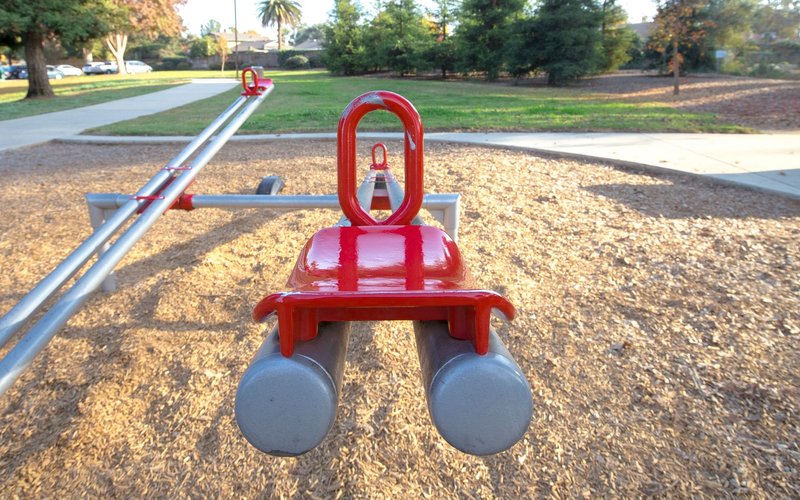
The seesaw is the textbook case. The pivot sits between the two riders, and pushing down on one end lifts the other. A light child sitting far from the pivot can balance a heavier one sitting close to it.
First-class levers are the only class that can go either way. Put the fulcrum near the load and you multiply force, which is how a crowbar lifts a paving stone. Put it in the exact centre and you get a plain balance, like a seesaw with two equal riders. Put it near the effort and you trade force for speed.
Scissors are two first-class levers sharing one pivot. The screw is the fulcrum, your fingers are the effort, and the paper is the load.
Second-class levers: the load in the middle
In a wheelbarrow, the wheel axle is the fulcrum at one end, your hands on the handles are the effort at the other, and the heavy load of soil sits between them. Because the load is always closer to the pivot than your hands are, the effort arm is always longer than the load arm. A second-class lever always multiplies force.
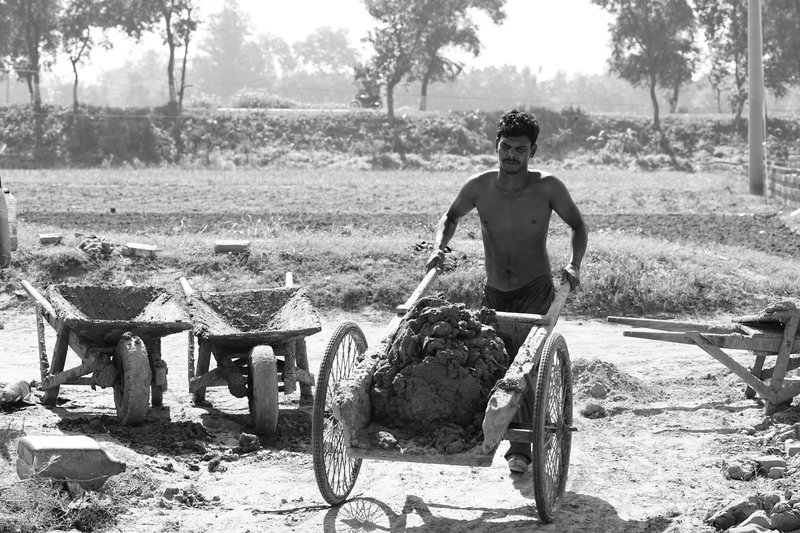
A bottle opener works the same way. The tip resting on top of the cap is the fulcrum, the cap’s edge that’s being pried up is the load just beside it, and your hand lifts at the far end of the handle. A door is a less obvious example: the hinge is the fulcrum, the door’s weight is the load at its middle, and you push at the handle on the far edge.
Third-class levers: the effort in the middle
Here the force is applied between the pivot and the load, so the effort arm is always shorter than the load arm. You push harder than the load weighs. That sounds like a bad deal, and for force it is. What you get back is speed and reach.
Pinch a pair of tweezers and the tips move through a precise, small range while your fingers press near the hinge. A fishing rod works on the same principle: your hand moves a short distance near the handle and the tip, with the fish or lure, sweeps through a far larger arc. A baseball bat does it too, since your hands drive a short section of the bat and the sweet spot at the far end moves much faster.
Third-class levers are everywhere precisely because speed and control are often worth more than force.
How to tell the classes apart: FLE 123
Memorising three diagrams works until an exam hands you a lever drawn at a strange angle. This shortcut doesn’t depend on the drawing.
Remember FLE 123:
- 1st class: F is in the middle (Fulcrum)
- 2nd class: L is in the middle (Load)
- 3rd class: E is in the middle (Effort)
To use it, find the three parts in whatever you’re looking at, then ask which one sits between the other two. Take a pair of tweezers. The pivot is the joined end, the load is whatever you’re gripping at the tips, and your fingers press in between. Effort is in the middle, so it’s third class. Take a nutcracker. The hinge is at one end, the nut is between the hinge and your hands, so load is in the middle: second class.
The letters always run F, L, E, and the class numbers run 1, 2, 3 in the same order.
The lever formula and mechanical advantage
Levers balance when the turning effect on each side is equal. That turning effect, called torque, is force multiplied by distance from the fulcrum:
effort × effort arm = load × load arm
Rearrange it and you get the mechanical advantage, which is how many times the lever multiplies your force:
mechanical advantage = effort arm ÷ load arm
A value above 1 means you push with less force than the load weighs. A value below 1 means you push harder than the load weighs, in exchange for moving it farther or faster. This is an ideal figure that ignores friction and the weight of the bar itself, which is why real levers do slightly worse.
Worked example: a crowbar
You want to lift one corner of a 700 newton crate (about 71 kg) with a 1.5 metre crowbar. You slide the tip under the crate and set a block of wood 0.1 m from the tip as the fulcrum.
- Load arm: 0.1 m
- Effort arm: 1.5 − 0.1 = 1.4 m
- Mechanical advantage: 1.4 ÷ 0.1 = 14
- Effort needed: 700 N ÷ 14 = 50 N
Fifty newtons is roughly the weight of a 5 kg bag of flour. You’ve lifted a crate that would otherwise take about fourteen times that.
The catch is conservation of energy. To raise the crate 1 cm, your hand has to travel 14 cm. The lever doesn’t create work, it repackages it into a smaller force over a longer distance.
Worked example: a wheelbarrow
A wheelbarrow holds 600 N of soil, centred 0.5 m from the axle. The handles are gripped 1.5 m from the axle.
- Mechanical advantage: 1.5 ÷ 0.5 = 3
- Effort needed: 600 N ÷ 3 = 200 N
You carry a third of the load and the wheel handles the rest. Slide the soil forward toward the wheel and the load arm shrinks, so the barrow feels lighter. Pile it near the handles and it gets heavy fast.
Why a third-class lever is still useful
Take a fishing rod where your lower hand sits 0.2 m from the pivot hand and the lure is 2.0 m from the pivot. The mechanical advantage is 0.2 ÷ 2.0 = 0.1. You push ten times harder than the weight at the tip. In return, the tip moves ten times farther than your hand does, and ten times faster.
Levers in the human body
Your skeleton is a set of levers, with bones as the bars, joints as the fulcrums and muscles supplying the effort. Most of them are built for speed and range, not strength, which is why muscles have to be so strong.
Elbow (third class). When you curl a weight, the elbow is the fulcrum and the biceps attaches to the forearm only a few centimetres from the joint. The weight in your hand is about 30 to 35 cm away. The mechanical advantage is well below 1, so the biceps has to pull several times harder than the weight you’re lifting. The payoff is that a small contraction swings your hand through a wide arc.
Calf (second class). Stand on your toes and the ball of your foot becomes the fulcrum, your body weight comes down through the ankle in the middle, and the calf muscle pulls up on the heel through the Achilles tendon. Load in the middle makes this a second-class lever with a mechanical advantage above 1, which is why you can hold your full weight on tiptoe.
Head (first class). Nodding pivots the skull on the top of the spine. Neck muscles at the back pull down on one side of the pivot to balance the weight of the face and front of the skull on the other. It’s one of the few first-class levers in the body.
Jaw (usually third class). The joint in front of your ear is the fulcrum, and the chewing muscles pull between the joint and the teeth. Biting with your back molars gives you a stronger grip than biting with your front teeth, because the load sits closer to the fulcrum.
Archimedes and the origin of the law of the lever
People were using levers long before anyone explained them. Egyptian builders and farmers used pivoting poles to raise water and shift stone, and the shaduf, a counterweighted pole for lifting water from rivers, dates back thousands of years.
The first known mathematical treatment comes from the Greek scientist Archimedes of Syracuse in the third century BCE. His work On the Equilibrium of Planes showed that two weights balance when they are inversely proportional to their distances from the fulcrum, which is the formula above. The line attributed to him, “Give me a place to stand and I will move the Earth,” is a statement of that principle: with a long enough lever, a small force can in theory move any load. Encyclopaedia Britannica’s entry on the lever covers the history and the physics in more depth, and EBSCO’s research starter on levers is a good academic overview.
The Earth-moving claim doesn’t survive the arithmetic. To lift a mass the size of the planet by a single centimetre, the lever would need an effort arm so long that your hand would have to travel across distances far beyond the size of the solar system.
A five-minute lever experiment
You need a 30 cm ruler, a pencil, and about ten identical coins.
- Lay the pencil flat on a table and balance the ruler across it at the 15 cm mark. This is your fulcrum.
- Stack two coins at the 5 cm mark, which is 10 cm from the pivot. Add coins at the 20 cm mark, 5 cm from the pivot on the other side, until the ruler balances.
- Check the numbers. Two coins at 10 cm give a turning effect of 20. At 5 cm from the pivot, it takes 4 coins to match.
- Slide the pencil off-centre and repeat. The balance point moves, but the rule stays the same: coins × distance on one side equals coins × distance on the other.
Once you’ve seen this work with loose change, the formula stops being abstract. Measure the distances, multiply, compare.
Quick quiz and FAQ
Which class of lever is a wheelbarrow? Second class. The load sits between the wheel (fulcrum) and your hands (effort).
Which class always has a mechanical advantage below 1? Third class, because the effort arm is always shorter than the load arm.
A 2 m bar is pivoted 0.5 m from the load. What is the mechanical advantage? The load arm is 0.5 m and the effort arm is 1.5 m. 1.5 ÷ 0.5 = 3.
Are scissors one lever or two? Two first-class levers joined at a shared fulcrum.
Can a lever increase both force and distance? No. It trades one for the other. Gain in force means loss in distance moved, and the reverse.
Why use a lever with a mechanical advantage below 1? For speed, range of motion and control. Your arm, a fishing rod and a pair of tweezers all give up force to get it.
Does the word “levers” mean anything outside physics? Yes. In business and engineering, “levers” often means factors that can be adjusted to change an outcome, such as growth levers. That usage borrows the physics idea: a small input at the right point moves a much larger result.