Table of Contents
- TLDR
- Why Trinidad and Tobago Has So Few Endemics
- Birds
- The One Endemic Mammal
- Amphibians
- Reptiles
- Plants
- Where to Actually See These Species
- The Ones Running Out of Time
TLDR {#tldr}
Trinidad and Tobago has roughly 70 endemic species total — heavy on plants and invertebrates, thin on vertebrates. The numbers: 59 endemic vascular plants, two endemic birds, one endemic mammal, a scattering of endemic reptiles and amphibians. That’s a small list for a Caribbean nation, and the reason is geological, not biological — these islands were still attached to South America a few thousand years ago. The headliners are the Trinidad Piping-Guan (a critically endangered bird known locally as the pawi), the White-tailed Sabrewing hummingbird, Sir David Attenborough’s myotis bat, and the Golden Tree Frog, which lives on exactly two mountaintops.
Why Trinidad and Tobago Has So Few Endemics {#why-so-few}
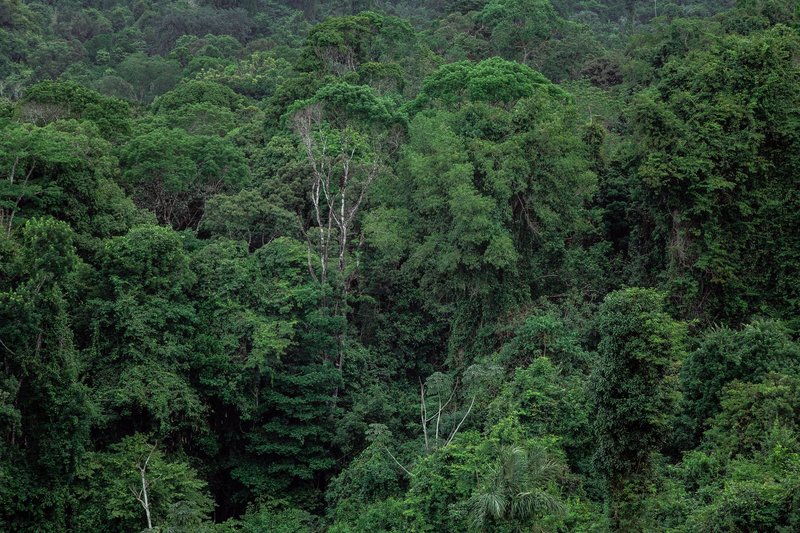
Most Caribbean islands are old and isolated enough that species arrive, get stuck, and evolve into something new over millions of years. Trinidad isn’t built that way. It sits on the South American continental shelf, and as recently as the last Ice Age it was physically connected to Venezuela by dry land across what’s now the Gulf of Paria. Tobago separated first, around 13,000 years ago; Trinidad held on longer, with some researchers putting the final split as recent as 1,500 years ago.
That matters because endemism needs isolation, and isolation needs time. A continental island that broke off yesterday, geologically speaking, still carries a near-copy of the mainland’s plants and animals — jaguars, capuchin monkeys, anacondas, all present in Trinidad, none of them unique to it. Compare that to Jamaica or Cuba, isolated for millions of years, and it’s obvious why those islands rack up hundreds of endemics while Trinidad and Tobago land in the dozens. The genuinely unique species here are the ones that got marooned on specific mountaintops, in specific bromeliads, or on Tobago after it split off — pockets of isolation within a landmass that otherwise reads like a slice of Venezuela.
Birds {#birds}
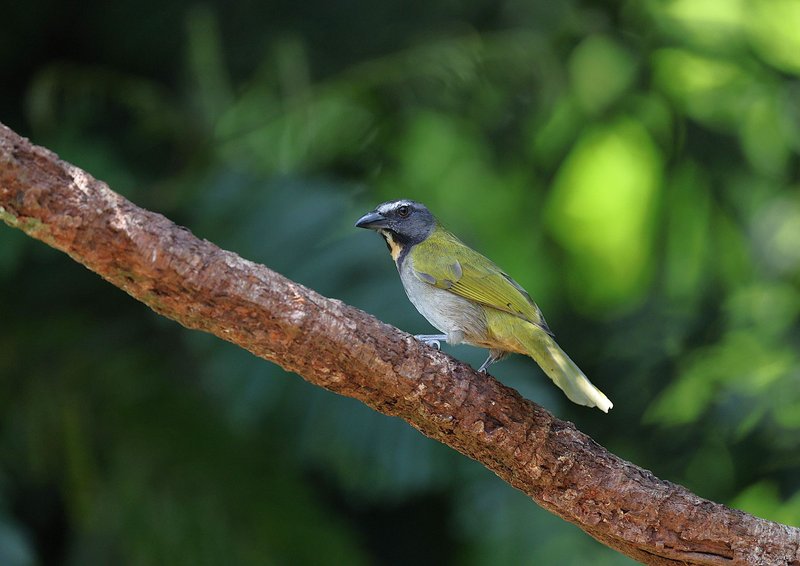
Only two bird species belong to Trinidad and Tobago and nowhere else, which is a strikingly low number for a country with over 460 recorded bird species overall.
Trinidad Piping-Guan (Pipile pipile). Locally called the pawi, this is a 60-centimeter, glossy black, turkey-sized bird with a white-edged crest and a bare blue face. It’s also one of the rarest birds on the planet — the population is estimated at somewhere between 150 and 330 mature individuals, all confined to a roughly 350-square-kilometer patch of forest in the eastern Northern Range. BirdLife International lists it as Critically Endangered, and hunting pressure — not habitat loss — is the main reason it nearly disappeared. Public education campaigns over the past decade have slowed the decline, but the pawi is still, functionally, one bad year from extinction.
White-tailed Sabrewing (Campylopterus ensipennis). This one belongs to Tobago alone. It’s an unusually large hummingbird for the genus, with the namesake white outer tail feathers flaring visibly in flight. Unlike the pawi, it isn’t rare within its range — it’s just restricted to it, found nowhere on Trinidad or the mainland.
A near-miss worth knowing: the Trinidad Motmot is often mentioned alongside these two, though it’s endemic to the country’s forests broadly rather than a single island quirk. It’s the easier of the three to actually spot, if you’re keeping a checklist.
The One Endemic Mammal {#mammals}
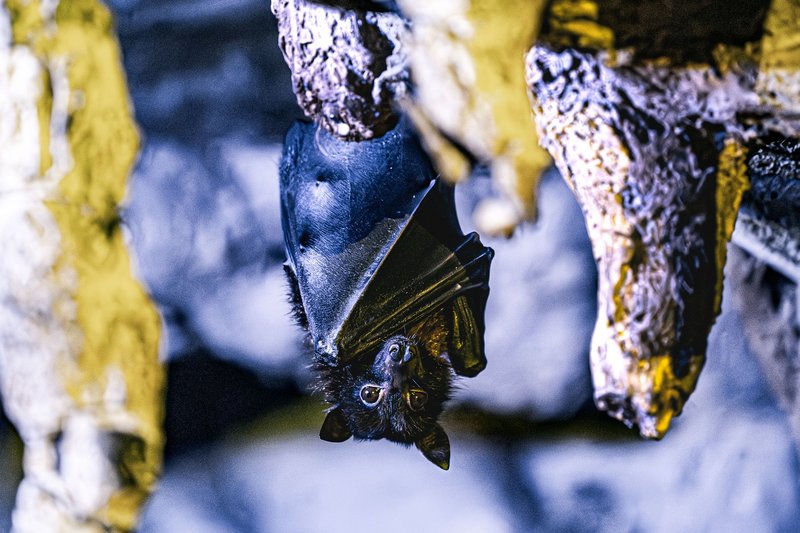
Of the roughly 100 mammal species recorded in Trinidad and Tobago — ocelots, capuchins, dozens of bats — exactly one is found nowhere else on Earth: Sir David Attenborough’s myotis (Myotis attenboroughi), a small vespertilionid bat endemic to Tobago. It was only formally described in recent years, which says less about how rare it is and more about how easy small, similar-looking forest bats are to overlook. It’s a reminder that “endemic” doesn’t always mean charismatic — sometimes it means a mouse-sized bat that took taxonomists decades to notice was different from its neighbors.
Amphibians {#amphibians}
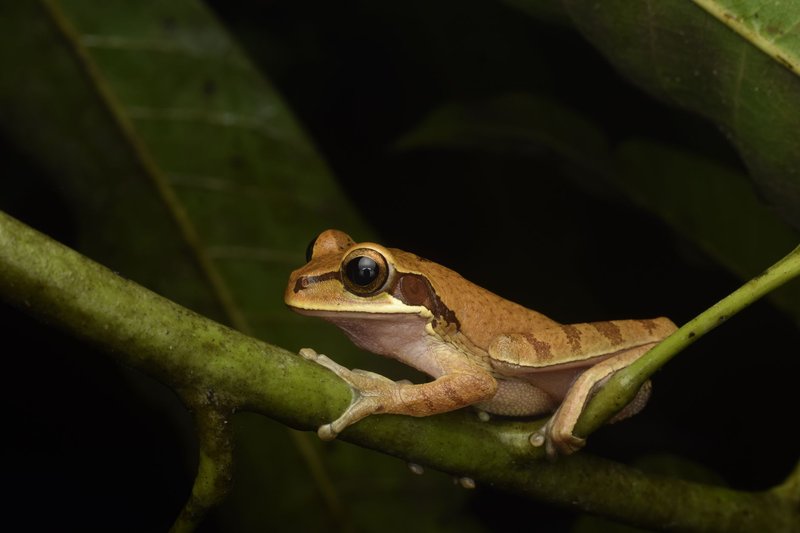
The Golden Tree Frog (Phytotriades auratus) is the closest thing this list has to a celebrity. It’s small — about 3.5 centimeters — genuinely gold-colored, and lives almost its entire life inside the water-holding leaves of one specific bromeliad species, Glomeropitcairnia erectiflora. In Trinidad, that bromeliad only grows on the summits of the island’s two highest peaks, El Tucuche and El Cerro del Aripo, which makes the frog’s entire known range a couple of mountaintop cloud forests.
Here’s the twist worth knowing if you go looking for it in field guides: for decades this species was treated as endemic to Trinidad specifically. Then researchers documented it on Cerro Humo in eastern Venezuela, which technically knocks it off the “Trinidad-only” list. It’s still endemic to the wider Trinidad-and-Tobago-and-adjacent-Venezuela cloud forest pocket, and it’s still critically endangered — scientists have started using environmental DNA sampling of bromeliad water just to confirm it’s still present on El Tucuche without disturbing the plants. The species is a good case study in how “endemic” is a moving target as fieldwork improves, not a fixed fact.
Reptiles {#reptiles}
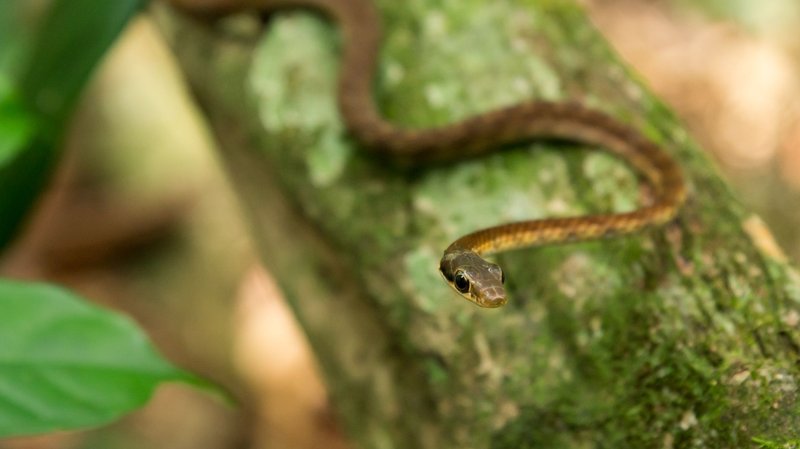
Tobago, despite being the smaller island, punches above its weight on endemic snakes. Three species live there and nowhere else:
- Tobago False Coral Snake (Erythrolamprus ocellatus) — small, around 50 centimeters, red-bodied with black-and-white eyespots down its back, mimicking a venomous coral snake it isn’t related to.
- Tobago Stream Snake (Erythrolamprus pseudoreginae) — described relatively recently, with its closest relatives sitting across the water in north-central Venezuela rather than on Trinidad, which tells you something about how Tobago’s wildlife split off on its own timeline.
- Leptophis haileyi — a Tobago-endemic member of the parrot snake genus.
None of these are common tourist sightings; they’re the kind of species herpetologists specifically go into the Main Ridge forest looking for, not something you’ll stumble on at a beach bar.
Plants {#plants}
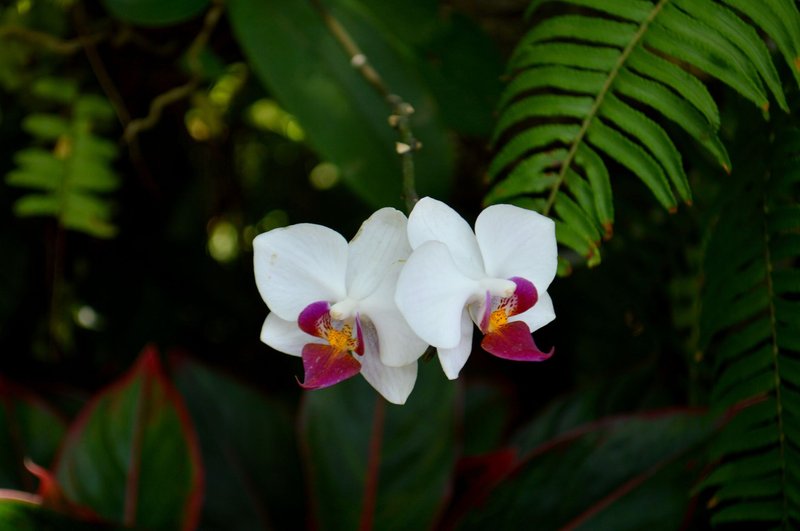
Plants carry the bulk of the country’s endemism: 59 species of native vascular plants found only here, split 39 to Trinidad, 12 to Tobago, and 6 shared between both. Most cluster in two habitat types — the ridge-tops of Trinidad’s Northern Range and the Main Ridge forest of Tobago — the same pattern of isolated high ground that produced the Golden Tree Frog.
Orchids dominate the list, and not in a good way conservation-wise: Cochleanthes trinitatis is endangered, while Epidendrum lanceolatum and Maxillaria broadwayi are both critically endangered. Outside the orchids, Podocarpus trinitensis — a native conifer relative — is one of only four endemic plants stable enough to carry a Least Concern rating. Clusia intertexta and Begonia eciliata round out the critically endangered column. Across all 59 species, only four are considered safe. The other 55 are, to varying degrees, running out of habitat.
Where to Actually See These Species {#where-to-see}
You won’t check most of this list off from a resort balcony. A few real leads:
- Grand Riviere, on Trinidad’s north coast, is the single most reliable place on Earth to see a wild Trinidad Piping-Guan, particularly around wild nutmeg trees, which are its preferred food source.
- Main Ridge Forest Reserve in Tobago — recognized as the oldest legally protected forest reserve in the world set aside specifically for conservation — is the core range for the White-tailed Sabrewing and all three endemic snakes.
- El Tucuche and El Cerro del Aripo, Trinidad’s two highest peaks, are the only known summits where the Golden Tree Frog’s host bromeliad grows. These are serious hikes, not casual walks.
- Caroni Swamp, while better known for the (non-endemic but spectacular) scarlet ibis roosts, sits in the same Northern Range ecosystem that shelters much of the country’s endemic flora.
The Ones Running Out of Time {#endangered}
If this list gets shorter in your lifetime, the pawi and the Golden Tree Frog are the two most likely to go first. The Trinidad Piping-Guan survives in the low hundreds, confined to a single forest block, still targeted by hunters despite legal protection. The Golden Tree Frog depends on one bromeliad species surviving on two mountain summits, which means a single bad drought or a shift in cloud forest elevation could erase its entire range in Trinidad in one event. Neither species has a backup population to fall back on. That’s the actual weight behind the word “endemic” here — not a badge of uniqueness, but a description of exactly how little margin these species have left.