Table of Contents
- Quick Answer: Does Australia Have Volcanoes?
- Why the Mainland Went Quiet
- The Newer Volcanics Province: 400+ Volcanoes and a New Theory
- Volcanic Sites Worth Visiting
- Mount Gambier and the Blue Lake That Time Forgot
- Undara: One Eruption That Ran 160 Kilometres
- Tower Hill and the Story the Bunganditj Never Forgot
- The Volcanoes West and South Nobody Mentions
- Could Australia Erupt Again?
Quick Answer: Does Australia Have Volcanoes?
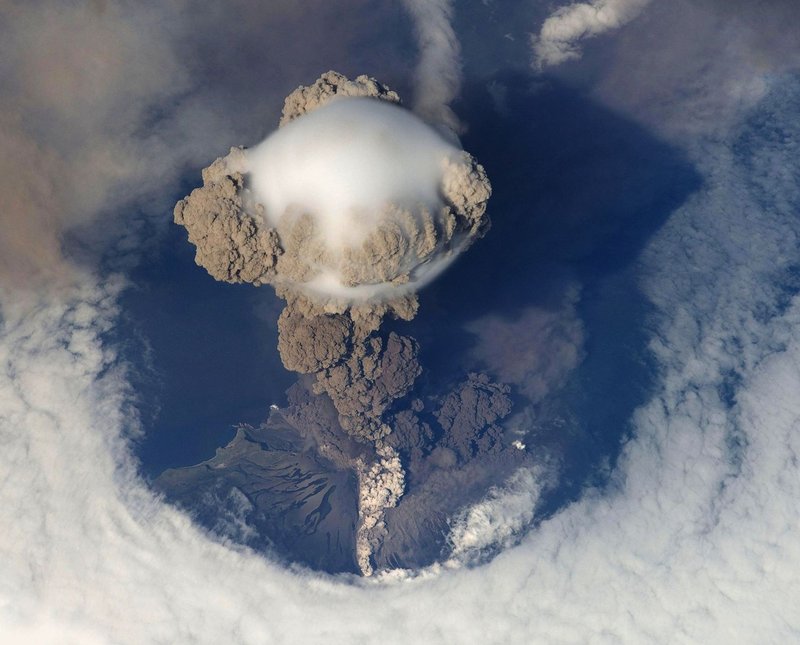
Yes and no, and the “yes” is stranger than most people expect. The Australian mainland has no active volcanoes — nothing has erupted on the continent itself in around 5,000 years. But Australia the country does have two active volcanoes right now, and neither is anywhere near a city. They’re on Heard Island and the McDonald Islands, a pair of subantarctic specks in the Indian Ocean, roughly 4,100 kilometres southwest of Perth and closer to Antarctica than to any Australian capital.
The active one is Big Ben, a snow-covered stratovolcano whose summit, Mawson Peak, tops out at 2,745 metres — taller than Mount Kosciuszko, making it technically Australia’s highest peak even though almost nobody’s heard of it. Satellite monitoring has picked up near-continuous activity at the summit since the early 2000s, with a confirmed eruption as recently as May 2023.
Beyond those two live volcanoes, the mainland carries the scars of a much longer volcanic past: more than 400 extinct and dormant volcanic centres scattered mostly down the east coast, plus older volcanic remnants in Western Australia and Tasmania that most guides skip entirely.
Why the Mainland Went Quiet
Most people picture volcanoes sitting on the edge of tectonic plates — the Pacific “Ring of Fire” being the textbook example. Australia sits in the middle of a plate, thousands of kilometres from any boundary, which is exactly why it doesn’t get the frequent, violent eruptions you see in places like Indonesia or Japan.
Instead, eastern Australia’s volcanoes are what geologists call intraplate volcanism — eruptions that happen away from plate edges, usually explained by a hotspot: a stationary plume of hot mantle material that the crust drifts over, like a blowtorch under a moving sheet of plywood. As the Australian Plate has crept north over roughly the last 33 million years, it’s dragged the continent over one or more of these hot zones, leaving a trail of extinct volcanoes that gets progressively younger as you move south — a pattern you can trace from the Whitsundays down through the Glass House Mountains to the volcanic plains of western Victoria.
The Newer Volcanics Province: 400+ Volcanoes and a New Theory
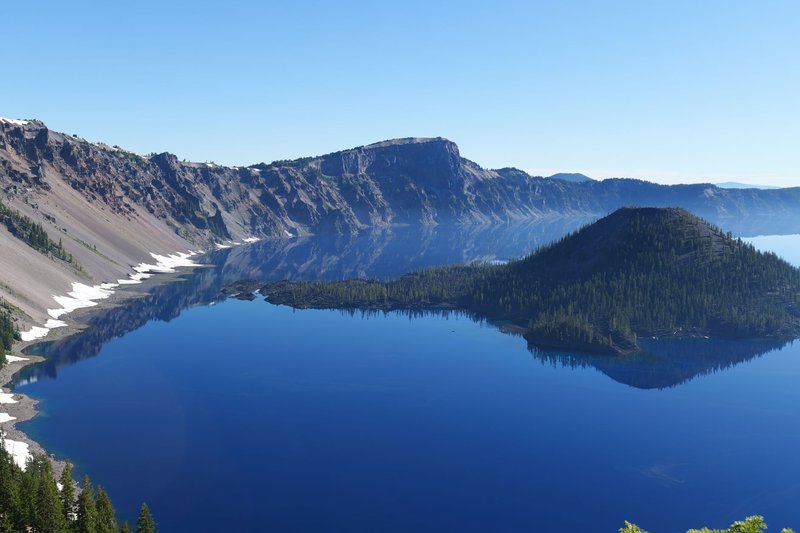
The youngest and densest cluster sits in the Newer Volcanics Province, a belt running from South Australia’s southeast through western Victoria that contains more than 400 separate volcanic centres — cones, craters, maars, and lava fields — all under 4.5 million years old. That’s remarkably recent by geological standards, and the eruptions kept coming right up until a few thousand years ago.
For decades, the standard explanation was a mantle plume, the same mechanism behind Hawaii. But that theory has trouble explaining why the volcanism here doesn’t follow a clean, single-direction age progression the way Hawaii’s chain does. A 2023 magnetotelluric survey of the region instead found evidence for edge-driven convection and shear-driven upwelling — essentially, hot mantle material squeezing upward at the ragged boundary where thick, old continental crust meets thinner oceanic-type crust offshore, rather than rising from a single fixed plume below.
There’s also a newer, wilder idea gaining traction: that bursts of magma reaching the Newer Volcanics Province are connected to activity thousands of kilometres away at the Tonga-Kermadec subduction zone, where the Pacific Plate is diving under the Australian Plate. Research published in Science Advances proposed that surges in the rate at which oceanic slab material sinks into the mantle at subduction zones can trigger bursts of intraplate volcanism far from the trench itself — a mechanism that could help explain why the Newer Volcanics Province erupts in irregular pulses rather than a steady drip. It’s not settled science, but it’s the most interesting rewrite of the “why here” question in years.
Volcanic Sites Worth Visiting
If you actually want to stand on one of these things, here’s the shortlist that matters — mainland sites you can drive to, plus the one you genuinely cannot.
| Site | State | Age / Last Activity | Can You Visit? |
|---|---|---|---|
| Mount Gambier | SA | Erupted ~4,300–6,000 years ago | Yes — Blue Lake lookout, walking trails, right in town |
| Mount Schank | SA | Slightly older than Mount Gambier | Yes — crater rim walk, 20 minutes from Mount Gambier |
| Glass House Mountains | QLD | ~26–27 million years old | Yes — national park, hiking and climbing on several peaks |
| Undara Lava Tubes | QLD | Lava tubes formed ~190,000 years ago | Yes — guided tours only, part of Undara Volcanic National Park |
| Tower Hill | VIC | Formed ~36,800 years ago | Yes — wildlife reserve inside the crater, walking tracks |
| Big Ben (Mawson Peak) | Heard Island | Active, erupted as recently as 2023 | No — no public access, one of the most remote places on Earth |
Mount Gambier and the Blue Lake That Time Forgot
Mount Gambier’s claim to fame isn’t just that it’s a volcano — it’s that its crater lake changes colour. Every November, the Blue Lake flips from a dull grey-blue to a saturated cobalt blue almost overnight, a phenomenon linked to water temperature changes altering how calcite crystals scatter light, and it stays that vivid blue until March.
The volcano itself is part of a complex of four overlapping maar craters, and it’s young enough that the local Bunganditj people almost certainly saw it erupt. Their traditional stories describe fires and ash at this site, oral accounts that geologists have used to help cross-check radiocarbon dates showing the most recent activity occurred somewhere between 4,300 and 6,000 years ago — meaning some of the last people to watch an Australian mainland volcano erupt passed the memory down for thousands of years before Europeans ever heard of it, according to research covered by The Conversation.
Undara: One Eruption That Ran 160 Kilometres
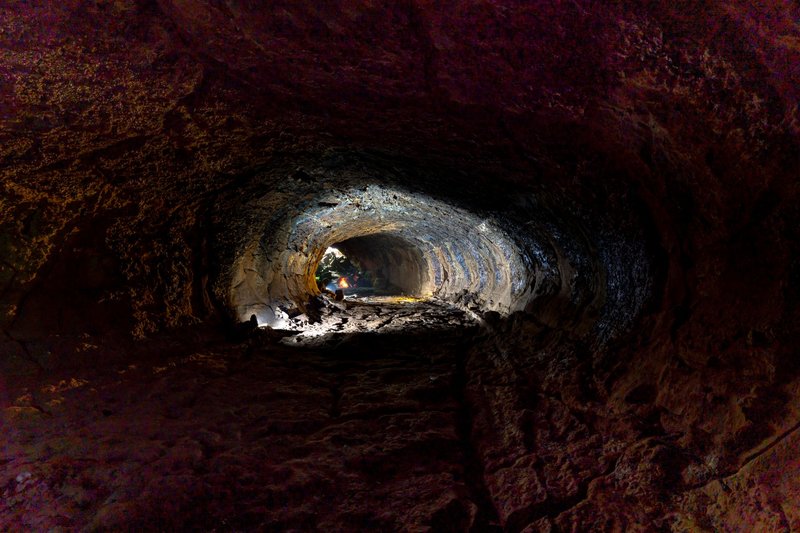
Undara, in far north Queensland, is a different kind of impressive: not explosive, just relentless. About 190,000 years ago, a shield volcano that had already been building for around a million years let go with an eruption that pushed roughly 23.3 cubic kilometres of lava outward at an estimated 1,000 cubic metres per second. The lava didn’t erupt violently and fall back — it flowed, and as the outer surface cooled and crusted over, the still-molten lava underneath kept draining out through the middle, leaving hollow tubes behind. Some ran more than 160 kilometres from the vent.
The result, protected today within Undara Volcanic National Park, is one of the longest lava tube systems on the planet — accessible only through guided tours, partly for safety and partly because sections shelter bat colonies and are still being surveyed.
Tower Hill and the Story the Bunganditj Never Forgot
Tower Hill, near Warrnambool in western Victoria, is a nested maar volcano — a broad, shallow crater blown out when rising magma hit water-saturated rock and flashed to steam, followed by more eruptions that built cone-shaped islands inside the crater lake that formed afterward. Argon-argon dating on a lava bomb pinned the eruption at roughly 36,800 years ago.
That date matters for a reason beyond geology. Excavated stone artefacts have been found beneath the volcanic ash layer at Tower Hill, meaning Aboriginal people were already living in the area before it erupted — evidence that pushes back the confirmed timeline of Aboriginal occupation in the region to at least 34,000 years, and arguably makes local oral traditions describing ancestral fire and eruption some of the oldest continuously told stories on Earth.
The Volcanoes West and South Nobody Mentions
Most rundowns stop at Victoria and South Australia, but the west coast and Tasmania have volcanic pasts too — they’re just old enough that they don’t look like volcanoes anymore. Western Australia’s volcanic activity is mostly ancient, tied to Proterozoic and Archean-era events billions of years old, long since eroded into greenstone belts and mineral-rich rock rather than anything resembling a crater. Tasmania has its own scattering of Cainozoic-era basalt volcanic remnants, similarly old and heavily weathered.
Neither state offers the crisp, walkable cones you get in Victoria or Queensland, which is exactly why they get left out of most “volcanoes in Australia” lists — there’s nothing photogenic left to point a camera at. But the rock record is there for anyone chasing the full picture rather than just the visitable highlights.
Could Australia Erupt Again?
Almost certainly, eventually — just not on any timeline that matters to anyone reading this. The Newer Volcanics Province is classified as active rather than extinct precisely because its eruptions have kept recurring for millions of years on an irregular schedule, with the most recent activity only a few thousand years old. Geoscience Australia doesn’t rule out future eruptions in the region — it just notes there’s no way to predict when, since there’s no subducting plate producing the kind of steady, monitorable pressure buildup you get at volcanoes like those in Indonesia or Japan.
If it does happen again, the most likely style is a maar or scoria cone eruption — sudden, localized, and explosive at first contact with groundwater, similar to what built Tower Hill, rather than a slow-building stratovolcano threat. Geoscience Australia and university researchers keep light seismic monitoring across the region as a matter of course, but nobody is issuing warnings, because there’s nothing currently building toward one. Heard Island’s Big Ben will keep doing what it does, quietly, at the bottom of the world — the only Australian volcano actually worth watching in real time.