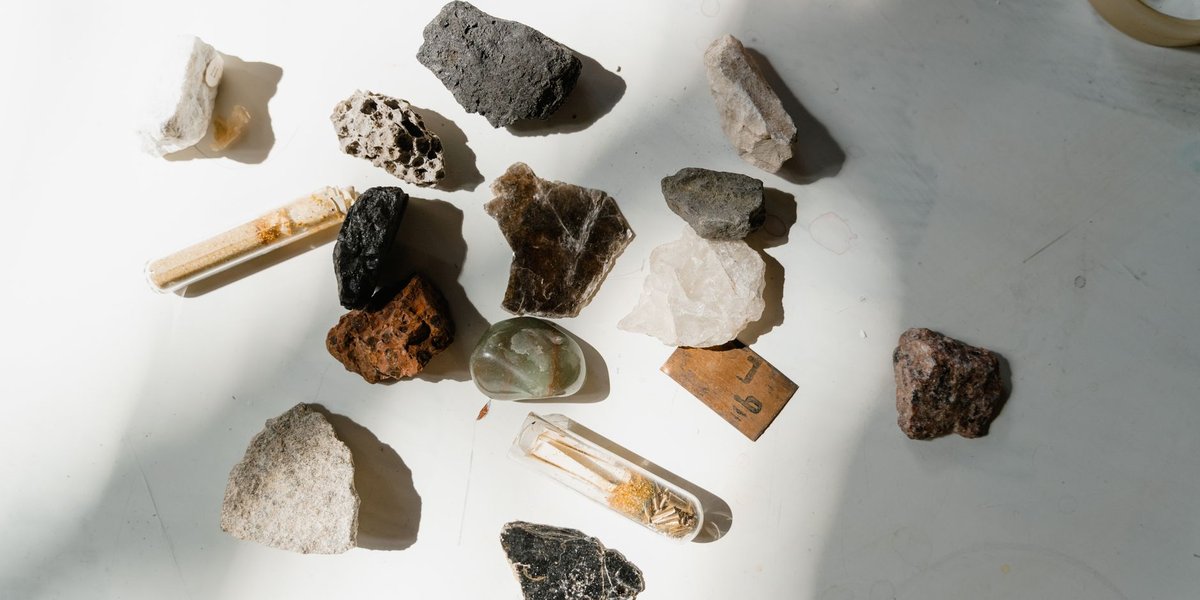
Ask most people what Alberta is made of and they’ll say oil. Fair enough. But the same geology that cooked up the oil sands also stacked the province with salt domes, gypsum beds, helium-rich gas, lithium-loaded brines, and a gemstone so rare it only forms from one extinct sea creature. Alberta sits on two completely different geological stories pressed together, and that’s why the mineral list runs long.
The province straddles the Western Canada Sedimentary Basin — a wedge of sedimentary rock up to six kilometres thick — and clips the ancient Canadian Shield in its far northeast corner. The basin gives you the energy and industrial minerals layered down over hundreds of millions of years of shallow seas and swamps. The Shield gives you the old, hard, metamorphic crust where the metals and uranium live. Two basements, two mineral economies.
This guide walks through what’s down there, grouped by what it’s actually used for, plus where rockhounds can legally go looking.
Table of Contents
- The Quick Version
- Why Alberta Has So Many Minerals
- Energy Minerals
- Industrial Minerals
- Critical Minerals
- Gemstones and Collectibles
- Where You Can Actually Go Rockhounding
- Mineral Cheat Sheet
The Quick Version
Alberta’s minerals fall into four buckets. Energy minerals (oil sands bitumen, coal) are the headliners and the economy’s backbone. Industrial minerals (salt, limestone, gypsum, silica sand, sulphur) are the unglamorous workhorses that build roads, drywall, and glass. Critical minerals (lithium, helium, vanadium, uranium, rare-earth elements) are the newer story — the stuff batteries, MRI machines, and clean tech need, and Alberta is racing to produce them. And then there’s ammolite, the official provincial gemstone, found in commercial quantity almost nowhere else on Earth.
If you only remember one fact: Alberta isn’t a hard-rock mining province like Ontario or B.C. Most of what’s mined here comes out of sedimentary layers or gets pumped up dissolved in brine.
Why Alberta Has So Many Minerals
Picture the last 500 million years as a slow conveyor belt of environments. Tropical seas advanced and retreated across what’s now Alberta over and over. Each cycle dropped a different layer: reef-building organisms became limestone, evaporating lagoons left thick beds of salt and gypsum, and dead marine plankton sank, got buried, and slow-cooked into hydrocarbons.
That repetition is the whole trick. A single shallow sea is interesting. A few dozen of them stacked on top of each other, compressed under kilometres of younger rock, is a mineral warehouse. The Alberta Geological Survey maps these layers because their position — how deep, how thick, how warm — determines whether you get coal, brine lithium, or sour gas.
The northeast corner is the exception. There the sedimentary cover thins out and the Precambrian Canadian Shield pokes through, the same billion-plus-year-old rock that hosts metal deposits across the rest of Canada — including Manitoba’s shield-hosted nickel and copper belts. That’s Alberta’s window into hard-rock potential for uranium and base metals.
Energy Minerals
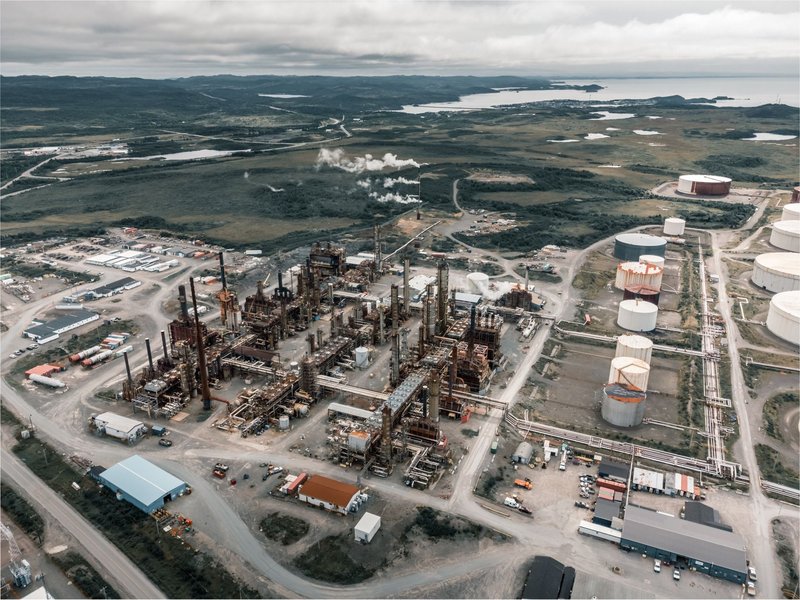
Bitumen (oil sands). The big one. The Athabasca, Cold Lake, and Peace River deposits hold one of the largest accumulations of crude bitumen on the planet — heavy, tar-like oil clinging to grains of sand. It’s not pumped like conventional oil; near the surface it’s strip-mined, and deeper deposits are melted in place with steam and drawn up. Technically a hydrocarbon rather than a true mineral, but it’s the reason most people have heard of Alberta geology at all.
Coal. Alberta holds a huge share of Canada’s coal reserves, running in a belt from the foothills up through the central plains. Historically it fueled the province’s power plants; today the conversation has shifted toward metallurgical coal for steelmaking and the politics of where new mining is allowed. The coal formed from Cretaceous-age swamps, the same warm, soggy world that left so many dinosaur fossils in the badlands.
Natural gas (and what rides along with it). Conventional and shale gas are produced across the basin, and the gas matters here partly because of its passengers — sulphur and helium both come out of Alberta wells, which is why they show up again below.
Industrial Minerals
These are the minerals nobody writes songs about and everybody depends on.
Salt (halite). Underneath central and eastern Alberta sit enormous beds of rock salt, left behind by evaporating ancient seas. Companies dissolve it with water and pump up the brine, then either purify it or use the empty caverns for storage. This is also the source rock for some of the lithium story below.
Limestone. Quarried mainly along the Rocky Mountain front, limestone goes into cement, lime, and construction aggregate. The mountains themselves are largely built of it — old reef and seafloor carbonate shoved upward when the Rockies formed.
Gypsum. The stuff of drywall. Alberta’s gypsum comes from those same evaporite sequences as the salt, deposited when shallow seas dried down and dropped their dissolved calcium sulphate.
Silica sand. High-purity quartz sand used for glass, foundry molds, and as proppant in oil and gas wells. Demand for frac sand tied Alberta’s silica deposits directly to the energy boom.
Sulphur. Alberta is one of the world’s major sulphur producers, almost all of it recovered from “sour” natural gas that’s full of hydrogen sulphide. Stripping the sulphur out makes the gas usable and the byproduct — those distinctive bright-yellow blocks stacked near gas plants — feeds global fertilizer production.
Aggregate. Sand and gravel sound boring until you realize a single kilometre of highway swallows tens of thousands of tonnes. It’s the highest-volume mineral product in the province by sheer weight.
Critical Minerals
This is where Alberta’s mineral story is changing fastest. “Critical” minerals are the ones modern technology and clean energy can’t run without, and Canada has flagged a list of them as strategic priorities. Several are produced — or chased — right here.
Lithium. Alberta’s twist on lithium isn’t hard-rock mining or salt-flat evaporation. It’s brine — ancient, lithium-rich water trapped in deep formations, often in old oil-and-gas reservoirs. Several companies are piloting direct lithium extraction, pumping the brine up, pulling the lithium out, and reinjecting the rest. The appeal is obvious: the wells, pipelines, and expertise already exist from a century of petroleum work.
Helium. Helium is rarer and more strategic than its party-balloon reputation suggests — it’s essential for MRI scanners, semiconductors, and rocketry, and it literally leaks off the planet once released. Southern Alberta’s gas fields carry helium concentrations high enough to justify dedicated extraction, and the province has actively courted helium producers.
Vanadium. Used to harden steel and increasingly eyed for grid-scale flow batteries, vanadium is locked in some of Alberta’s black shales and oil sands byproducts, raising the prospect of pulling a battery metal out of bitumen processing.
Uranium. The potential sits in the northeast, near the Shield, geologically next door to Saskatchewan’s world-class uranium district. Alberta’s deposits are far less developed, but the basement rock is the right kind.
Rare-earth elements. The seventeen metals behind magnets, EV motors, and wind turbines. Alberta’s interest is partly in unconventional sources — recovering rare earths from coal ash, byproduct streams, and certain mineralized zones rather than digging fresh hard-rock mines. Canada’s critical minerals strategy explains why provinces are suddenly hunting for them.
Gemstones and Collectibles
Ammolite. Alberta’s crown jewel, literally — it became the official provincial gemstone and is one of the few biogenic gemstones on Earth, alongside pearl and amber. Ammolite is the fossilized, opal-like shell of ammonites, extinct marine mollusks that died out with the dinosaurs. Over 70 million years, the aragonite in their shells took on a fiery iridescence — reds, greens, blues, and golds that shift as you tilt the stone.
It comes almost exclusively from the Bearpaw Formation along the St. Mary River in southern Alberta, near Lethbridge. Commercial mining is a small, tightly held operation, which is part of why high-grade ammolite commands serious prices. No other place produces it in gem quantity.
Petrified wood, agate, and amber. Alberta’s rivers and badlands turn up petrified wood (the province’s official stone), agates polished smooth in gravel beds, and small amounts of amber in the coal-bearing formations. None are rare enough to mine commercially, but they’re the backbone of the hobbyist scene.
Gold. Yes, there’s gold in Alberta — but not in veins. It’s placer gold: fine flakes and the occasional small nugget washed down from the mountains and concentrated in river gravels, especially along the North Saskatchewan River. Nobody’s getting rich, but recreational panners do find color.
Where You Can Actually Go Rockhounding
The honest answer: less freely than you’d hope, and the rules are worth checking before you pocket anything.
In Alberta, surface minerals belong to the Crown, and collecting on public land is generally tolerated for small, personal, non-commercial amounts — a few stones, hand tools only, no digging into riverbanks. Provincial and national parks are off-limits for collecting entirely. Private land always needs the owner’s permission.
Two big asterisks. First, fossils are protected under Alberta’s heritage legislation — you can surface-collect certain common fossils for personal keeping, but you can’t sell them, and significant finds legally belong to the province. Second, ammolite that’s still attached to ammonite shell counts as a fossil, so the casual-collecting rules are stricter than for a polished stone you’d buy in a shop.
Practical hunting grounds for the hobbyist: gravel bars along the North Saskatchewan and Red Deer rivers for agates and placer gold, the badlands exposures for petrified wood, and the foothills gravels generally. Bring a bag, a pick, and a look at the current Alberta Parks and public-land rules before you go — the regulations get updated, and “I didn’t know” isn’t a defense if you walk off with a protected fossil.
Mineral Cheat Sheet
| Mineral | Where it’s found | What it’s used for |
|---|---|---|
| Bitumen (oil sands) | Athabasca, Cold Lake, Peace River | Crude oil, fuels |
| Coal | Foothills and central plains belt | Power, steelmaking |
| Salt (halite) | Central and eastern Alberta beds | Industrial chemicals, brine, storage |
| Limestone | Rocky Mountain front | Cement, lime, aggregate |
| Gypsum | Evaporite beds | Drywall, plaster |
| Silica sand | Scattered basin deposits | Glass, foundry, frac sand |
| Sulphur | Recovered from sour gas | Fertilizer, chemicals |
| Lithium | Deep brines / old oil reservoirs | EV and grid batteries |
| Helium | Southern Alberta gas fields | MRI, semiconductors, aerospace |
| Vanadium | Black shales, oil sands byproducts | Steel alloys, flow batteries |
| Uranium | Northeast (Shield margin) | Nuclear fuel |
| Rare earths | Coal ash, byproduct streams | Magnets, EV motors, turbines |
| Ammolite | Bearpaw Formation, near Lethbridge | Gemstone, jewelry |
| Placer gold | River gravels (North Saskatchewan) | Recreational panning |
Alberta’s reputation as a one-resource province sells the geology short. The oil gets the headlines because of scale and money, but the same buried seas that made the bitumen also left salt to mine, gas full of helium, brine full of lithium, and a single formation near Lethbridge that produces the rarest organic gem on the continent. Two ancient basements, half a billion years of stacked environments, and a mineral list that’s still getting longer as the critical-minerals hunt heats up. Not bad for a place everyone assumes is just oil and wheat.