

New Mexico's signature fossil is Coelophysis, a slim Triassic dinosaur that is also the state fossil. Its record spans three eras of rock, and the state has 729 dinosaur records among 11,388 fossil records.
Permian. The Robledo Mountains near Las Cruces hold trackways about 280 million years old, left on a coastal flat by early reptiles and amphibians. The Permian has 2,137 records and the Carboniferous before it 2,994.
Triassic. In 1947 an American Museum team led by Edwin Colbert opened a quarry at Ghost Ranch in the Chinle Formation and found hundreds of Coelophysis skeletons together. The database lists 18 Coelophysis records for the state, which shows that a record is one find and not one animal. The legislature named it state fossil in 1981.
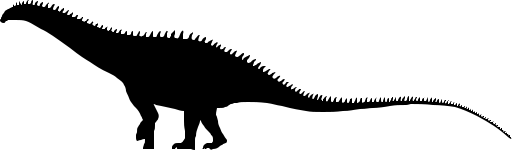
Cretaceous. In the San Juan Basin, Alamosaurus has 22 records and the crested Parasaurolophus 14.
The ice age adds Equus (36 records) and Mammuthus (11). Ice age bone also turns up in caves; see caves in New Mexico.
Dinosaurs found in New Mexico
The Paleobiology Database lists 729 dinosaur finds in New Mexico. These are the best documented.
- Allosaurus: A large Late Jurassic predator, 8 to 9 m long, with three-fingered hands and serrated teeth. Found 8 times, from 158 to 143 million years ago.
- Triceratops: A plant eater with three horns and a bony neck frill. It lived until the extinction 66 million years ago. Found 7 times, from 83.6 to 66 million years ago.
- Tyrannosaurus (T. rex): A meat eater up to 12 m long with a bite strong enough to crush bone. Lived in the Late Cretaceous. Found 3 times, from 83.6 to 66 million years ago.
- Apatosaurus: A Late Jurassic long-necked plant eater about 21 m long. Many scientists now treat Brontosaurus as a separate genus. Found 2 times, from 155 to 143 million years ago.
- Diplodocus: A Late Jurassic long-necked plant eater about 25 m long, with a whip-like tail and peg-shaped teeth. Found 2 times, from 155 to 143 million years ago.
- Stegosaurus: A plant eater with two rows of upright back plates and four spikes on its tail. Late Jurassic. Found 2 times, from 155 to 143 million years ago.
- Ankylosaurus: A Late Cretaceous plant eater covered in bony armor, with a heavy bone club at the end of its tail. Found 1 time, from 83.6 to 72.2 million years ago.
- Alamosaurus: A giant Late Cretaceous long-necked plant eater, among the last sauropods in North America. Found 22 times, from 83.6 to 66 million years ago.
- Coelophysis: A slim Triassic predator about 3 m long. One quarry holds hundreds of its skeletons. Found 18 times, from 227 to 201 million years ago.
- Parasaurolophus: A duck-billed dinosaur about 10 m long with a hollow crest curving back from its head. Crest up to 1.8 m long. Found 14 times, from 83.6 to 72.2 million years ago.
- Camarasaurus: A long-necked plant eater with a short, blunt skull and spoon-shaped teeth. Common in Late Jurassic rock. Found 4 times, from 155 to 143 million years ago.
- Albertosaurus: A Late Cretaceous tyrannosaur about 9 m long, smaller and lighter than T. rex. Found 2 times, from 83.6 to 72.2 million years ago.
Other fossils found in New Mexico
Beyond dinosaurs, the New Mexico record includes these animals and plants.
- Equus (horse): The horse genus, with zebras and donkeys. Horses evolved in North America and died out there in the Ice Age. Found 36 times, from 4.7 to 0 million years ago.
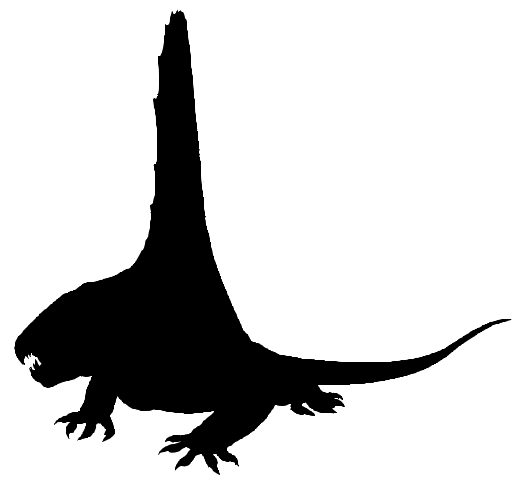
- Dimetrodon: A sail-backed predator up to about 4 m long, from the Early Permian. Closer kin to mammals than to dinosaurs. Found 5 times, from 299 to 286 million years ago.
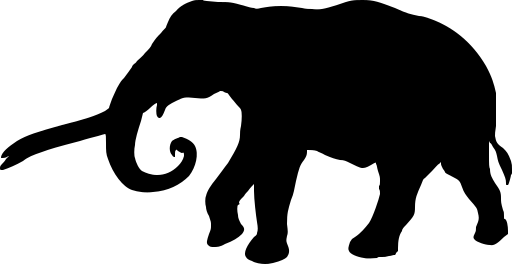
- Mammuthus (mammoth): An Ice Age elephant relative with long curved tusks. Woolly mammoths lived in the north, Columbian ones farther south. Found 11 times, from 4.7 to 0 million years ago.
- Baculites (baculite): An ammonite with a straight, rod-shaped shell instead of a coil, common in Late Cretaceous seas. Found 40 times, from 93.9 to 72.2 million years ago.
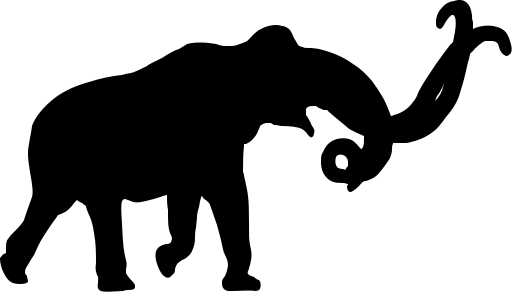
- Mammut (mastodon): A browsing Ice Age elephant relative with long, upward-curving tusks and ridged, low-crowned teeth. Not a mammoth. Found 5 times, from 16.3 to 0 million years ago.
- Ptychodus: A Late Cretaceous shark with broad, ridged teeth suited to crushing clams and other hard-shelled prey. Found 17 times, from 101 to 83.6 million years ago.
- Tylosaurus: A Late Cretaceous mosasaur about 12 m long, with a toothless bony tip on its snout. Found 1 time, from 101 to 66 million years ago.
- Calamites (giant horsetail): A tree-sized relative of horsetails, up to about 20 m tall. Common in Carboniferous coal swamps. Found 3 times, from 323 to 299 million years ago.
- Bison: The bison genus. Ice Age bison were larger than today's, and Bison latifrons had horns spanning about 2 m. Found 9 times, from 2.6 to 0 million years ago.
- Smilodon (sabre-toothed cat): An Ice Age big cat with upper canines up to 18 cm long. Often called a sabre-toothed tiger, but not a tiger. Found 3 times, from 2.6 to 0.01 million years ago.
- Canis (wolf, coyote or dog): The genus of wolves, coyotes and dogs. Ice Age fossils include gray wolves. The dire wolf now has its own genus. Found 13 times, from 4.7 to 0 million years ago.
- Camelops (camel): North America is where camels evolved. Camelops was one of the last, dying out at the end of the Ice Age. Found 17 times, from 4.7 to 0 million years ago.
State symbols
- State fossil: Coelophysis (adopted 1981) Read the statute
NM Secretary of State page fetched: 'named the New Mexico State Fossil by the State Legislature on March 17, 1981'. Codified NMSA 1978 s12-3-4 (nmlegis.gov bot-blocked, not fetched). Theropod dinosaur; no separate state dinosaur designation found. PBDB: Coelophysis valid.
How the land changed
Every fossil records the place it was buried in. Reading those places period by period shows how New Mexico changed.
- Carboniferous (359 to 299 Ma): most fossils from this time come from a shallow sea.
- Permian (299 to 252 Ma): most fossils from this time come from a reef.
- Triassic (252 to 201 Ma): most fossils from this time come from rivers and lakes.
- Cretaceous (143 to 66 Ma): most fossils from this time come from dry land.
- Paleogene (66 to 23 Ma): most fossils from this time come from dry land.
- Quaternary (2.6 to 0 Ma): most fossils from this time come from dry land.
Oldest and youngest finds in New Mexico
The oldest find in the New Mexico record is Eoconodontus, dated to about 494 million years ago. The youngest is Equus, from the last 12,000 years.
Fossil finds in New Mexico by period
| Period | Million years ago | Finds | Most common group |
|---|---|---|---|
| Cambrian | 539 to 487 | 35 | Fish and sharks |
| Ordovician | 487 to 443 | 186 | Invertebrates |
| Devonian | 420 to 359 | 496 | Invertebrates |
| Carboniferous | 359 to 299 | 2,994 | Invertebrates |
| Permian | 299 to 252 | 2,137 | Invertebrates |
| Triassic | 252 to 201 | 709 | Reptiles, amphibians and birds |
| Jurassic | 201 to 143 | 66 | Dinosaurs |
| Cretaceous | 143 to 66 | 2,688 | Invertebrates |
| Paleogene | 66 to 23 | 1,030 | Mammals |
| Neogene | 23 to 2.6 | 494 | Mammals |
| Quaternary | 2.6 to 0 | 553 | Mammals |
Frequently asked questions
What is the state fossil of New Mexico?
New Mexico has designated Coelophysis as its state fossil, adopted in 1981.
What dinosaurs have been found in New Mexico?
The best-documented dinosaurs in the New Mexico record are Allosaurus, Triceratops, Tyrannosaurus, Apatosaurus and Diplodocus. The Paleobiology Database lists 729 dinosaur finds there.
How many fossils have been found in New Mexico?
The Paleobiology Database records 11,388 fossil finds in New Mexico, covering 1,837 kinds of animals, plants and other life.
What is the oldest fossil found in New Mexico?
The oldest find in the New Mexico record is Eoconodontus, dated to about 494 million years ago.
How can I see fossils near me in New Mexico?
Type a town or ZIP code into the search box at the top of this page, or use your location, to see the fossils recorded within 25 to 200 km. Natural history museums and state fossil parks are the best places to see real specimens.
Keep exploring
More fossil states: California, Texas, Wyoming, Florida, Utah, Montana, all 50 states.
Credits and data
- Fossil finds: the Paleobiology Database, licensed CC BY 4.0. Counts are records in the database, which reflect research effort as well as geology.
- Ancient Earth maps and plate motion: PALEOMAP PaleoDEMs, Scotese and Wright (2018), CC BY 4.0, doi:10.5281/zenodo.5460860.
- Place names: US Census Gazetteer (public domain) and GeoNames, CC BY 4.0.
- Silhouettes: PhyloPic contributors (Marie Aimee ALLARD, Jagged Fang Designs, David Orr, artrociraptor, Dmitry Bogdanov, U.S. National Park Service (vectorized by William Gearty), Margot Michaud, Steven Traver, An Ignorant Atheist, Scott Hartman, Guillaume Dera).