


Montana's dinosaurs are mostly Late Cretaceous: Triceratops (45 records), Tyrannosaurus (19) and the duck-billed Maiasaura, with 896 dinosaur records in all out of 10,138 fossil records for the state.
Hell Creek. In 1902 Barnum Brown dug a partial skeleton out of the Hell Creek Formation that Henry Fairfield Osborn named Tyrannosaurus rex in 1905. The formation is a coastal plain of rivers and deltas that ran beside the Western Interior Seaway in the final stretch before the extinction 66 million years ago.
Egg Mountain. In 1978 Jack Horner and Bob Makela, working near Choteau in the Two Medicine Formation, opened a nest holding 15 baby dinosaurs. The animal was named Maiasaura, good mother lizard, after evidence that some dinosaurs cared for their young. Montana made it the state fossil in 1985.
Early Cretaceous. Older rock holds 55 records of Tenontosaurus and 27 of the predator Deinonychus, which was described in 1969 and often turns up beside it.
Montana also has marine Cretaceous records, including 27 of Baculites and two of Mosasaurus, from the years when the seaway covered the plains.
Dinosaurs found in Montana
The Paleobiology Database lists 896 dinosaur finds in Montana. These are the best documented.
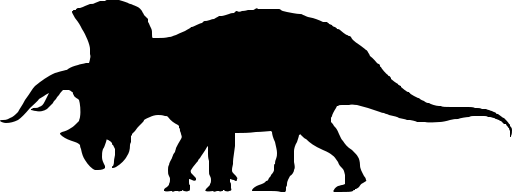
- Triceratops: A plant eater with three horns and a bony neck frill. It lived until the extinction 66 million years ago. Found 45 times, from 72.2 to 66 million years ago.
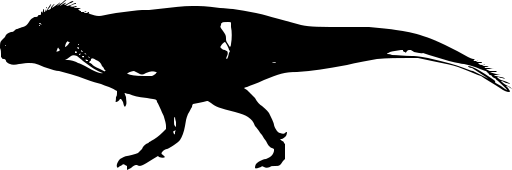
- Tyrannosaurus (T. rex): A meat eater up to 12 m long with a bite strong enough to crush bone. Lived in the Late Cretaceous. Found 19 times, from 83.6 to 66 million years ago.
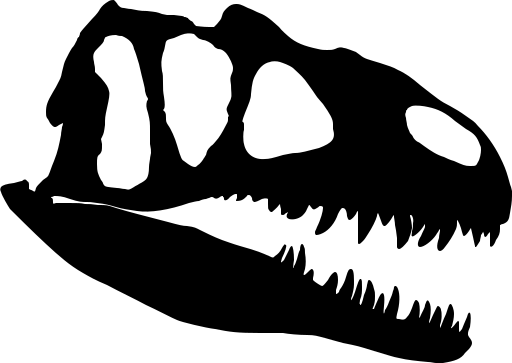
- Allosaurus: A large Late Jurassic predator, 8 to 9 m long, with three-fingered hands and serrated teeth. Found 3 times, from 155 to 143 million years ago.
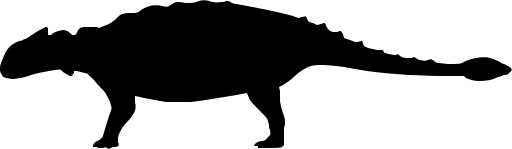
- Ankylosaurus: A Late Cretaceous plant eater covered in bony armor, with a heavy bone club at the end of its tail. Found 3 times, from 72.2 to 66 million years ago.
- Apatosaurus: A Late Jurassic long-necked plant eater about 21 m long. Many scientists now treat Brontosaurus as a separate genus. Found 2 times, from 155 to 143 million years ago.
- Diplodocus: A Late Jurassic long-necked plant eater about 25 m long, with a whip-like tail and peg-shaped teeth. Found 2 times, from 155 to 143 million years ago.
- Tenontosaurus: An Early Cretaceous plant eater about 7 m long. Fossils of the predator Deinonychus are often found near its bones. Found 55 times, from 121 to 93.9 million years ago.
- Stegosaurus: A plant eater with two rows of upright back plates and four spikes on its tail. Late Jurassic. Found 1 time, from 155 to 149 million years ago.
- Deinonychus: A 3 m predator with a large sickle-shaped claw on each foot. Its 1969 description changed how scientists saw dinosaurs. Found 27 times, from 121 to 93.9 million years ago.
- Edmontosaurus: A duck-billed dinosaur up to about 12 m long, with hundreds of small teeth packed into its cheeks for grinding plants. Found 25 times, from 72.2 to 66 million years ago.
- Troodon: A small Late Cretaceous dinosaur first named from a single tooth. Close relatives had large eyes and big brains. Found 25 times, from 83.6 to 66 million years ago.
- Pachycephalosaurus: A Late Cretaceous plant eater with a dome of thick bone on its skull. It lived near the end of the dinosaur age. Found 16 times, from 72.2 to 66 million years ago.
Other fossils found in Montana
Beyond dinosaurs, the Montana record includes these animals and plants.
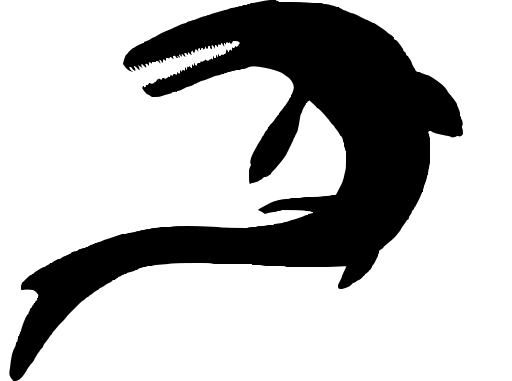
- Mosasaurus: A giant sea lizard up to about 12 m long, a relative of snakes and monitor lizards. It died out 66 million years ago. Found 2 times, from 83.6 to 72.2 million years ago.
- Equus (horse): The horse genus, with zebras and donkeys. Horses evolved in North America and died out there in the Ice Age. Found 7 times, from 4.7 to 0.01 million years ago.
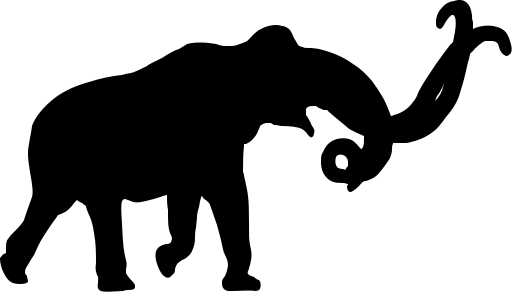
- Mammuthus (mammoth): An Ice Age elephant relative with long curved tusks. Woolly mammoths lived in the north, Columbian ones farther south. Found 4 times, from 1.4 to 0.01 million years ago.
- Baculites (baculite): An ammonite with a straight, rod-shaped shell instead of a coil, common in Late Cretaceous seas. Found 27 times, from 101 to 66 million years ago.
- Squalicorax (crow shark): A Late Cretaceous shark with serrated, triangular teeth. Its name means crow shark. Found 10 times, from 93.9 to 72.2 million years ago.
- Mammut (mastodon): A browsing Ice Age elephant relative with long, upward-curving tusks and ridged, low-crowned teeth. Not a mammoth. Found 2 times, from 12.5 to 0.21 million years ago.
- Tylosaurus: A Late Cretaceous mosasaur about 12 m long, with a toothless bony tip on its snout. Found 1 time, from 83.6 to 72.2 million years ago.
- Deinosuchus: A giant alligator relative up to about 10 m long. Tooth marks on dinosaur bones suggest it ate dinosaurs. Found 2 times, from 83.6 to 72.2 million years ago.
- Bison: The bison genus. Ice Age bison were larger than today's, and Bison latifrons had horns spanning about 2 m. Found 3 times, from 1.4 to 0.01 million years ago.
- Megalonyx (Jefferson's ground sloth): A ground sloth about 3 m long. Thomas Jefferson described its claw bones in 1797 and named it for the claw. Found 1 time, from 1.4 to 0.21 million years ago.
- Canis (wolf, coyote or dog): The genus of wolves, coyotes and dogs. Ice Age fossils include gray wolves. The dire wolf now has its own genus. Found 4 times, from 0.13 to 0 million years ago.
State symbols
- State fossil: Duck-billed dinosaur (Maiasaura) (adopted 1985) Read the statute
MCA 1-1-509: "The duck-billed dinosaur Maiasaura peeblesorum is the official Montana state fossil." Enacted Sec. 1 Ch. 37 Laws of 1985. Statute calls a dinosaur the state fossil; no separate state dinosaur. Fetched and verified.
How the land changed
Every fossil records the place it was buried in. Reading those places period by period shows how Montana changed.
- Cambrian (539 to 487 Ma): most fossils from this time come from a shallow sea.
- Devonian (420 to 359 Ma): most fossils from this time come from a shallow sea.
- Carboniferous (359 to 299 Ma): most fossils from this time come from a shallow sea.
- Cretaceous (143 to 66 Ma): most fossils from this time come from dry land.
- Paleogene (66 to 23 Ma): most fossils from this time come from dry land.
- Neogene (23 to 2.6 Ma): most fossils from this time come from rivers and lakes.
Oldest and youngest finds in Montana
The oldest find in the Montana record is Acrothele, dated to about 510 million years ago. The youngest is Spermophilus, from the last 12,000 years.
Fossil finds in Montana by period
| Period | Million years ago | Finds | Most common group |
|---|---|---|---|
| Cambrian | 539 to 487 | 302 | Invertebrates |
| Ordovician | 487 to 443 | 202 | Invertebrates |
| Devonian | 420 to 359 | 693 | Invertebrates |
| Carboniferous | 359 to 299 | 1,063 | Invertebrates |
| Permian | 299 to 252 | 180 | Invertebrates |
| Triassic | 252 to 201 | 151 | Invertebrates |
| Jurassic | 201 to 143 | 276 | Invertebrates |
| Cretaceous | 143 to 66 | 3,613 | Dinosaurs |
| Paleogene | 66 to 23 | 2,921 | Mammals |
| Neogene | 23 to 2.6 | 608 | Plants and algae |
| Quaternary | 2.6 to 0 | 99 | Mammals |
Frequently asked questions
What is the state fossil of Montana?
Montana has designated Duck-billed dinosaur (Maiasaura) as its state fossil, adopted in 1985.
What dinosaurs have been found in Montana?
The best-documented dinosaurs in the Montana record are Triceratops, Tyrannosaurus, Allosaurus, Ankylosaurus and Apatosaurus. The Paleobiology Database lists 896 dinosaur finds there.
How many fossils have been found in Montana?
The Paleobiology Database records 10,138 fossil finds in Montana, covering 1,801 kinds of animals, plants and other life.
What is the oldest fossil found in Montana?
The oldest find in the Montana record is Acrothele, dated to about 510 million years ago.
How can I see fossils near me in Montana?
Type a town or ZIP code into the search box at the top of this page, or use your location, to see the fossils recorded within 25 to 200 km. Natural history museums and state fossil parks are the best places to see real specimens.
Keep exploring
More fossil states: California, Texas, Wyoming, Florida, Utah, New Mexico, all 50 states.
Credits and data
- Fossil finds: the Paleobiology Database, licensed CC BY 4.0. Counts are records in the database, which reflect research effort as well as geology.
- Ancient Earth maps and plate motion: PALEOMAP PaleoDEMs, Scotese and Wright (2018), CC BY 4.0, doi:10.5281/zenodo.5460860.
- Place names: US Census Gazetteer (public domain) and GeoNames, CC BY 4.0.
- Silhouettes: PhyloPic contributors (Jagged Fang Designs, artrociraptor, Marie Aimee ALLARD, Itai Fein, Amy Beauvois, David Orr, U.S. National Park Service (vectorized by William Gearty), Margot Michaud, An Ignorant Atheist, Steven Traver, Scott Hartman, B Kimmel).