
No dinosaur fossils have been recorded in Florida. The Paleobiology Database has none, and only 28 of its 18,915 Florida records are older than the Paleogene. The state is a limestone platform that spent much of its history under a shallow sea, and its fossils are sharks, shells and mammals.
Florida was under that sea 50 million years ago. The Neogene has 9,187 records and the Quaternary 7,546. Shells dominate, with 454 records of the cone snail Conus and 269 of the clam Anadara.
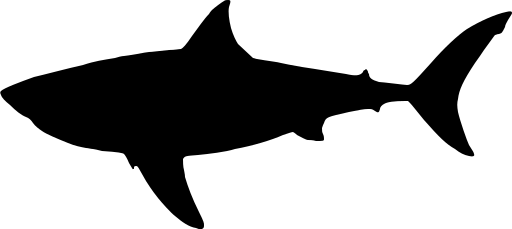
The big animals come from the phosphate country of central Florida. Phosphate was found along the Peace River in 1881, in gravel full of fossil bone, and the river still washes out shark teeth. Otodus, the megalodon shark, has 22 records and Carcharodon, the white shark genus, 21.
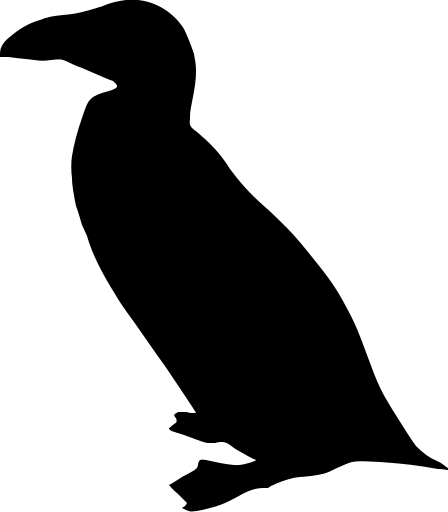
The ice age filled the land with mammoths (31 records), mastodons (30), Smilodon (18) and bison (19). Florida also has five records of Pinguinus, the great auk, a flightless North Atlantic seabird that is now extinct.
Florida has no official state fossil.
Other fossils found in Florida
Beyond dinosaurs, the Florida record includes these animals and plants.
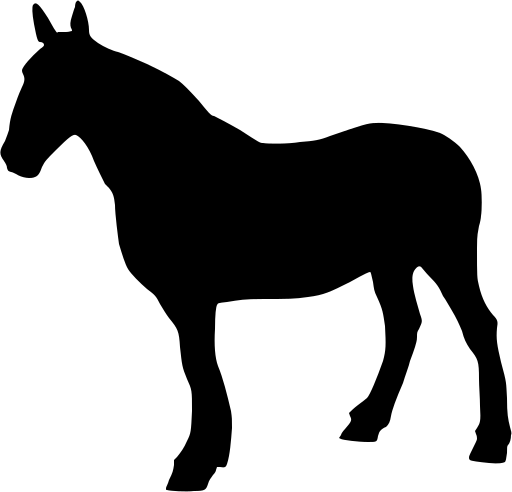
- Equus (horse): The horse genus, with zebras and donkeys. Horses evolved in North America and died out there in the Ice Age. Found 75 times, from 9.4 to 0.01 million years ago.
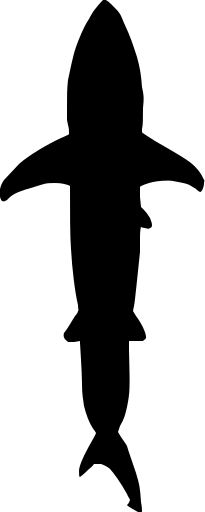
- Otodus (megalodon): The largest known predatory shark, about 15 m long, with teeth up to 18 cm. It died out about 3.6 million years ago. Found 22 times, from 31.8 to 1.8 million years ago.
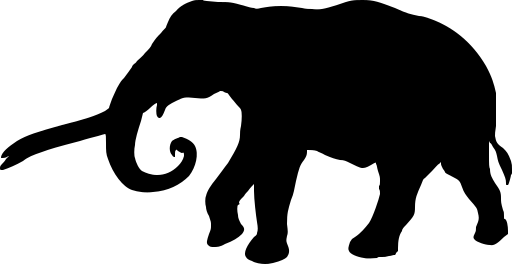
- Mammuthus (mammoth): An Ice Age elephant relative with long curved tusks. Woolly mammoths lived in the north, Columbian ones farther south. Found 31 times, from 5.3 to 0.01 million years ago.
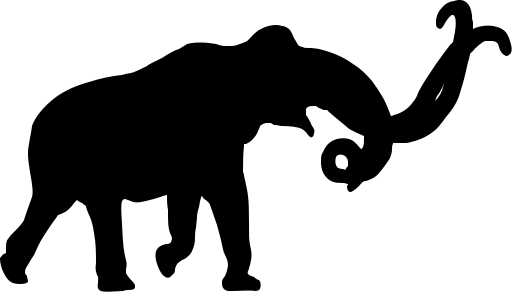
- Mammut (mastodon): A browsing Ice Age elephant relative with long, upward-curving tusks and ridged, low-crowned teeth. Not a mammoth. Found 30 times, from 11.6 to 0.01 million years ago.
- Pinguinus (great auk): A flightless seabird of the North Atlantic that was hunted to extinction. The last were killed in 1844. Found 5 times, from 0.77 to 0 million years ago.
- Conus (cone snail): A cone snail. Living cone snails hunt with a venomous harpoon-like tooth. Found 454 times, from 37.7 to 0 million years ago.
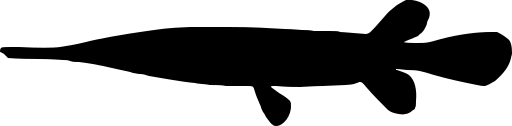
- Lepisosteus (gar): A gar: a fish with a long toothy snout and thick, diamond-shaped scales. The genus still lives in North American rivers. Found 18 times, from 41 to 0 million years ago.
- Alligator: A crocodile relative. Found 31 times, from 29.5 to 0 million years ago.
- Anadara (ark clam): An ark clam, one of the few clams with red blood that carries hemoglobin. Found 269 times, from 33.9 to 0.01 million years ago.
- Momipites: A microfossil: a pollen grain from a walnut-family tree. Common in Paleocene rock. Found 2 times, from 48.1 to 37.7 million years ago.
- Carcharodon: A mackerel shark. Found 21 times, from 31.8 to 0.21 million years ago.
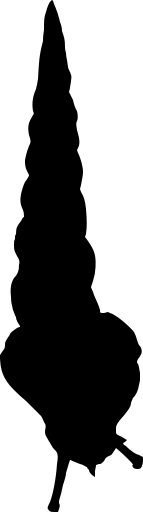
- Turritella (turret shell): A tall spiral snail. In some Cretaceous and younger rock layers its shells are so numerous they form much of the stone. Found 184 times, from 37.7 to 0.01 million years ago.
How the land changed
Every fossil records the place it was buried in. Reading those places period by period shows how Florida changed.
- Ordovician (487 to 443 Ma): most fossils from this time come from a shallow sea.
- Silurian (443 to 420 Ma): most fossils from this time come from a shallow sea.
- Devonian (420 to 359 Ma): most fossils from this time come from a shallow sea.
- Paleogene (66 to 23 Ma): most fossils from this time come from a shallow sea.
- Neogene (23 to 2.6 Ma): most fossils from this time come from a shallow sea.
- Quaternary (2.6 to 0 Ma): most fossils from this time come from a coast or delta.
Oldest and youngest finds in Florida
The oldest find in the Florida record is Colpocoryphe, dated to about 468 million years ago. The youngest is Conus, from the last 12,000 years.
Fossil finds in Florida by period
| Period | Million years ago | Finds | Most common group |
|---|---|---|---|
| Ordovician | 487 to 443 | 3 | Invertebrates |
| Silurian | 443 to 420 | 8 | Invertebrates |
| Devonian | 420 to 359 | 17 | Invertebrates |
| Paleogene | 66 to 23 | 2,154 | Invertebrates |
| Neogene | 23 to 2.6 | 9,187 | Invertebrates |
| Quaternary | 2.6 to 0 | 7,546 | Invertebrates |
Frequently asked questions
How many fossils have been found in Florida?
The Paleobiology Database records 18,915 fossil finds in Florida, covering 1,840 kinds of animals, plants and other life.
What is the oldest fossil found in Florida?
The oldest find in the Florida record is Colpocoryphe, dated to about 468 million years ago.
How can I see fossils near me in Florida?
Type a town or ZIP code into the search box at the top of this page, or use your location, to see the fossils recorded within 25 to 200 km. Natural history museums and state fossil parks are the best places to see real specimens.
Keep exploring
More fossil states: California, Texas, Wyoming, Utah, New Mexico, Montana, all 50 states.
Credits and data
- Fossil finds: the Paleobiology Database, licensed CC BY 4.0. Counts are records in the database, which reflect research effort as well as geology.
- Ancient Earth maps and plate motion: PALEOMAP PaleoDEMs, Scotese and Wright (2018), CC BY 4.0, doi:10.5281/zenodo.5460860.
- Place names: US Census Gazetteer (public domain) and GeoNames, CC BY 4.0.
- Silhouettes: PhyloPic contributors (David Orr, Vincent BACHA, U.S. National Park Service (vectorized by William Gearty), Steven Traver, John James Audubon (Modified), Guillaume Dera, Christoph Schomburg, Caleb M. Gordon, Katie S. Collins).