

Texas has produced Permian fin-backed reptiles, Cretaceous dinosaur tracks and bones, a giant pterosaur and ice age mammoths. The Paleobiology Database holds 52,738 fossil records from the state, and 19,122 of them come from the Permian.
That Permian record is the red beds of north-central Texas, where Edward Drinker Cope collected the sail-backed Dimetrodon in the 1870s. The database lists 70 Dimetrodon finds dated from about 299 to 267 million years ago, tens of millions of years before the first dinosaurs.
The dinosaurs are Cretaceous. In Dinosaur Valley State Park the Paluxy River has cut into the Glen Rose Formation and exposed sauropod and theropod tracks pressed into lime mud on an ancient shoreline. In Big Bend, a graduate student found the first Quetzalcoatlus bones in the Javelina Formation in 1971; its wingspan reached about 10 m. Alamosaurus, a long-necked giant recorded 11 times, lived there between 72 and 66 million years ago.
A shallow sea covered Texas 80 million years ago, and it left its own fossils: 91 records of the rod-shaped ammonite Baculites and 39 of the crow shark Squalicorax.
Texas has no state fossil. Its state dinosaur, Paluxysaurus, is listed in the Paleobiology Database as a synonym of Sauroposeidon, an Early Cretaceous sauropod.
Dinosaurs found in Texas
The Paleobiology Database lists 359 dinosaur finds in Texas. These are the best documented.
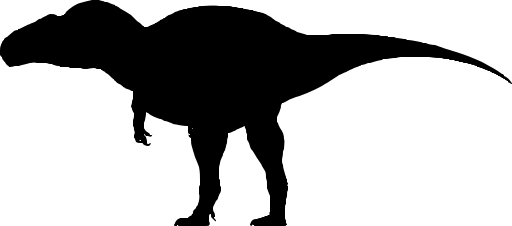
- Acrocanthosaurus: An Early Cretaceous predator about 11 m long with tall spines along its back, among the largest of its time. Found 1 time, from 120 to 113 million years ago.
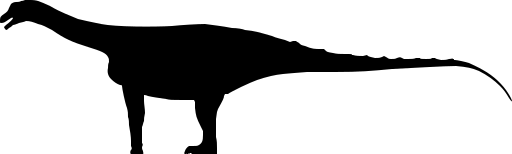
- Alamosaurus: A giant Late Cretaceous long-necked plant eater, among the last sauropods in North America. Found 11 times, from 72.2 to 66 million years ago.
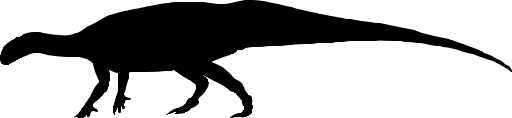
- Tenontosaurus: An Early Cretaceous plant eater about 7 m long. Fossils of the predator Deinonychus are often found near its bones. Found 5 times, from 120 to 110 million years ago.
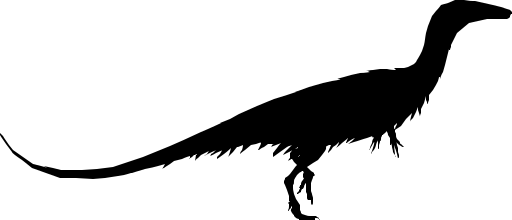
- Coelophysis: A slim Triassic predator about 3 m long. One quarry holds hundreds of its skeletons. Found 4 times, from 237 to 201 million years ago.
- Torosaurus: A Late Cretaceous horned dinosaur with a skull up to about 2.5 m long, one of the longest of any land animal. Found 2 times, from 72.2 to 66 million years ago.
- Camarasaurus: A long-necked plant eater with a short, blunt skull and spoon-shaped teeth. Common in Late Jurassic rock. Found 1 time, from 155 to 143 million years ago.
- Sauroposeidon: An Early Cretaceous sauropod known from neck bones. Its neck is estimated at about 11.5 m long. Found 1 time, from 120 to 113 million years ago.
- Eubrontes: Large three-toed footprints over 25 cm long, made by a big meat-eating dinosaur. Common in Early Jurassic rock. Found 8 times, from 113 to 110 million years ago.
- Saurornitholestes: A small Late Cretaceous raptor about 1.8 m long, with a sickle-shaped claw on each foot. Found 19 times, from 83.6 to 66 million years ago.
- Richardoestesia: A small Late Cretaceous predator known from teeth and jaw pieces. Named in 1990 for paleontologist Richard Estes. Found 13 times, from 83.6 to 72.2 million years ago.
- Edmontonia: A Late Cretaceous armored dinosaur about 6 m long with big shoulder spikes and no tail club. Found 3 times, from 83.6 to 72.2 million years ago.
- Agujaceratops: A horned dinosaur. Found 14 times, from 83.6 to 72.2 million years ago.
Other fossils found in Texas
Beyond dinosaurs, the Texas record includes these animals and plants.
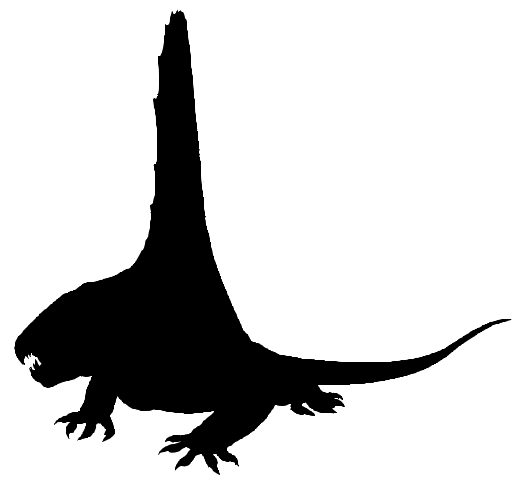
- Dimetrodon: A sail-backed predator up to about 4 m long, from the Early Permian. Closer kin to mammals than to dinosaurs. Found 70 times, from 299 to 267 million years ago.
- Equus (horse): The horse genus, with zebras and donkeys. Horses evolved in North America and died out there in the Ice Age. Found 80 times, from 5.3 to 0.01 million years ago.
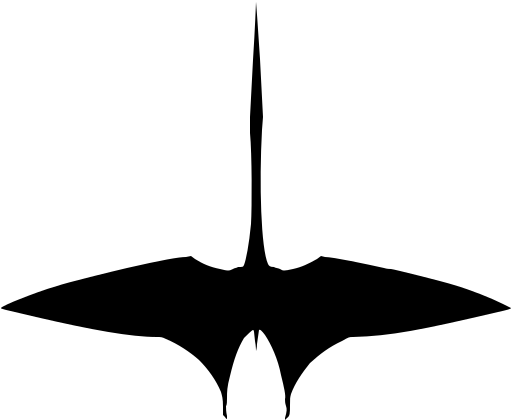
- Quetzalcoatlus: One of the largest flying animals ever, with a wingspan of about 10 m. It was a pterosaur, not a dinosaur. Found 8 times, from 72.2 to 66 million years ago.
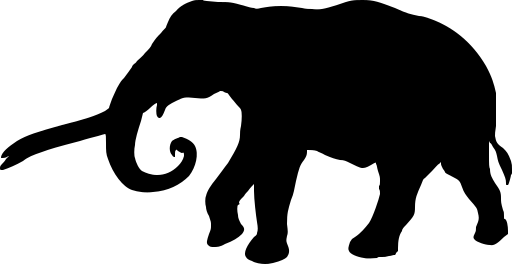
- Mammuthus (mammoth): An Ice Age elephant relative with long curved tusks. Woolly mammoths lived in the north, Columbian ones farther south. Found 31 times, from 2.6 to 0.01 million years ago.
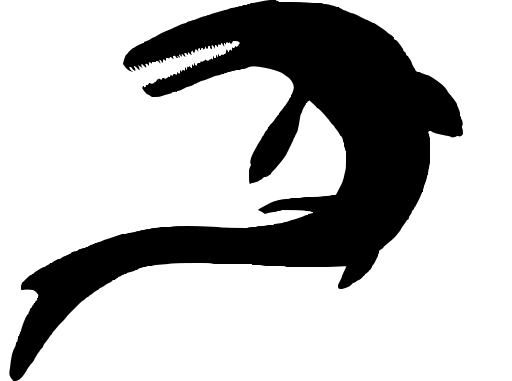
- Mosasaurus: A giant sea lizard up to about 12 m long, a relative of snakes and monitor lizards. It died out 66 million years ago. Found 2 times, from 83.6 to 72.2 million years ago.
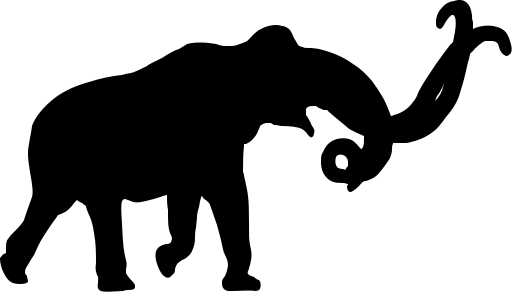
- Mammut (mastodon): A browsing Ice Age elephant relative with long, upward-curving tusks and ridged, low-crowned teeth. Not a mammoth. Found 24 times, from 23 to 0.01 million years ago.
- Baculites (baculite): An ammonite with a straight, rod-shaped shell instead of a coil, common in Late Cretaceous seas. Found 91 times, from 101 to 56 million years ago.
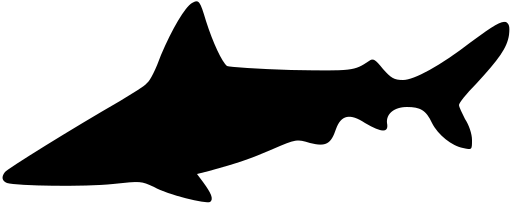
- Squalicorax (crow shark): A Late Cretaceous shark with serrated, triangular teeth. Its name means crow shark. Found 39 times, from 106 to 61.7 million years ago.
- Bison: The bison genus. Ice Age bison were larger than today's, and Bison latifrons had horns spanning about 2 m. Found 34 times, from 4.7 to 0 million years ago.
- Smilodon (sabre-toothed cat): An Ice Age big cat with upper canines up to 18 cm long. Often called a sabre-toothed tiger, but not a tiger. Found 5 times, from 2.6 to 0.01 million years ago.
- Megalonyx (Jefferson's ground sloth): A ground sloth about 3 m long. Thomas Jefferson described its claw bones in 1797 and named it for the claw. Found 15 times, from 9.4 to 0.01 million years ago.
- Diplocaulus: An amphibian up to 1 m long with a boomerang-shaped head. The head may have worked like a hydrofoil in water. Found 51 times, from 290 to 267 million years ago.
State symbols
- State dinosaur: Paluxysaurus jonesi (adopted 2009) Read the statute
Designated by concurrent resolution H.C.R. 16 (81st Leg. 2009) as 'official Lone Star State Dinosaur' replacing Pleurocoelus (S.C.R. 57 75th Leg. 1997). Texas State Library symbols page (tsl.texas.gov/ref/abouttx/symbols.html) confirms. PBDB: Paluxysaurus is a subjective synonym of Sauroposeidon (Wedel et al. 2000).
How the land changed
Every fossil records the place it was buried in. Reading those places period by period shows how Texas changed.
- Carboniferous (359 to 299 Ma): most fossils from this time come from a shallow sea.
- Permian (299 to 252 Ma): most fossils from this time come from a shallow sea.
- Cretaceous (143 to 66 Ma): most fossils from this time come from a shallow sea.
- Paleogene (66 to 23 Ma): most fossils from this time come from a shallow sea.
- Neogene (23 to 2.6 Ma): most fossils from this time come from dry land.
- Quaternary (2.6 to 0 Ma): most fossils from this time come from dry land.
Oldest and youngest finds in Texas
The oldest find in the Texas record is Tricrepicephalus, dated to about 505 million years ago. The youngest is Bison, from the last 12,000 years.
Fossil finds in Texas by period
| Period | Million years ago | Finds | Most common group |
|---|---|---|---|
| Cambrian | 539 to 487 | 1,021 | Invertebrates |
| Ordovician | 487 to 443 | 467 | Invertebrates |
| Silurian | 443 to 420 | 118 | Fish and sharks |
| Devonian | 420 to 359 | 15 | Fish and sharks |
| Carboniferous | 359 to 299 | 6,157 | Invertebrates |
| Permian | 299 to 252 | 19,122 | Invertebrates |
| Triassic | 252 to 201 | 455 | Reptiles, amphibians and birds |
| Jurassic | 201 to 143 | 16 | Invertebrates |
| Cretaceous | 143 to 66 | 11,595 | Invertebrates |
| Paleogene | 66 to 23 | 11,107 | Invertebrates |
| Neogene | 23 to 2.6 | 1,527 | Mammals |
| Quaternary | 2.6 to 0 | 1,134 | Mammals |
Frequently asked questions
What is the state dinosaur of Texas?
Paluxysaurus jonesi is the official state dinosaur of Texas, adopted in 2009.
What dinosaurs have been found in Texas?
The best-documented dinosaurs in the Texas record are Acrocanthosaurus, Alamosaurus, Tenontosaurus, Coelophysis and Torosaurus. The Paleobiology Database lists 359 dinosaur finds there.
How many fossils have been found in Texas?
The Paleobiology Database records 52,738 fossil finds in Texas, covering 3,925 kinds of animals, plants and other life.
What is the oldest fossil found in Texas?
The oldest find in the Texas record is Tricrepicephalus, dated to about 505 million years ago.
How can I see fossils near me in Texas?
Type a town or ZIP code into the search box at the top of this page, or use your location, to see the fossils recorded within 25 to 200 km. Natural history museums and state fossil parks are the best places to see real specimens.
Keep exploring
More fossil states: California, Wyoming, Florida, Utah, New Mexico, Montana, all 50 states.
Credits and data
- Fossil finds: the Paleobiology Database, licensed CC BY 4.0. Counts are records in the database, which reflect research effort as well as geology.
- Ancient Earth maps and plate motion: PALEOMAP PaleoDEMs, Scotese and Wright (2018), CC BY 4.0, doi:10.5281/zenodo.5460860.
- Place names: US Census Gazetteer (public domain) and GeoNames, CC BY 4.0.
- Silhouettes: PhyloPic contributors (Dmitry Bogdanov, David Orr, Jagged Fang Designs, Mark P. Witton & Darren Naish, U.S. National Park Service (vectorized by William Gearty), Amy Beauvois, Ryan Santos Soledade, Steven Traver, Matt Dempsey, Tasman Dixon, Margot Michaud, An Ignorant Atheist).