Virginia has more than 4,400 documented caves, and almost all of them are west of the Blue Ridge. Only a small group is set up for visitors with lights, walkways and a guide. This post covers that group, explains why the caves are where they are, and tells you what to know before you try anything wilder.
Contents
- TLDR
- Why Virginia has so many caves
- Virginia show caves compared
- The Shenandoah Valley caves
- Caves in Southwest and Central Virginia
- Two caves that aren’t in Virginia
- Which cave should you pick
- Planning your visit
- Wild caves and caving in Virginia
- White-nose syndrome and your gear
TLDR
- Best overall: Luray Caverns. It’s the largest and most polished, with paved, level walkways and the Great Stalacpipe Organ.
- Best for formations up close: Skyline Caverns in Front Royal, known for rare anthodites.
- Best for history: Grand Caverns in Grottoes, a show cave since 1806.
- Easiest entry: Shenandoah Caverns, which uses an elevator and mostly level paths.
- Best outdoors-plus-cave stop: Natural Tunnel State Park in far Southwest Virginia.
- Every cave stays near 54F year-round. Bring a light jacket in July.
Why Virginia has so many caves
Caves form where water can dissolve rock, and limestone dissolves. Rain picks up carbon dioxide from air and soil, becomes weakly acidic, and seeps down through cracks in carbonate rock. Over hundreds of thousands of years those cracks widen into passages.
Virginia’s limestone and dolomite sit in the Valley and Ridge province, the long belt of folded rock running from the Shenandoah Valley down to the Tennessee line. East of the Blue Ridge the bedrock is mostly granite, schist and other rock that doesn’t dissolve, so the cave count drops sharply. The same limit shows up farther north, where few caves form in Massachusetts because its bedrock holds little soluble rock. That’s why the cave map of Virginia looks like a stripe down the western side of the state.
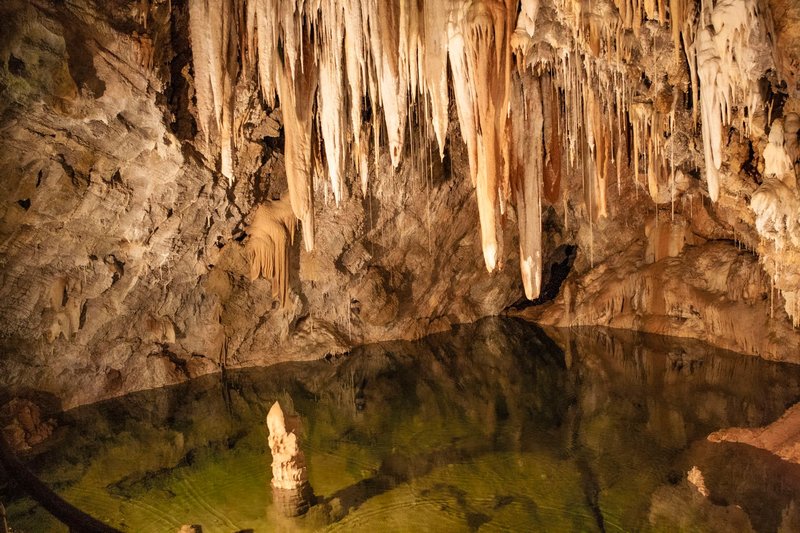
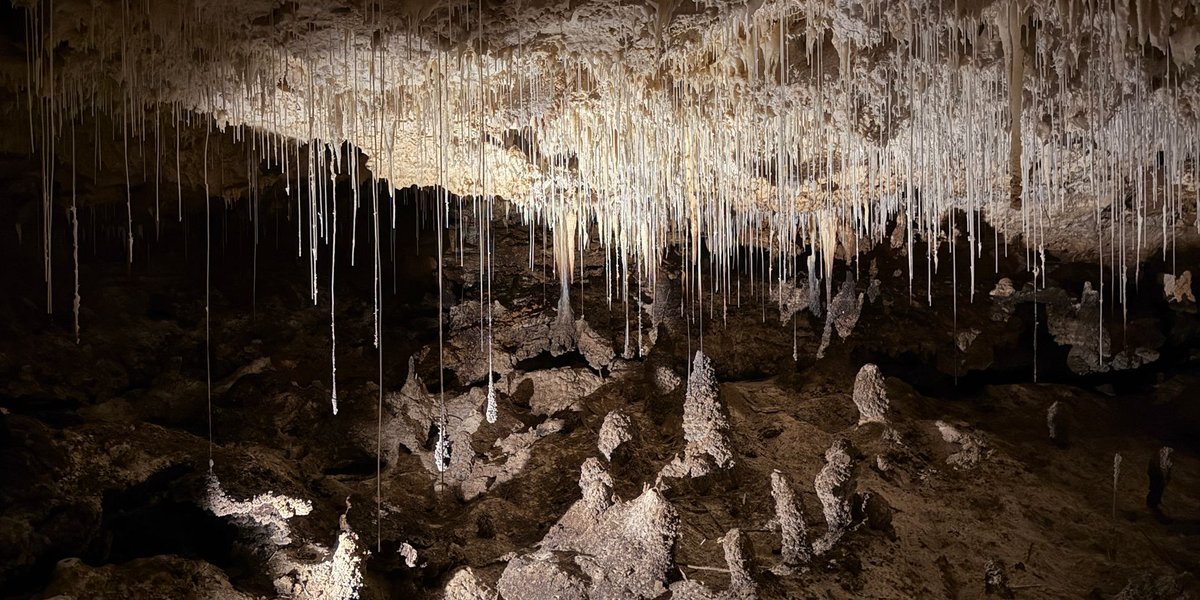
The same water builds the formations. Each drop leaves a film of calcite as it falls or runs. Stalactites hang, stalagmites rise, flowstone drapes the walls. Growth is slow, often well under an inch per century, so a column taller than you took longer to form than most human civilizations have existed. It’s also why guides tell you not to touch anything: skin oils stop the calcite from depositing on that spot.
Cave air also tracks the average yearly temperature outside. In the Virginia valleys that works out to roughly 54F, summer and winter.
Virginia show caves compared
Prices are approximate adult tickets and change often: $ is under $20, $$ is $20 to $30, and $$$ is over $30. Check each cave’s site for current prices, hours and tour schedules before you drive.
| Cave | Location | Tour length | Price | Accessibility | Best for |
|---|---|---|---|---|---|
| Luray Caverns | Luray, Shenandoah Valley | About 1 hour | $$$ | Paved, level path; wheelchair and stroller friendly | First-timers, families, photographers |
| Skyline Caverns | Front Royal, Shenandoah Valley | About 1 hour | $$ | Some slopes and steps; call ahead | Formations, Skyline Drive trips |
| Shenandoah Caverns | Quicksburg, Shenandoah Valley | About 1 hour | $$ | Elevator entry, mostly level | Kids, limited mobility |
| Grand Caverns | Grottoes, Shenandoah Valley | About 1 hour | $$ | Stairs and uneven floor; call ahead | History, shield formations |
| Endless Caverns | New Market, Shenandoah Valley | About 1 hour | $$ | Call ahead | Confirm status before going |
| Dixie Caverns | Salem, near Roanoke | 45 to 60 minutes | $ to $$ | Stairs; call ahead | Roanoke-area stop |
| Natural Tunnel | Duffield, Southwest Virginia | Self-guided | $ (park fee) | Chairlift to tunnel floor | Scenery, trains, hiking |
All the show caves sit within a degree or two of 54F, so don’t pick one for the temperature. Pick by location and by what you want to look at.
The Shenandoah Valley caves
Five of the seven stops above are within about a 90-minute drive of each other along I-81 and US-11 and US-340. That makes the valley the best place in the state to cave-hop.
Luray Caverns
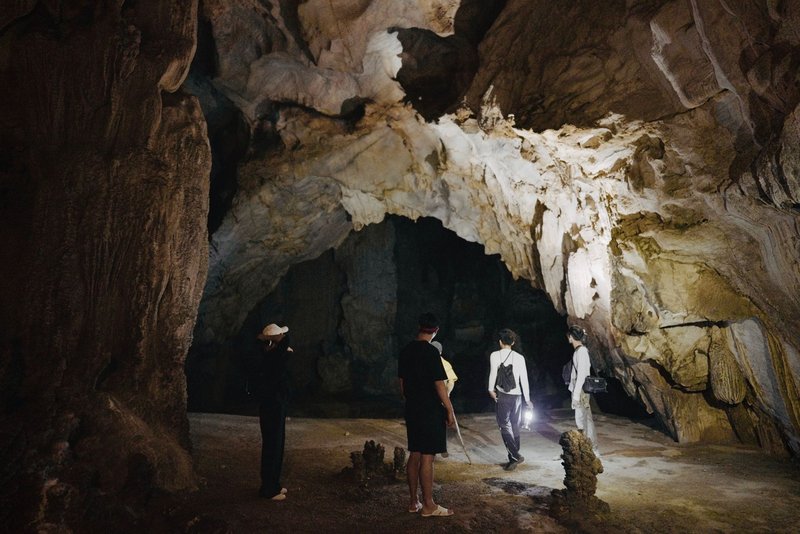
Luray is the benchmark. It was found in 1878, and it’s often described as the largest caverns in the eastern United States. The tour runs about a mile and a quarter on paved paths, which is why it works for strollers and wheelchairs when most caves can’t.
The signature stop is the Great Stalacpipe Organ. Leland Sprinkle, a mathematician and electronics engineer, wired rubber-tipped mallets to stalactites across about 3.5 acres of the cave in the 1950s. Each stalactite is tuned by where it’s struck, and the guide plays hymns and folk tunes through the whole room. The other draw is Dream Lake, a shallow pool so still that it doubles the ceiling and fools first-time visitors about its depth.
The trade-off is crowds. On fall weekends the groups are large, and it’s the most expensive ticket on this list.
Skyline Caverns
Skyline sits at the northern end of Skyline Drive in Front Royal, which makes it the natural first or last stop on a Shenandoah National Park trip. It was opened to the public in the late 1930s.
What sets it apart is the anthodites: clusters of thin white crystals that grow outward in all directions like spiky flowers. They’re rare in show caves, and Skyline is the one to visit if you want to see them rather than hear about them. Compared with Luray, it’s smaller and quieter, and the guides have more time for questions.
Shenandoah Caverns
Railroad workers found this cave in 1884, and it has been a stop in the valley ever since. The elevator entry and mostly level route make it one of the easier tours, and the rooms are packed with draperies and translucent banded flowstone that guides call bacon. Good for families with small kids or older relatives who want a cave without stairs.
Grand Caverns
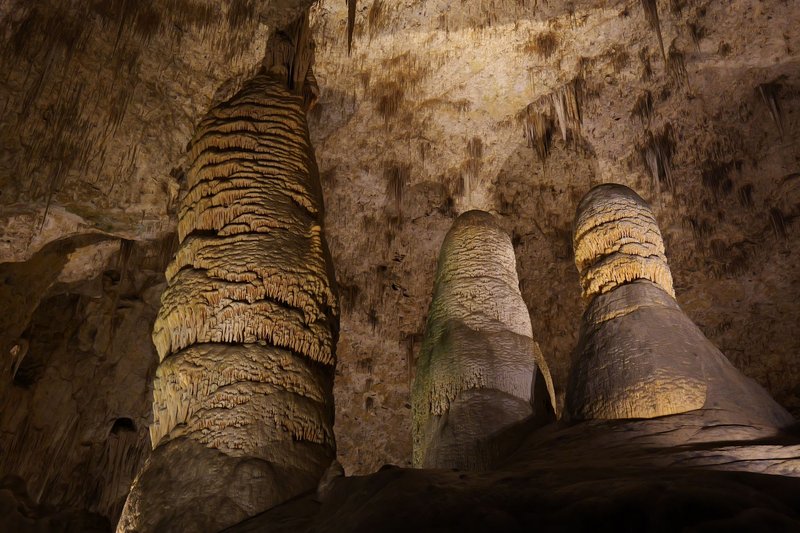
Grand Caverns started life as Weyer’s Cave after Bernard Weyer found it in 1804, and it began taking visitors in 1806. That makes it the oldest continuously operating show cave in the United States. Soldiers from both sides signed the walls during the Civil War, and the largest chamber was used as a ballroom, which is where the cave’s name comes from.
It’s also known for shields, flat disc-shaped formations that grow from fractures in the rock and are rare in most caves. Grand Caverns is owned by the town of Grottoes and is run as a regional park, so the feel is less theme park and more local landmark. The floor is uneven in places, so wear shoes with grip.
Endless Caverns
Endless Caverns near New Market got its name because early explorers kept finding more passage. The cave has been a tourist attraction since the 1920s. Tour operations there have varied, so confirm that tours are running and what they cover before you build a day around it.
Caves in Southwest and Central Virginia
South and west of the Shenandoah Valley, the show caves thin out. The two worth knowing sit far apart.
Dixie Caverns
Dixie Caverns is in Salem, just off I-81 beside Roanoke. It’s the practical pick if you’re already in the Roanoke Valley, and it’s best known for the Wedding Bell, a large flowstone formation where couples have posed for photos for decades. Expect a shorter tour than Luray and a more old-school presentation.
Natural Tunnel State Park
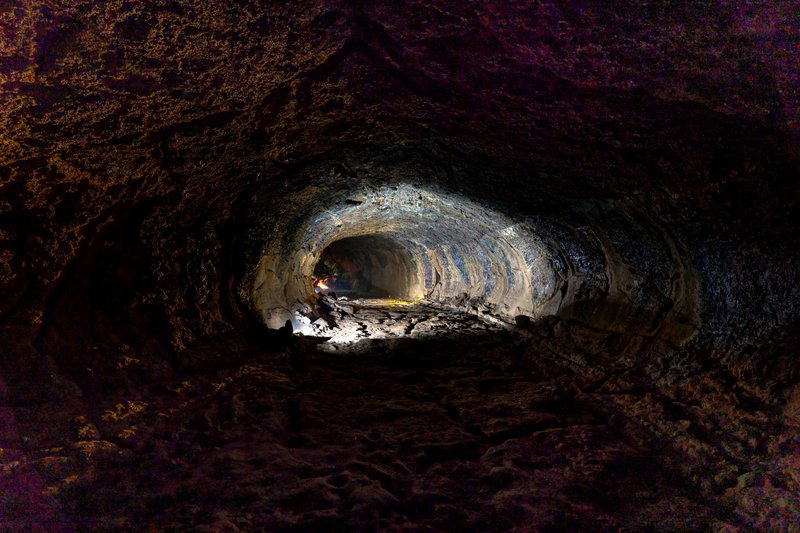
Natural Tunnel isn’t a tour cave. It’s a tunnel that Stock Creek carved through a ridge in Natural Tunnel State Park near Duffield. It’s about 850 feet long and up to roughly ten stories high. William Jennings Bryan called it the eighth wonder of the world, and a railroad line still runs through it today.
A chairlift takes you down to the floor, and walking trails reach the mouth. Check the park for chairlift hours, which are seasonal. Of the caves here, it’s the only one where you might see a freight train pass.
Two caves that aren’t in Virginia
Two names show up in “Virginia caves” lists that don’t belong there.
Sand Cave is in Kentucky. It’s a large sandstone rock shelter in the Cumberland Gap area, not a limestone cave, and it keeps getting dragged into Virginia lists because of its location near the state line.
Lost World Caverns is in Lewisburg, West Virginia. It’s a good cave, and it’s an easy detour if you’re driving through the Greenbrier Valley, but it isn’t a Virginia cave.
Which cave should you pick
- One cave only, first visit: Luray.
- Kids under about 6 or strollers: Luray or Shenandoah Caverns. Both are the most forgiving on stairs.
- Photographers: Skyline for crystals, Luray for Dream Lake reflections.
- History fans: Grand Caverns.
- Heading to Shenandoah National Park anyway: Skyline Caverns, then Luray the same day.
- Staying near Roanoke: Dixie Caverns.
- Want something that isn’t a typical cave tour: Natural Tunnel.
Two itineraries cover most trips. A one-day run goes Skyline in the morning, then south on US-340 to Luray in the afternoon. A weekend adds Shenandoah Caverns and Grand Caverns on the second day, with Endless Caverns as an optional extra if it’s operating. Southwest Virginia is a separate trip, a few hours from the valley.
Planning your visit
Season. The show caves are open year-round, and the constant 54F makes them a cool break in summer and a warm one in winter. Crowds peak on summer holidays and during October foliage. Weekday mornings in late winter are quietest.
What to wear. A light jacket or sweatshirt, and closed-toe shoes with grip. Cave floors are damp and polished by foot traffic. Leave heels and sandals at the hotel.
Combining caves. Going to three in one weekend is fine, but they start to blur. Pick one headline cave and make the others different, such as one for formations and one for history.
Accessibility. Luray is the most accessible, and Shenandoah Caverns is close behind. For the others, call and ask about stairs, slopes and stroller policy, since layouts and rules change.
Wild caves and caving in Virginia
Most of Virginia’s caves have no lights, no guide and no ticket booth. Many are on private land, and some are gated to protect bats or fragile formations. State law prohibits breaking or removing cave formations and disturbing cave life, so this isn’t a place to improvise.
The safest way in is through the National Speleological Society, the national caving non-profit, which has local chapters called grottos. Grottos run trips, teach basic skills like vertical safety, and know which landowners allow access. Beginners should go with an experienced group the first few times. The usual rules apply: three light sources each, a helmet, no solo trips, and tell someone outside where you are.
If you want a taste of off-trail caving without joining anything, check whether a show cave runs an adventure-style or lantern tour on its schedule. Some do, and they’re the legal, guided version.
The state’s Cave and Karst Trail is a good next step if you want to see how caves and sinkholes connect to Virginia’s groundwater and landscape.
White-nose syndrome and your gear
White-nose syndrome is a fungal disease that kills hibernating bats. The fungus, Pseudogymnoascus destructans, was first found in New York in 2006 and reached Virginia a few years later. Bat colonies in the region have dropped sharply since.
People carry the fungus between caves on shoes, clothing and gear. The U.S. Fish and Wildlife Service decontamination protocol covers the details. The short version:
- Don’t wear clothing or shoes into a Virginia cave that you wore in another cave, especially in another state.
- Wash and dry gear after every trip, and follow the current protocol for decontamination.
- Respect seasonal closures. Bats hibernate roughly from fall to spring, and waking them burns fat they can’t replace.
- Show-cave visitors can usually just wear normal clothes, but some caves ask whether you’ve visited other caves recently. Answer honestly.
Virginia’s caves are mostly 54F and mostly dark, and what’s inside them took longer to form than any building you’ll pass on the drive there. Pick one, go, and leave the formations as you found them.