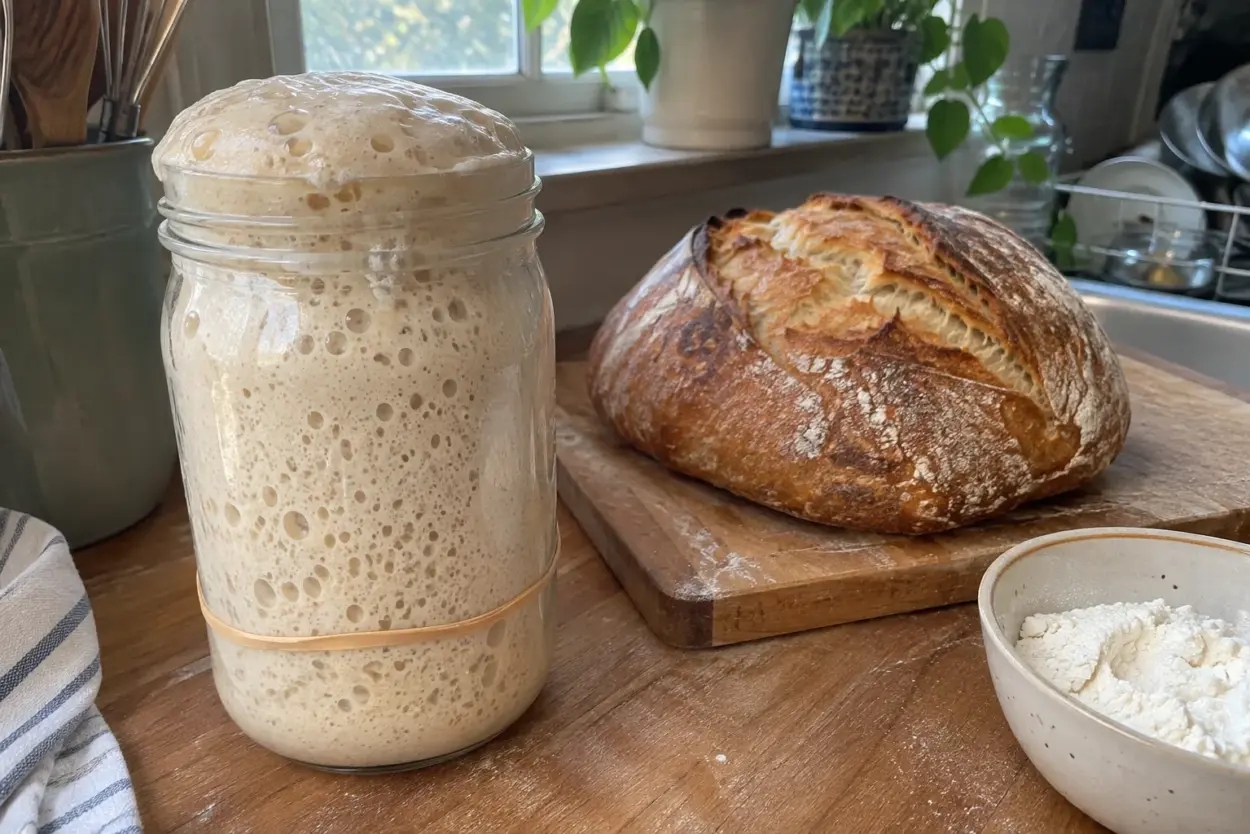
Short answer: stir 50 g of whole wheat or rye flour into 50 g of lukewarm water in a jar and leave it loosely covered at 70 to 75 °F (21 to 24 °C). From day 3, keep 50 g each day, discard the rest and feed it 50 g of flour and 50 g of water. The starter is ready when it doubles within 4 to 8 hours of a feed three days in a row, usually between day 7 and day 14.
I keep a rye starter on the counter and a backup in the fridge, and the method that works is the boring one: weigh everything, keep the jar warm and feed on schedule. A starter is a population of lactic acid bacteria and wild yeast that you select by feeding, and every rule below follows from that. This guide covers the daily schedule, how to feed a mature starter, how to tell when it is ready, a calculator that weighs each feed and predicts the peak, and the microbiology behind each step.
At a glance
What you need
- 50 g whole wheat or rye flour per day (white flour once it is established)
- 50 g lukewarm water per day (tap water is fine for most cities)
- 1 glass jar, about 1 quart (1 L)
- 1 kitchen scale that reads in grams
- 1 rubber band to mark the level
Steps
- Mix 50 g flour and 50 g water. Cover loosely.
- Leave it alone on day 2, even if it rises.
- From day 3: keep 50 g, discard the rest, feed 50 g flour and 50 g water.
- Keep feeding daily until it doubles within 4 to 8 hours.
- Switch to white flour and twice-daily feeds once it is reliable.
Find a warm spot
Temperature decides the schedule more than anything else you control. A starter at 65 °F can take three weeks; the same flour at 75 °F is ready in about ten days. If your kitchen is cold, put the jar in the oven with only the light on, or on top of the fridge, and check it with a thermometer.
This guide contains Amazon affiliate links. 33Science earns a commission on qualifying purchases. See our affiliate disclosure.
Sourdough starter calculator
Choose what you are doing: feeding an established starter, building a levain for a recipe or starting from scratch. The calculator weighs out the starter, flour and water, says how much to discard and estimates the peak time at your kitchen temperature.
Sourdough starter calculator
Pick what you are doing. The calculator weighs out the feed, tells you how much to discard and estimates when the starter will peak at your kitchen temperature.
The peak estimate comes from growth math. Feeding at 1:5:5 dilutes the culture 11 times, so the microbes need about 3.5 doublings to fill the jar back to a ripe starter, against 1.6 doublings for a 1:1:1 feed. That is why a bigger feed buys you a longer gap. Each doubling slows by about half for every 10 °C drop, which is why the same starter peaks in 4 hours in summer and 8 in winter.
Ingredients and tools
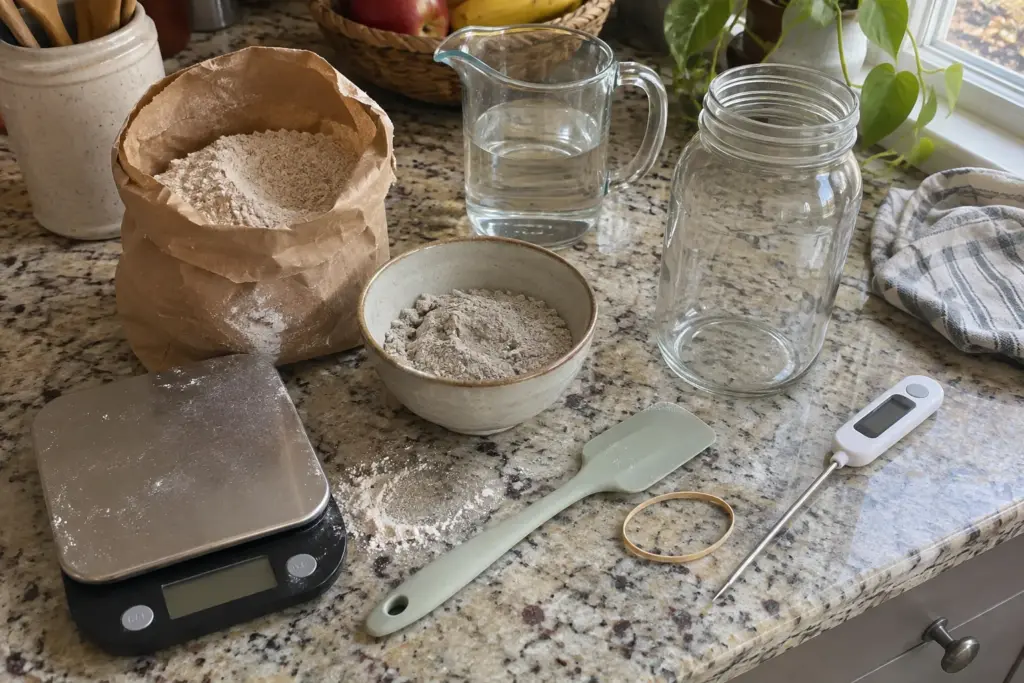
Whole grain flour
Rye or whole wheat: starch, protein, bran, germ
50 g a dayUse whole grain for the first week. The bran carries far more bacteria and yeast than white flour, plus the minerals and enzymes that feed them, so the culture establishes days sooner. Rye is the fastest and most forgiving.
Water
H2O, lukewarm
50 g a dayUse it at 75 to 80 °F to give the jar a warm start. Most municipal tap water works. If your starter stalls and your water smells of chlorine, switch to filtered water.
Bread flour or all-purpose
Refined wheat flour
After day 7Optional. Once the starter is reliable, feeding it white flour gives a milder flavor and a starter that behaves the same as the dough you will bake. Many bakers keep a blend of 80% white and 20% whole grain.
Where the microbes come from
You do not need to catch yeast from the air. When researchers had bakers on two continents make starters from the same recipe, the starter communities most closely matched the microbes already in the flour, with a smaller share in common with the bakers’ hands. Flour is the inoculum; the jar on your counter selects which of its microbes win.
Tools
- A kitchen scale that reads in 1 g steps. Cup measures of flour vary by 20% or more, and that throws off the hydration.
- A wide-mouth glass jar of about 1 quart, so a starter that doubles has room. Straight sides make the rise easy to read.
- A rubber band or a strip of tape to mark the level after each feed
- A small silicone spatula for stirring and scraping the sides
- An instant-read thermometer for the water and the spot where the jar sits
How to make a sourdough starter: day-by-day schedule
The amounts below make a starter that stays at about 150 g after each feed, enough to bake one or two loaves a week. The calculator switches the schedule to a small or large batch and adjusts the timeline for your temperature.
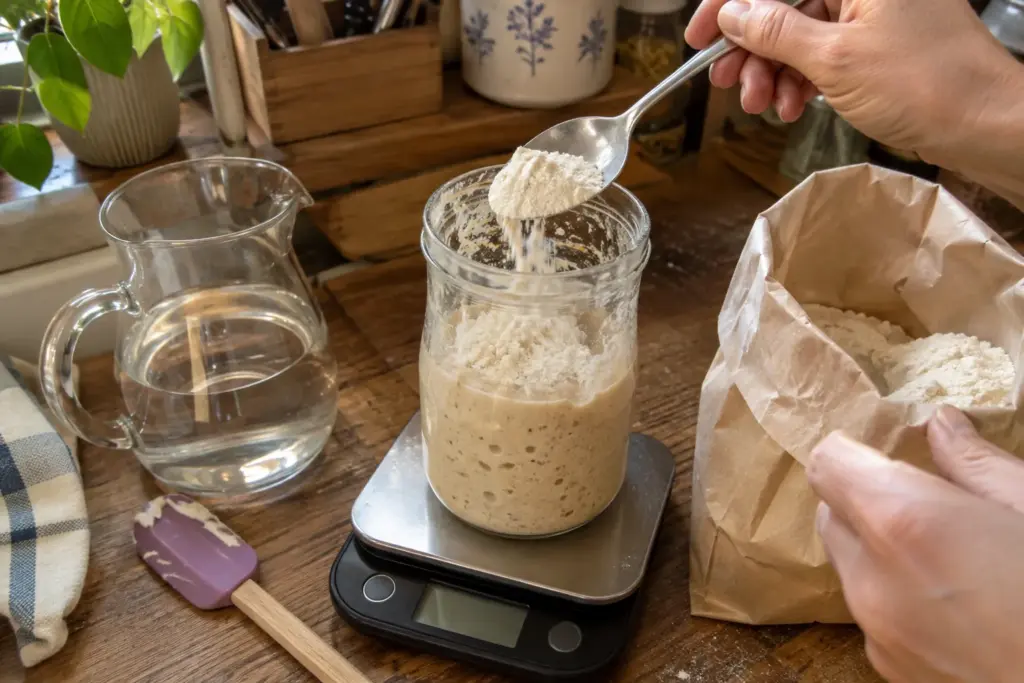
- Day 1: mix. Weigh the empty jar and write the weight on a piece of tape. Add 50 g of whole wheat or rye flour and 50 g of lukewarm water and stir until no dry flour is left. It should look like thick pancake batter. Scrape down the sides, cover loosely with the lid resting on top or a cloth, and leave it in a warm spot.
- Day 2: wait. Stir it once. Many starters bubble and rise on day 2 and smell cheesy, sour or like old socks. That rise comes from bacteria, not yeast. Do not feed yet.
- Day 3: first feed. Stir, then remove all but 50 g (set the jar on the scale and spoon out the excess). Add 50 g of flour and 50 g of water, stir well, scrape down the sides and mark the level with a rubber band.
- Days 4 to 6: keep feeding. Repeat the day 3 feed once a day at about the same time. The jar often goes flat and quiet in this stretch while the acidity climbs. This is normal. Keep feeding.
- Days 7 to 14: watch it rise. Bubbles return, the smell turns to yogurt, beer or green apple, and the starter rises a little higher each day. Once it reaches at least 50% above the rubber band, start feeding twice a day (12 hours apart) at the same 1:1:1 ratio.
- Ready. When it doubles within 4 to 8 hours of a feed for three days in a row, it is ready to bake with. Move it to the feeding routine in the next section.
Use the discard
Discard is not waste. Keep it in a jar in the fridge for up to a week and add it to pancakes, waffles, crackers or flatbread, where baking soda or commercial yeast does the rising. It adds flavor, not lift.
Why discard at all? A starter that is never thinned keeps growing, so each feed has to double the last one. By day 10 you would be adding a kilogram of flour a day. Discarding keeps the food-to-microbe ratio high enough for the culture to grow back on every feed, and it removes acid that would otherwise build up and slow the yeast.
How to feed a mature sourdough starter
Once a starter is established, feed it at the ratio that matches your schedule. The ratio is written as starter:flour:water by weight, so 1:2:2 means 25 g of starter, 50 g of flour and 50 g of water.
- Weigh the starter you keep. Set a clean jar on the scale, tare it and spoon in the amount of old starter the ratio calls for. Discard the rest or save it.
- Add flour and water. Tare again and add the flour, then the water. Use 75 to 80 °F water in winter.
- Stir hard. Mix until smooth and no dry flour remains. Stirring adds oxygen and spreads the microbes through the fresh food.
- Mark and wait. Scrape down the sides, put a rubber band at the level and cover loosely.
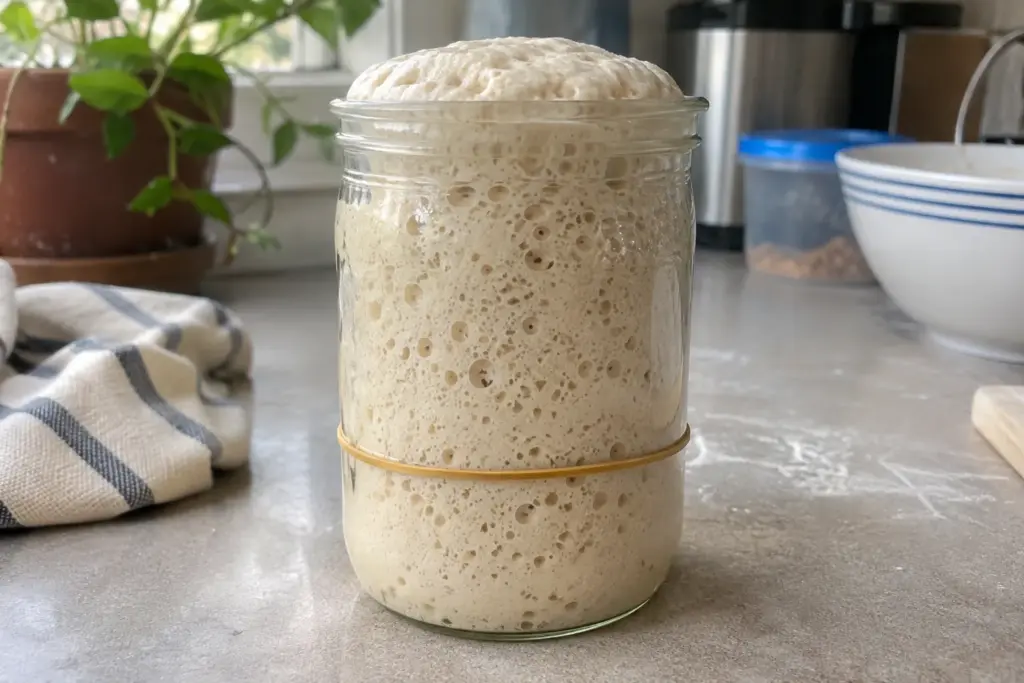
- Use it at the peak. The starter is at its strongest when it has doubled or more, the top is domed and covered in bubbles, and it is just starting to flatten. Mix your dough then.
Feeding ratios and timing
Times are for a mature whole-wheat-fed starter at 100% hydration (equal weights of flour and water). White flour runs about 15% slower, rye about 5% faster than whole wheat.
| Ratio | Dilution | Peak at 68 °F (20 °C) | Peak at 75 °F (24 °C) | Best for |
|---|---|---|---|---|
| 1:1:1 | 3× | 4.5 to 6.5 h | 3.5 to 5 h | Twice-daily feeds, starting a new culture |
| 1:2:2 | 5× | 6 to 8.5 h | 4.5 to 6.5 h | Once-daily feeds |
| 1:5:5 | 11× | 8.5 to 11.5 h | 6.5 to 8.5 h | Overnight before baking |
| 1:10:10 | 21× | 10 to 14 h | 8 to 10.5 h | Warm kitchens, long workdays |
A higher ratio does not weaken the starter. The small seed contains billions of cells, and diluting it only means they need more doublings to fill the jar. Bakers in hot climates use 1:10:10 or more so the starter does not peak and collapse while they sleep.
Feeding a flat starter
Do not feed a starter that has not risen since its last feed. If it is sluggish, the problem is temperature or time, not food. Move it somewhere warmer and wait for it to rise before the next feed; feeding again only dilutes a population that has not grown back.
Is it ready? How to test your starter
Use the rise, not the calendar. A starter that doubles predictably will raise bread; one that only bubbles will not.
- Feed at 1:1:1 and mark the level. Put a rubber band at the top of the freshly fed starter.
- Time the rise. Check every hour or two. Note when it reaches twice the height of the band.
- Repeat for three feeds. Ready means doubling within 4 to 8 hours at 70 to 75 °F, three times in a row. One good day is not enough: the early bacterial bloom can double a jar once and then stall.
- Check the smell and texture. A ready starter smells pleasantly sour, like yogurt or beer, and pulls into stretchy, web-like strands when you lift it with a spoon.
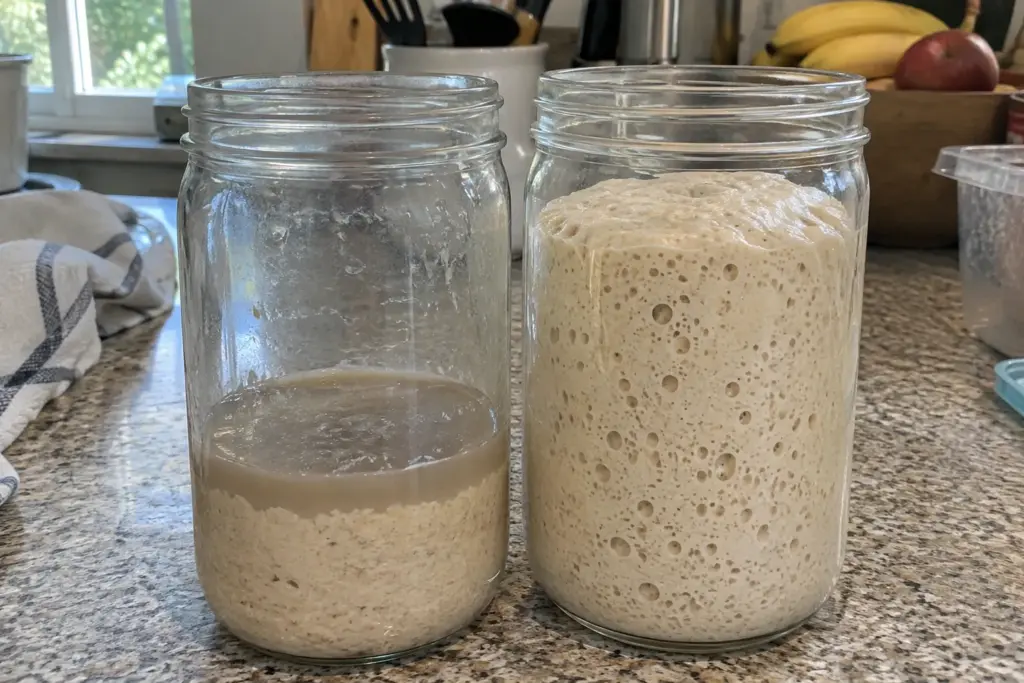
The float test, dropping a spoonful into water to see if it floats, measures trapped gas and nothing else. A stiff starter at its peak floats; a liquid 125% starter often sinks while fully active, because the gas escapes through the thin batter. Trust the doubling.
The science of a sourdough starter
In short
A starter is a selection experiment. Flour brings hundreds of microbial species; each feed and the acid that builds between feeds weed out all but a few acid-tolerant lactic acid bacteria and one or two yeasts. Within about two weeks they form a stable community that outcompetes newcomers.
Who lives in the jar
A mature starter holds roughly 100 million to 1 billion lactic acid bacteria per gram and 1 to 10 million yeast cells, about 100 bacteria for every yeast. The bacteria make the acids that give sourdough its flavor and keep other microbes out; the yeast makes most of the carbon dioxide that raises the bread. The classic bacterium is Fructilactobacillus sanfranciscensis, named for San Francisco but found in starters worldwide, alongside Lactiplantibacillus plantarum and relatives. The yeast is usually Saccharomyces cerevisiae, the same species as baker’s yeast, or Kazachstania humilis. Both are single-celled, like the other unicellular organisms that run most of microbiology.
The largest survey to date sequenced starters from 500 home bakers in North America, Europe and Australasia. The median starter held a single yeast species, but 70 different yeasts turned up across the set. Geography barely mattered: a starter in Sydney was as likely to resemble one in San Francisco as one next door. How the starter was made and fed mattered more. The same study found that acetic acid bacteria, a group bakers rarely think about, explained much of the difference in rise speed and aroma between starters.
Why the first week rises, stalls and rises again
In a study that followed 40 starters made from 10 flours for 14 days, the average pH fell from 5.3 on day 1 to 4.2 on day 2 and 3.7 on day 3, then settled near 3.5 by day 14. The rise followed a different curve: it kept improving until day 10 for most flours and until day 14 for rye, emmer and all-purpose flour.
| Day | Average pH | What dominates |
|---|---|---|
| 1 | 5.3 | Flour microbes of every kind, including Enterobacteriaceae |
| 2 | 4.2 | Fast gas-producing bacteria such as Leuconostoc: the false rise |
| 3 to 6 | 3.7 | Acid-tolerant lactic acid bacteria take over; little gas, a quiet jar |
| 10 to 14 | 3.5 to 3.7 | Stable lactobacilli plus yeast: steady, predictable rise |
The quiet phase has a clear cause. The day-2 gas comes from bacteria like Leuconostoc, which stop growing as the pH drops toward 4.5. In baker Debra Wink’s trials, yeast did not start multiplying in earnest until the pH reached about 3.5. Between those two points almost nothing makes gas, so the jar looks dead. Wink found that starting with acidified water or pineapple juice in place of plain water skipped the bacterial bloom and kept new starters on schedule. It is a useful fix for a starter stuck past day 7, not a requirement.
What the microbes eat and make
Flour is mostly starch, and the microbes cannot use it directly. Amylase enzymes already present in the flour cut starch into maltose, a disaccharide of two glucose units:
(C6H10O5)n + H2O → maltose (C12H22O11) → 2 C6H12O6
The yeast ferments glucose to ethanol and carbon dioxide, the gas that raises the starter:
C6H12O6 → 2 C2H5OH + 2 CO2
The main sourdough lactobacilli are heterofermentative: from each glucose they make lactic acid, carbon dioxide and either ethanol or acetic acid:
C6H12O6 → CH3CH(OH)COOH + C2H5OH + CO2
Lactic acid gives a mild, yogurt-like sourness; acetic acid, the acid in vinegar, gives a sharp tang. Both are organic acids, and together they drop the pH below 4, where most spoilage bacteria cannot grow. The partnership is tidy: F. sanfranciscensis prefers maltose, while K. humilis cannot use maltose at all and lives on the glucose the bacteria release, so the two do not compete for food.
Temperature: bacteria and yeast want different things
Lab measurements put the growth optimum of F. sanfranciscensis at 32 to 33 °C, with growth stopping at 41 °C. The sourdough yeast K. humilis (studied under its older name Candida milleri) grows best at 27 °C and stops at 36 °C. The bacteria also stop growing below about pH 3.9, while the yeast is unaffected anywhere from pH 3.5 to 7. That explains three things bakers notice:
- A warm starter (above 80 °F) turns more sour and less lively, because warmth favors the bacteria over the yeast.
- A cold starter is slow but not dead. Growth roughly halves for every 10 °C drop.
- A starter left long past its peak keeps souring until the acid stops the bacteria, then the hungry yeast makes alcohol: the gray liquid called hooch.
Myths
- “Sourdough needs San Francisco air.” The species named after the city lives in starters on every continent, and flour, not air, supplies the microbes.
- “Chlorinated water kills a starter.” Drinking water is limited to 4 mg/L of chlorine in the US, and most of that reacts with the organic matter in flour within seconds. Most starters do fine on tap water. If yours stalls, filtered water is an easy test.
- “Hooch means it has gone bad.” Hooch is mostly water and ethanol. Pour it off for a milder starter or stir it in for a sourer one, then feed.
- “An old starter makes better bread.” A starter reaches a stable community within weeks. A 100-year-old starter is mostly a story; how you feed it now decides how it behaves.
Storing your starter
| Where | How | Feed | Revive |
|---|---|---|---|
| Counter, 70 to 78 °F | Loosely covered jar | Every 12 to 24 h | Ready to use at each peak |
| Fridge, 38 to 40 °F | Feed, wait 1 to 2 h, then refrigerate | Once a week | Two feeds at room temperature |
| Dried | Spread thin on parchment, dry 2 to 3 days, crumble | Never | Soak flakes in water, then feed daily for 2 to 4 days |
| Frozen | 50 g in a sealed bag | Never | Thaw, then feed daily for 2 to 3 days |
Cold slows the microbes to a crawl without killing them, so a fridge starter survives weeks of neglect. Drying is the best backup: the flakes keep for months in a sealed jar and weigh almost nothing, which makes them easy to share.
Wake it up first
Before baking with a fridge starter, give it two feeds at room temperature. Straight from the fridge, the yeast is still slow and the bread will underproof.
Troubleshooting
| Problem | Cause | Fix |
|---|---|---|
| Rose on day 2, then went flat | Bacterial bloom ended; yeast not established yet | Keep feeding daily. Normal through day 6 |
| No activity after day 7 | Too cold, or white flour only | Move to 75 to 80 °F, feed whole rye, try 1 tbsp pineapple juice in place of water |
| Gray or brown liquid on top | Hooch: hungry starter | Pour off or stir in, then feed. Feed more often or at a higher ratio |
| Smells like nail polish remover | Hungry yeast makes ethyl acetate | Feed twice a day for a few days |
| Rises but collapses fast | Peaks before you see it | Feed at 1:5:5 or use cooler water to slow it |
| Too runny, no dome | Hydration too high or weak flour | Use 10 to 20% less water or more whole grain |
| Fuzzy spots, pink or orange streaks | Mold or contaminating bacteria | Throw the whole jar away |
Do not quit on day 4
The most common way to ruin a new starter is giving up during the quiet days 3 to 6, or tipping it out because it smells bad on day 2. Neither is a sign of failure. Keep feeding on schedule until day 14 before you change anything else.
Safety
Before you start
- Raw flour is a raw food. The FDA warns that flour can carry E. coli and other bacteria and that milling does not kill them. Do not taste raw starter or dough, wash your hands and the counter after handling it, and keep it away from ready-to-eat food. Baking kills these bacteria.
- Mold means discard. Fuzzy growth of any color, or pink, orange or red streaks, mean the jar is contaminated. Do not scrape it off; throw out the whole starter and wash the jar in hot soapy water.
- Do not seal the jar tight. Fermentation makes carbon dioxide, and a sealed jar of active starter builds pressure. Rest the lid on top or use a cloth.
- Sourdough bread is not gluten-free. Fermentation breaks down some gluten, but a wheat or rye sourdough is not safe for people with celiac disease.
Discard can go in the trash or compost. Large amounts poured down the drain can harden into a paste in the trap, so scrape the jar before washing it.
More practical science: browse all our everyday science how-tos, from household chemistry to experiments you can build at home.
Frequently asked questions
Most starters are ready in 7 to 14 days at 70 to 75 degrees Fahrenheit. Cooler kitchens can take three weeks. The starter is ready when it doubles within 4 to 8 hours of a feed three days in a row.
Whole rye or whole wheat flour starts fastest because the bran carries more microbes, minerals and enzymes. Once the starter is established you can feed it bread flour or all-purpose flour.
The early rise comes from gas-producing bacteria, not yeast. They stop as the starter turns acidic, and the yeast takes a few more days to grow. Keep feeding daily and the rise returns.
Yes, unless you want to keep doubling the feed. Discarding keeps the jar a manageable size and keeps the food-to-microbe ratio high enough for the starter to grow back each time. Save the discard for pancakes or crackers.
Use 1:1:1 starter, flour and water by weight for twice-daily feeds, 1:2:2 for once a day and 1:5:5 or 1:10:10 when you need it to peak 8 to 12 hours later.
It is hooch, a mix of water and alcohol made by hungry yeast. It is harmless. Pour it off or stir it in, then feed the starter more often.
Yes, most tap water works. Chlorine levels in drinking water are low and react quickly with the flour. If a starter stalls, try filtered water.
Fuzzy mold or pink, orange or red streaks mean it is contaminated and should be thrown away. A sour, alcoholic or nail polish smell and a gray liquid layer only mean it is hungry.
Yes. Feed it, leave it out for an hour or two, then refrigerate and feed once a week. Give it two feeds at room temperature before baking.
No. Pineapple juice lowers the starting pH and skips the early bacterial bloom, which keeps some starters on schedule, but flour and water alone work.
Sources
- Landis E.A. et al. (2021). The diversity and function of sourdough starter microbiomes. eLife 10:e61644
- McKenney E.A. et al. (2023). Sourdough starters exhibit similar succession patterns but develop flour-specific climax communities. PeerJ 11:e16163
- American Society for Microbiology. The sourdough microbiome (on Reese et al., mSphere 5:e00950-19, 2020)
- Gänzle M.G., Ehmann M., Hammes W.P. (1998). Modeling of growth of Lactobacillus sanfranciscensis and Candida milleri in response to process parameters of sourdough fermentation. Applied and Environmental Microbiology 64(7)
- Wink D. The Pineapple Juice Solution, Part 2. The Fresh Loaf
- American Society of Baking. Sourdough
- U.S. Food and Drug Administration. Flour is a raw food and other safety facts
- U.S. EPA. National Primary Drinking Water Regulations (chlorine MRDL 4 mg/L)
- King Arthur Baking. Sourdough starter recipe