TL;DR
- Virginia has no active volcanoes and none that can realistically erupt again.
- It does have two extinct volcanic sites, both about 48 million years old (Eocene): Mole Hill in Rockingham County near Harrisonburg, and Trimble Knob in Highland County near Monterey.
- Mole Hill is on private land and closed to the public. Trimble Knob can be seen from US 220.
- Older volcanic rock, hundreds of millions of years old, is much more widespread in the state.
Table of Contents
- Does Virginia have volcanoes?
- Mole Hill and Trimble Knob compared
- How the volcanoes formed
- Hotspot or delamination?
- Could a Virginia volcano erupt again?
- Older volcanic rock in Virginia
- Visiting the sites
- FAQ
Does Virginia have volcanoes?
Yes and no. Nothing in Virginia is active, smoking, or monitored for unrest. But the state has the remains of two small volcanoes that erupted roughly 48 million years ago, during the Eocene epoch, which makes them some of the youngest volcanic features on the US East Coast.
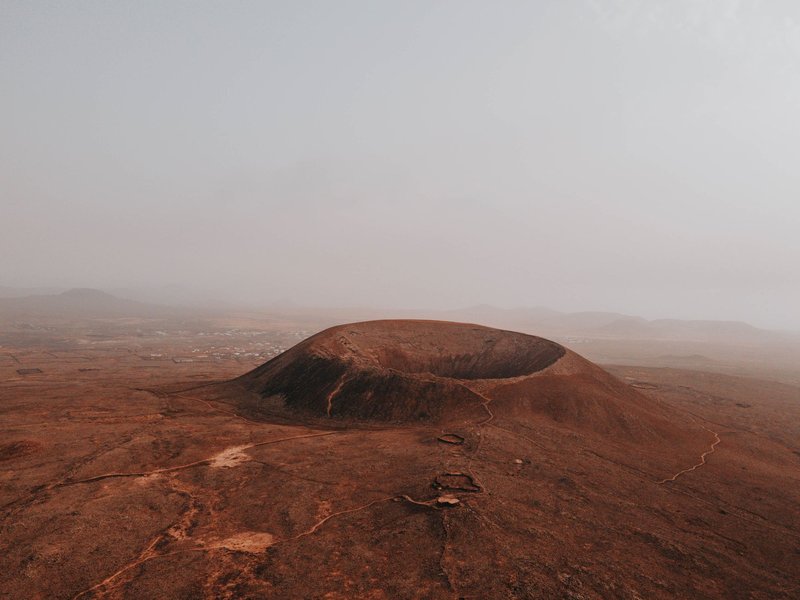
The first is Mole Hill, a rounded rise in Rockingham County just outside Harrisonburg in the Shenandoah Valley. The second is Trimble Knob, a hill in Highland County, near the town of Monterey, up in the mountains along the West Virginia line. Both are made of basalt, the dark, fine-grained rock that cools from runny, iron-rich lava.
Neither looks like a volcano. There’s no crater and no cone. What you’re looking at is the hardened plumbing of a volcano that eroded away around it, which is a different thing and a more interesting one.
Mole Hill and Trimble Knob compared
| Mole Hill | Trimble Knob | |
|---|---|---|
| County | Rockingham | Highland |
| Nearest town | Harrisonburg | Monterey |
| Age | About 48 million years (Eocene) | About 48 million years (Eocene) |
| Rock | Basalt | Basalt |
| What remains | Basalt plug in a former volcanic vent | Exposed basalt hill |
| Public access | None, privately owned | Viewable from US 220 |
| Setting | Shenandoah Valley floor | Allegheny Mountains |
The ages are close enough that geologists treat them as part of one short episode of volcanic activity in the central Appalachians, not as separate events.
How the volcanoes formed
Here’s the sequence researchers have pieced together for Mole Hill, the better-studied of the two.
Magma rose through the crust and hit the layers of limestone and other sedimentary rock that fill the valley. Those rocks hold groundwater. When hot magma meets water underground, the water flashes to steam and the result is an explosion, not a gentle lava flow. These blasts shattered rock and blew out a vent. Magma then filled the vent and hardened as a plug of basalt.
Then came the long part: about 48 million years of erosion. Basalt is harder and more resistant than the limestone and shale around it. Rain, rivers, and frost stripped the soft rock away and left the dense plug standing. The original volcano, whatever it looked like on the surface, is gone. What’s left is the rock that sat underneath it.
That’s why Mole Hill looks like an ordinary hill from the road. The volcanic part is its core.
Hotspot or delamination?
The harder question is why magma showed up here at all. Virginia sits in the middle of a tectonic plate, hundreds of miles from the nearest plate boundary, which is where almost all volcanoes form.
Two main explanations compete.
The hotspot idea. A hotspot is a stationary plume of hot rock rising from deep in the mantle. As a plate slides over it, the plume punches through and makes volcanoes. Hawaii is the textbook case. Applied to Virginia, the argument is that the North American plate passed over a plume about 48 million years ago.
The delamination idea. The base of the continental plate, the dense lower lithosphere, can become unstable and peel away, sinking into the mantle beneath it. Hotter mantle rock then rises to fill the gap, and as it decompresses it melts. Under this model there’s no plume at all. The volcanism is a side effect of the plate’s own bottom layer dropping off.
Recent geochemical work on the Virginia basalts has favored the second explanation, and NASA’s Earth Observatory has a short account of the region’s volcanic past that includes both ideas. The debate isn’t fully closed. The rocks are small in volume and the sample is limited, so researchers are working with a few exposures, not a continent-sized record.
Could a Virginia volcano erupt again?
No, for practical purposes. A few reasons stack up.
- The plumbing is spent. Mole Hill and Trimble Knob are solidified plugs. There’s no magma chamber under them.
- The trigger is gone. Whatever pushed magma upward 48 million years ago, whether a plume or delaminating lithosphere, has long since moved on or finished.
- No plate boundary. Virginia is in the interior of the North American plate. There’s no subduction zone and no rift here.
The volcano monitoring done by the USGS Volcano Hazards Program covers the Cascades, Alaska, Hawaii, and the Marianas, among others. Virginia isn’t on the list because it doesn’t need to be.
Earthquakes are a separate matter. Virginia does get them. The magnitude 5.8 quake near Mineral in Louisa County on August 23, 2011, was felt across much of the East Coast. But it came from slip on an old fault and had nothing to do with magma.
Older volcanic rock in Virginia
If you want volcanic rock you can actually walk up to, look to older formations. Virginia has far more of it than the two Eocene sites suggest.
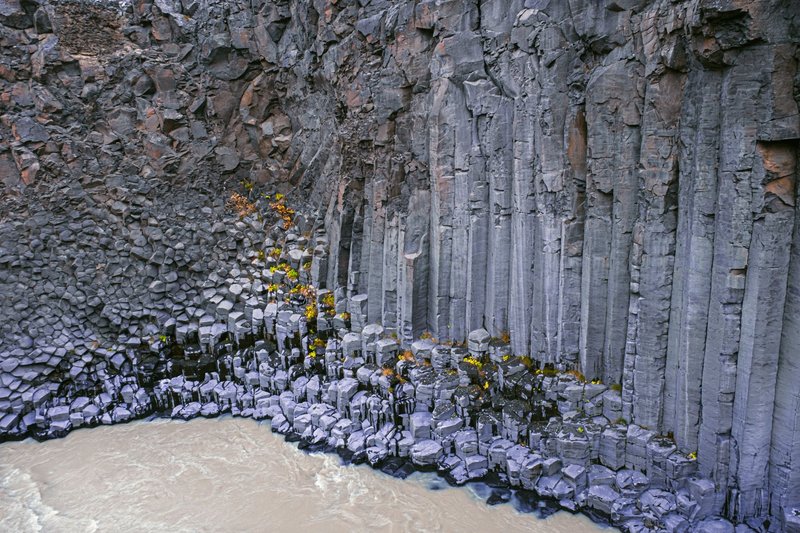
Catoctin greenstone. About 570 million years ago, as the supercontinent Rodinia broke apart, huge basalt flows poured across what is now the Blue Ridge. Later mountain building baked and squeezed these flows, turning the basalt into a greenish metamorphic rock called greenstone. It underlies much of the Blue Ridge, and the National Park Service describes it as a major rock unit in Shenandoah National Park. Drive Skyline Drive and you’ll be passing ancient lava flows at several overlooks.
Triassic basalt. Around 200 million years ago, as the Atlantic began to open, the crust stretched and cracked, forming rift basins across eastern North America. In Virginia, the Culpeper and Danville basins hold basalt flows and intrusions from this period. Parts of Northern Virginia, including areas around Manassas, sit on or near these rocks.
In terms of age, the order runs from Catoctin (about 570 million years), to Triassic (about 200 million), to the Eocene plugs (about 48 million). Mole Hill and Trimble Knob are the late, small epilogue to a very long volcanic history.
Visiting the sites
This is the part most pages skip, and it matters if you’re planning a trip.
Mole Hill is private property and closed to the public. It’s visible from the surrounding area, but you can’t hike it, climb it, or walk onto it. Some online listings make it sound like a stop. It isn’t. If you want to see it up close, the option is to go with a university geology group or a guided field trip arranged with the landowner’s permission.
Trimble Knob is the easier one. You can see it from US 220 in Highland County, so a pull-off and a look is realistic. Treat it as a roadside viewing, not a trail destination, and don’t climb onto adjoining land without permission.
Some practical suggestions:
- Pair it with the geology map. The Virginia Department of Energy’s geology publications and the USGS geologic map of the state show where the Eocene intrusions sit, so you can place them in context.
- Base yourself in Monterey or Harrisonburg. Both have lodging and food, and both put you within a short drive of the sites.
- Check conditions in winter. Highland County is high and mountain roads can ice up. It’s one of the colder parts of the state.
- Go in for the rock, not the view. The payoff is understanding what you’re looking at. Neither site has a visitor center or interpretive signs.
FAQ
Does Virginia have any active volcanoes?
No. Virginia has no active volcanoes and no volcanic hazard zones. The most recent volcanic activity in the state ended around 48 million years ago.
Where are the volcanoes in Virginia?
The two known Eocene volcanic sites are Mole Hill in Rockingham County, near Harrisonburg, and Trimble Knob in Highland County, near Monterey. Older volcanic rocks, such as Catoctin greenstone and Triassic basalt, appear in the Blue Ridge and the Piedmont basins.
How old are Virginia’s volcanoes?
Mole Hill and Trimble Knob are about 48 million years old, from the Eocene epoch. The older Catoctin lavas date to roughly 570 million years ago, and the Triassic basalts to about 200 million years ago.
Are they the youngest volcanoes on the East Coast?
They’re among the youngest volcanic rocks in the eastern US, and they’re regularly described that way. The claim is fair, with the caveat that “youngest” here still means tens of millions of years.
Can you visit Mole Hill?
Not on your own. It’s on private land. Trimble Knob can be seen from US 220.
Is Virginia volcanically active?
No. Virginia is seismically active at a low level, as the 2011 Mineral earthquake showed, but it isn’t volcanically active. Earthquakes there come from old faults, not from magma.