A fatty acid is a molecule made of a carboxyl group (-COOH) attached to a chain of carbon and hydrogen atoms. That’s the whole definition. Everything else, from butter to fish oil to the membrane around each of your cells, comes down to how long that chain is and how many double bonds sit along it.
Contents
- What fatty acids are
- Fatty acids vs. fats
- The main types of fatty acids
- Essential fatty acids
- Omega-3 and omega-6 fatty acids
- What fatty acids do in the body
- Fatty acids in food
- FAQ
- Summary
What fatty acids are

Picture a tadpole. The head is the carboxyl group, which is slightly acidic and mixes well with water. The tail is a hydrocarbon chain, which repels water and mixes well with oil. That split personality is the reason fatty acids can build cell membranes: the heads face the watery outside and inside of the cell, and the tails tuck together in the middle.
Chain length varies a lot. Butyric acid has just four carbons. Palmitic acid, the most common saturated fatty acid in the human body, has sixteen. Most fatty acids in food and in your tissues have an even number of carbons, between 12 and 22, because cells build them two carbons at a time.
Chemists write them in shorthand. Palmitic acid is 16:0, meaning 16 carbons and zero double bonds. Oleic acid, the main fat in olive oil, is 18:1: 18 carbons, one double bond.
Fatty acids vs. fats
People use the words as if they were interchangeable. They aren’t.
A dietary fat, called a triglyceride, is three fatty acids bonded to one glycerol backbone. Your digestive enzymes cut triglycerides apart, and the freed fatty acids are what your gut absorbs. When a nutrition label lists “saturated fat,” it’s describing the fatty acids packed into the triglycerides in that food.
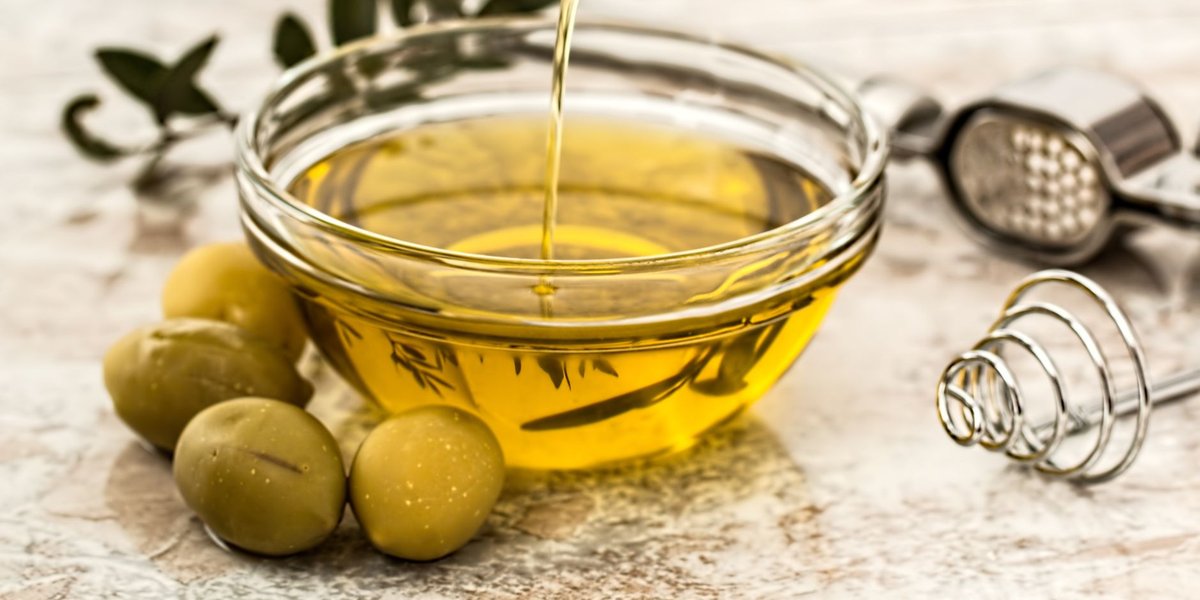
Most real foods contain a mixture. Olive oil is mostly oleic acid, but it also carries palmitic and linoleic acid. Butter is mostly saturated, but about a quarter of its fatty acids are monounsaturated. No food is a pure single type.
The main types of fatty acids
Fatty acids are sorted in a few overlapping ways. The sorting that matters most for health is by double bonds.
Saturated fatty acids have no double bonds. The chain is straight and packs tightly, which is why butter, lard and coconut oil are solid at room temperature. Examples of saturated fats list the saturated fat content of common foods per serving.
Monounsaturated fatty acids have one double bond. The bond puts a kink in the chain, so the molecules don’t stack as neatly and the fat stays liquid. Olive oil is the classic case.
Polyunsaturated fatty acids have two or more double bonds. They stay liquid even in the fridge, which is why fish oil doesn’t solidify.
Trans fatty acids are unsaturated, but with the hydrogen atoms on opposite sides of the double bond. That keeps the chain straight, like a saturated one. Small amounts occur naturally in meat and dairy from ruminants. Most of the trans fat in the diet has historically come from partially hydrogenated vegetable oils, which is an industrial process.
You’ll also see fatty acids grouped by length:
- Short-chain: fewer than 6 carbons. Butyrate (4 carbons) is the best known.
- Medium-chain: 6 to 12 carbons. Found in coconut and palm kernel oil.
- Long-chain: 13 to 21 carbons. Most dietary fatty acids land here.
- Very long-chain: 22 or more carbons.
| Type | Example | Main food sources | Health note |
|---|---|---|---|
| Saturated | Palmitic acid (16:0) | Butter, cheese, red meat, palm oil | Raises LDL cholesterol when it displaces unsaturated fat |
| Monounsaturated | Oleic acid (18:1) | Olive oil, avocado, almonds | Linked to better blood lipid profiles when it replaces saturated fat |
| Polyunsaturated, omega-6 | Linoleic acid (18:2) | Sunflower oil, walnuts, soybean oil | Essential; needed in the diet |
| Polyunsaturated, omega-3 | ALA (18:3), EPA (20:5), DHA (22:6) | Flaxseed, walnuts, salmon, sardines | ALA is essential; EPA and DHA support heart, eye and brain tissue |
| Trans | Elaidic acid (18:1 trans) | Partially hydrogenated oils, some baked goods | Raises LDL and lowers HDL; the WHO wants industrial trans fat eliminated |
| Short-chain | Butyrate (4:0) | Made by gut bacteria from fiber; small amounts in butter | Fuels the cells lining the colon |
Essential fatty acids

“Essential” has a narrow meaning in biochemistry: your body can’t make it, so it has to come from food. Humans lack the enzymes needed to put double bonds at the omega-3 and omega-6 positions of a carbon chain. That leaves exactly two essential fatty acids:
- Linoleic acid (LA), an omega-6.
- Alpha-linolenic acid (ALA), an omega-3.
Every other fatty acid your body uses can be built from these two, from other fats, or from excess carbohydrate. Your liver can convert ALA into EPA and then DHA, but the conversion is slow and inefficient, with most estimates putting it in the single digits for DHA. That’s why dietary EPA and DHA from fish matter, and why strict vegetarians often look at algae-based supplements.
The US National Institutes of Health sets an adequate intake for ALA at 1.6 grams a day for adult men and 1.1 grams for adult women. A tablespoon of ground flaxseed or a small handful of walnuts covers it.
Omega-3 and omega-6 fatty acids
The numbers refer to where the first double bond sits, counting from the far end of the chain, the methyl end. In an omega-3, it’s the third carbon. In an omega-6, the sixth.
That position changes what your body makes from them. Omega-6 fatty acids feed the production of signaling molecules involved in inflammation, blood clotting and immune response. Omega-3-derived molecules tend to be less inflammatory, and some actively help resolve inflammation. Both sets are necessary. You need inflammation to fight infection and heal a cut.
The two families compete for the same enzymes, which is the origin of the “omega-6 to omega-3 ratio” debate. Typical Western diets run heavy on omega-6 from refined seed oils and light on omega-3. The practical fix is less complicated than the debate: eat more omega-3 sources, rather than obsessing over cutting omega-6, which is the family that includes the linoleic acid you need.
What fatty acids do in the body
Energy. Fat delivers about 9 calories per gram, more than double carbohydrate or protein. Your cells break fatty acids down in the mitochondria through beta-oxidation, snipping off two carbons at a time. At rest, a large share of the energy your muscles and heart use comes from fatty acids.
Cell membranes. Every cell is wrapped in a double layer of phospholipids, each built from two fatty acids and a phosphate head. The mix of fatty acids sets how fluid the membrane is. Kinked unsaturated chains keep it flexible; straight saturated chains make it firmer. DHA is concentrated in the retina and in brain tissue, where membrane fluidity affects how signals pass.
Signaling. Fatty acids like arachidonic acid (an omega-6) and EPA are converted into eicosanoids, short-lived hormone-like molecules that regulate blood vessel tone, pain, fever and clotting. Aspirin works by blocking one enzyme in this pathway.
Absorption of vitamins. Vitamins A, D, E and K dissolve in fat. A salad eaten with no fat at all delivers fewer of them.
Gut health. Short-chain fatty acids such as butyrate, acetate and propionate are produced when gut bacteria ferment dietary fiber. Butyrate is the preferred fuel of the cells lining the colon.
Fatty acids in food
The practical takeaway: it’s the pattern across your diet that counts, not any single food.
- Monounsaturated: olive oil, avocados, almonds, peanuts, canola oil.
- Omega-6: sunflower, corn and soybean oils, most nuts and seeds.
- Omega-3 (ALA): flaxseed, chia seeds, walnuts, canola oil.
- Omega-3 (EPA and DHA): salmon, sardines, mackerel, herring, trout, and algae oil.
- Saturated: butter, cheese, fatty cuts of meat, coconut oil, palm oil.
- Trans: fried fast food, some packaged pastries and margarines made with partially hydrogenated oil.
On the saturated end, the NHS advises swapping saturated fat for unsaturated where you can. The swap is the point: replacing saturated fat with polyunsaturated or monounsaturated fat lowers LDL cholesterol, while replacing it with refined carbohydrate does not do the same job.
On trans fat, the World Health Organization links intake to higher risk of heart disease and has called for industrially produced trans fat to be eliminated from the global food supply. Several countries have already banned partially hydrogenated oils, which makes it much rarer than it was twenty years ago.
For fish, health agencies commonly suggest two servings a week, with at least one being an oily fish. The same NIH fact sheet notes that most of the evidence for EPA and DHA comes from food rather than supplements.
FAQ
What is the simplest definition of a fatty acid? A carboxylic acid with a long hydrocarbon tail. The acid end bonds to other molecules; the tail stores energy and gives fats their oily behavior.
Which fatty acids are essential? Two: linoleic acid (omega-6) and alpha-linolenic acid (omega-3). Your body can’t synthesize them, so they must come from food.
Are all saturated fatty acids equally bad? No. Stearic acid (18:0) has a smaller effect on LDL cholesterol than palmitic acid (16:0). Food context also matters: saturated fat in whole dairy behaves differently in studies than saturated fat in processed meat. The usual guidance is still to limit total saturated fat, and the WHO recommends keeping it below 10% of energy intake.
Is omega-3 better than omega-6? Neither is better. You need both, and most people already get plenty of omega-6. Omega-3 is the one more diets fall short on.
Are short-chain fatty acids the same as the fat in food? Mostly not. The short-chain fatty acids that matter for health, like butyrate, are made in your colon from fiber rather than eaten as fat. That’s one of the reasons fiber matters.
Can the body make its own fatty acids? Yes, apart from the two essential ones. The liver converts excess carbohydrate into palmitic acid and builds other fatty acids from that starting point.
Summary
Fatty acids are carbon chains with an acid group at one end, and their length and double bonds determine their behavior. Saturated ones are straight and solid, unsaturated ones are kinked and liquid, and trans ones are unsaturated but behave like saturated. Two of them, linoleic acid and alpha-linolenic acid, are essential and must be eaten. Beyond fuel, fatty acids build cell membranes, make signaling molecules and help you absorb fat-soluble vitamins. For most people, a good fatty acid profile means more fish, nuts, seeds and olive oil, less processed food, and no need to memorize a single ratio.