
This page has free printable periodic tables of all 118 elements: color, black and white, blank, blank with atomic numbers, and a kids version, plus a one-page element list. Each table prints on one landscape page, every PDF comes in US Letter and A4, and all are free for classroom and home use. Download one below or build your own.
Color periodic table
US Letter · 1 page · 342 KB · PDF
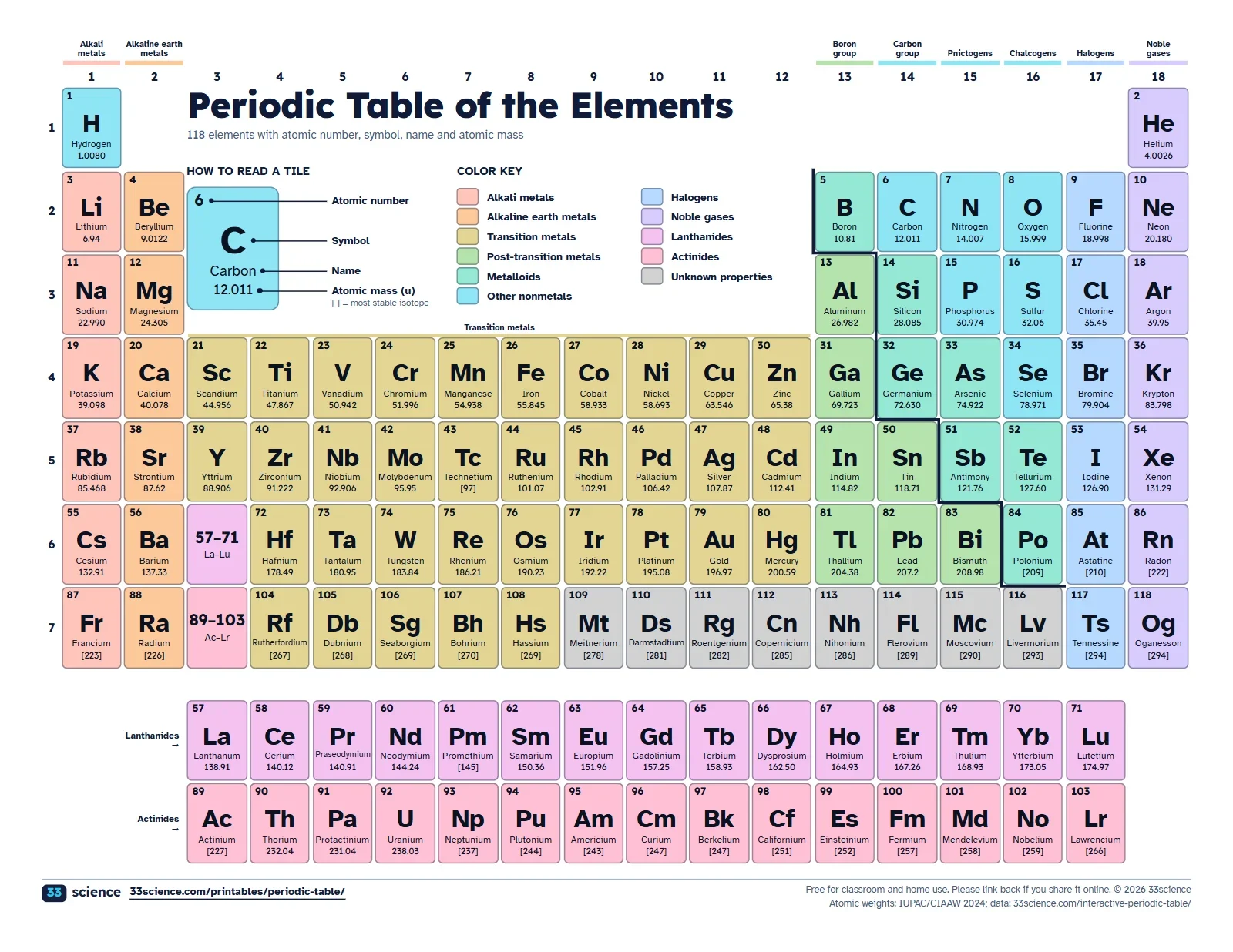
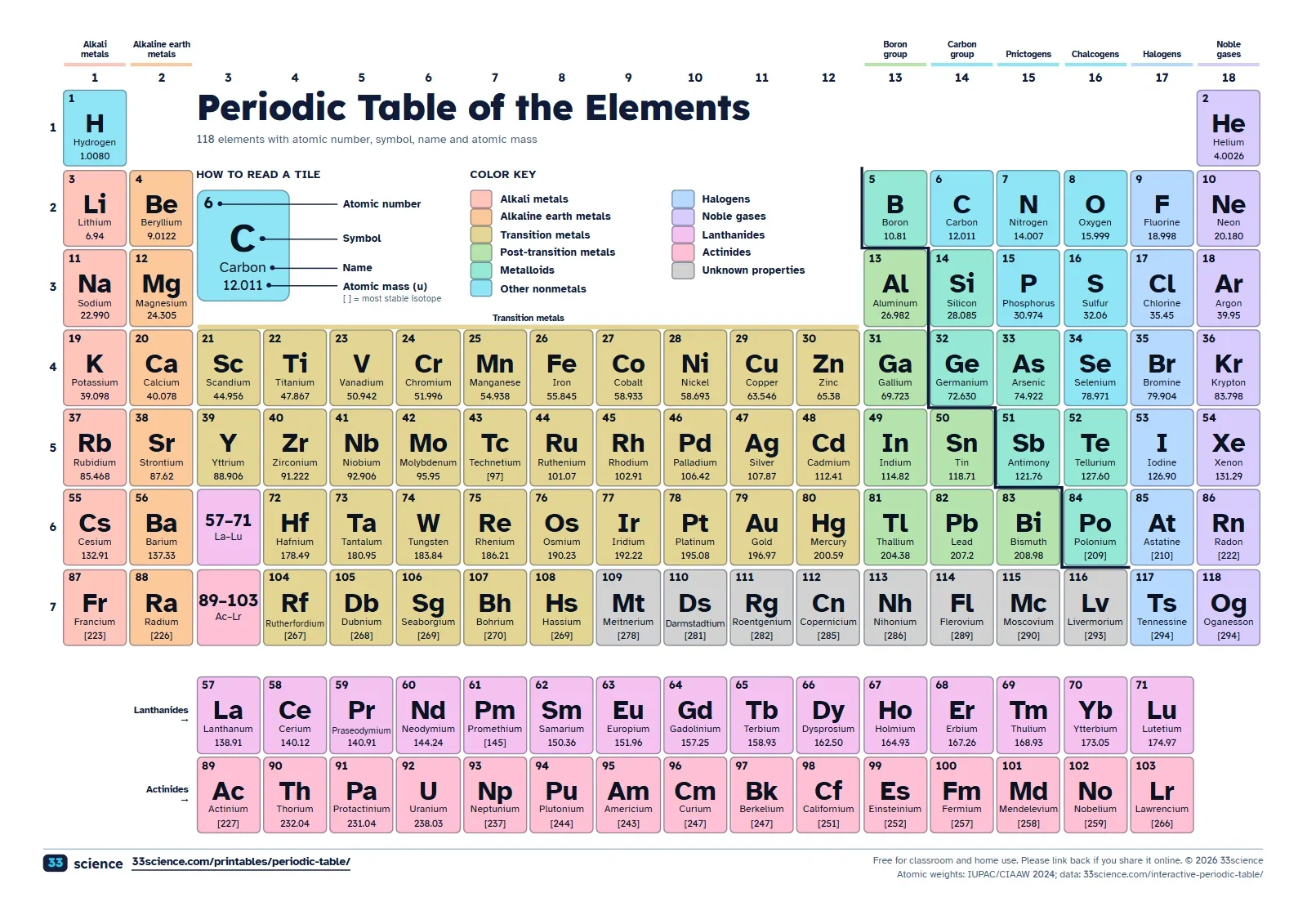
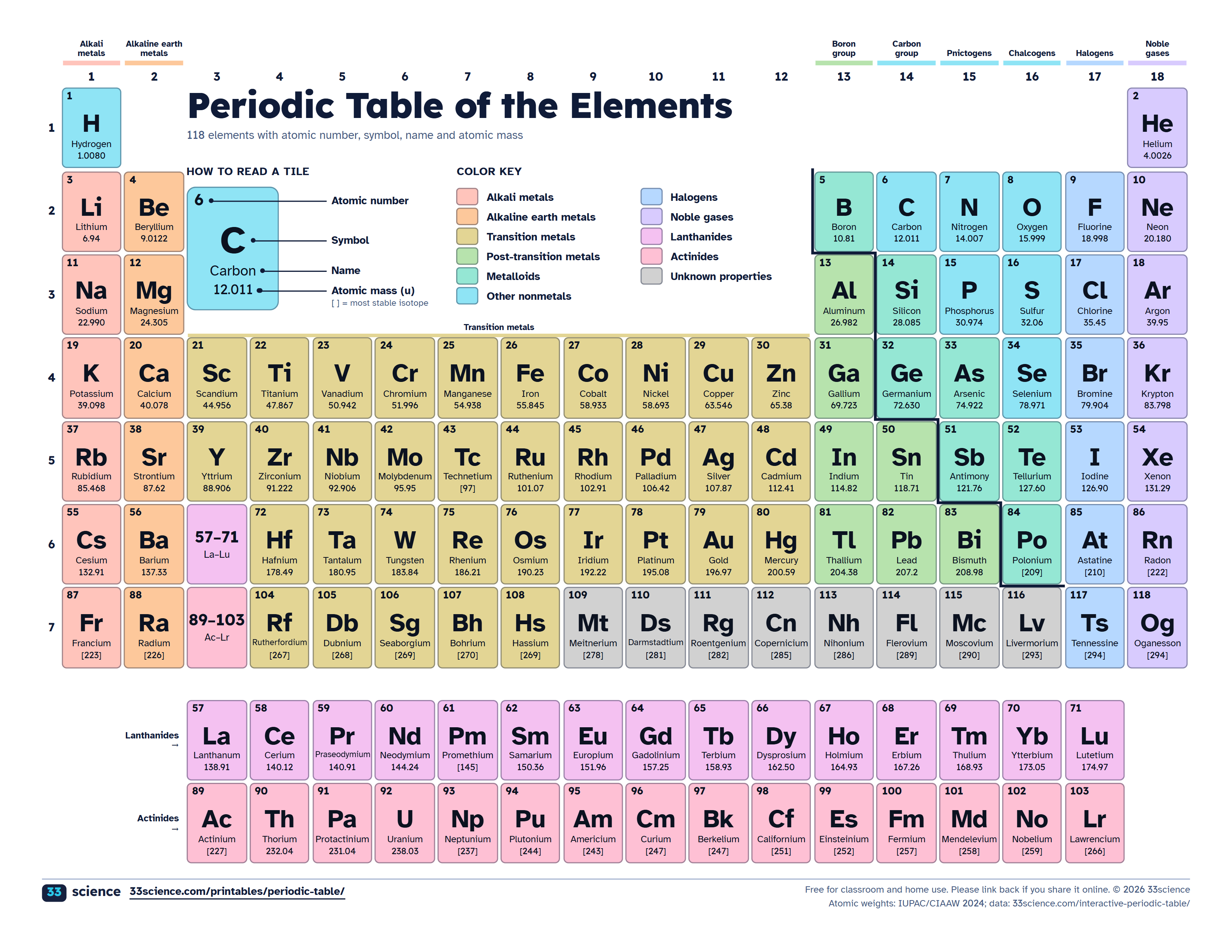
Atomic number, symbol, name and atomic mass for all 118 elements, colored by element type, with groups, periods and a color key.
Black and white periodic table
US Letter · 1 page · 333 KB · PDF
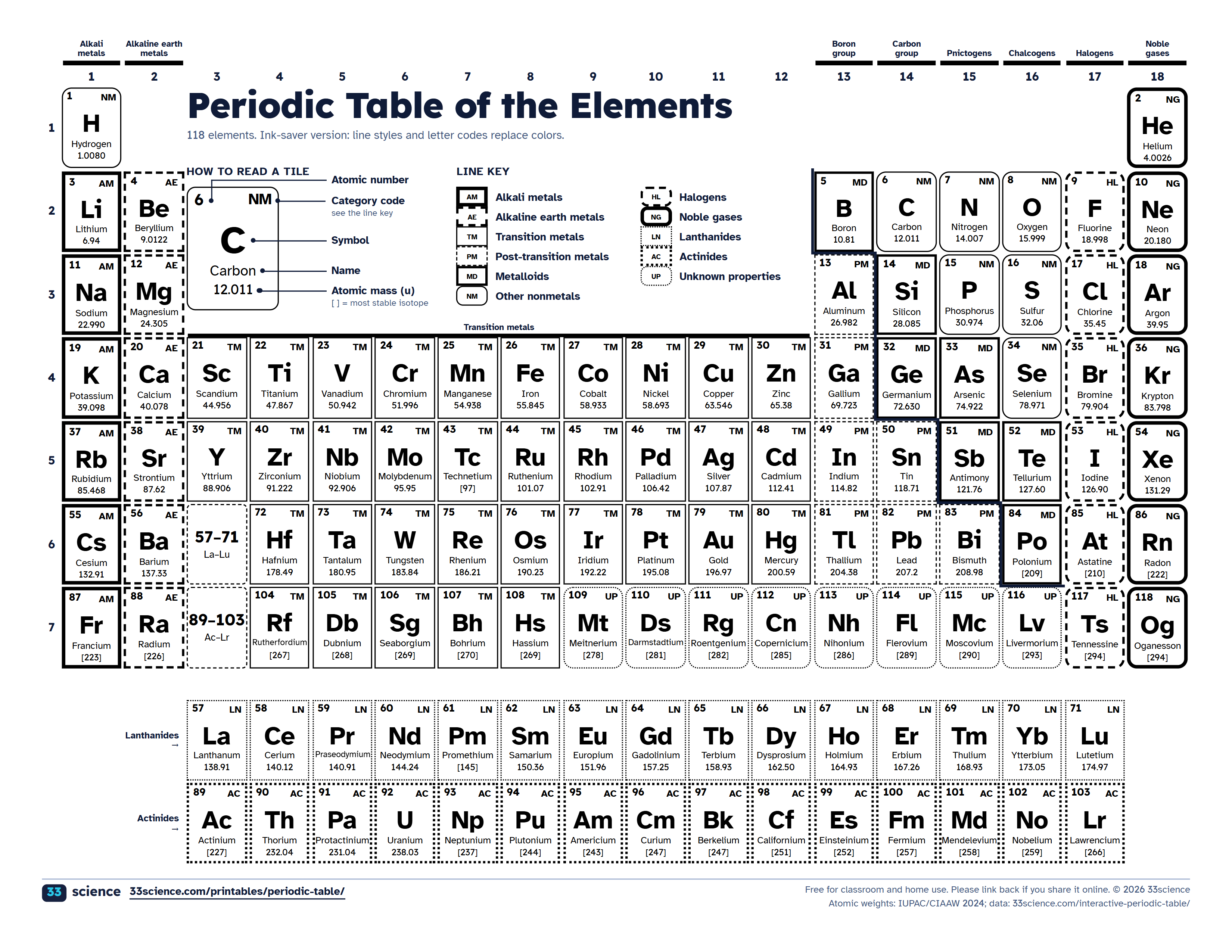
The same labels in black and white for low ink use. Line styles and two-letter codes replace the colors.
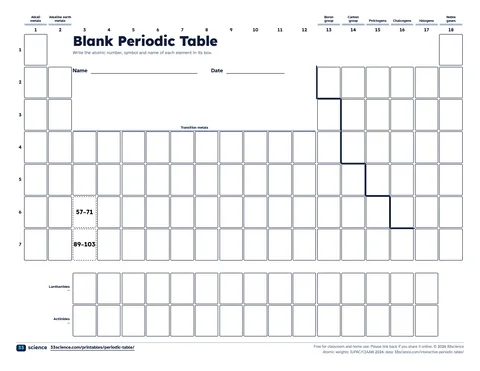
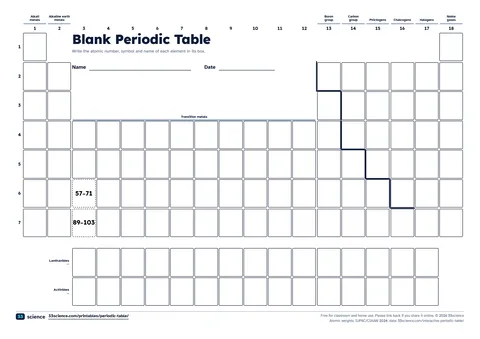
Blank periodic table
US Letter · 1 page · 117 KB · PDF
An empty grid with group and period numbers, ready to fill in from memory.
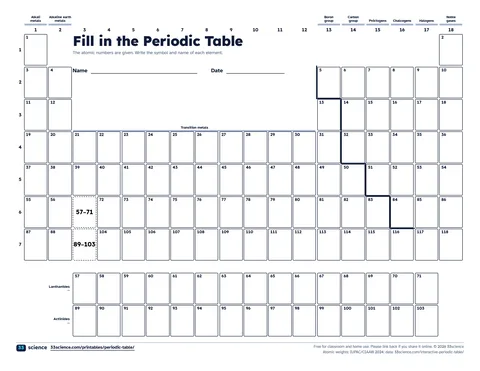
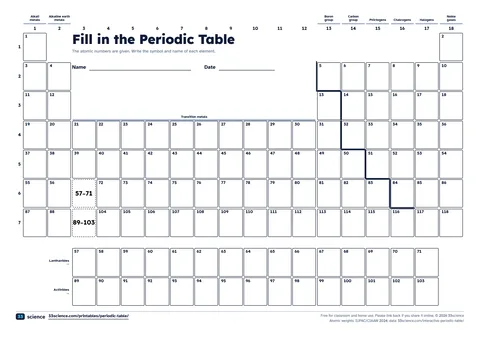
Periodic table with atomic numbers only
US Letter · 1 page · 159 KB · PDF
Atomic numbers are filled in. Students write the symbol and name. The black and white table is the answer key.
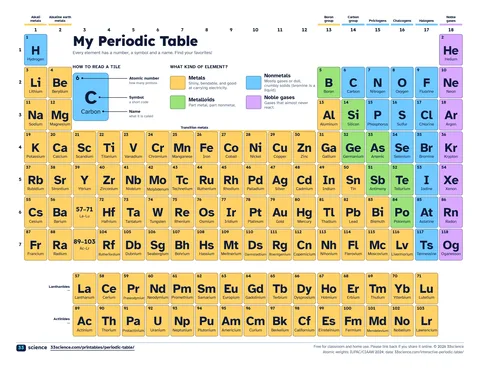
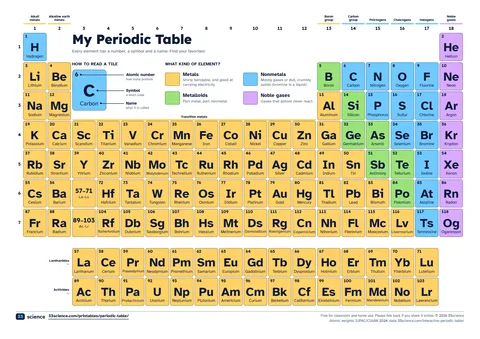
Periodic table for kids
US Letter · 1 page · 303 KB · PDF
Large symbols with just the number and name, in four simple color groups.
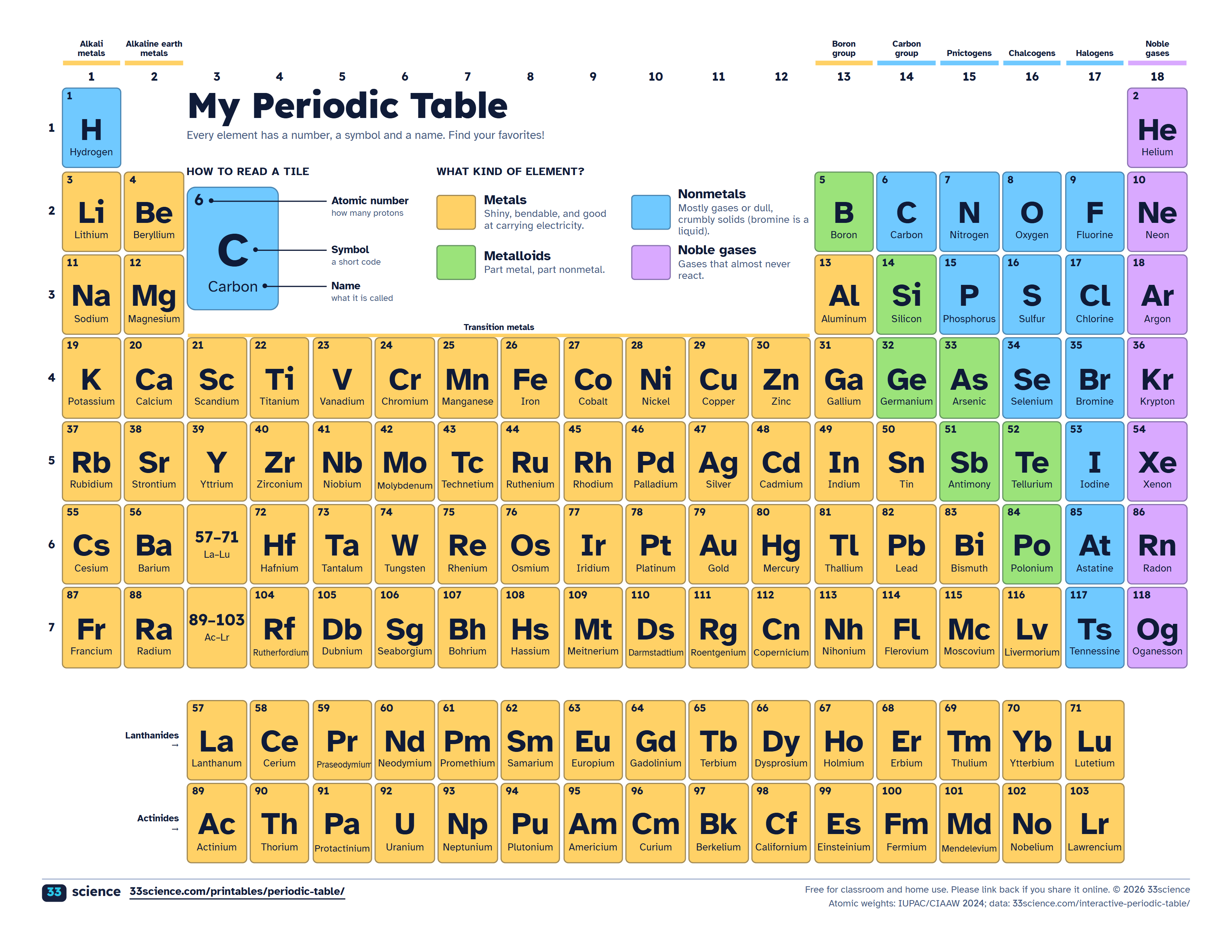
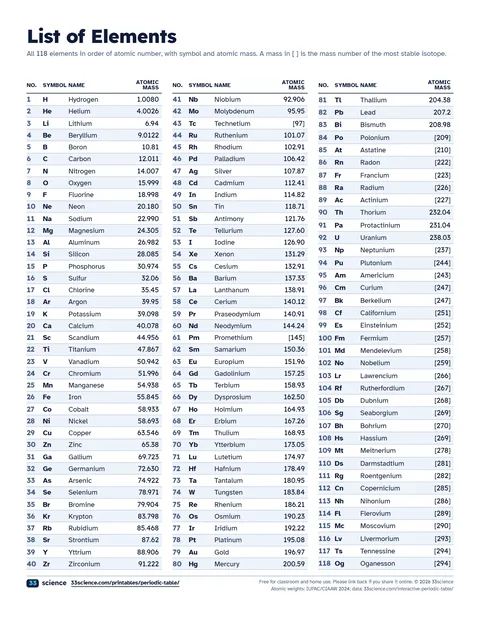
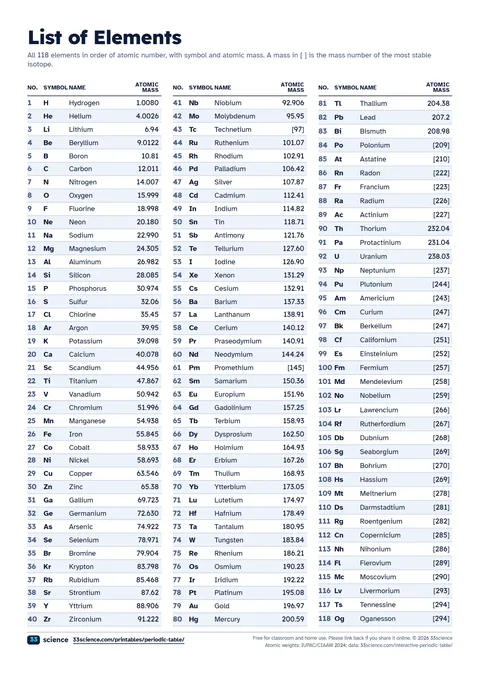
List of the 118 elements
US Letter · 1 page · 219 KB · PDF
All 118 elements in atomic number order with symbol and atomic mass, on one portrait page.
Free for classroom and home use. Please link back if you share it online.
Which printable periodic table should you print?
Pick the sheet by the job it has to do. All of them use the same layout, so students can move from one to another without relearning where things are.
- Classroom wall or lab bench: the color table. It is labeled with the atomic number, symbol, name and atomic mass of every element, plus group and period numbers and a category legend.
- Homework and reference: the black and white table. It has the same labels, uses little ink and photocopies cleanly. Categories show as border styles and two-letter codes instead of fills.
- Quizzes and memory work: the blank table is an empty grid with group and period numbers. The blank table with atomic numbers gives students the number in each tile and leaves the symbol and name to fill in. The black and white table is its answer key.
- Coloring: print the blank table with atomic numbers and have students shade each element by category, using the color table as the guide.
- Younger kids: the kids version has large symbols and shows only the number, symbol and name. It uses four color groups: metals, metalloids, nonmetals and noble gases.
- Looking up a name or mass: the element list puts all 118 elements in atomic number order on one page.
- Slides, documents and websites: use a periodic table image. The PNG files of the color, black and white and kids tables are about 3,300 pixels wide.
How to read a periodic table tile
Each tile on the color and black and white tables holds four items. The atomic number is the small number at the top: it counts the protons in the nucleus and sets the element’s place in the table. The large letters are the chemical symbol. The full name sits under the symbol. The number at the bottom is the atomic mass.
For carbon the tile reads 6, C, Carbon, 12.011. Every carbon atom has 6 protons, and the average mass of carbon atoms in a natural sample is 12.011 atomic mass units (u). The same number is the molar mass in grams per mole, so 12.011 g of carbon contains one mole of atoms. The molar mass calculator adds these masses together for any chemical formula.
The numbers along the top, 1 to 18, are groups: the columns. Main-group elements in one group have the same number of outer electrons and react in similar ways. The numbers down the side, 1 to 7, are periods: the rows. A mass in square brackets, such as [97] on technetium, belongs to an element with no standard atomic weight. The number is the mass number of its longest-lived known isotope. Some tables print [98] for technetium instead, because technetium-97 and technetium-98 have almost the same half-life.
Build your own periodic table
The customizer makes a table that shows only what you want printed. Choose one of 10 color schemes, such as element type, electronegativity or melting point. Choose what goes on each tile from the number, symbol, name, mass, charges, electronegativity, electron configuration and state. Set the paper to Letter, A4, 11×17 or A3, and turn the title and legend on or off.
A symbols-only table with no names makes a quiz sheet. A table colored by electronegativity supports a lesson on trends. When the preview looks right, press print and choose Save as PDF as the destination to keep the file. Nothing is uploaded.
Live preview, scaled to fit. The printed sheet is full size.
How to print a periodic table PDF so it fits on one page
Every table here is built for one landscape page, so a normal print gives you the whole table. These settings give the best result.
- Match the paper. Use the Letter file on US Letter paper (8.5 x 11 inches), standard in the US and Canada. Use the A4 file on A4 paper (210 x 297 mm) everywhere else. The Letter or A4 switch at the top of the page changes every link at once.
- Set the scale. Choose Actual size or 100% in the print dialog. If your printer clips the edges, choose Fit to page instead.
- Print in landscape. The table files already are, and most print dialogs follow them. The element list is a portrait page.
- Use normal quality for color. Draft mode lightens the fills, and the pale categories can turn hard to tell apart.
Printing a periodic table poster
For an 11×17 inch (tabloid) or A3 sheet, make the table in the customizer above and set the paper size before you print. For a wall poster, take the PDF to a print shop. The PDF stays sharp at any size. The PNG is about 3,300 pixels wide, which is 300 dots per inch at 11 inches across, so use the PDF for anything bigger.
Laminating and cardstock
Laminate the blank table and students can fill it in with a dry-erase marker, wipe it and try again. Print the color table on cardstock for a desk reference that lasts a school year. Check your printer’s manual for the thickest paper it accepts.
What the colors on the periodic table mean
The colors mark element categories: families of elements that behave alike. The color table uses ten, plus a gray shade for unknown properties, and the counts below come from its 118 tiles.
- Alkali metals (6): soft, highly reactive metals in group 1, not counting hydrogen.
- Alkaline earth metals (6): the group 2 metals, harder and less reactive than the alkali metals.
- Transition metals (34): the middle block, including iron, copper, silver and gold.
- Post-transition metals (7): softer metals to the right of the transition block, such as aluminum, tin and lead.
- Metalloids (7): boron, silicon, germanium, arsenic, antimony, tellurium and polonium, which sit along the staircase between metals and nonmetals.
- Other nonmetals (7): hydrogen, carbon, nitrogen, oxygen, phosphorus, sulfur and selenium.
- Halogens (6): fluorine, chlorine, bromine, iodine, astatine and tennessine, in group 17.
- Noble gases (7): group 18, whose full outer shells make them almost unreactive.
- Lanthanides (15) and actinides (15): the two rows below the main table.
The eight elements from 109 to 116 are shaded as unknown properties, because they are made only a few atoms at a time and their chemistry is mostly predicted. The stepped line on the table separates the metals on its left from the metalloids and nonmetals on its right. Hydrogen, a nonmetal, is the exception.
The lanthanides and actinides belong in periods 6 and 7, between groups 2 and 3. Placed in line, they would stretch the table to 32 columns, which does not fit a page. Pulling them out into two rows underneath keeps the table readable. The kids version collapses all of this into four colors.
How accurate is this periodic table?
The tables show all 118 confirmed elements, from hydrogen to oganesson. Atomic masses are the IUPAC and CIAAW standard atomic weights, taken from the abridged table that gives one value per element, such as 1.008 for hydrogen and 12.011 for carbon. The data was checked in 2026, and the footer of each PDF prints the source and year.
Thirty-four radioactive elements have no standard atomic weight. Their tiles show the mass number of the longest-lived known isotope in square brackets. Atomic weights are revised from time to time, so check the year in the footer if you compare against an older textbook.
Classroom license
All the periodic tables on this page are free for classroom and home use. Print as many copies as your students or children need. If you share a table online, link back to this page instead of re-uploading the file. The same notice is printed in each PDF footer.
Use the printable table in a lesson
The interactive periodic table shows a spinning atom for each element and recolors the whole table by any property, which pairs well with a printed copy. The periodic table with charges adds the common ion charge to each tile and has its own blank quiz. For practice, try the periodic table word search, and open the atom 3D model to see how electrons fill each shell. Our other free charts and worksheets are in the science printables hub.
Periodic table with names: all 118 elements
This list gives every element in atomic number order with its symbol and atomic mass, and the one-page PDF version is in the downloads above.
| No. | Symbol | Name | Atomic mass |
|---|---|---|---|
| 1 | H | Hydrogen | 1.0080 |
| 2 | He | Helium | 4.0026 |
| 3 | Li | Lithium | 6.94 |
| 4 | Be | Beryllium | 9.0122 |
| 5 | B | Boron | 10.81 |
| 6 | C | Carbon | 12.011 |
| 7 | N | Nitrogen | 14.007 |
| 8 | O | Oxygen | 15.999 |
| 9 | F | Fluorine | 18.998 |
| 10 | Ne | Neon | 20.180 |
| 11 | Na | Sodium | 22.990 |
| 12 | Mg | Magnesium | 24.305 |
| 13 | Al | Aluminum | 26.982 |
| 14 | Si | Silicon | 28.085 |
| 15 | P | Phosphorus | 30.974 |
| No. | Symbol | Name | Atomic mass |
|---|---|---|---|
| 16 | S | Sulfur | 32.06 |
| 17 | Cl | Chlorine | 35.45 |
| 18 | Ar | Argon | 39.95 |
| 19 | K | Potassium | 39.098 |
| 20 | Ca | Calcium | 40.078 |
| 21 | Sc | Scandium | 44.956 |
| 22 | Ti | Titanium | 47.867 |
| 23 | V | Vanadium | 50.942 |
| 24 | Cr | Chromium | 51.996 |
| 25 | Mn | Manganese | 54.938 |
| 26 | Fe | Iron | 55.845 |
| 27 | Co | Cobalt | 58.933 |
| 28 | Ni | Nickel | 58.693 |
| 29 | Cu | Copper | 63.546 |
| 30 | Zn | Zinc | 65.38 |
| No. | Symbol | Name | Atomic mass |
|---|---|---|---|
| 31 | Ga | Gallium | 69.723 |
| 32 | Ge | Germanium | 72.630 |
| 33 | As | Arsenic | 74.922 |
| 34 | Se | Selenium | 78.971 |
| 35 | Br | Bromine | 79.904 |
| 36 | Kr | Krypton | 83.798 |
| 37 | Rb | Rubidium | 85.468 |
| 38 | Sr | Strontium | 87.62 |
| 39 | Y | Yttrium | 88.906 |
| 40 | Zr | Zirconium | 91.222 |
| 41 | Nb | Niobium | 92.906 |
| 42 | Mo | Molybdenum | 95.95 |
| 43 | Tc | Technetium | [97] |
| 44 | Ru | Ruthenium | 101.07 |
| 45 | Rh | Rhodium | 102.91 |
| No. | Symbol | Name | Atomic mass |
|---|---|---|---|
| 46 | Pd | Palladium | 106.42 |
| 47 | Ag | Silver | 107.87 |
| 48 | Cd | Cadmium | 112.41 |
| 49 | In | Indium | 114.82 |
| 50 | Sn | Tin | 118.71 |
| 51 | Sb | Antimony | 121.76 |
| 52 | Te | Tellurium | 127.60 |
| 53 | I | Iodine | 126.90 |
| 54 | Xe | Xenon | 131.29 |
| 55 | Cs | Cesium | 132.91 |
| 56 | Ba | Barium | 137.33 |
| 57 | La | Lanthanum | 138.91 |
| 58 | Ce | Cerium | 140.12 |
| 59 | Pr | Praseodymium | 140.91 |
| 60 | Nd | Neodymium | 144.24 |
| No. | Symbol | Name | Atomic mass |
|---|---|---|---|
| 61 | Pm | Promethium | [145] |
| 62 | Sm | Samarium | 150.36 |
| 63 | Eu | Europium | 151.96 |
| 64 | Gd | Gadolinium | 157.25 |
| 65 | Tb | Terbium | 158.93 |
| 66 | Dy | Dysprosium | 162.50 |
| 67 | Ho | Holmium | 164.93 |
| 68 | Er | Erbium | 167.26 |
| 69 | Tm | Thulium | 168.93 |
| 70 | Yb | Ytterbium | 173.05 |
| 71 | Lu | Lutetium | 174.97 |
| 72 | Hf | Hafnium | 178.49 |
| 73 | Ta | Tantalum | 180.95 |
| 74 | W | Tungsten | 183.84 |
| 75 | Re | Rhenium | 186.21 |
| No. | Symbol | Name | Atomic mass |
|---|---|---|---|
| 76 | Os | Osmium | 190.23 |
| 77 | Ir | Iridium | 192.22 |
| 78 | Pt | Platinum | 195.08 |
| 79 | Au | Gold | 196.97 |
| 80 | Hg | Mercury | 200.59 |
| 81 | Tl | Thallium | 204.38 |
| 82 | Pb | Lead | 207.2 |
| 83 | Bi | Bismuth | 208.98 |
| 84 | Po | Polonium | [209] |
| 85 | At | Astatine | [210] |
| 86 | Rn | Radon | [222] |
| 87 | Fr | Francium | [223] |
| 88 | Ra | Radium | [226] |
| 89 | Ac | Actinium | [227] |
| 90 | Th | Thorium | 232.04 |
| No. | Symbol | Name | Atomic mass |
|---|---|---|---|
| 91 | Pa | Protactinium | 231.04 |
| 92 | U | Uranium | 238.03 |
| 93 | Np | Neptunium | [237] |
| 94 | Pu | Plutonium | [244] |
| 95 | Am | Americium | [243] |
| 96 | Cm | Curium | [247] |
| 97 | Bk | Berkelium | [247] |
| 98 | Cf | Californium | [251] |
| 99 | Es | Einsteinium | [252] |
| 100 | Fm | Fermium | [257] |
| 101 | Md | Mendelevium | [258] |
| 102 | No | Nobelium | [259] |
| 103 | Lr | Lawrencium | [266] |
| 104 | Rf | Rutherfordium | [267] |
| 105 | Db | Dubnium | [268] |
| No. | Symbol | Name | Atomic mass |
|---|---|---|---|
| 106 | Sg | Seaborgium | [269] |
| 107 | Bh | Bohrium | [270] |
| 108 | Hs | Hassium | [269] |
| 109 | Mt | Meitnerium | [278] |
| 110 | Ds | Darmstadtium | [281] |
| 111 | Rg | Roentgenium | [282] |
| 112 | Cn | Copernicium | [285] |
| 113 | Nh | Nihonium | [286] |
| 114 | Fl | Flerovium | [289] |
| 115 | Mc | Moscovium | [290] |
| 116 | Lv | Livermorium | [293] |
| 117 | Ts | Tennessine | [294] |
| 118 | Og | Oganesson | [294] |
Frequently asked questions
How do I print a periodic table on one page?
Download the PDF in your paper size, Letter or A4, and print it in landscape at Actual size or 100%. Each table is built as one landscape page, so the whole table fits. If your printer clips the edges, choose Fit to page. For a bigger table, build one in the customizer at 11x17 or A3.
Is there a black and white periodic table?
Yes. The black and white periodic table has the same labels as the color one: atomic number, symbol, name, atomic mass, groups and periods. Element categories show as border styles and two-letter codes instead of colored fills, so it uses little ink and photocopies cleanly. It comes in Letter and A4, and as a PNG image.
Where can I download a periodic table image?
The downloads above include PNG images of the color, black and white and kids tables, each about 3,300 pixels wide. That is 300 dots per inch at 11 inches across, which suits slides, documents and websites. For anything printed larger than that, use the PDF.
How many elements are on the periodic table?
The periodic table has 118 elements, from hydrogen (atomic number 1) to oganesson (118). IUPAC has confirmed all of them. Elements up to uranium (92) occur in nature, although technetium and promethium exist there only in traces. Neptunium and plutonium also form in tiny traces in uranium ore. Heavier elements are made only in nuclear reactors and particle accelerators.
What do the numbers on the periodic table mean?
The whole number on each tile is the atomic number: the count of protons in the atom. The decimal number is the atomic mass in atomic mass units, an average over the element's natural isotopes. The numbers 1 to 18 across the top are groups, and 1 to 7 down the side are periods.
Is there a blank periodic table I can fill in?
Yes. The blank table is an empty grid with group and period numbers. The blank table with atomic numbers adds the number to each tile, and students write the symbol and name. The black and white table works as its answer key. Both come in Letter and A4.
Is there a periodic table for kids?
Yes. The kids version shows only the atomic number, symbol and name in large type, and uses four colors: metals, metalloids, nonmetals and noble gases. It prints on one page in Letter or A4. Older students can move on to the full color table with atomic masses.
Can I use these periodic tables in my classroom or share them?
Yes. They are free for classroom and home use, and you can print as many copies as you need. If you share a table online, link back to this page instead of re-uploading the file. The same notice is printed in the footer of each PDF.