TLDR
Spain has active volcanoes, but only in one place: the Canary Islands. Tenerife’s Mount Teide is the country’s tallest peak and a monitored, dormant-but-not-extinct stratovolcano. La Palma’s Cumbre Vieja erupted for 85 days in 2021, the longest and most destructive eruption in the island’s recorded history, and reconstruction is still underway in 2026. El Hierro produced Spain’s first-ever recorded submarine eruption in 2011. Mainland Spain has volcanoes too — the Garrotxa zone near Olot and the Campo de Calatrava field near Ciudad Real — but nothing there has erupted in over 10,000 years. All of it is safe to visit right now, including La Palma.
Table of Contents
- Why Spain Has Two Separate Volcanic Regions
- The Canary Islands: Spain’s Active Volcanic Zone
- Mainland Spain’s Volcanoes
- Can You Visit? Safety in 2026
- FAQ
Why Spain Has Two Separate Volcanic Regions
Spain’s volcanoes don’t share a single cause, which is why they don’t look or behave alike. The Canary Islands sit on oceanic crust off the coast of Morocco, built by a hotspot-and-rifting system related to the same mantle plume activity that shaped the Atlas Mountains. That’s why the islands are still building themselves upward, one eruption at a time, and why Tenerife, La Palma, Lanzarote, and El Hierro have all erupted within the last three centuries.
Mainland Spain’s volcanoes are a different story entirely. Garrotxa, in Catalonia, and Campo de Calatrava, in Castile-La Mancha, formed from continental rift volcanism tied to the broader European Rift System — the same tectonic stretching that also produced volcanic fields in Germany’s Eifel region and France’s Massif Central. Both mainland fields went quiet thousands of years before the Roman Empire existed. They’re volcanoes in the geological sense, not in the “keep an eye on the news” sense.
The Canary Islands: Spain’s Active Volcanic Zone
Mount Teide, Tenerife
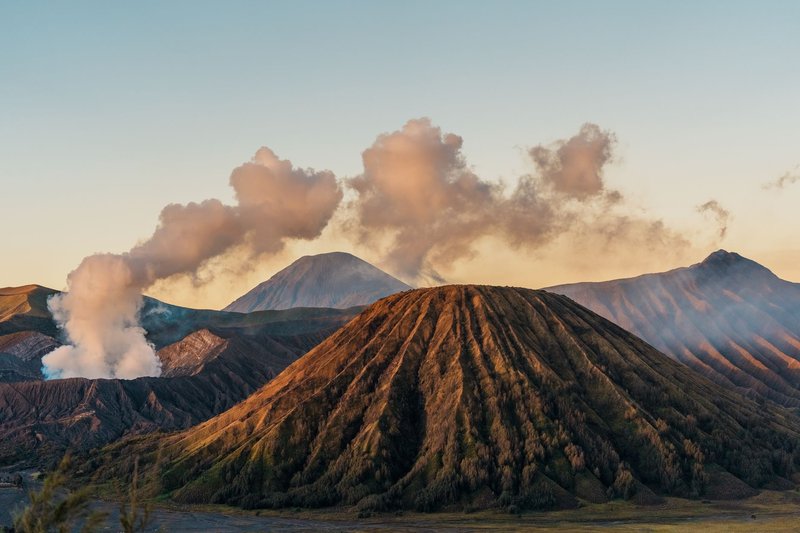
At 3,715 meters, Teide is the highest point in Spain and the third-tallest volcanic edifice on Earth measured from its base on the ocean floor, behind only Mauna Kea and Mauna Loa. It last erupted in 1909, from a flank vent called El Chinyero, and it remains classified as dormant rather than extinct — Spain’s Instituto Geográfico Nacional keeps a permanent seismic network on it.
You can reach the upper station at 3,555 meters by cable car, but the final stretch to the actual summit crater requires a free permit from Teide National Park, released in batches through the Tenerife ON booking system, with new slots opening weekly for the following 28 days. Demand regularly outpaces supply in summer, so this isn’t a same-day plan. Most visitors skip the permit entirely and stop at the cable car’s upper platform, which still puts you above the cloud layer that blankets the island most afternoons.
La Palma and the 2021 Cumbre Vieja Eruption
Cumbre Vieja erupted on September 19, 2021, and didn’t stop until December 13 — 85 days that made it the longest eruption ever recorded on La Palma. The lava covered more than 1,000 hectares, destroyed over 3,000 buildings, and forced roughly 7,000 people to evacuate. Total damage came to around 843 million euros.
Recovery has been slow by design, not neglect — rebuilding on fresh basalt requires new road grades, new utility corridors, and soil that in some spots is still years from being farmable. By late 2025, about 32% of the destroyed farmland had been rebuilt or was actively under reconstruction, and NASA’s Earth Observatory has documented new roads and structures appearing directly on the 2021 flow. There’s also a plan in motion for 2026 to fold the new volcanic cone into an expanded Cumbre Vieja National Park, along with protected status for the lava deltas the eruption pushed out into the Atlantic.
The volcano itself has been quiet since the eruption ended — low seismicity, stable ground deformation, ongoing monitoring. La Palma is open, and the areas outside the former exclusion zone were never affected in the first place.
Lanzarote’s Timanfaya: The 1730s Eruption That Remade an Island
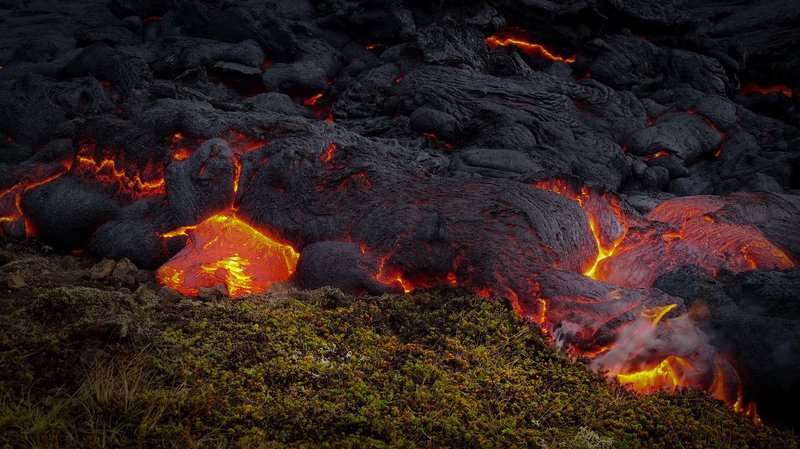
If La Palma’s eruption sounds long, Timanfaya makes it look brief. The eruption that created Timanfaya National Park ran from 1730 to 1736 — over 2,000 days — opening more than 300 vents and building 25 volcanic cones along a fissure system stretching at least 14 kilometers. It buried roughly a quarter of Lanzarote’s surface and erased 26 villages. There’s been nothing on that scale since; Timanfaya is dormant, and the island has built an entire tourism identity around its lava fields, including a restaurant that grills food over geothermal heat rising straight out of the ground.
El Hierro: Spain’s Only Submarine Eruption
El Hierro, the smallest and westernmost Canary Island, produced something none of the others have: a fully submarine eruption, and the first volcanic event in the Canaries ever tracked with modern instruments from start to finish. It began on October 10, 2011, roughly two kilometers south of the island, with vents at 150–180 meters depth. Over the following months, researchers recorded more than 12,000 earthquakes and watched pumice rafts and discolored, gas-charged water spread across the surface. No island territory was lost or gained — the eruption built a new underwater cone that never broke the surface — but it gave scientists their clearest look yet at how a Canary Island volcano actually starts.
The Quieter Islands
Gran Canaria, Fuerteventura, and La Gomera are volcanic in origin too, but their activity is far older and heavily eroded. Fuerteventura’s volcanism dates back roughly 20 million years, making it the oldest of the Canary Islands and explaining why its landscape reads more like a weathered, rounded ridge system than the sharp cones you see on Tenerife or Lanzarote.
Mainland Spain’s Volcanoes
Garrotxa Volcanic Zone, Catalonia
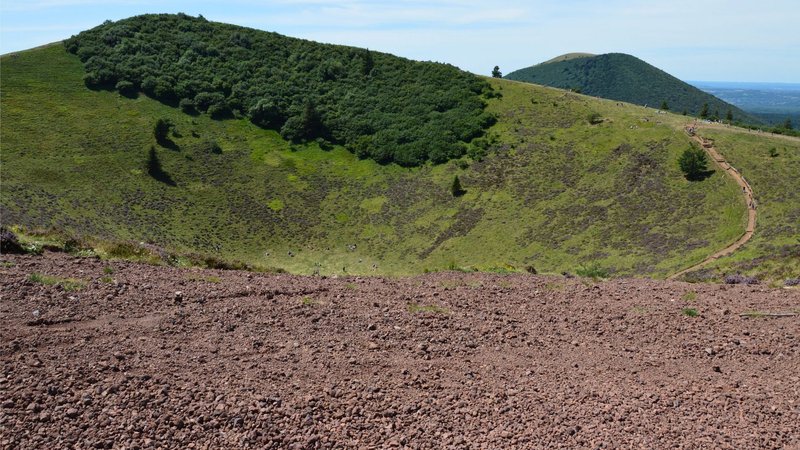
Ninety kilometers northeast of Barcelona, near the town of Olot, the Garrotxa Volcanic Zone Natural Park protects around 40 cinder cones scattered across a landscape of beech forests and farmland — a strange, quiet contrast to how a volcanic field usually looks. The field has been active on and off for roughly 700,000 years, and its youngest and largest cone, Croscat, stands 786 meters above sea level with a crater 600 meters long. Croscat last erupted about 11,000 years ago, which by volcanic standards counts as recent — but there’s no monitoring network flagging unrest here, because there’s been none to speak of since the Holocene began.
Campo de Calatrava, Castile-La Mancha
South of Ciudad Real, the Campo de Calatrava volcanic field is the largest of its kind on the Iberian Peninsula, spread across more than 5,000 square kilometers with over 300 individual volcanic structures — cinder cones, lava domes, and maars, the crater lakes left behind by explosive steam-driven eruptions. It’s also home to continental Europe’s most significant cluster of maar lakes, several of which still hold water today. The field was active between roughly 7.4 million and 700,000 years ago, and UNESCO recognized the area as a Global Geopark for exactly that combination of scale and preservation.
Can You Visit? Safety in 2026
Every volcano on this list is open to visitors right now. Teide National Park runs normal operations, cable car included, with the summit permit as the only extra step. La Palma has no active exclusion zones — the 2021 eruption is over, monitored, and quiet, and the areas that were evacuated are either rebuilt, being rebuilt, or set aside as protected volcanic terrain. Timanfaya and El Hierro have long-established visitor infrastructure. Garrotxa and Calatrava are hiking and geopark destinations with marked trails, not restricted sites.
The one practical planning note: Teide’s summit permit is the single bottleneck in this entire list. Book it before you book your flights if reaching the actual crater matters to you.
FAQ
Is Spain volcanically active? Yes, but only in the Canary Islands. Mount Teide, Cumbre Vieja on La Palma, Timanfaya on Lanzarote, and the submarine vents off El Hierro have all been active within the last 300 years. Mainland Spain’s volcanic fields haven’t erupted in over 10,000 years.
Can you hike to the summit of Mount Teide? Yes, with a free permit from Teide National Park booked in advance through the Tenerife ON system. Without a permit, you can still ride the cable car to 3,555 meters, just short of the crater rim.
Is La Palma safe to visit after the 2021 eruption? Yes. The eruption ended in December 2021, the volcano has shown low seismicity since, and there are no active restricted zones. Reconstruction of destroyed farmland and roads is ongoing, but tourist areas were largely untouched.
Are the Garrotxa and Calatrava volcanoes still active? No. Garrotxa’s youngest cone, Croscat, last erupted about 11,000 years ago. Calatrava’s volcanism ended around 700,000 years ago. Neither field is monitored for eruption risk because neither shows any.
How many volcanoes does Spain have? It depends on how you count — the Canary Islands alone have well over 100 individual volcanic cones and vents, Garrotxa has around 40, and Campo de Calatrava has more than 300 structures. Spain doesn’t have a small, fixed number of “the volcanoes” the way some countries do; it has several large volcanic fields, each built from many individual eruptions over time.