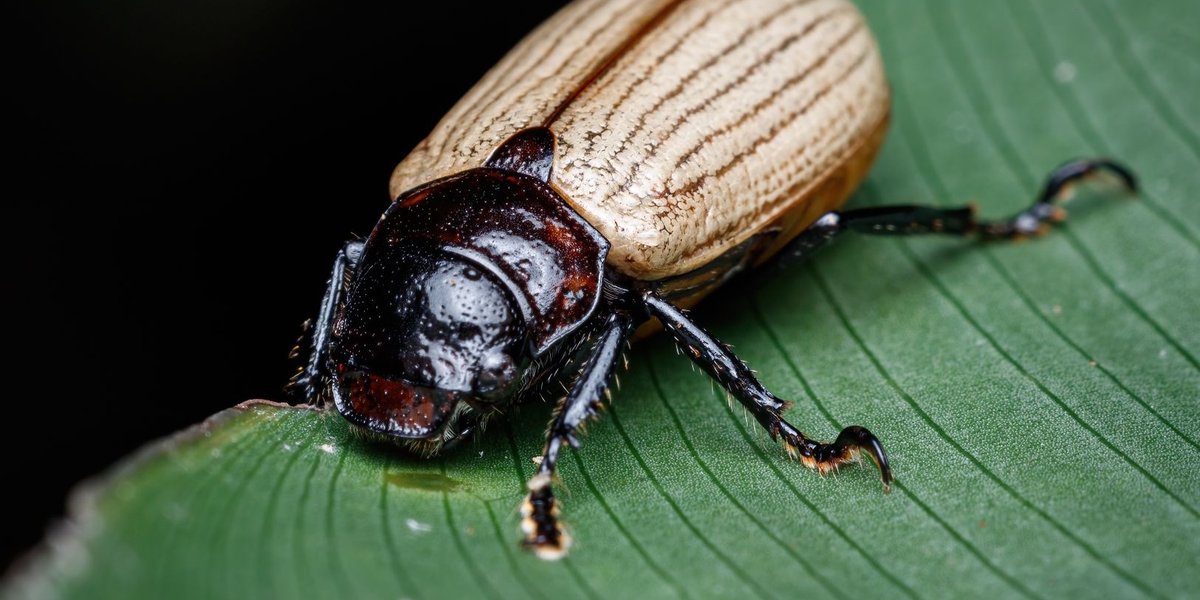
Roughly one in every four animal species on Earth is a beetle. Coleoptera, the order that covers everything from ladybugs to weevils, holds about 400,000 described species — around 40% of all known insects — and the Smithsonian Institution adds new ones to the count most years. That’s not a random trivia stat. It’s the reason “beetle” as a category is almost useless for figuring out what’s actually going on in your yard.
Most people who go looking for beetle information fall into one of two camps: curious about the insect world in general, or staring at something crawling across the kitchen floor wondering if it’s a problem. This guide covers both, but it’s built around the second question, because that’s the one with a deadline. You’ll get the beneficial species worth leaving alone, the pest species worth acting on, and the ID markers that separate a beetle you should welcome from one you should evict.
Table of Contents
- Quick ID: Good Beetle or Bad Beetle
- Beneficial Beetles You Want to See
- Problem Beetles Worth Dealing With
- Japanese Beetle vs. June Bug
- What to Actually Do About an Indoor Beetle Problem
- FAQ
Quick ID: Good Beetle or Bad Beetle
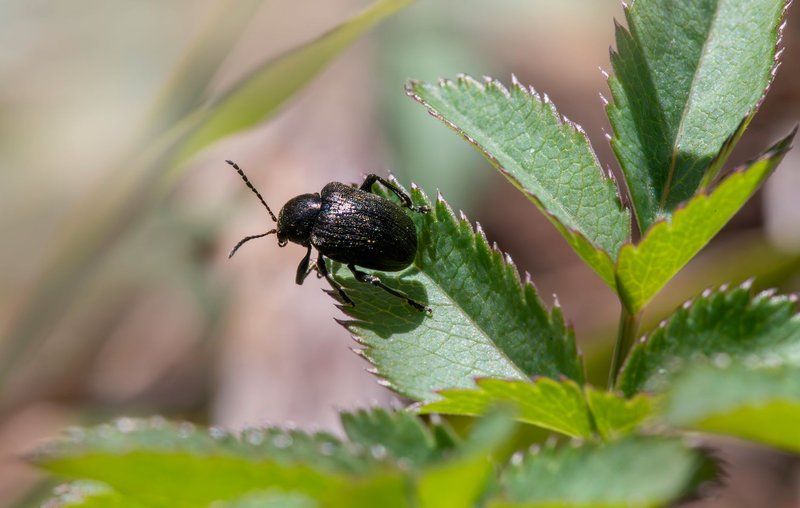
Before the deep dive, here’s the shortcut. If you can name the beetle, this table tells you whether to relax or act.
| Beetle | Where you’ll find it | Verdict |
|---|---|---|
| Ladybug (lady beetle) | Plants, especially near aphid colonies | Beneficial — leave it |
| Ground beetle | Under mulch, stones, at soil level | Beneficial — leave it |
| Soldier beetle | Flower heads, goldenrod, milkweed | Beneficial — leave it |
| Japanese beetle | Roses, grapevines, lawns (as grubs) | Pest — act on it |
| Carpet beetle | Closets, wool rugs, stored fabric | Pest — act on it |
| Powderpost beetle | Untreated wood, furniture, framing | Pest — act on it |
| June bug (May beetle) | Porch lights at night, lawns (as grubs) | Nuisance, rarely serious |
Beneficial Beetles You Want to See
These are the beetles doing unpaid pest control in your garden. Killing them on sight is the single most common mistake first-time gardeners make.
Ladybugs
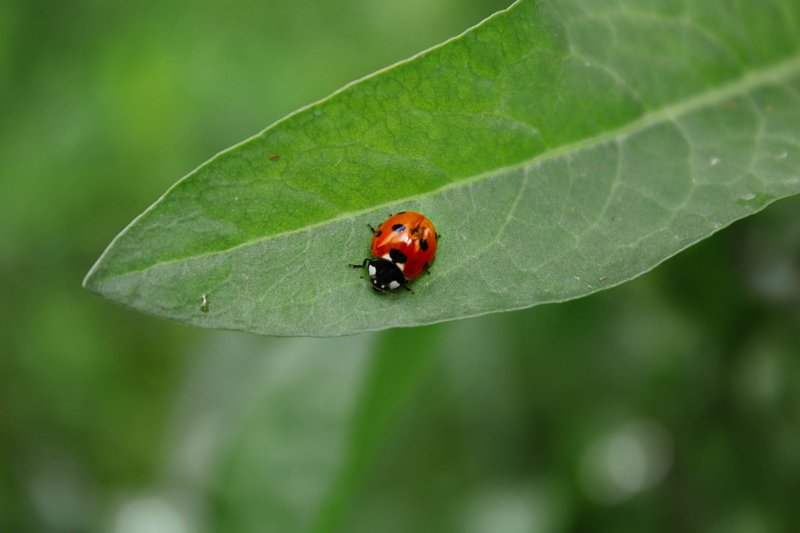
The red-with-black-spots look is the one everyone recognizes, but color varies more than people expect — some species run orange, yellow, or nearly black with red spots instead of the reverse. What doesn’t vary is the appetite: a single ladybug can eat several thousand aphids over its lifetime, along with mealybugs, mites, and scale insects. If you’re seeing them cluster on a rose bush or a stand of milkweed, that’s not a coincidence — they’re following the aphids.
Leave them alone, and resist the urge to buy bagged ladybugs for release. Most commercially sold ladybugs are wild-collected, not farmed, and releasing them outside their native range has its own ecological downsides.
Ground Beetles
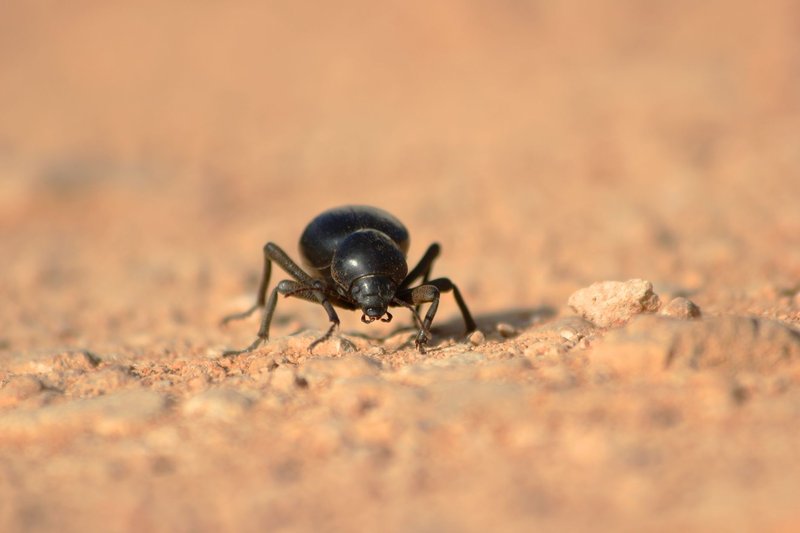
Dark, shiny, fast-moving, and usually seen for half a second before they vanish under a rock — that’s a ground beetle. Species active at night tend to be solid black; the day-active ones can have a metallic sheen. They live at soil level rather than on plants, which is exactly where you want a predator that eats slugs, cutworms, snails, and the larvae of other pest insects. According to University of Vermont Extension, ground beetles are among the most effective secondary consumers and natural controls for soil-dwelling garden pests, and a healthy population can measurably cut down on slug damage without any intervention from you.
Soldier Beetles
Often mistaken for fireflies because of the similar elongated, soft-shelled body, soldier beetles show up in late summer on goldenrod and other flat-topped flowers. The adults eat aphids and small caterpillars; the larvae, which live in the soil, go after the eggs and larvae of other beetles and moths. Nicknamed “Pennsylvania leatherwings” for their soft, leathery wing covers, they’re harmless to plants and people — no sting, no bite worth mentioning.
Problem Beetles Worth Dealing With
The pest side of the beetle world splits into two problems: things eating your plants, and things eating your house.
Japanese Beetles
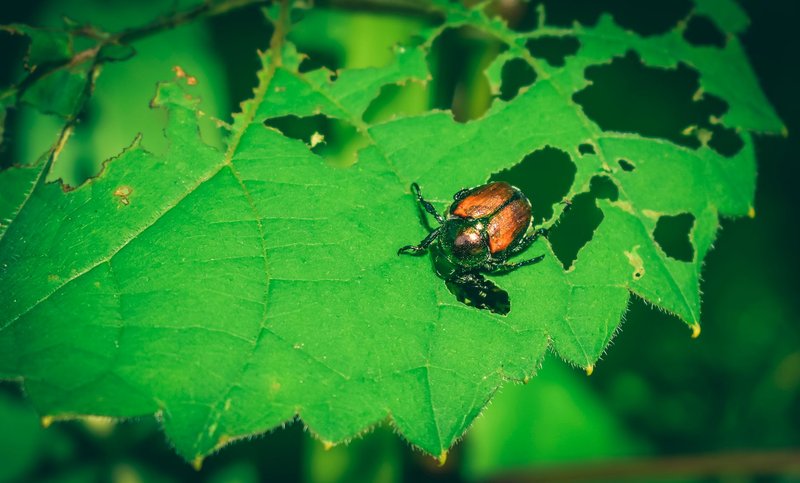
Metallic green head and thorax, copper-colored wing covers, about ⅜ to ½ inch long, and they feed in groups during daylight — that combination is diagnostic. They skeletonize leaves, eating everything between the veins and leaving a lace-like husk behind, and they’re not picky: roses, grapevines, linden trees, and beans are all regular targets. The larval stage is arguably the bigger problem. Japanese beetle grubs feed on turfgrass roots underground, and according to USDA APHIS, it takes roughly six to seven grubs per square foot of lawn before you’ll see visible damage — patches that go pale and brown, then peel back like loose carpet when the root system is gone.
They complete one generation per year, per Virginia Tech Extension, which is actually useful: it means a bad Japanese beetle summer doesn’t compound overnight, and grub treatments timed for early fall hit the population at its most vulnerable stage.
Carpet Beetles
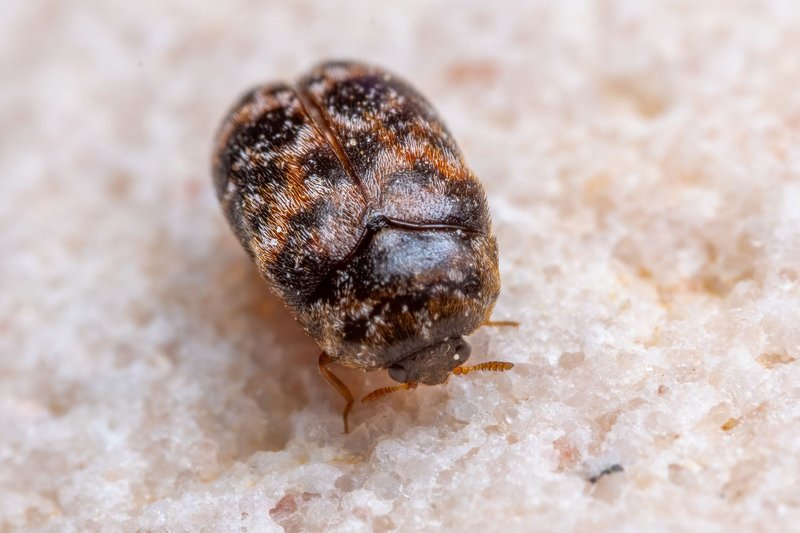
These are small — around 1/8 inch — round-bodied, and mottled black, white, and brown depending on the species. The adults aren’t actually the problem; they eat pollen and don’t damage fabric. It’s the larvae, fuzzy and slightly elongated, that chew through wool, silk, fur, feathers, and any natural-fiber item left undisturbed for a while. According to UC Integrated Pest Management, the telltale signs are irregular holes in fabric, shed larval skins, and fecal pellets near the damage — not just the beetles themselves, which you may never actually see crawling around.
Powderpost and Wood-Boring Beetles
Small, cylindrical, reddish-brown to black, and easy to miss until you notice the evidence: tiny round exit holes in wood, roughly the diameter of a pencil lead, sometimes with fine powdery frass (essentially wood dust) collecting underneath. These beetles lay eggs in unfinished or untreated wood — furniture, flooring, structural framing — and the larvae do the actual damage, tunneling through the wood for months or years before emerging as adults. Active infestations show fresh, light-colored frass; old exit holes with no frass buildup usually mean the infestation has already run its course.
Japanese Beetle vs. June Bug
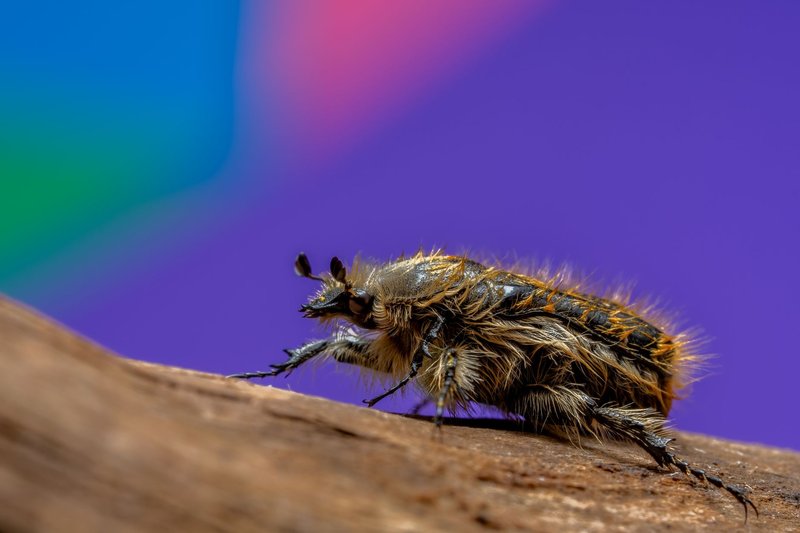
These two get confused constantly, partly because both show up in early-to-mid summer and both have grub stages that damage lawns. The differences are consistent enough to use as a field test:
- Size and color. Japanese beetles run ⅜–½ inch and metallic green with copper wing covers. June bugs (also called May beetles) are bigger, ½–1 inch, and a dull reddish-brown with no metallic sheen.
- When they’re active. Japanese beetles feed in groups during the day, right out in the open on your plants. June bugs are nocturnal — they’re the ones bouncing off your porch light at 10 p.m., not the ones on your roses at noon.
- What they eat as adults. Japanese beetles do visible, immediate damage to foliage and flowers. Adult June bugs barely feed at all; almost all of their damage happens underground, as grubs, chewing on turf and crop roots.
- The grubs. June bug grubs are larger and tunnel deeper than Japanese beetle grubs, and the root loss they cause tends to be more severe — which is also why lawns with a bad June bug grub problem sometimes attract moles and skunks digging for an easy meal.
If it’s daytime and it’s on a rose bush, it’s a Japanese beetle. If it’s nighttime and it’s at a porch light, it’s a June bug.
What to Actually Do About an Indoor Beetle Problem
For carpet beetles, the fix starts with laundry, not pesticide. Wash or dry-clean anything the larvae could be feeding on — wool sweaters, down bedding, old rugs — since dirty fabric with skin oils and food residue is exactly what attracts them. Vacuum thoroughly and often, paying attention to closet corners, baseboards, and under furniture where larvae hide from light. Seal the entry points, too: torn window screens and gaps around door frames let the adults in from outside in the first place. Diatomaceous earth worked into carpet edges and cracks is a low-toxicity option if vacuuming alone isn’t cutting it.
For wood-boring beetles, the calculus is different because the damage is structural, not cosmetic. Fresh frass under a small hole means an active infestation and it’s worth getting a pest control professional to confirm the species and treat it — some respond to surface borate treatments, others need fumigation. Old, dusty holes with no new frass are usually a closed case; you can patch the wood and move on.
For Japanese beetles on ornamental plants, hand-picking into a bucket of soapy water in the early morning (when they’re sluggish) works surprisingly well for a small garden. Skip the pheromone traps sold at hardware stores — they’re effective at attracting beetles from well beyond your yard, which often means you end up with more of them, not fewer.
FAQ
Are all beetles harmless to humans? Almost all of them, yes. A small number, like blister beetles, can cause skin irritation if handled, and a few large species can deliver a surprising pinch with their mandibles. None found in typical North American yards are dangerous in any serious sense.
Do ladybugs bite? Occasionally, and it barely registers — more of a pinch than a bite. It’s not a defense worth worrying about, and it doesn’t happen often.
Why am I suddenly seeing beetles indoors in fall? Several outdoor species, including some ladybugs and boxelder bugs (not technically a beetle, but a frequent look-alike), move toward buildings in autumn looking for a place to overwinter. Sealing gaps around windows and doors is the most effective long-term fix.
Can beneficial beetles also become a nuisance? Occasionally. Ladybug swarms looking for overwintering sites indoors are the most common example — beneficial outdoors, annoying in bulk indoors. The response is exclusion (seal entry points), not extermination.
Is it worth calling an exterminator for a few beetles? For a handful of carpet beetles or a wandering ground beetle, no. For an active wood-boring infestation with fresh frass, or a carpet beetle problem that keeps returning after cleaning, professional treatment is the faster and more reliable route.
The Short Version
Beetle identification isn’t really about memorizing 400,000 species — it’s about recognizing the dozen or so that actually show up where you live. Metallic and in groups on your roses in daylight means Japanese beetle. Dull brown and bouncing off your porch light at night means June bug. Small, round, and found near wool or dried food means carpet beetle. Dark, fast, and living under a rock means a ground beetle doing you a favor. Once you can sort what’s in front of you into “leave it” or “deal with it,” the rest is just following through.