A single uranium fuel pellet the size of a fingertip holds about as much energy as a ton of coal. That’s the whole story of nuclear energy in one fact. You’re splitting atoms, and the gap between the pieces and the original turns into heat — an enormous amount of it, from almost no material.
Nuclear power supplies roughly 10% of the world’s electricity and close to 20% in the United States, and after decades of stagnation it’s back in the conversation thanks to climate targets and the electricity-hungry boom in AI data centers. Here’s how it actually works, and what’s true about the parts people argue over.
Table of Contents
- The short version
- What nuclear energy actually is
- How a reactor turns fission into electricity
- Fission vs. fusion
- Is nuclear energy clean? Is it renewable?
- The advantages
- The real challenges
- Safety and waste, minus the myths
- Small modular reactors and what’s next
- FAQ
The short version
Nuclear energy comes from splitting heavy atoms (usually uranium-235) in a controlled chain reaction. The split releases heat, the heat boils water into steam, the steam spins a turbine, and the turbine drives a generator. That’s it — at the business end, a nuclear plant is a very sophisticated way to boil water.
It produces almost no carbon dioxide while running, generates power 24/7 regardless of weather, and packs an absurd amount of energy into a tiny amount of fuel. The trade-offs are upfront cost, the long timelines to build a plant, and the radioactive waste that stays hazardous for thousands of years. Whether that’s a good deal depends on what you’re weighing it against.
What nuclear energy actually is
Atoms have a nucleus packed with protons and neutrons, held together by the strongest force in nature. In heavy, unstable atoms like uranium-235, that nucleus is barely holding it together. Fire a stray neutron at it and the whole thing splits — fission — into two smaller atoms, a few loose neutrons, and a burst of energy.
Here’s the part that makes it a power source rather than a one-off bang: those loose neutrons go on to hit other uranium atoms, splitting them too. Each split throws off more neutrons, which trigger more splits. That’s a chain reaction. Let it run unchecked and you get a bomb. Throttle it precisely and you get a power plant. The entire engineering challenge of a reactor is keeping that chain reaction at exactly the right pace — not too fast, not dying out.
The energy itself comes from mass. The fragments after a split weigh fractionally less than the original atom, and that missing mass converts to energy following Einstein’s E=mc². Because c² is a gigantic number, a sliver of mass becomes a torrent of heat. This is why those fingertip-sized fuel pellets do so much work.
How a reactor turns fission into electricity
Walk through a conventional plant and the logic is surprisingly mechanical:
- The fuel. Uranium is formed into ceramic pellets, stacked into metal tubes called fuel rods, and bundled into assemblies that sit in the reactor core.
- The reaction. Fission heats the core to hundreds of degrees. Control rods — made of neutron-absorbing materials like boron or cadmium — slide in and out to speed up or slow the chain reaction. Push them all the way in and the reaction stops.
- The heat transfer. Water pumped through the core carries that heat away. In the most common design, a pressurized water reactor, this water is kept under enormous pressure so it stays liquid even at 300°C-plus.
- The steam. That heat boils a separate loop of water into steam.
- The turbine and generator. Steam blasts through a turbine, spinning it at thousands of RPM. The turbine turns a generator, and electromagnetic induction does the rest, producing electricity.
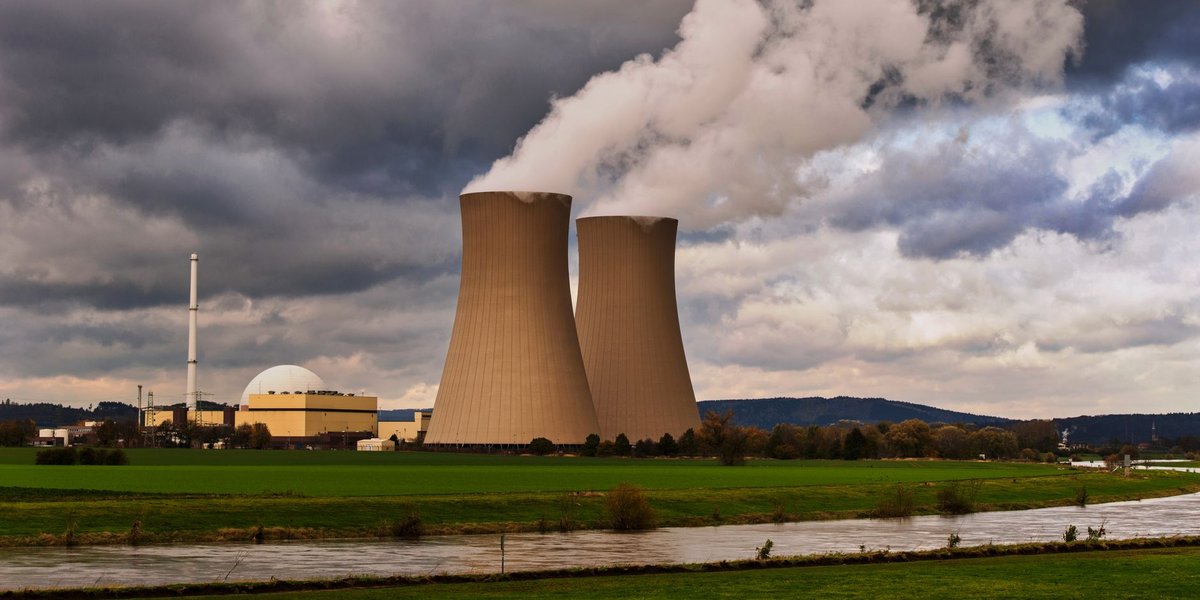
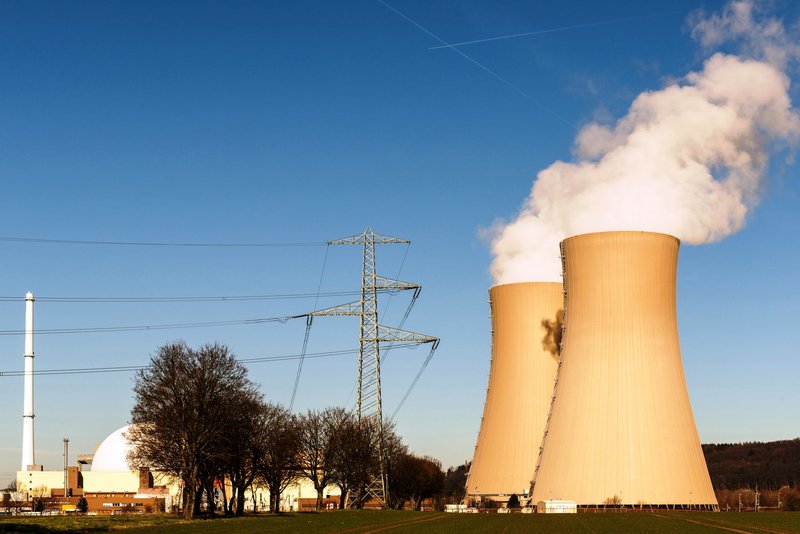
- The cooling. Used steam condenses back into water — those giant hyperbolic cooling towers you picture aren’t reactors, they’re just releasing waste heat as water vapor.
The clever bit is that nothing about steps four through six is exotic. A coal plant does the same thing; it just makes its heat by burning carbon. Swap the firebox for a reactor core and you’ve eliminated the smokestack.
Fission vs. fusion
People mix these up constantly, and they’re nearly opposites.
| Fission | Fusion | |
|---|---|---|
| What happens | Heavy atoms split apart | Light atoms merge together |
| Typical fuel | Uranium-235, plutonium-239 | Hydrogen isotopes (deuterium, tritium) |
| Where it happens | Every commercial reactor today | Stars — including the Sun |
| Status | Mature, ~440 reactors worldwide | Experimental, no net-energy power plant yet |
| Radioactive waste | Long-lived, significant | Far less, shorter-lived |
| Runaway risk | Requires active control | Stops the instant conditions slip |
Every nuclear power plant operating right now runs on fission. Fusion is the holy grail — it’s what powers the Sun, the fuel is essentially limitless, and the waste problem is tiny by comparison. Experiments like ITER in France and a wave of private startups have hit real milestones, including reactions that briefly released more energy than was pumped in. But a fusion plant feeding electricity to your house is still years away, probably more. When someone promises “unlimited clean energy soon,” they mean fusion, and “soon” is doing heavy lifting.
Is nuclear energy clean? Is it renewable?
These are two different questions and they get answered together by mistake.
Is it clean? By the carbon metric, yes. Generating electricity from nuclear fission emits essentially no CO₂. Counting the full lifecycle — mining, construction, fuel processing — its emissions per kilowatt-hour sit in the same low range as wind and solar, far below coal or gas. If your worry is climate change, nuclear is firmly on the clean side.
Is it renewable? No. Uranium is a finite mineral dug out of the ground, same as coal or copper. We won’t run out anytime soon, and breeder reactors plus seawater extraction could stretch supply for centuries, but “we have a lot” isn’t the same as “renewable.” Renewables replenish on a human timescale — sunlight, wind, flowing water. Uranium doesn’t.
So nuclear lands in its own category: a low-carbon, non-renewable energy source. That’s why climate policy fights over it. People who care about emissions like it; people who define clean energy as strictly renewable don’t count it. Both are using the words correctly — they’re just measuring different things.
The advantages
It’s reliable baseload power. A nuclear plant runs flat-out around the clock, hitting capacity factors above 90% — meaning it produces near its maximum nearly all the time. Solar stops at night and wind comes and goes; a reactor doesn’t care whether it’s cloudy. It’s why even hurricane-prone, sun-drenched states keep them running — Florida leans on two nuclear plants for exactly this kind of steady, weather-proof output.
It’s extraordinarily energy-dense. That fuel-pellet-equals-a-ton-of-coal ratio means a single plant on a modest footprint can power a city. The land and material demands per unit of electricity are tiny compared to sprawling solar farms or wind arrays.
Low emissions at scale. France gets roughly 70% of its electricity from nuclear and has one of the lowest-carbon grids of any major economy. That’s not a model or a projection — it’s been running that way for forty years.
It pairs well with renewables. The knock on solar and wind is intermittency. Nuclear fills the steady floor underneath them, which is a big part of why it’s re-entering climate plans rather than being phased out.
The real challenges
Upfront cost and timelines. This is the killer. New plants routinely run over budget and over schedule — the Vogtle expansion in Georgia, the first new U.S. reactors in decades, came in years late and billions over. The fuel is cheap and the operating costs are low, but the capital cost to build is brutal.
Waste with a long tail. Spent fuel stays dangerously radioactive for thousands of years. The volume is small — all the used fuel the U.S. has ever produced would fit on a single football field stacked a few yards high — but no country has yet opened a permanent deep geological repository, so most waste sits in secure interim storage on-site.
Public perception. Three Mile Island, Chernobyl, and Fukushima loom larger in the public mind than the statistics justify, and that fear shapes politics, permitting, and funding regardless of the engineering.
Proliferation. The same fuel cycle that powers a reactor can, with effort and intent, edge toward weapons-grade material. It’s why nuclear programs come wrapped in international oversight.
Safety and waste, minus the myths
The fear is the part most worth recalibrating. Measured by deaths per unit of energy produced, nuclear is among the safest sources we have — comparable to wind and solar, and dramatically safer than coal, which kills people steadily and quietly through air pollution. The headline disasters are real, but they’re rare, and the slow toll of fossil fuels dwarfs them.
Chernobyl was a fundamentally flawed Soviet design run by operators conducting a reckless test, with no proper containment building — a combination that couldn’t happen in a Western reactor. Fukushima was triggered by one of the largest earthquakes ever recorded and the tsunami that followed; the radiation released killed no one directly, though the evacuation itself caused real harm. Three Mile Island, the worst U.S. accident, released so little radiation that the surrounding population’s exposure was a fraction of a routine medical scan.
On waste: those fission byproducts — intensely radioactive isotopes like cesium-137 among them — make for a genuine engineering and political problem, but the material is contained, tracked, and tiny in volume. Compare that to fossil fuel “waste,” which we deal with by venting it straight into the atmosphere. Neither is free. One is just easier to ignore because you can’t see it.
Small modular reactors and what’s next
The newest twist is size. Instead of one giant custom-built plant, small modular reactors (SMRs) are designed to be built in factories, shipped as units, and ganged together as demand grows. The pitch is to fix nuclear’s worst flaw — the budget-busting, decade-long construction — by standardizing and shrinking it. Many SMR designs also lean on passive safety: physics, not pumps and operators, shuts the reaction down if something goes wrong.
The timing isn’t an accident. AI data centers are projected to consume staggering amounts of round-the-clock power, and tech companies want carbon-free electricity that doesn’t blink. That’s nuclear’s exact profile. Microsoft signed a deal to restart Three Mile Island’s undamaged reactor; Google and Amazon have backed SMR developers. None of it is at scale yet, and SMRs still have to prove they’re actually cheaper rather than just smaller. But it’s the most serious momentum nuclear has had in a generation.
FAQ
Is nuclear energy safe? Statistically, yes — by deaths per unit of energy it ranks alongside wind and solar and far ahead of coal and gas. The famous accidents were rare and tied to specific design or natural-disaster failures. The everyday risk of living near a properly run reactor is extremely low.
Why don’t we use more nuclear if it’s so clean? Cost and time, mostly. New plants are expensive to build and take a decade or more, which makes investors nervous and gives cheaper gas an edge. Public fear and waste-storage politics pile on. The technology works; the economics and politics are the bottleneck.
How long does nuclear waste stay radioactive? The most hazardous components decay over thousands of years, which is why permanent storage demands deep, geologically stable sites. The total volume is small, but the timescale is what makes it hard.
Is nuclear energy renewable? No. Uranium is a finite mined resource, so nuclear is non-renewable. It is, however, low-carbon — which is why it gets grouped with clean energy even though it isn’t renewable.
What’s the difference between a nuclear reactor and a nuclear bomb? Concentration and control. Reactor fuel is enriched to a few percent uranium-235 and the chain reaction is deliberately throttled; a bomb needs roughly 90% enrichment and an uncontrolled reaction. A power reactor physically cannot explode like a weapon.
Will fusion replace fission? Eventually, maybe. Fusion offers more fuel and far less waste, but no fusion plant yet produces net electricity for the grid. For the foreseeable future, “nuclear energy” means fission.