Indonesia has roughly 17,000 islands strung across the equator, and a startling number of them are evolutionary islands too — places where animals got cut off long enough to become something the rest of the world never saw. The country holds about 17% of all known species on Earth while covering barely 1.3% of its land. That math only works because so much of Indonesian wildlife is endemic: it exists here and nowhere else.
The single best explanation for why nobody else has these animals is a line you can’t see, drawn by a Victorian naturalist who beat Darwin to print on natural selection. We’ll start there, because most lists skip it, and then meet 14 species island by island — pig-deer, dragons, dwarf buffalo, a primate with fingers like wire, and a flower that smells like a corpse.
Table of Contents
- The Wallace Line: why Indonesia is a wildlife factory
- Sulawesi: the island that does its own thing
- Komodo and the Lesser Sundas
- Java and Bali
- Sumatra
- Papua: the Australian side
- One plant worth the airfare
- What’s killing them, and where to see them right
The Wallace Line: why Indonesia is a wildlife factory
Sail east from Borneo to Sulawesi — a gap of about 35 kilometers at the narrowest — and the animals change completely. Borneo has tigers, orangutans, elephants, the whole Asian cast. Sulawesi, right next door, has marsupials, oddball pigs, and birds that belong to Australia. Cross that little strait and you’ve crossed faunal hemispheres.
That boundary is the Wallace Line, named for Alfred Russel Wallace, who mapped it in the 1850s while collecting specimens across the archipelago. The reason it’s so sharp comes down to ice-age sea levels. During glacial periods, when oceans dropped, Sumatra, Java, and Borneo sat on a shallow shelf connected to mainland Asia — animals walked across. East of the line, the water was always deep, even at the lowest sea level. Nothing walked across. The two faunas evolved in isolation for tens of millions of years.
Indonesia straddles this divide, which means it inherited the tail ends of two separate animal kingdoms plus everything that evolved in the islands stuck in between. That in-between zone — Sulawesi and its neighbors — is called Wallacea, and it’s the strangest of the lot, because animals arrived there by rafting or flying across water and then had nothing to compete with. Evolution went sideways. That’s where we’ll spend the most time.
Sulawesi: the island that does its own thing
Sulawesi is shaped like a drunken starfish and acts like a continent. Around 99% of its non-flying mammals are endemic. Nowhere else in the archipelago concentrates weirdness like this.
1. Babirusa
The babirusa is a pig whose upper canines grow straight up through the skin of its snout and curve back toward its forehead. In old males they can spiral until they nearly touch the skull. The teeth aren’t used for fighting — males spar with their lower tusks — so the function is still debated, which is the kind of thing that keeps zoologists up at night. The name means “pig-deer” in Malay. Found in the swamp forests of northern and central Sulawesi, the babirusa is listed as Vulnerable by the IUCN, squeezed by hunting and shrinking habitat.
2. Anoa
Picture a buffalo that stopped growing at the size of a large dog. The anoa stands barely a meter at the shoulder, making it the smallest wild cattle on the planet. There are two kinds — lowland and mountain — both endemic to Sulawesi, both Endangered. They’re shy, solitary, and live deep in the forest, which is exactly why most visitors never see one and most poachers eventually do. Fewer than 2,500 mature lowland anoa are thought to remain.
3. Spectral tarsier
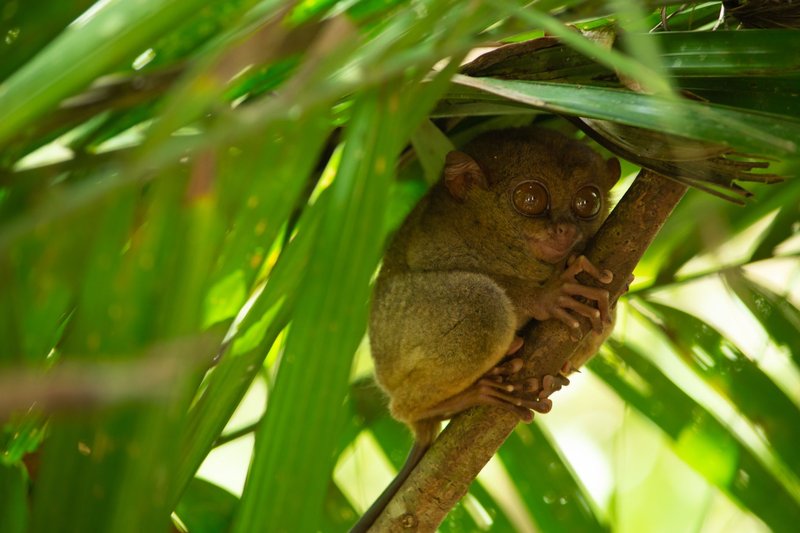
A tarsier is a primate that weighs about as much as a deck of cards and has eyes so large that, scaled to a human, each one would be the size of a grapefruit. The eyes can’t move in their sockets, so the animal swivels its head almost 180 degrees, owl-style, to look around. The spectral tarsier hunts insects at night in the forests of northern Sulawesi and communicates in calls so high-pitched humans can barely hear them. It’s one of the few primates that’s almost entirely carnivorous.
4. Maleo
The maleo is a chicken-sized bird that refuses to incubate its own eggs. Instead, females bury them in sun-warmed sand or soil heated by volcanic activity and walk away. The egg is roughly five times the size of a chicken’s, and the chick hatches underground already able to fly — it digs itself out and is on its own from minute one. Maleos are Endangered, hammered by egg harvesting along Sulawesi’s coasts and geothermal fields.
5. Black crested macaque
Jet-black, with a punk-rock crest and a startling pink rump, this macaque lives in the far northeast of Sulawesi. You may have seen one without knowing it: the “monkey selfie” that triggered a years-long copyright fight was a female crested macaque named Naruto who grabbed a photographer’s camera. They’re Critically Endangered — bushmeat hunting has cut the population hard — and survive mostly in the Tangkoko reserve.
Komodo and the Lesser Sundas
South and east of Sulawesi, the chain of islands running toward Timor hosts the heavyweight of Indonesian endemics and a couple of smaller stars. Keep following that chain past the Indonesian border and you reach Timor-Leste, which has its own roster of endemic species found nowhere else — the Lesser Sundas are an endemism hotspot on both sides of the line.
6. Komodo dragon
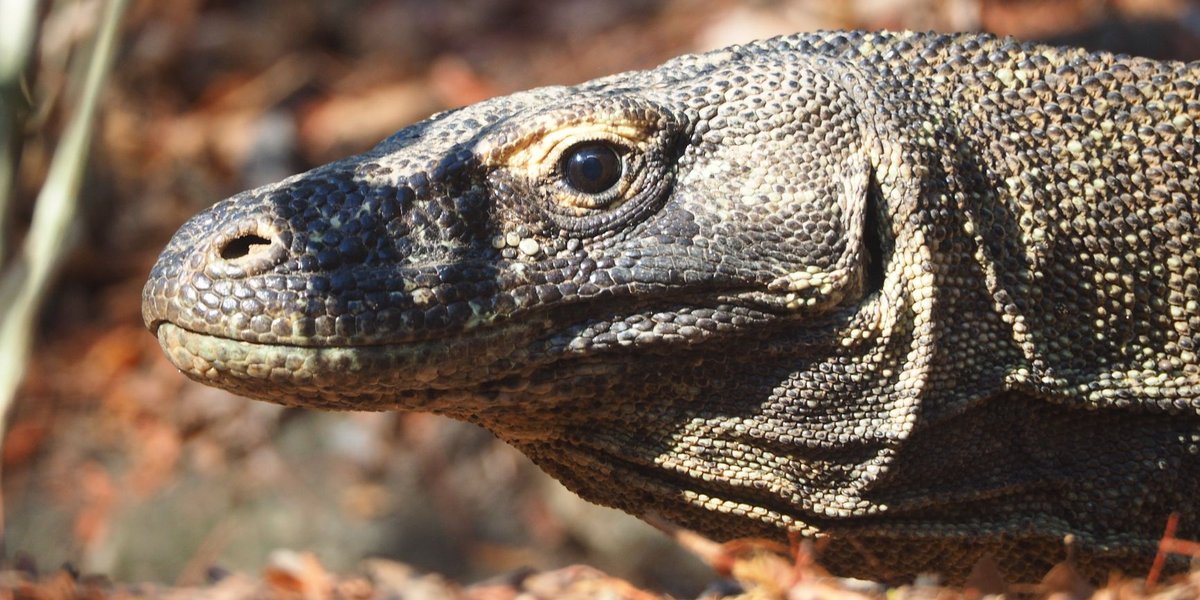
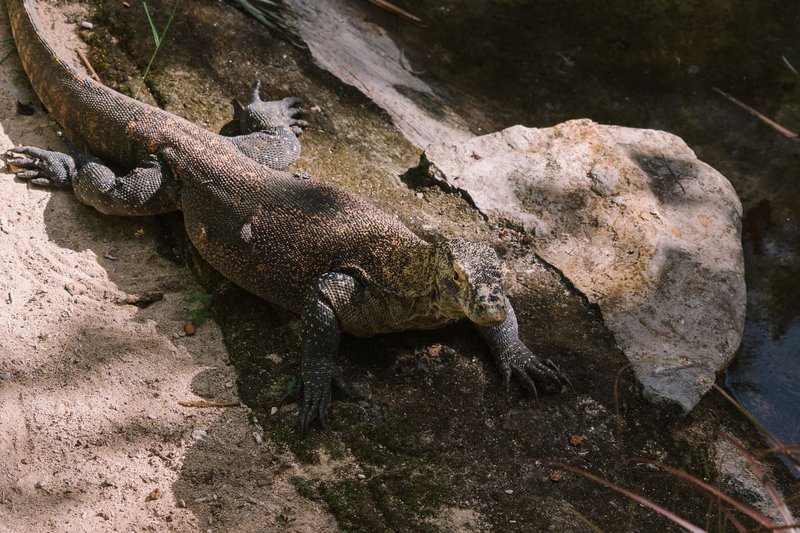
The largest living lizard, reaching three meters and 70 kilograms, the Komodo dragon exists on a handful of islands — Komodo, Rinca, Flores, and a few specks nearby — and nowhere else on Earth. For years people believed its bite killed through septic bacteria. Research from the University of Melbourne later showed the real weapon is venom: glands in the lower jaw deliver toxins that drop blood pressure and prevent clotting, so bitten prey bleeds out and goes into shock. A big dragon can take down a water buffalo. It headlines almost any list of remarkable reptiles, and it’s listed as Endangered, with rising sea levels threatening its low-lying island habitat.
7. Flores giant rat
Flores has a habit of producing oversized rodents, and this one is the headliner — body length around 45 centimeters, not counting a tail that’s longer again. It’s a remnant of the island’s strange “island giantism” history, the same evolutionary quirk that, in reverse, also gave Flores the dwarf human species Homo floresiensis, the “hobbit.” The giant rat is still around, foraging in the highland forests, listed as Near Threatened.
8. Sumba hornbill
Restricted to the single island of Sumba, this hornbill is a forest bird with a rust-colored body and a pale, gently curved casque. It depends almost entirely on large fruiting trees and old-growth nesting cavities, which makes it a direct casualty of logging. With its tiny range and falling numbers, it’s classed as Vulnerable and functions as a living indicator of how much of Sumba’s forest is left.
Java and Bali
These two islands sit firmly on the Asian side of the Wallace Line, but isolation still did its work. Both are also among the most densely populated places on the planet, which has not been kind to their wildlife.
9. Javan rhinoceros
Once spread across Southeast Asia, the Javan rhino is now down to a single population in Ujung Kulon National Park on Java’s western tip — roughly 75 animals, all of them in one place. It’s the rarest large mammal on Earth and Critically Endangered. One disease outbreak or one tsunami in the wrong spot could end the species. The rhinos are so wary that most of what scientists know about them comes from camera traps rather than direct sightings.
10. Bali myna
Bali’s only endemic bird, and one of its national symbols. The Bali myna is snow-white with a sky-blue mask around the eye and a wispy crest — striking enough that it was trapped nearly out of existence for the cage-bird trade. By the early 2000s, the wild population had crashed to single digits. It’s Critically Endangered, and the modest recovery it’s managed comes almost entirely from captive breeding and release programs in the northwest of the island.
11. Javan hawk-eagle
A medium-sized forest raptor with a tall crest, found only in Java’s remaining rainforest. It’s widely believed to be the real-life inspiration for Garuda, the mythical bird that serves as Indonesia’s national emblem. Fewer than 1,000 are thought to remain, scattered across forest fragments, and it’s listed as Endangered — a national icon that’s quietly running out of room.
Sumatra
The big western island sits on the Asian shelf and shares some megafauna with the mainland, but several subspecies and species split off and became Sumatra’s alone.
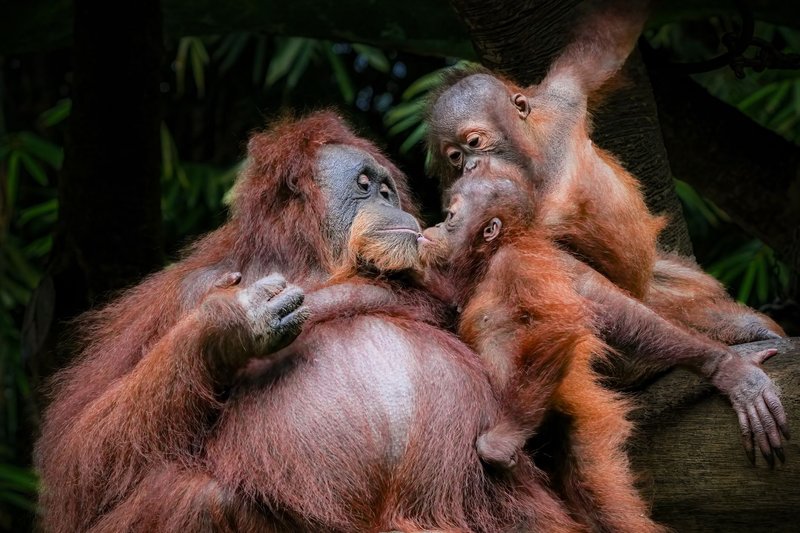
12. Sumatran orangutan
One of three orangutan species, all of them found only in Indonesia and Malaysian Borneo. The Sumatran orangutan lives almost entirely in the northern province of Aceh and is Critically Endangered, with palm-oil expansion clearing the lowland forest it needs. It’s more social and more frugivorous than its Bornean cousin, and it builds a fresh sleeping nest of bent branches high in the canopy every single night — an adult will construct tens of thousands of them over a lifetime.
13. Sumatran tiger
The smallest surviving tiger subspecies, and the last of Indonesia’s tigers after the Javan and Bali tigers were both driven extinct in the 20th century. Darker and more closely striped than mainland tigers, with webbed paws that help it move through swampy terrain. Fewer than 400 are estimated to remain in the wild, and it’s Critically Endangered. When the Sumatran tiger goes, the entire genus disappears from island Southeast Asia.
Papua: the Australian side
Cross to the eastern end of the archipelago and you’re on the Australian plate. The wildlife here has more in common with Cairns than with Jakarta — marsupials, monotremes, and the planet’s most extravagant birds.
14. Birds-of-paradise
Indonesian New Guinea hosts dozens of bird-of-paradise species, many endemic to specific valleys or mountains. The males evolved feathers and dances of almost absurd elaboration — the Wilson’s bird-of-paradise has a bald turquoise crown you can see in the dark and curled wire tail feathers, and clears a patch of forest floor to display on a literal stage. The same dazzling family spills across the border, as the full list of birds of Papua New Guinea makes clear. Because females did all the choosing and there were few predators to punish flamboyance, sexual selection ran unchecked for millions of years. David Attenborough has called filming them one of the highlights of his career, and it’s easy to see why: nothing else on Earth looks like this.
One plant worth the airfare
Every list of Indonesian endemics goes all-in on animals and forgets the plants, which is a shame, because Indonesia grows the most theatrical flowers on the planet.
The Rafflesia arnoldii produces the largest single flower in the world — up to a meter across and weighing 10 kilograms. It has no leaves, no stem, and no roots of its own; it’s a parasite that lives entirely inside a forest vine until it bursts out to bloom for a few days. And it smells like rotting meat, on purpose, to draw the carrion flies that pollinate it. Locals call it the “corpse flower.” It’s found in the rainforests of Sumatra and Borneo, and catching one in bloom is largely a matter of luck and timing.
What’s killing them, and where to see them right
A pattern runs through nearly every entry above: small range, Endangered or worse. That’s not coincidence. Endemism and extinction risk are two sides of the same coin — an animal confined to one island has nowhere to retreat when that island changes.
The big threats are consistent. Deforestation for palm oil and timber erases habitat, especially in Sumatra and Borneo. The wildlife trade drains specific species — the Bali myna and black crested macaque were both trapped or hunted to the brink. And climate-driven sea-level rise looms over the low-lying island species like the Komodo dragon.
If you want to see these animals, do it where the money funds protection rather than removal. Komodo National Park runs licensed ranger-guided treks. Tangkoko reserve in North Sulawesi is the reliable place for crested macaques and tarsiers, with local guides. Ujung Kulon protects the last Javan rhinos, though you won’t see one — and that’s the point. Skip any operation that lets you hold, feed, or pose with wildlife; for endemic species this rare, a photo op is rarely worth what it costs the animal.