Germany is a manufacturing superpower that mines almost no metal. That contradiction sits at the center of the country’s mineral story. It digs more lignite out of the ground than any other nation on Earth, runs some of the world’s deepest potash and salt operations, and then imports nearly every gram of copper, iron, and rare earth its factories consume. The last German metal mine closed in 1992, and the country has leaned on shipments from abroad ever since.
So what does Germany actually have underfoot? Plenty — just not the stuff you’d expect from a place that builds cars, machine tools, and chemicals at industrial scale.
Table of Contents
- Quick Reference: Germany’s Mineral Output
- Energy Minerals: The Coal Story
- Industrial Minerals: Where Germany Leads
- Metals: A Nation That Imports Almost Everything
- Lithium: The Project That Could Change the Math
- Critical Raw Materials and the Import Problem
- Famous Mineral Localities for Collectors
- The Takeaway
Quick Reference: Germany’s Mineral Output {#quick-reference}
Before the detail, here’s where Germany stands globally on the minerals it produces in meaningful quantity:
| Mineral | Germany’s Global Standing | Notes |
|---|---|---|
| Lignite (brown coal) | #1 producer worldwide | Burned almost entirely for electricity |
| Potash | Top 5 producer | Mined by K+S in the Werra and Harz regions |
| Rock salt | Top 5 producer | Vast underground reserves |
| Kaolin (china clay) | Significant European producer | Used in ceramics, paper, porcelain |
| Silica sand | Major European supplier | Glass and foundry industries |
| Hard coal | Production ended 2018 | Now fully imported |
| Metals (iron, copper, etc.) | Near-zero domestic mining | Last metal mine closed 1992 |
The pattern is clear: Germany is rich in bulk industrial minerals and energy minerals, and poor in metals. That shapes everything about its raw-materials strategy.
Energy Minerals: The Coal Story {#energy-minerals}
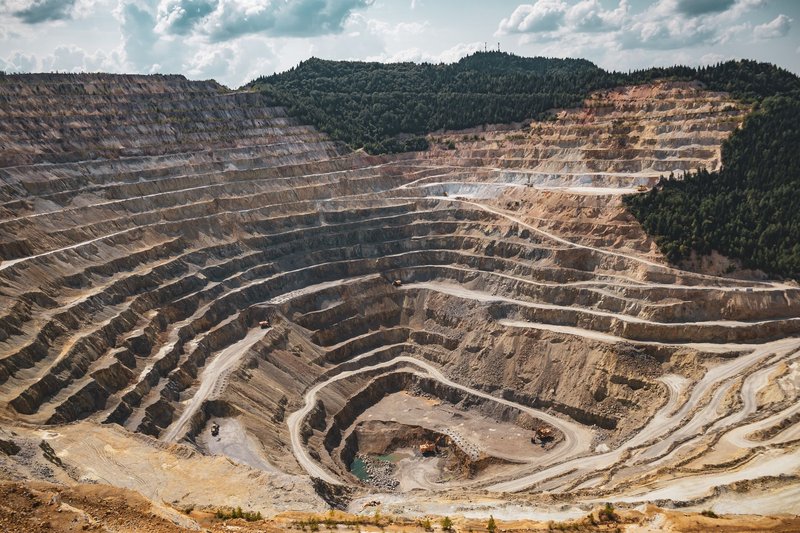
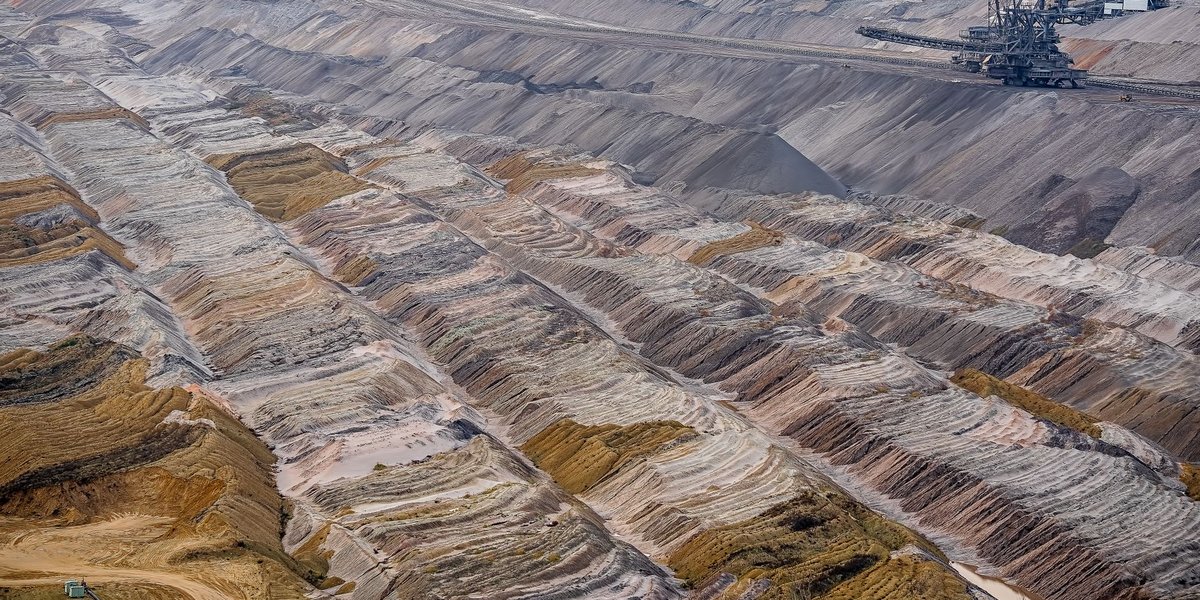
Germany’s single most significant mineral resource is brown coal, or lignite. It’s the world’s largest producer, and it isn’t close. The giant open-pit mines in the Rhineland near Cologne, in Lusatia along the Polish border, and in the central German region around Leipzig pull up hundreds of millions of tonnes a year. Garzweiler and Hambach in the Rhineland are some of the largest excavations of any kind on the continent — pits so wide they’ve swallowed entire villages, whose residents were relocated to make room.
Lignite is a low-grade fuel. It holds more water and less energy per tonne than hard coal, which makes it uneconomical to ship far. So Germany burns it where it digs it: power plants sit right at the edge of the mines, fed by conveyor belts. That proximity is the whole reason lignite stayed competitive for decades.
Hard coal is a different story. The Ruhr Valley built modern Germany on deep-shaft hard coal, but those seams ran deep and expensive. The last German hard-coal mine, Prosper-Haniel in Bottrop, closed at the end of 2018, ending centuries of underground mining. Germany still uses hard coal — it just imports all of it now.
The bigger shift is the phase-out. Germany has legislated an exit from coal-fired power, with the original timeline targeting 2038 and political pressure to move it forward. That means the lignite that defines Germany’s mineral output today is on a countdown. The mines that have run for generations are scheduled to go quiet, and the regions that depend on them — Lusatia especially — face a hard economic transition.
Industrial Minerals: Where Germany Leads {#industrial-minerals}
If metals are Germany’s weakness, industrial minerals are its quiet strength.
Potash is the headliner. Germany is one of the world’s top potash producers, and almost all of it comes from a single company: K+S, headquartered in Kassel. Potash is potassium-rich salt, and its main job is fertilizer — it’s one of the three macronutrients plants need. K+S mines it in the Werra-Fulda region and around the Harz, in deposits laid down when ancient seas evaporated roughly 250 million years ago. The Zechstein Sea left behind layered beds of potassium and magnesium salts that German miners have worked since the 1860s.
Rock salt comes from the same geological story. Those evaporite basins under northern and central Germany hold enormous salt reserves, mined both for industry and for de-icing roads. Some worked-out salt caverns get a second life as underground storage for natural gas — and, increasingly, as candidate sites for storing hydrogen.
Silica sand feeds the glass and foundry industries, with major deposits in places like Haltern in North Rhine-Westphalia. Kaolin, the white clay behind porcelain and high-quality paper, is mined in Bavaria around Hirschau and Schnaittenbach. And fluorspar — calcium fluoride, used in steelmaking and to produce hydrofluoric acid — comes from veins in the Black Forest, a region whose mining history stretches back to the Middle Ages.
These aren’t glamorous minerals. Nobody writes headlines about silica sand. But they’re the materials that keep a manufacturing economy running, and Germany mostly supplies its own.
Metals: A Nation That Imports Almost Everything {#metals}
Here’s the part that surprises people. Germany — home to ThyssenKrupp steel, to an auto industry built on aluminum and copper, to a chemical sector that runs on metal catalysts — mines virtually no metal ore at all.
It wasn’t always this way. The Harz Mountains were one of medieval Europe’s great mining districts, producing silver, lead, copper, and zinc for nearly a thousand years. Those metals came largely from sulfide ore minerals like galena and sphalerite, the workhorse sources of lead and zinc. Rammelsberg, the mine above the town of Goslar, ran continuously for over 1,000 years before closing in 1988, and it’s now a UNESCO World Heritage Site. The Erzgebirge — literally the “Ore Mountains” — on the Saxon-Czech border gave silver, tin, and later uranium.
But shallow, rich ore bodies get exhausted, and what’s left isn’t competitive against open-pit megamines in Chile, Australia, or Africa. The world’s major metals still come overwhelmingly from a handful of dominant ores mined at vast scale elsewhere, and Germany’s deposits simply can’t match them on cost. The last operating metal mine in Germany shut down in 1992. Today, the steel and metalworking industries that anchor the German economy run almost entirely on imported ore, scrap, and refined metal.
That’s a strategic vulnerability hiding inside an industrial strength, and it’s the reason the next two sections matter so much.
Lithium: The Project That Could Change the Math {#lithium}
For a country that imports nearly all its metals, lithium is the exception that has everyone’s attention. Germany sits on real lithium resources, and the most advanced project is at Zinnwald, in the Erzgebirge of Saxony, right on the Czech border.
Zinnwald’s lithium sits in zinnwaldite, a mica mineral named after the locality itself. The deposit has been known for ages — the area was mined for tin and tungsten historically — but lithium changes the economics. With Europe building battery gigafactories and trying to cut its dependence on Chinese-refined lithium, a domestic source inside an EU member state is strategically valuable in a way it never was before.
There’s also significant interest in geothermal lithium in the Upper Rhine Valley, where hot brines pumped up for geothermal energy carry dissolved lithium that could, in principle, be extracted as a byproduct. Several pilot projects are testing whether that works at commercial scale.
None of this is producing at volume yet. But it represents the first credible path in decades toward Germany mining a strategically critical metal on its own soil — and it’s the angle most reference articles on German minerals barely mention.
Critical Raw Materials and the Import Problem {#critical-raw-materials}
Germany’s mineral situation is a microcosm of a Europe-wide problem. The EU has flagged a list of critical raw materials — rare earths, cobalt, lithium, magnesium, graphite, and more — that are essential to modern industry and concentrated in a handful of supplier countries.
For most of these, Germany’s domestic production is effectively zero. Rare earth elements, vital for the permanent magnets in electric-vehicle motors and wind turbines, come overwhelmingly from China, which dominates both mining and refining. The same lopsided pattern shows up across the list of rare earth-producing countries, where a single nation controls most of both the mining and the separation chemistry. The same concentration risk applies to processed lithium, gallium, and graphite.
The EU’s response is the Critical Raw Materials Act, which sets targets for domestic extraction, processing, and recycling, and aims to diversify away from single-source dependency. For Germany specifically, that means three things at once: trying to develop projects like Zinnwald, building recycling capacity to recover metals from old batteries and electronics, and securing supply partnerships abroad. The country that mines no metal is being forced to think hard about where its metal comes from.
Famous Mineral Localities for Collectors {#collector-localities}
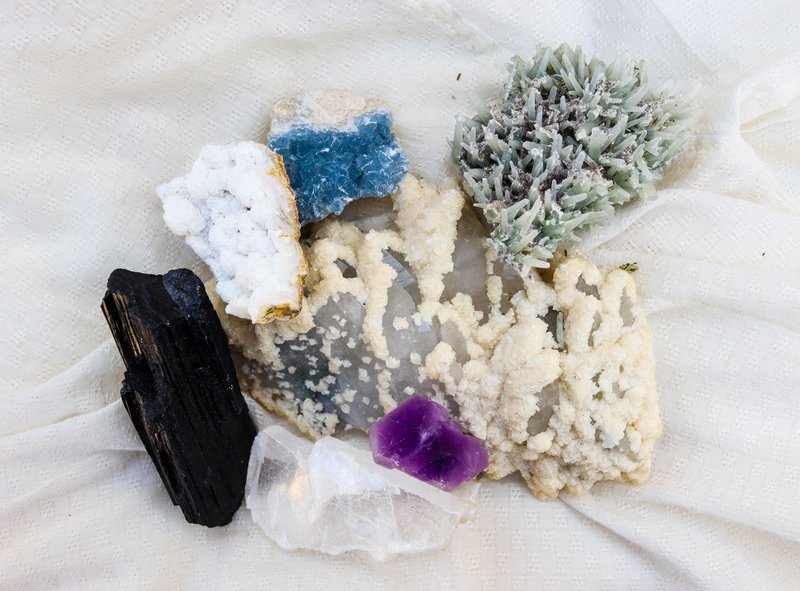
Beyond economics, Germany is genuinely important to mineral collectors and mineralogists — and a few of its localities are world-famous in that world.
- Hagendorf South, Bavaria — A pegmatite quarry that’s a legend among phosphate-mineral collectors. It’s the type locality for several rare phosphate species, meaning these minerals were first described from specimens found here.
- The Harz Mountains — Centuries of mining at Sankt Andreasberg and Clausthal produced classic specimens of silver minerals, calcite, fluorite, and rare arsenic and antimony species prized in museum collections.
- The Black Forest — The historic mining districts around Wittichen and Schauinsland yielded fine fluorite, barite, and silver minerals. The region’s deep mining tradition left a legacy of well-documented specimen localities.
- The Erzgebirge (Ore Mountains) — Beyond its industrial history, the Ore Mountains are a classic source of silver, tin, and uranium minerals, including the original specimens that helped early mineralogists define entire mineral groups.
For collectors, a German locality label on a specimen often signals a piece with real provenance — material from mines that, in many cases, no longer operate and never will again.
The Takeaway {#takeaway}
Germany’s minerals tell a two-sided story. On one side: world-leading lignite, abundant potash and rock salt, and a solid base of industrial minerals that keep its factories supplied. On the other: an almost total absence of domestic metal mining, a coal-power phase-out that will eventually retire its biggest mineral resource, and a deep dependence on imported critical raw materials.
The interesting part is what comes next. The Zinnwald lithium project, geothermal lithium in the Rhine Valley, and the EU’s push to localize critical-material supply chains could rewrite the picture over the coming decades — turning a country that famously mines no metal into one that mines at least the few metals that matter most. Whether that happens at scale is the open question. The geology is there. The economics and the politics are still catching up.