Organic sedimentary rocks are rocks built mostly from the carbon-rich remains of once-living things — plants piled in a swamp, plankton raining down on a seafloor, shells stacking up over millions of years. That’s the whole definition. The carbon came from biology, not from minerals crystallizing out of water.
That last part trips people up, because the textbook chapters that cover these rocks tend to lump “chemical and organic” together in one breath and then spend most of their time on the chemical half. So here’s the clean version: what organic sedimentary rocks are, the main types you’ll actually be tested on or quizzed about, how they form, and a quick way to tell them apart from everything else in the sedimentary family.
Contents
- What Counts as Organic
- Organic vs. Chemical vs. Clastic
- The Main Types (Quick Comparison)
- Coal and the Coalification Sequence
- Diatomite, Oil Shale, and Chert
- How to Identify Them
- Why They Matter
What Counts as Organic
The dividing line is the source of the material, not whether the rock looks “alive.” A rock is organic when its bulk came from the bodies of organisms — carbon from plant tissue, silica from microscopic plankton skeletons, calcium carbonate from shells and coral.
Two big families dominate:
- Carbonaceous rocks — rich in plant-derived carbon. Coal is the headline act here, along with oil shale and black shale.
- Biochemical rocks — built from the mineralized hard parts of organisms. Fossiliferous limestone, chalk, and diatomite live here.
There’s a real overlap with the “chemical” category, and geologists argue about where to draw the boundary. Coquina (a limestone made almost entirely of broken shells) is biological in origin but chemical in composition. That ambiguity is exactly why so many sources blur the two. For the purpose of identifying a rock in front of you, the useful question is simpler: did living things make most of this?
Organic vs. Chemical vs. Clastic
Sedimentary rocks come in three flavors, and knowing which is which is half the battle.
Clastic rocks are made of physical fragments — sand, silt, gravel, mud — that got eroded off older rock, transported, and cemented back together. Sandstone and shale are the classics. The material is broken-up rock, not biology.
Chemical rocks precipitate directly out of water when minerals come out of solution. Rock salt forming as a sea evaporates, or travertine building up around a hot spring — no organism required.
Organic rocks are the biological third option: the material was alive. The University of Saskatchewan’s open geology textbook frames the split this way and notes how often the organic and chemical groups get collapsed into one — partly because shells straddle both.
Quick gut check: a rock full of recognizable shell bits or plant matter, or one that’s noticeably light and full of carbon, is pointing you toward organic. Zoom out one level and the contrast gets even sharper when you line sedimentary rocks up against their fiery counterparts — the differences between igneous and sedimentary rocks come down to how the material formed in the first place.
The Main Types (Quick Comparison)
Here’s the whole organic lineup in one table. This is the consolidated reference the textbook explainers tend to scatter across several pages.
| Rock | Source organism | Composition | Quick identification | Main use |
|---|---|---|---|---|
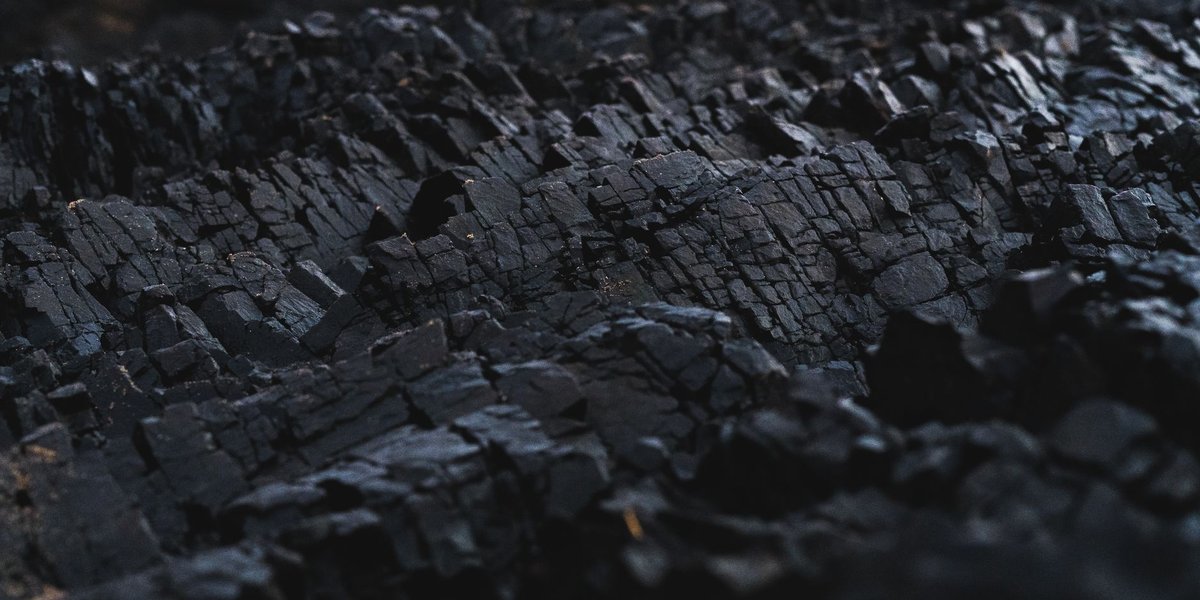
| Coal | Land plants (swamp vegetation) | Carbon | Black, lightweight, dirties your hands, may show plant fossils | Fuel, steel (coke) |
| Oil shale | Algae, plankton | Clay + solid organic matter (kerogen) | Dark, fine-grained, smells of oil when struck | Hydrocarbon source |
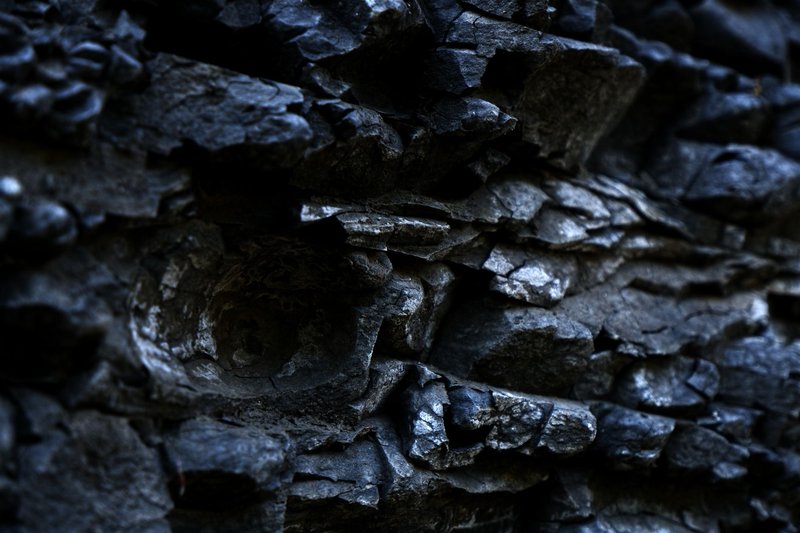
| Black shale | Marine plankton | Clay + organic carbon | Dark gray to black, splits in thin sheets | Petroleum source rock |
| Diatomite | Diatoms (algae) | Silica (opal) | Pale, chalky, very light, sticks to your tongue | Filters, abrasives, absorbents |
| Chert (organic) | Radiolaria, sponges | Silica | Hard, glassy, conchoidal fracture | Tools (historically), industrial |
| Chalk | Coccolithophores (algae) | Calcium carbonate | White, soft, powdery, fizzes in acid | Cement, agriculture |
| Fossiliferous limestone | Shells, coral, plankton | Calcium carbonate | Visible fossils, fizzes in acid | Cement, building stone |
Two patterns fall out of that table. Composition isn’t the giveaway — silica, carbon, and carbonate all show up. The giveaway is the origin organism. And the identification tests are wildly different from rock to rock, which is good news: a fizz test, a tongue test, and a sniff test will separate most of these.
Coal and the Coalification Sequence
Coal is the centerpiece of this rock type, and it’s worth understanding as a process rather than a single rock. Coal isn’t one thing — it’s a series of stages, and each stage is a different rock with a different name. The progression is called coalification, and it’s driven by burial: more depth means more heat and pressure, which squeezes out water and volatile gases and concentrates the carbon.
The sequence runs:
- Peat — partially decayed plant matter in a waterlogged swamp. Not technically a rock yet; spongy, brown, around 60% carbon. This is the raw ingredient.
- Lignite — “brown coal.” Soft, crumbly, low energy. The first true coal stage, around 60–70% carbon.
- Bituminous coal — the workhorse. Dense, black, the stuff most people picture. Roughly 75–85% carbon. Most electricity-generating and coking coal is bituminous.
- Anthracite — the endpoint. Hard, shiny, nearly pure carbon (over 90%), burns hot and clean with little smoke. It takes the most heat and pressure to form, so it’s the rarest. The famous anthracite fields of Pennsylvania are a textbook example, and they sit among the wider catalog of minerals found in Pennsylvania that the region’s geology produced.
Push anthracite even further and you cross out of the sedimentary world entirely into graphite — a metamorphic mineral that belongs with the other metamorphic rocks forged by heat and pressure. The key takeaway: depth and temperature drive the whole ladder. A coal seam’s rank tells you something about the geologic history it survived.
One scale detail worth holding onto: it takes something like 10 meters of compacted peat to yield a single meter of coal. The U.S. Energy Information Administration traces most U.S. coal back to swamps of the Carboniferous period, roughly 300 million years ago, when much of the land sat under vast wetland forests.
Diatomite, Oil Shale, and Chert
Coal gets the spotlight, but the supporting cast is where organic rocks get genuinely strange.
Diatomite is made almost entirely of diatoms — single-celled algae with glass-like silica shells. When trillions of them die and settle, you get a rock so light and porous it can float briefly before soaking up water. It’s also mildly abrasive at a microscopic scale, which is why it ends up in toothpaste, pool filters, and (as diatomaceous earth) garden pest control. Stick your tongue to a piece and it grabs, because it’s pulling moisture into all that pore space.
Oil shale isn’t shale that contains oil — it’s a fine-grained rock packed with kerogen, a solid organic precursor to oil. The oil hasn’t formed yet; you have to heat the rock to drive it out. That distinction matters when people argue about energy reserves: the material is there, but it’s locked in a solid you’d have to cook.
Black shale is the quieter cousin and arguably the most economically important rock on this list. Its dark color comes from organic carbon that accumulated on oxygen-starved seafloors, where there wasn’t enough oxygen to rot the dead plankton away. Bury black shale deep enough, give it time, and that organic matter cooks into petroleum. It’s the source rock for a huge share of the world’s oil and gas.
Organic chert forms from the silica skeletons of radiolaria and sponges, compacted into a hard, glassy rock. It fractures in smooth curved surfaces, which is exactly why early humans knapped it into blades and arrowheads. (Plenty of chert also forms chemically, which is another reason the organic/chemical line stays blurry.)
How to Identify Them
You don’t need a lab to sort most of these. A few field tests do the heavy lifting:
- The acid test. A drop of dilute hydrochloric acid fizzes on anything carbonate — chalk, limestone, coquina. No fizz rules carbonates out.
- The streak/smudge test. Coal blackens your fingers and is conspicuously light for its size. If it smudges and feels low-density, you’re in coal territory.
- The hardness test. Chert is hard enough to scratch glass and won’t yield to a knife. Diatomite and chalk crumble under a fingernail.
- The tongue test. Press it to your tongue — diatomite and chalk stick because they’re porous and absorb saliva. Chert won’t.
- The smell test. Strike or scratch oil shale and many black shales and you’ll catch a faint petroleum odor from the organic matter.
- Look for fossils. Visible shells, coral fragments, or leaf impressions are a direct tell that biology built the rock.
Run a sample through fizz, hardness, and tongue, and you’ve usually narrowed it to one or two candidates.
Why They Matter
Organic sedimentary rocks are, more than any other rock type, the ones civilization runs on. Coal powered the Industrial Revolution and still generates a large share of global electricity. Black shale and oil shale are the source rocks behind petroleum and natural gas — nearly all the oil ever pumped started as organic mud on an ancient seafloor. Even the quieter members earn their keep: diatomite filters your drinking water and beer, chalk goes into cement, and limestone is one of the most-used building materials on Earth.
They’re also a carbon archive. Every coal seam and oil shale bed represents carbon that living things pulled out of the atmosphere hundreds of millions of years ago and locked underground. Burning them reverses that, which is the whole climate story in one sentence. The National Oceanic and Atmospheric Administration tracks how releasing that long-buried carbon drives the rise in atmospheric CO2.
So the next time a textbook rushes past “chemical and organic” sedimentary rocks in a single line, you’ll know the organic half is the one that ended up heating your home and filling your gas tank. Not bad for a pile of dead swamp plants.