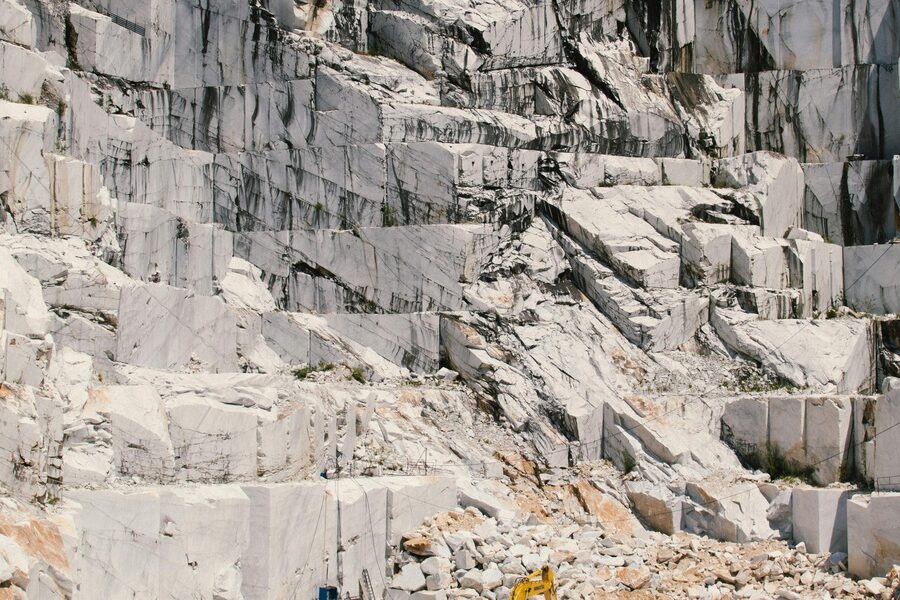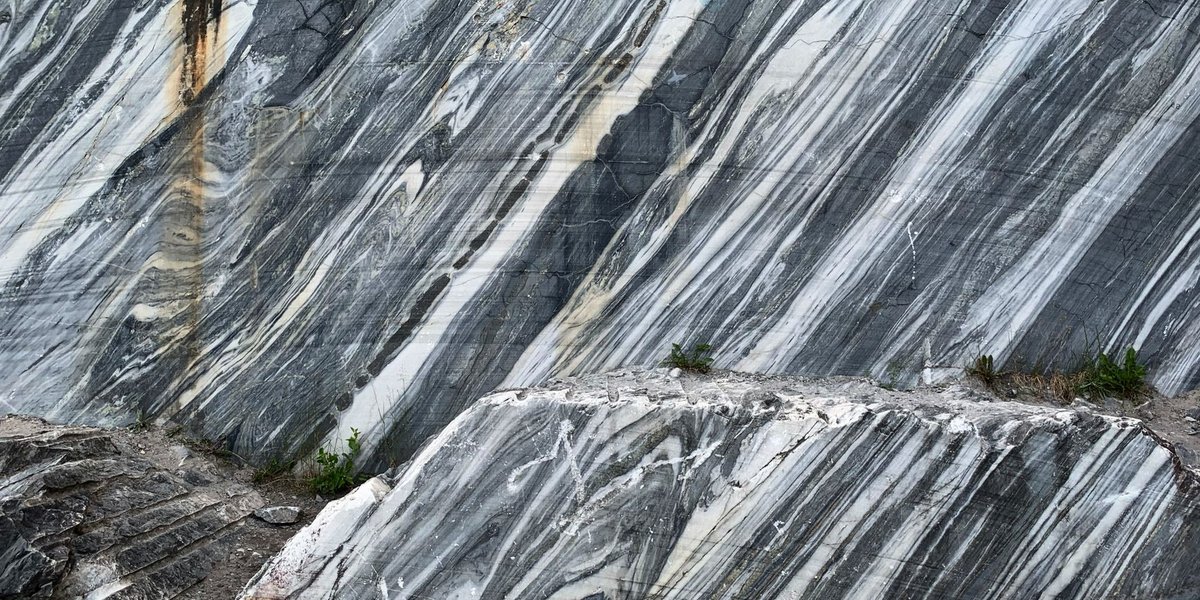
Foliated rocks wear stripes. Non-foliated rocks don’t — and that single fact does most of the identification work for you.
When a rock metamorphoses under directed pressure, its platy minerals line up into bands, the way a deck of cards flattens when you press it. That alignment is foliation. But not every metamorphic rock gets squeezed from one direction. Some bake next to a magma intrusion (contact metamorphism), and others recrystallize from minerals that have no flat shape to align in the first place. The result is a massive, unbanded rock with crystals scattered in no particular direction. That’s a non-foliated metamorphic rock.
Below are eight clear examples of non-foliated metamorphic rocks, each with its parent rock, the mineral that defines it, and one honest test you can run with your hands or a pocketknife. There’s a comparison table up top if you just need the quick version.
Table of Contents
- Quick comparison table
- 1. Marble
- 2. Quartzite
- 3. Hornfels
- 4. Greenstone
- 5. Amphibolite
- 6. Anthracite
- 7. Eclogite
- 8. Granulite
- Foliated vs. non-foliated, in one breath
- Quick-reference recap
Quick comparison table
| Rock | Parent rock | Key mineral | Color / texture | How to ID |
|---|---|---|---|---|
| Marble | Limestone / dolostone | Calcite (or dolomite) | White to gray, sugary, often veined | Fizzes in weak acid; scratches with a steel knife |
| Quartzite | Sandstone | Quartz | White to gray, glassy, hard | Won’t scratch with steel; breaks through grains, not around them |
| Hornfels | Shale or mudstone | Mixed fine grains | Dark, dense, often spotted | Tough, fine-grained, breaks with a sharp ring |
| Greenstone | Basalt | Chlorite, epidote, actinolite | Dull green, fine-grained | Green color plus a basaltic origin |
| Amphibolite | Basalt or gabbro | Hornblende + plagioclase | Black-and-white speckled | Visible black hornblende needles, no banding |
| Anthracite | Bituminous coal | Carbon | Black, bright, glassy luster | Lightweight, shiny, conchoidal fracture |
| Eclogite | Basalt (high pressure) | Garnet + omphacite | Red garnets in green matrix | Red-in-green “Christmas” look |
| Granulite | Various, high-grade | Pyroxene, garnet, feldspar | Light, coarse, granular | Coarse interlocking grains, dry feldspar-rich body |
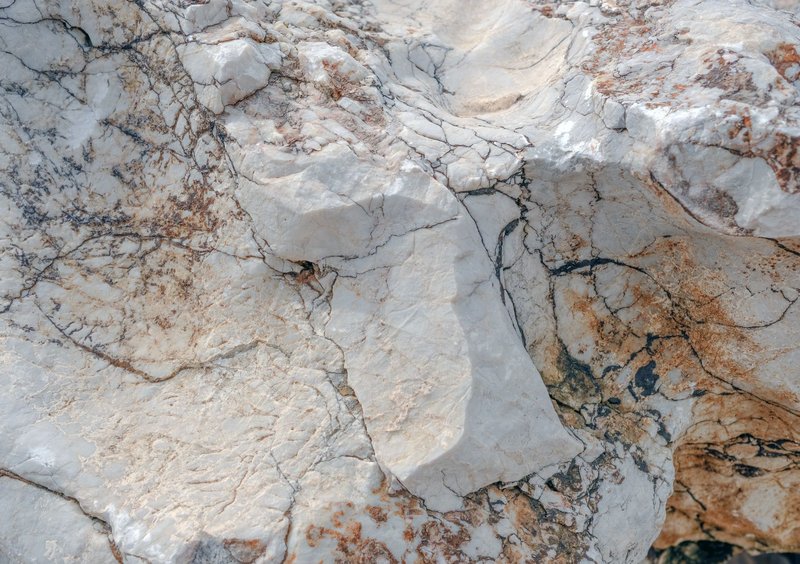
1. Marble
Marble is the one everybody already half-knows, and the classic teaching example of contact and regional metamorphism without foliation. Its parent rock is limestone (or dolostone), and the metamorphism recrystallizes the original calcite into bigger, interlocking grains. That recrystallization is why a cut marble surface catches light in tiny sparkling facets — those are calcite crystals, not polish.
How to tell it apart: marble is soft. A steel knife scratches it easily, and a drop of dilute hydrochloric acid (or even strong vinegar, slowly) makes it fizz, because calcite reacts with acid. The swirling gray veins so prized in countertops are impurities — clay, iron oxides, organic carbon — that got stretched as the rock recrystallized.
2. Quartzite
Quartzite starts as sandstone and ends up as one of the hardest rocks you’ll handle. Heat and pressure fuse the original quartz sand grains until the spaces between them disappear and the whole rock becomes a single welded mass of quartz.
The field test is satisfying. Sandstone breaks around its grains, leaving a gritty, sandy surface. Quartzite breaks straight through the grains, because the grains and the cement are now the same material — the fracture cuts a glassy, almost waxy face. It also refuses to scratch with steel; quartz sits at 7 on the Mohs scale, harder than a knife blade. If you can’t scratch it and it isn’t fizzing in acid, you’re probably holding quartzite, not marble.
3. Hornfels
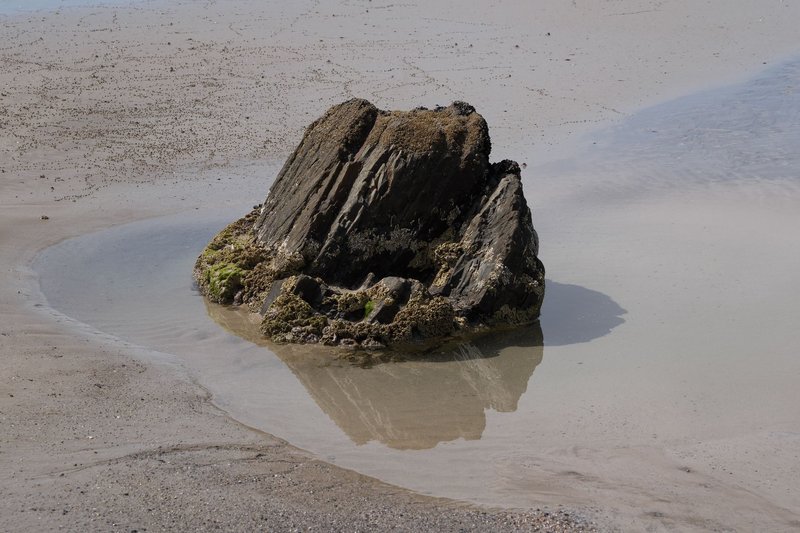
Hornfels is what happens when fine-grained rock like shale or mudstone gets cooked beside an intruding magma body. No directed pressure, just heat — so the new minerals grow in random orientations, and you get a dense, tough, non-foliated rock named for its horn-like toughness.
It’s a tricky one to ID because hornfels is a textural name, not a single mineral recipe; its makeup depends on the parent rock. The tells are its hardness, its very fine grain, and a sharp, almost ringing sound when you tap it. Many hornfels samples are spotted, with dark blobs of porphyroblasts — minerals like cordierite or andalusite that grew large in the surrounding fine matrix during the bake.
4. Greenstone
Greenstone is metamorphosed basalt, and the name does exactly what you’d hope. The green comes from a trio of minerals — chlorite, epidote, and actinolite — that form when basaltic ocean crust gets altered at relatively low metamorphic grades. Ancient greenstone belts, some over 3 billion years old, are among the oldest preserved crust on Earth and a major target for gold exploration.
To recognize it: dull green, fine-grained, fairly heavy, with no mineral banding. If a rock is green and clearly volcanic in origin but has been baked into something denser and harder than fresh basalt, greenstone is the call. It’s the gentlest grade on this list — push the metamorphism higher and that same basalt becomes amphibolite.
5. Amphibolite
Amphibolite is basalt or gabbro taken to medium-to-high grade. The defining mineral is hornblende, a black amphibole, paired with white-to-gray plagioclase feldspar. That pairing gives amphibolite its signature salt-and-pepper look: black needles and stubby prisms set against a paler background.
Here’s the catch worth knowing — amphibolite can be weakly foliated if it formed under strong directed pressure, but plenty of it is genuinely non-foliated, with hornblende crystals pointing every direction. The reliable ID is the mineralogy, not the texture: visible black hornblende plus plagioclase, denser and coarser than greenstone. If you see the black needles roughly randomly arranged, you’ve got the non-foliated variety.
6. Anthracite
Anthracite is the odd one out, and a favorite trick question. It’s metamorphosed coal — bituminous coal that got pressed and heated until most of the volatile compounds drove off, leaving a rock that’s around 90 percent or more carbon. Because there are no platy silicate minerals to align, it’s non-foliated by default.
You’ll know it by feel and shine. Anthracite is noticeably light for its size, jet black, and has a bright, almost glassy luster — not the dull, sooty look of ordinary coal. It breaks with a smooth, curved (conchoidal) fracture, and it doesn’t leave much black on your fingers. The U.S. Energy Information Administration ranks it as the highest grade of coal, which is really just another way of saying it’s been metamorphosed the most.
7. Eclogite
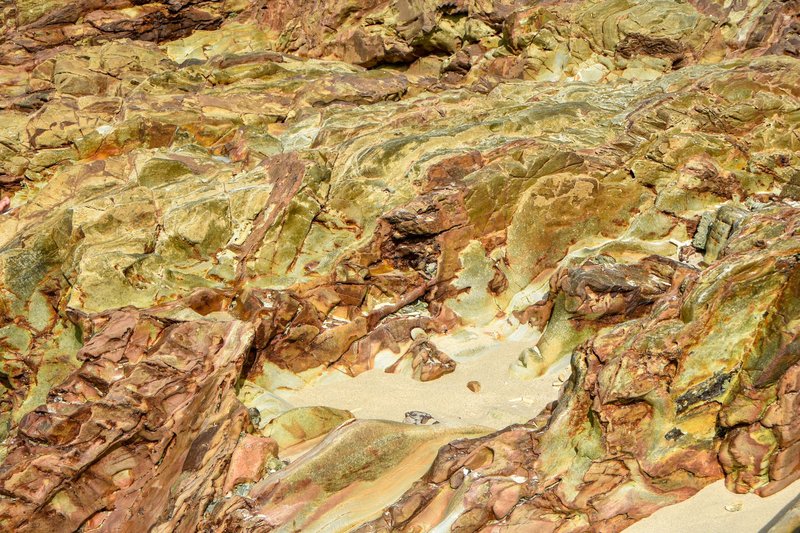
Eclogite is the showstopper. It forms when basalt is subjected to extreme pressure — the kind found deep in subduction zones, where ocean crust dives back into the mantle. The result is a dense rock of red garnet crystals scattered through a green matrix of omphacite, a sodium-rich pyroxene. Geologists sometimes call it the “Christmas rock” for the red-and-green palette.
Eclogite is one of the densest common rocks on Earth, which is part of why it matters: dense slabs of it help pull subducting plates down into the mantle. To ID it, look for that unmistakable combination — bright red garnets, no banding, embedded in a grass-to-emerald green groundmass. Nothing else on this list looks quite like it.
8. Granulite
Granulite is what rock becomes at the highest grades of regional metamorphism, deep in the continental crust where temperatures top roughly 700°C. The heat is so intense that the hydrous minerals break down and the rock dries out, leaving an interlocking mass of pyroxene, garnet, and feldspar. That dryness is the key to why it’s non-foliated: without flat micas and amphiboles, there’s little to align.
Granulite reads as coarse and granular (hence the name), generally light-colored from all the feldspar, with garnets and dark pyroxenes studded through it. According to the British Geological Survey, granulite-facies conditions represent some of the most extreme metamorphism rocks survive without melting outright. Push the temperature just a little higher and the rock starts to melt — at which point it stops being metamorphic and starts becoming igneous.
Foliated vs. non-foliated, in one breath
The split comes down to one question: did the rock form under directed pressure, and did it have flat minerals to respond to it?
- Foliated rocks — slate, phyllite, schist, gneiss — formed under directed pressure with platy minerals (micas, chlorite) that aligned into visible layers, bands, or a tendency to split into sheets.
- Non-foliated rocks — the eight above — either formed mostly from heat (contact metamorphism), or recrystallized from minerals that don’t line up, leaving a massive, unbanded texture.
A useful mental shortcut: if the rock looks striped or splits into flat slabs, it’s foliated. If it’s a uniform mass with crystals going every which way, it’s non-foliated. The eight here are only part of the picture, of course — if you want to see how they sit alongside their foliated cousins, this complete list of metamorphic rocks sorts dozens of types by parent rock, grade, and key minerals. For more on how directed pressure builds those bands, the University of Oregon’s geology resources cover the texture spectrum in detail.
Quick-reference recap
- Marble — from limestone; soft, veined, fizzes in acid.
- Quartzite — from sandstone; glass-hard, breaks through its grains.
- Hornfels — baked shale; dense, fine, often spotted.
- Greenstone — low-grade basalt; dull green.
- Amphibolite — higher-grade basalt; black hornblende and white feldspar.
- Anthracite — metamorphosed coal; light, shiny, nearly pure carbon.
- Eclogite — high-pressure basalt; red garnets in a green matrix.
- Granulite — extreme-grade rock; coarse, dry, feldspar-rich.
Run two tests in the field and you’ll sort most of these fast: try to scratch it with steel, and drop a little weak acid on it. Soft and fizzing is marble. Hard and silent is quartzite. From there, color and mineral content take you the rest of the way.