Table of Contents
- Why Ethiopia Grows Plants Found Nowhere Else
- Giants of the Sanetti Plateau and Bale Mountains
- Endemics of the Simien Mountains
- Highland Specialists Found Across the Country
- The Kafa Forests: Where Coffee Is Still Wild
- Where to See Them and What’s Being Done to Protect Them
- The Short Version
Ethiopia’s Biodiversity Institute has counted 476 plant species that grow nowhere else on the planet — not “rare,” not “hard to find outside the region,” but absent from every other country’s flora, full stop. That number puts Ethiopia ahead of every other country in continental Africa for plant endemism. Most of the list never makes it into a field guide a regular person would pick up. It sits in PDFs meant for taxonomists.
That’s a shame, because the endemic plants of Ethiopia are not a footnote. They’re rosette giants that outlive the people who plant them, red-hot pokers that get pollinated by an endangered canid, and a coffee species whose genetic future depends on a shrinking patch of rainforest in the country’s southwest. This is a walk through the standout species, organized by where you’d actually find them, with the conservation status and the specific detail that makes each one worth knowing.
Why Ethiopia Grows Plants Found Nowhere Else
Ethiopia’s highlands form one of the largest continuous mountain massifs in Africa, split by the Great Rift Valley and punctuated by peaks over 4,000 meters. That combination — extreme elevation, isolation from other African mountain systems, and a climate that swings from tropical at the base to near-arctic on the plateaus — is exactly the recipe that produces endemic species. Plants adapt to one narrow altitude band, get cut off from relatives on other mountains by the lowland heat in between, and evolve into something the rest of the continent doesn’t have.
The region sits inside what conservationists call the Eastern Afromontane Biodiversity Hotspot, one of the most species-dense and most threatened ecosystems on Earth. This hotspot extends into neighboring countries — Kenya’s highlands and the mountains of Sudan also harbor unique endemic floras — but Ethiopia’s particular geography has concentrated more endemic species here than anywhere else on the continent. The Afroalpine zone above 3,200 meters is the extreme end of that story: a treeless, frost-prone plateau where the plants that survive tend to be strange-looking for a reason. Giant rosettes, waxy leaves, insulating hairs — these aren’t quirks, they’re survival gear against nights that drop below freezing three hundred and sixty days a year.
Giants of the Sanetti Plateau and Bale Mountains
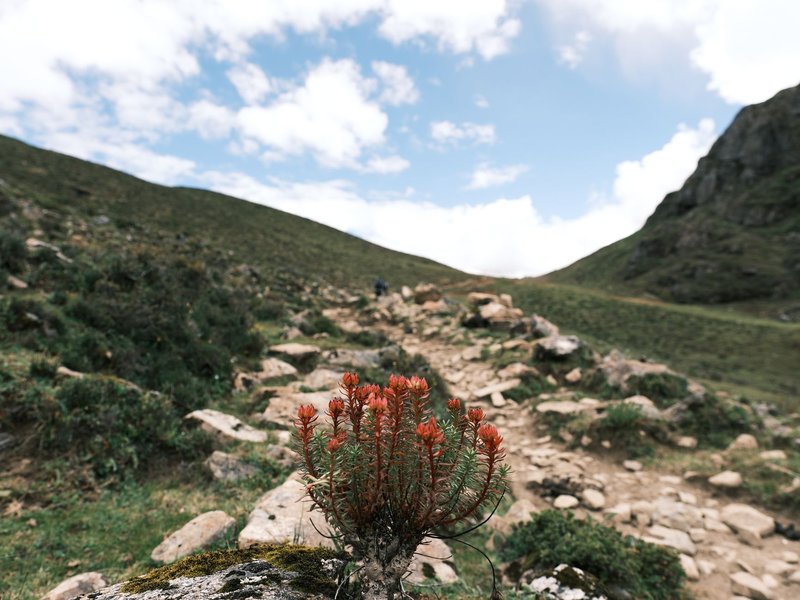
The Sanetti Plateau, inside Bale Mountains National Park, sits above 4,000 meters and is the single richest spot in the country for Afroalpine endemics. Everything here has adapted to cold, wind, and thin air, and the adaptations are visible from a distance.
Giant Lobelia (Lobelia rhynchopetalum). This is the plant people photograph in Bale and the Simien Mountains without knowing its name — a rosette on a woody stem that can reach 10 meters including its flower spike, standing alone on an otherwise treeless plateau. The height isn’t decoration. By growing tall, the giant lobelia lifts its growing point away from the ground, where temperature swings are most extreme, while still catching direct sun on its leaves. It’s a heat-storage strategy built out of plant tissue. The tradeoff is that it’s now in serious trouble: a peer-reviewed habitat-modeling study projects that only 3.4% of its current suitable habitat will remain by 2080, and its modeling already shows an 82% loss of genetic diversity as populations shrink and fragment.
Giant Groundsel (Solanecio gigas). Less famous than the lobelia but just as strange to look at — a tree-sized rosette plant that dominates patches of the Afroalpine zone alongside it. It’s endemic to Ethiopia and Eritrea specifically, part of a small group of giant groundsels that evolved independently on isolated African mountains, the same evolutionary trick that produced similar-looking giants on Kilimanjaro and in the Rwenzoris, but a different species every time.
Ethiopian Red Hot Poker (Kniphofia foliosa). A perennial herb with tall spikes of tubular orange-red flowers that carpet the high grasslands of Bale in the wet season. Its rhizomes show up in traditional medicine for malaria and wound treatment, but the more interesting story broke in 2024: researchers documented Ethiopian wolves feeding on its nectar, muzzles dusted with pollen afterward, making it the first large carnivore ever recorded acting as a pollinator. A predator and a flower, running the same transaction bees usually handle.
Endemics of the Simien Mountains
The Simien Mountains, a UNESCO World Heritage Site in the north, are geologically older and more eroded than Bale — the landscape reads as a wall of cliffs and jagged pinnacles rather than a plateau. A recent survey of the park’s flora recorded 75 species endemic to Ethiopia growing within its boundaries, with the daisy family (Asteraceae) contributing more endemic species than any other plant family in the country.
Simien Stonecrop (Rosularia semiensis). A small succulent that clings to the park’s rock faces and is, as the name suggests, known only from the Simien range — it doesn’t occur anywhere else in Ethiopia, let alone the world. Easy to miss, since it grows low and tucked into crevices rather than putting on a show.
Simien Nettle (Urtica simensis). One of the medicinal plants that made it onto the IUCN Red List of Threatened Species, used locally to treat a range of ailments. Its listing is a useful reminder that “endangered” and “unassuming-looking” aren’t mutually exclusive — a lot of Ethiopia’s threatened endemics aren’t showy flowers, they’re the plants people have quietly relied on for generations.
Abyssinian River Lily (Crinum abyssinicum). A tall amaryllid with an umbel of flowers on a bare stalk, found on riverbanks, overgrazed hilltops, and wet montane grassland between 2,050 and 3,650 meters across a wide swath of the highlands — Tigray, Gondar, Gojam, Shewa, Arsi, Kafa, Gamo-Gofa, Hararghe, and Bale. It’s not confined to a single park, but it’s confined to Ethiopia: not known to occur anywhere outside the country’s borders.
Kniphofia insignis. A close relative of the red-hot poker, sharing the river lily’s habitat and elevation range and, like it, absent from every flora outside Ethiopia. The two make a useful pair for anyone trying to learn the difference between a widespread native and a true endemic — geography is doing a lot of the identification work here.
Highland Specialists Found Across the Country
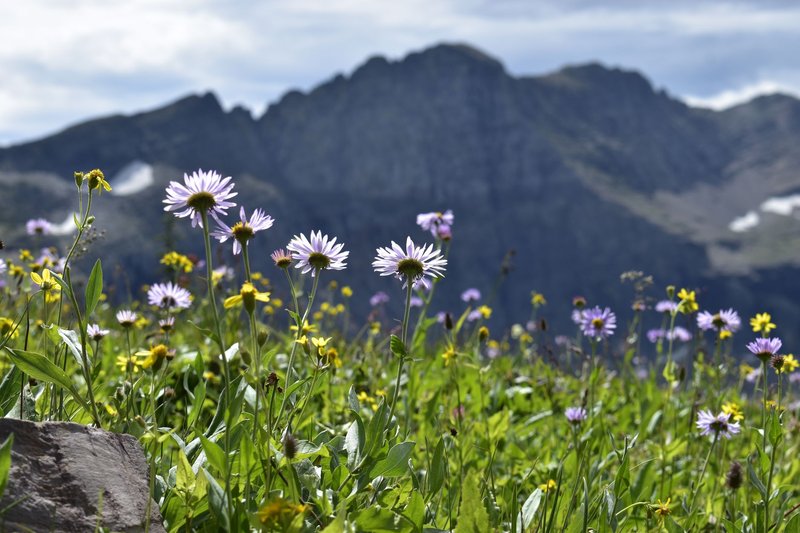
Not every endemic plant belongs to a single national park. Some are spread across the highland floristic regions generally, tied to elevation rather than to one specific range.
Highland Globe Thistle (Echinops longisetus). A spiny, silver-leaved thistle relative confined to Ethiopia’s highlands, part of a genus that shows up repeatedly in local pharmacology screening studies — researchers keep testing it for antimicrobial activity, which is usually a sign that traditional medicine got there first.
Echinops ellenbeckii. A sister species to the above, also restricted to the Ethiopian highlands and also studied for its chemical constituents. The two are frequently tested side by side in the same papers, which tells you something about how closely related — and how similarly useful — they are.
Laggera tomentosa. An Asteraceae species and one of the most commonly cited endemic medicinal plants in Ethiopian ethnobotanical surveys, also carrying an IUCN Red List listing. Its essential oils have been studied for antibacterial and antioxidant activity, and it shows up repeatedly in surveys of what herders and rural households actually use when nobody’s nearby with a pharmacy.
The Kafa Forests: Where Coffee Is Still Wild
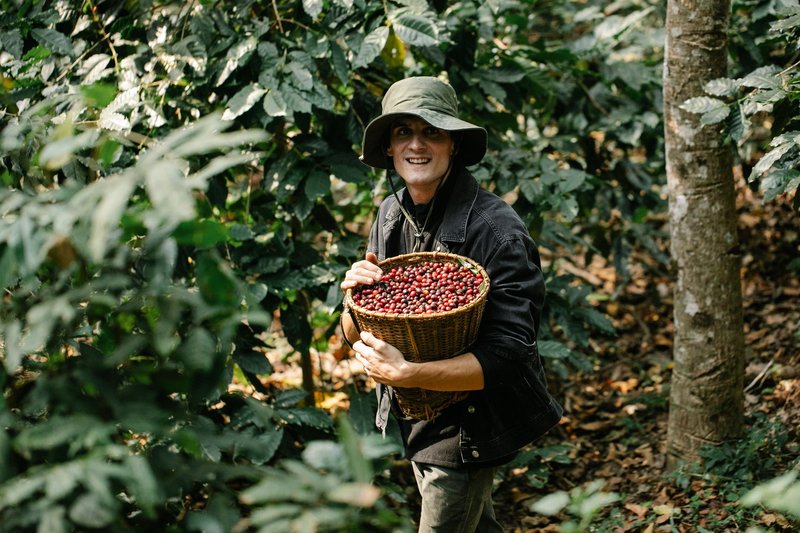
Here’s the one most readers already have a relationship with, without realizing it. The montane rainforests of southwestern Ethiopia, particularly around the Kafa region, are the center of origin and center of genetic diversity for Coffea arabica — every cup of arabica coffee on Earth traces back to wild populations still growing under this forest canopy. Wild arabica also persists in a handful of pockets across the border in South Sudan, so it’s not a pure Ethiopia-only endemic in the strictest taxonomic sense, but the overwhelming share of its genetic diversity is concentrated here, which is precisely why Kew Gardens has prioritized the region for conservation work.
The stakes are specific and not abstract. Roughly 2,000 square kilometers of high-quality forest with wild arabica remains, and it’s shrinking as the surrounding land gets cleared for cultivation. Losing it wouldn’t just be a loss for Ethiopia — it would strip the global coffee industry of the wild gene pool it may eventually need to breed disease resistance and climate tolerance into cultivated varieties. Kafa was named a UNESCO Biosphere Reserve in 2010 for exactly this reason: it’s not scenery, it’s a gene bank that happens to have trees.
Where to See Them and What’s Being Done to Protect Them
Bale Mountains National Park and Simien Mountains National Park are both accessible with a guide and a permit, and both are the most reliable places to see Afroalpine endemics without a botany degree — the Sanetti Plateau road in Bale runs right through giant lobelia territory, and Simien’s escarpment trails pass through stonecrop and nettle habitat within a few hours of the park gate. The Kafa Biosphere Reserve, further southwest, is less set up for casual tourism but is the place to understand wild coffee as a living forest rather than a bag on a shelf.
Conservation on the ground runs through a mix of national park protection, the Ethiopian Biodiversity Institute’s ongoing endemic species inventory, and targeted work like the Ethiopian Wolf Conservation Programme, which protects Bale’s Afroalpine grasslands as wolf habitat — protection that incidentally covers the red-hot poker fields the wolves now visit for nectar. The bigger threat across almost every species on this list isn’t poaching or collection. It’s agricultural expansion and firewood collection chipping away at habitat that was already narrow to begin with, plus the longer-term problem of a warming climate squeezing Afroalpine species toward mountaintops that only get so high.
The Short Version
The endemic plants of Ethiopia don’t need embellishment to be worth a trip or a closer look — a lobelia growing taller than a house because the ground is too cold for its own flowers, a wolf with pollen on its muzzle, a forest that grows the ancestor of your morning coffee. Ethiopia’s isolation and altitude built a flora that exists nowhere else, and most of it is still standing, for now, in a handful of protected ranges you can actually visit. What happens to it next depends on how much of that specific forest and grassland stays intact — which is a more concrete question than most biodiversity stories manage to ask.