No. Lithuania has no volcanoes — not active, not dormant, not even an eroded extinct one poking out of a field somewhere. If you came here to settle a quiz answer or a travel worry, that’s the whole story. Lithuania is one of the flattest, geologically calmest countries in Europe.
But “no” is the boring part. The interesting question is why a country can be completely volcano-free, and whether that’s always been true. Spoiler: it hasn’t. There’s volcanic rock under Lithuania that’s roughly two billion years old. You just can’t see it, and you never will.
Table of Contents
- The short answer
- Why Lithuania has no volcanoes
- The buried truth: ancient volcanic rock
- What about earthquakes?
- Lithuania’s “mountains” and what it has instead
- Lithuania terrain at a glance
- FAQ
The short answer
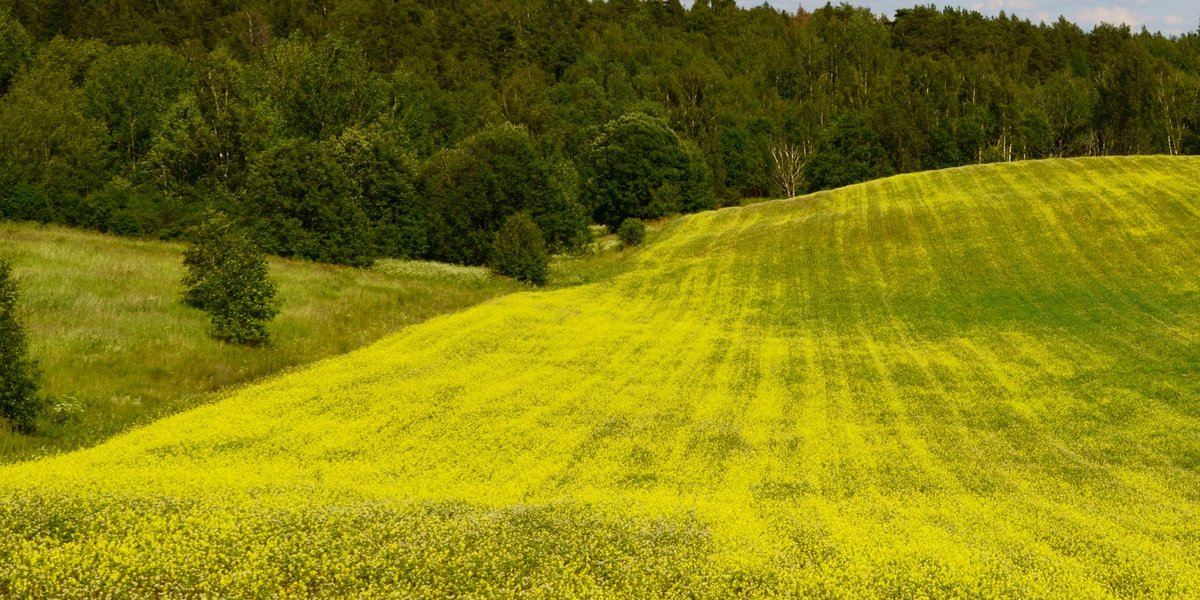
Lithuania sits on the Baltic coast in northeastern Europe, and its landscape is famously low and rolling. The country’s highest point, Aukštojas Hill, tops out at just 293.84 meters — that’s a hill barely taller than a few stacked office towers, and it’s the peak of the entire nation. There is no geological feature anywhere in Lithuania that qualifies as a volcano.
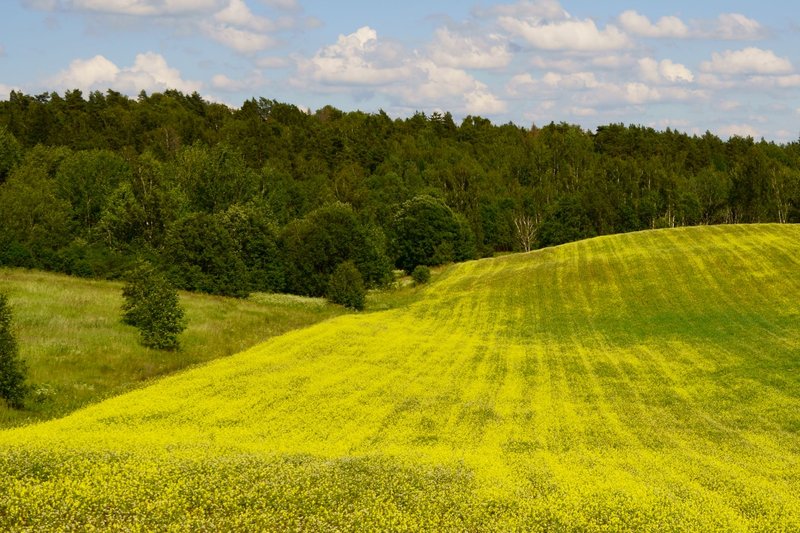
This isn’t a “well, technically” situation either. Some flat countries have at least one ancient volcanic plug or a basalt formation that locals point to. Lithuania doesn’t even have that at the surface. The reason comes down to where the country sits on the planet’s crust.
Why Lithuania has no volcanoes
Volcanoes need a specific recipe: somewhere for magma to reach the surface. That almost always happens at the boundaries between tectonic plates — where plates collide, pull apart, or grind past each other — or over hotspots, the deep mantle plumes that built places like Hawaii and Iceland.
Lithuania has neither. It sits squarely in the middle of the East European Craton, one of the oldest and most stable chunks of continental crust on Earth. A craton is essentially the geological equivalent of bedrock for an entire continent: ancient, thick, cold, and welded together so long ago that it stopped doing anything dramatic billions of years ago. The nearest active plate boundaries are thousands of kilometers away — the Mid-Atlantic Ridge to the northwest, the Mediterranean collision zone to the south.
No plate boundary, no hotspot, no magma pathway. That’s the entire mechanism, and Lithuania is missing all of it.
The flatness you see today is a second story layered on top. During the last Ice Age, massive glaciers advanced and retreated across the whole region, scraping the land down and dumping sediment as they melted. The hills Lithuania does have — the Baltic Highlands in the east — are glacial deposits, piles of debris left by retreating ice, not anything that pushed up from below. According to the U.S. Geological Survey, the world’s volcanoes cluster overwhelmingly along the Pacific “Ring of Fire” and other plate margins, which is exactly the kind of setting Lithuania has never been part of in any recent geological era.
The buried truth: ancient volcanic rock
Here’s the nuance almost every “is Lithuania flat” article skips. There is volcanic rock in Lithuania. It’s just buried under hundreds of meters of younger sediment and you’d need a drill rig to reach it.
Deep beneath the soil, glacial till, and sedimentary layers lies Lithuania’s crystalline basement — the ancient foundation rock of the craton. Geologists who’ve studied core samples from deep boreholes have identified Palaeoproterozoic rocks down there, formed roughly 1.8 to 2 billion years ago. Some of those rocks are volcanic in origin, dating to a time when this part of the planet’s crust was still being assembled and was tectonically active in ways it absolutely is not today.
So the honest, complete answer is layered:
- At the surface: zero volcanoes, zero volcanic features.
- In the deep basement: volcanic rock, but it’s nearly two billion years old, kilometers down, and tied to crust-building events that ended before complex life existed.
The volcanoes that made that rock vanished so long ago that “extinct” doesn’t even capture it. They predate almost everything. Calling Lithuania volcanic because of basement rock would be like calling your house a forest because the lumber came from trees.
What about earthquakes?
The same craton that blocks volcanoes also makes Lithuania one of the quietest places on Earth for earthquakes. Sitting far from any plate boundary means the crust here isn’t being stressed, stretched, or shoved the way it is around the Mediterranean or the Pacific.
Lithuania does get the occasional very minor tremor — the most notable in recent memory was a magnitude 5-ish event near the Kaliningrad region in 2004, felt across parts of the Baltic states. But damaging earthquakes are essentially absent from the country’s history. There’s no fault system capable of producing a major quake under Lithuania.
Add it up and Lithuania’s natural-disaster profile is remarkably mild: no volcanoes, no significant earthquakes, no tornadoes of consequence, no tsunamis on its shallow Baltic coast. The country’s real weather concerns are floods along the Nemunas River and the occasional severe winter storm — ordinary stuff for northern Europe.
Lithuania’s “mountains” and what it has instead
If you’re disappointed there’s no volcano to hike, Lithuania quietly offers some genuinely interesting geography in exchange.
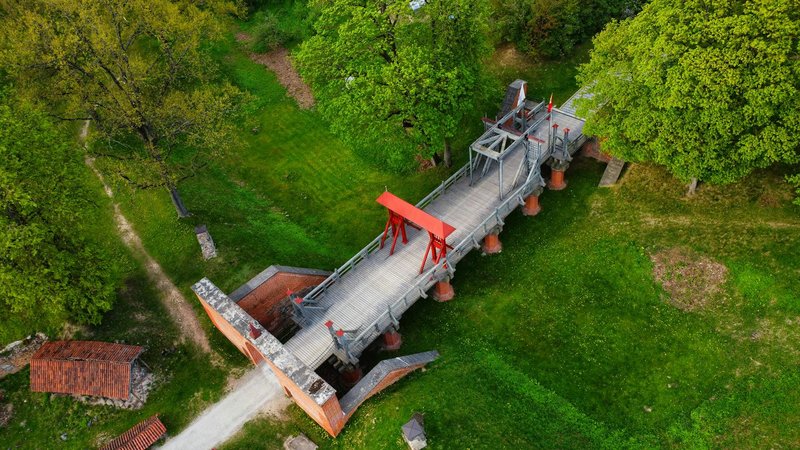
Aukštojas Hill is the official highest point at 293.84 meters, sitting in the Medininkai Highlands in the southeast near the Belarus border. For years the title was disputed with nearby Juozapinė Hill until precise surveying settled it. Calling it a mountain is generous — it’s a forested rise you could walk up without breaking much of a sweat.
What Lithuania has in spades instead:
- Glacial hills and ridges across the Baltic Highlands, sculpted entirely by Ice Age glaciers.
- Hillforts (piliakalniai) — hundreds of ancient earthwork mounds, many built up by hand over flat-topped glacial hills, where medieval Lithuanians once defended themselves. The famous Hill of Crosses sits on one such mound.
- Thousands of lakes, gouged out by the same glaciers, concentrated in the eastern highlands.
- The geographic center of Europe, which — by one widely cited calculation from France’s national geographic institute — lies just north of Vilnius, marked by a monument.
It’s a landscape shaped by ice, not fire. The drama here is slow and old, written in glacial debris and two-billion-year-old basement rock rather than lava and ash.
Lithuania terrain at a glance
| Feature | Detail |
|---|---|
| Active volcanoes | 0 |
| Dormant or extinct surface volcanoes | 0 |
| Highest point | Aukštojas Hill, 293.84 m |
| Tectonic setting | Interior of the stable East European Craton |
| Nearest plate boundary | Thousands of km away |
| Significant earthquake risk | Negligible |
| Oldest volcanic rock | Palaeoproterozoic basement, ~1.8–2 billion years old, buried |
| Dominant land-shaping force | Ice Age glaciation |
FAQ
Are there any volcanoes in Lithuania? No. Lithuania has no active, dormant, or extinct volcanoes at the surface. It sits in the stable interior of the East European Craton, far from any plate boundary or hotspot.
Has Lithuania ever had volcanoes? Only in the deep geological past. The crystalline basement rock beneath Lithuania includes volcanic rock formed about 1.8 to 2 billion years ago, during the era when the continental crust was being assembled. Those volcanoes disappeared long before complex life existed and left nothing at the surface.
What is the highest point in Lithuania? Aukštojas Hill, at 293.84 meters, in the Medininkai Highlands near the Belarus border. It’s a glacial hill, not a mountain or volcano.
Are there earthquakes in Lithuania? Very rarely, and almost never anything damaging. The 2004 Kaliningrad-region tremor was felt in Lithuania, but the country’s location on stable craton crust means significant earthquakes are essentially absent.
Does Lithuania have mountains? Not really. Its tallest point doesn’t reach 300 meters. Lithuania’s terrain is flat to gently rolling, with its highest ground formed by Ice Age glacial deposits rather than tectonic uplift.
Why is Lithuania so flat? Two reasons stacked together: it sits on ancient, stable crust that hasn’t been pushed up by tectonic forces for billions of years, and Ice Age glaciers later scraped and smoothed the land, leaving behind low hills, lakes, and ridges.